-
-
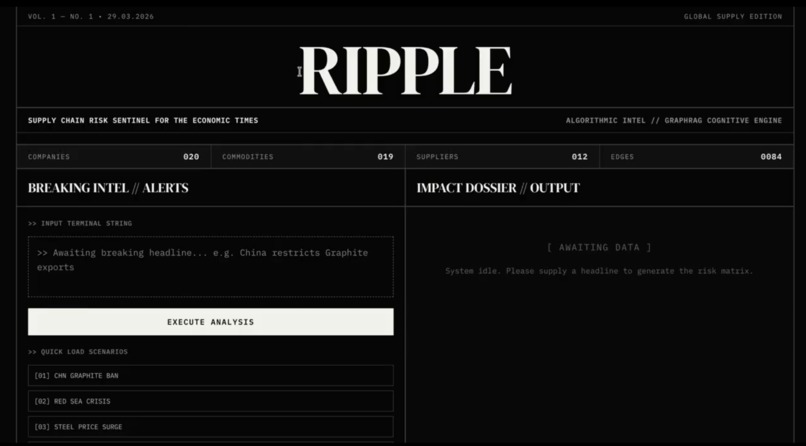
Idle screen
-
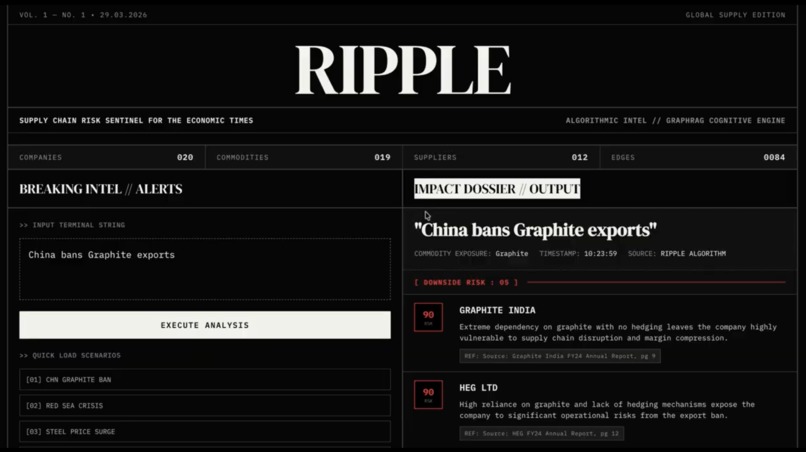
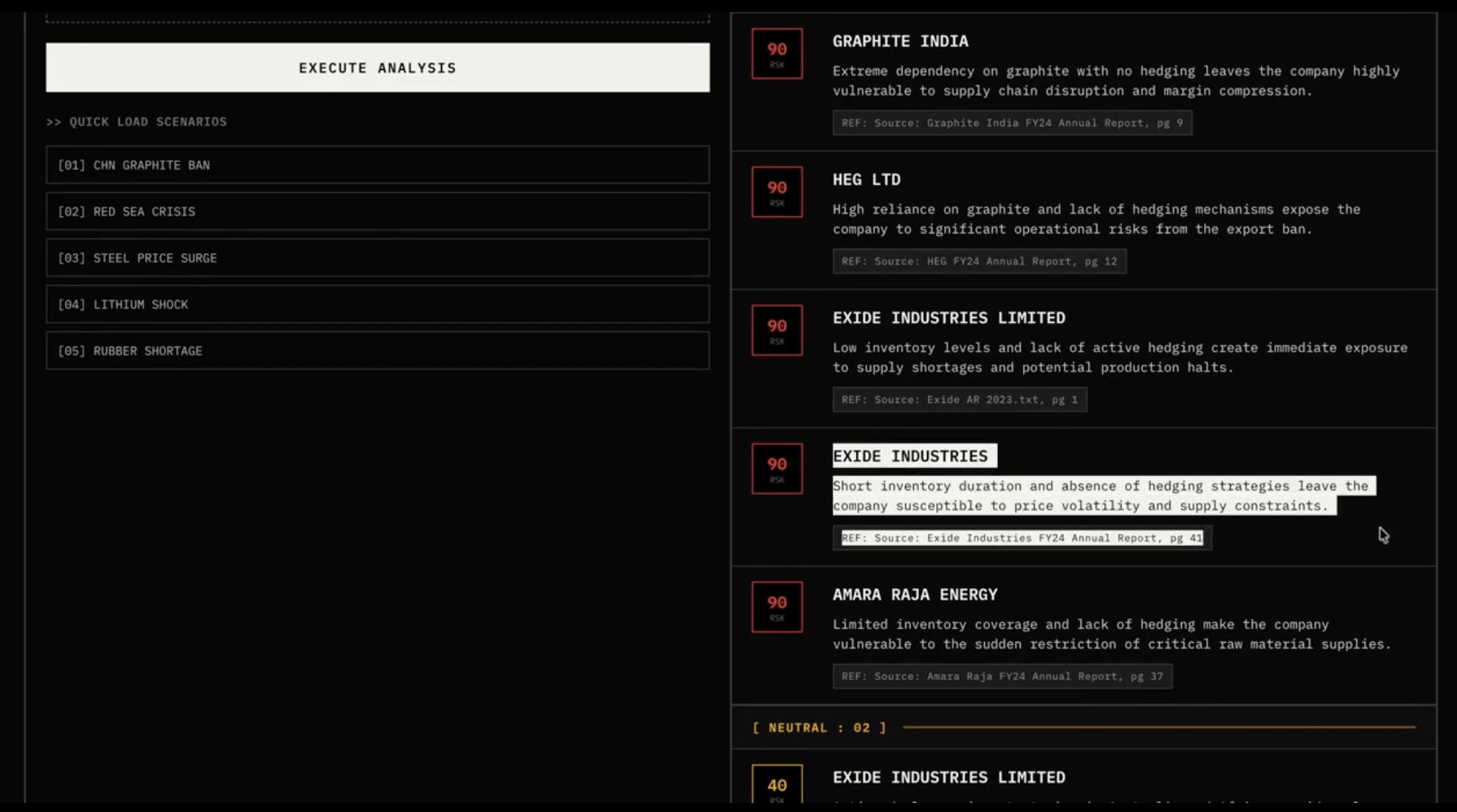
Results
-
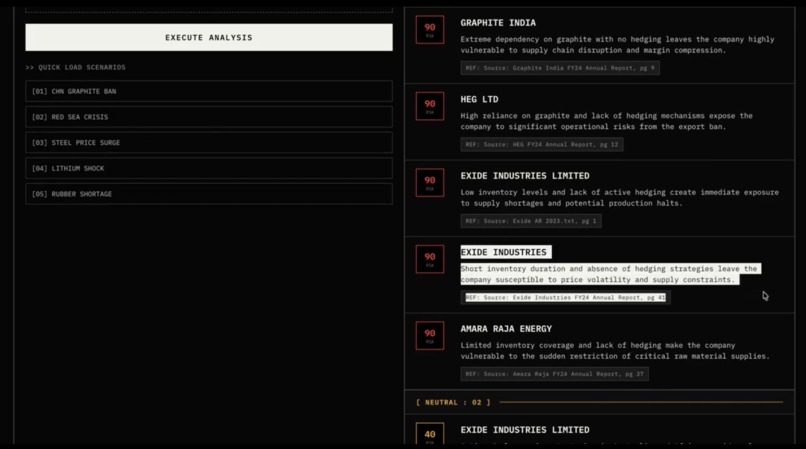
Results
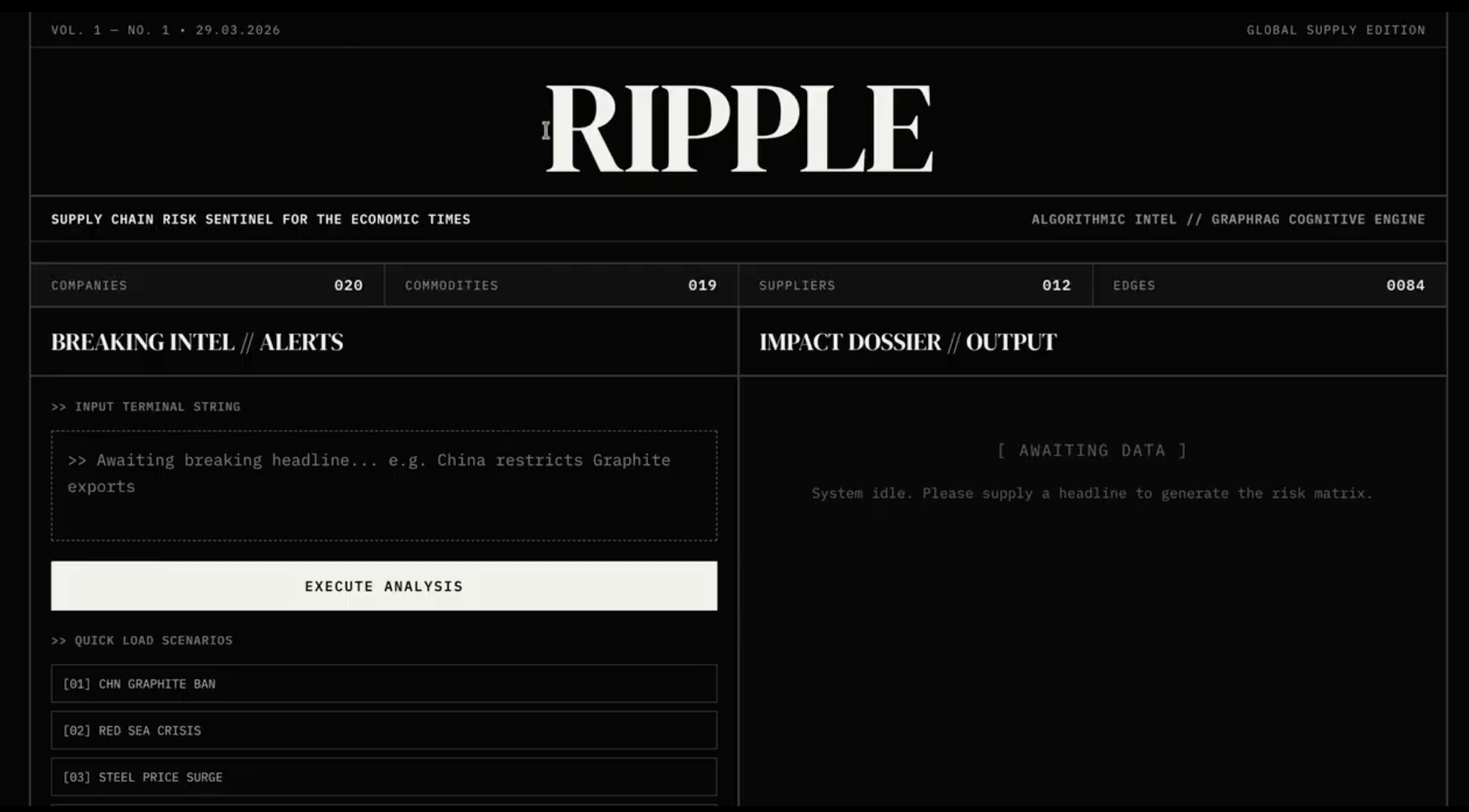
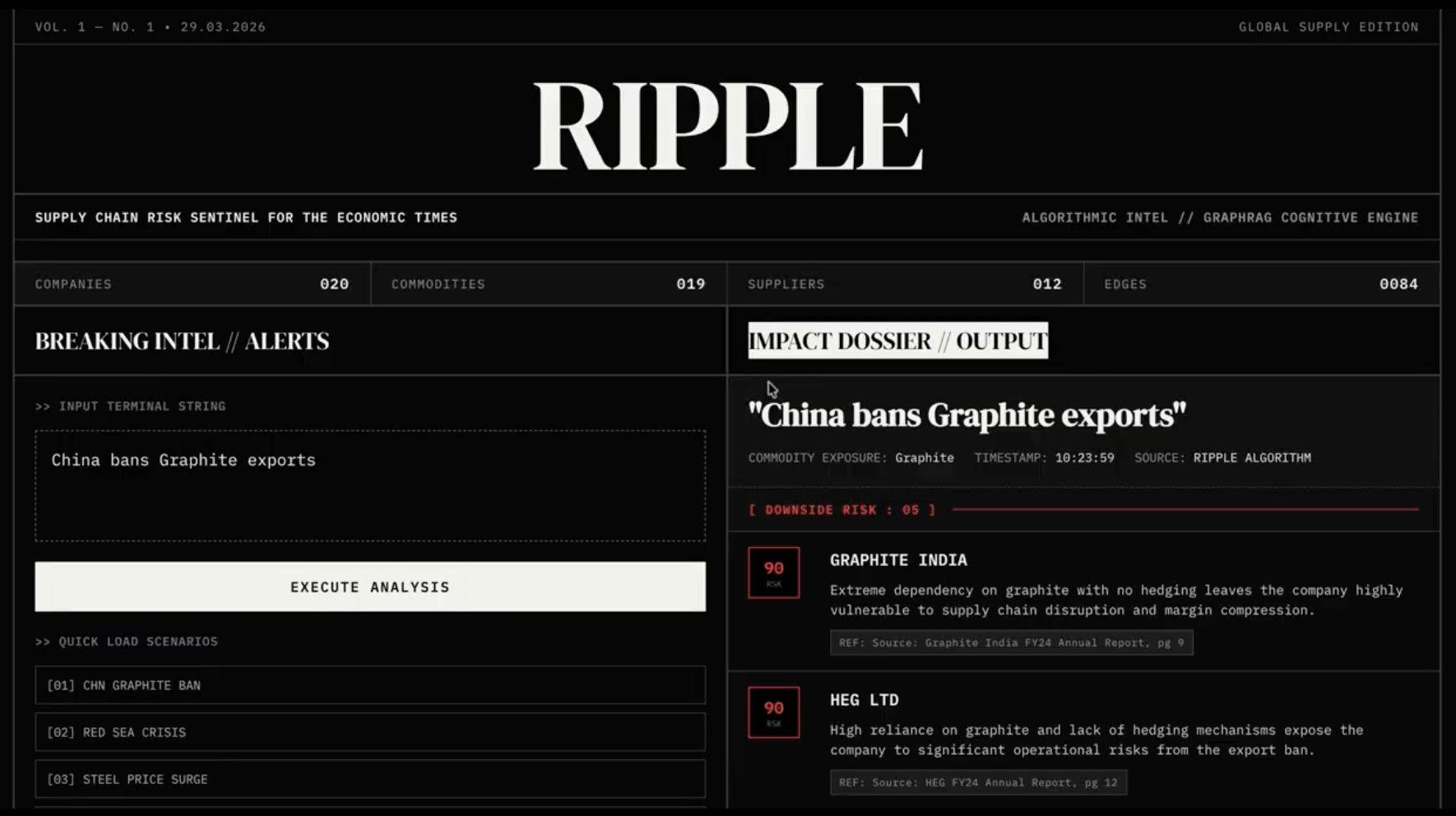
RIPPLE — Supply Chain Risk Sentinel
When geopolitics breaks supply chains, markets move before humans can think.
Ripple exists to close that gap.
The World Runs on Invisible Dependencies
A graphite export ban in China.
A lithium restriction in Chile.
A shipping disruption in the Red Sea.
Within minutes, billions of dollars in market value can shift.
But here’s the real problem:
Nobody truly knows which companies are actually exposed.
Financial analysts still rely on fragmented annual reports, spreadsheets, and hours of manual research to piece together supply chain dependencies after a global shock has already happened.
And modern AI systems are not solving this.
Traditional RAG pipelines retrieve text.
They do not understand resilience.
If a company mentions “graphite,” most AI systems flag it as vulnerable even if that company already secured:
- six months of strategic inventory,
- dual-sourcing agreements,
- or forward-priced contracts before the crisis began.
The result?
False alarms.
Noise.
Missed opportunities.
Slow decisions in a world moving at machine speed.
We believed there had to be a better way.
So we built Ripple.
What is Ripple?
Ripple is an Autonomous Multi-Agent GraphRAG Intelligence Engine that transforms breaking geopolitical events into real-time corporate risk intelligence.
In under five seconds, Ripple can determine:
- which companies are exposed,
- which firms are protected,
- and which organizations could actually benefit from the disruption.
Not through keyword matching.
Through reasoning across a live knowledge graph of:
- commodities,
- suppliers,
- hedging contracts,
- inventory buffers,
- and industrial dependencies.
Ripple does not retrieve documents.
It traverses economic reality.
The Core Insight
The most dangerous flaw in modern AI retrieval systems is that they cannot distinguish between:
“A company depends on graphite”
and
“A company depends on graphite but already hedged the risk six months ago.”
That distinction changes everything.
Ripple introduces a mitigation-aware reasoning system we call the:
Exposure Dampening Engine™
Before any company is flagged as “at risk,” Ripple evaluates three critical dampening vectors:
| Dampening Vector | What Ripple Checks |
|---|---|
| Dependency Ratio | How much of company cost structure depends on the affected commodity |
| Inventory Buffer | How many months of raw material inventory already exist |
| Hedging Policy | Whether the company has forward contracts, dual sourcing, or vertical integration |
This allows Ripple to separate:
- true downside exposure,
- partially protected firms,
- and upside beneficiaries.
In other words:
Ripple filters panic from reality.
How Ripple Works
Step 1 — A Breaking Event Happens
Example:
“China bans graphite exports.”
The user inputs the headline directly into Ripple.
Step 2 — Director Agent Interprets the Shock
Our Director Agent uses Google Gemini 2.5 Flash to transform raw news into structured geopolitical intelligence.
It extracts:
- affected commodity,
- region,
- disruption severity,
- event classification,
- downstream industrial dependencies.
This converts unstructured news into machine-actionable context.
Step 3 — Graph Explorer Traverses Economic Dependencies
Ripple then activates the Graph Explorer Agent.
Using dynamic Cypher traversal inside Neo4j, the system identifies:
- exposed companies,
- supplier relationships,
- dependency concentrations,
- inventory positions,
- and hedging structures.
This is where Ripple moves beyond ordinary AI.
Instead of semantic similarity search, Ripple performs topological reasoning across industrial relationships.
Step 4 — Risk Analyst Generates Intelligence
The final Risk Analyst Agent synthesizes the full graph context into a structured intelligence dossier.
Every company is classified as:
- Downside Risk
- Neutral / Dampened
- Upside Potential
Alongside:
- analytical reasoning,
- dependency metrics,
- mitigation analysis,
- and source citations.
All generated in real time.
Why This Matters
The global economy is entering an era defined by:
- geopolitical fragmentation,
- export restrictions,
- resource nationalism,
- and supply chain instability.
The organizations that survive this decade will not simply be the largest.
They will be the ones that understand hidden dependencies fastest.
Ripple was designed for exactly that future.
The Technology
Ripple is powered by a fully autonomous GraphRAG architecture.
Multi-Agent Cognitive Swarm
BREAKING NEWS
      │
      ▼
DIRECTOR AGENT
(Event Extraction)
      │
      ▼
GRAPH EXPLORER AGENT
(Neo4j Traversal)
      │
      ▼
RISK ANALYST AGENT
(Exposure Classification)
      │
      ▼
STRUCTURED INTELLIGENCE DOSSIER
Knowledge Graph Architecture
Ripple maintains a live industrial knowledge graph containing:
- companies,
- suppliers,
- commodities,
- hedging structures,
- and sourcing dependencies.
(:Company)
    ├── DEPENDS_ON ──> (:Commodity)
    ├── HEDGED_AGAINST ──> (:Commodity)
    └── SOURCED_FROM ──> (:Supplier)

(:Supplier)
    └── SUPPLIES ──> (:Commodity)
Every relationship includes provenance metadata and page-level citations extracted directly from annual reports.
No black-box hallucinations.
Every insight is traceable.
Data Ingestion Pipeline
Ripple includes a complete AI-powered ingestion pipeline for financial disclosures.
Annual Reports (PDF/TXT)
        │
        ▼
PDF Parsing Layer
        │
        ▼
LLM Structured Extraction
        │
        ▼
Graph Construction Engine
        │
        ▼
Neo4j Knowledge Graph
The extraction engine identifies:
- supplier names,
- commodity dependencies,
- inventory levels,
- hedging policies,
- sourcing regions,
- and dependency percentages.
This transforms static financial documents into living economic infrastructure.
Real-World Scenario Validation
Ripple was evaluated against curated macroeconomic shock scenarios including:
| Scenario | Result |
|---|---|
| China Graphite Export Ban | Identified exposed battery manufacturers and dampened inventory-buffered firms |
| Global Steel Price Surge | Distinguished unhedged auto manufacturers from dual-sourced firms |
| Red Sea Shipping Crisis | Detected downstream logistics exposure in industrial supply chains |
| Chile Lithium Restrictions | Classified battery ecosystem dependency risk |
| Southeast Asian Rubber Floods | Mapped tire and automotive supply vulnerabilities |
Ripple consistently reduced false-positive exposure classifications compared to naive dependency matching.
Design Philosophy: Swiss Editorial Noir
Most AI dashboards look interchangeable.
Ripple was intentionally designed to feel different.
Inspired by:
- Bloomberg terminals,
- financial newspapers,
- and brutalist editorial systems,
we built a design language called:
Swiss Editorial Noir
Features include:
- high-contrast dark interfaces,
- monospaced intelligence typography,
- exposed mechanical layouts,
- and zero decorative clutter.
Every pixel exists to communicate signal.
Challenges We Faced
Building Ripple required solving problems across:
- AI orchestration,
- graph database design,
- financial extraction,
- retrieval reliability,
- and mitigation-aware reasoning.
The hardest challenge was eliminating false positives.
A company mentioning a commodity is not enough.
We had to build systems capable of understanding:
- resilience,
- protection,
- hedging,
- and supply chain redundancy.
That challenge ultimately became Ripple’s biggest innovation.
What We Learned
Ripple taught us that the future of AI is not:
- bigger chatbots,
- prettier interfaces,
- or generic retrieval systems.
The future belongs to:
- structured reasoning,
- autonomous agents,
- and knowledge-aware intelligence systems.
GraphRAG is not just a retrieval upgrade.
It is a fundamentally different way of modeling reality.
Built With
- Python
- FastAPI
- Neo4j
- Cypher Query Language
- Google Gemini 2.5 Flash
- pdfplumber
- Pydantic
- HTML
- CSS
- JavaScript
- Multi-Agent Systems
- GraphRAG Architecture
- Knowledge Graph Engineering
The Vision
Ripple is more than a hackathon project.
It is a prototype for the next generation of economic intelligence systems.
A future where AI does not simply summarize information
but understands the structure of the world itself.


Log in or sign up for Devpost to join the conversation.