Project Description
Problem Statement
When disaster strikes, the people who most need help are the least able to ask for it. They are on damaged 2G networks, low-end phones, and speaking languages that crisis platforms were never built for. Most disaster-response software optimizes for the responder sitting at a desk with fast internet, and treats the person actually in the crisis zone as an afterthought. The result: requests for help either never get submitted, or they arrive as an unstructured flood that responders cannot triage.
Ripple flips that priority. We built the entire system around the hardest user first: a person on a dying phone, on a slow network, who may not speak English, at the worst moment of their life.
Solution Overview
Ripple is a two-sided crisis triage platform.
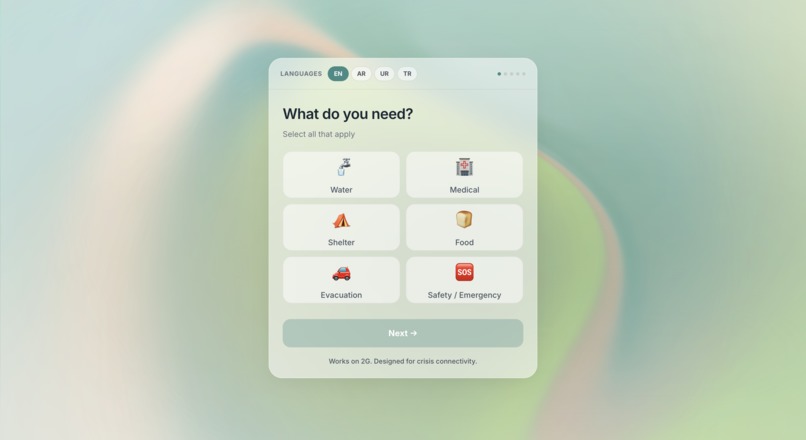
On the intake side, an affected person opens a mobile-first form that loads in under 30KB and can be completed and submitted in under 15 seconds. It is fully localized with right-to-left support across Arabic, Urdu, Turkish, and English, so someone can report their situation, location, and needs in their own language without fighting the interface.
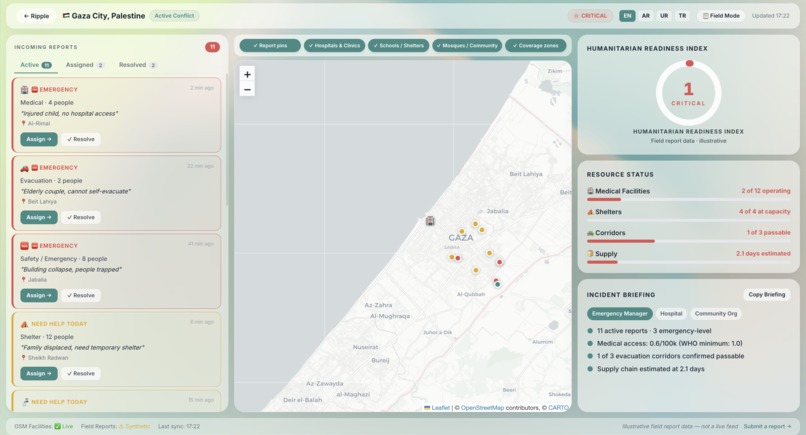
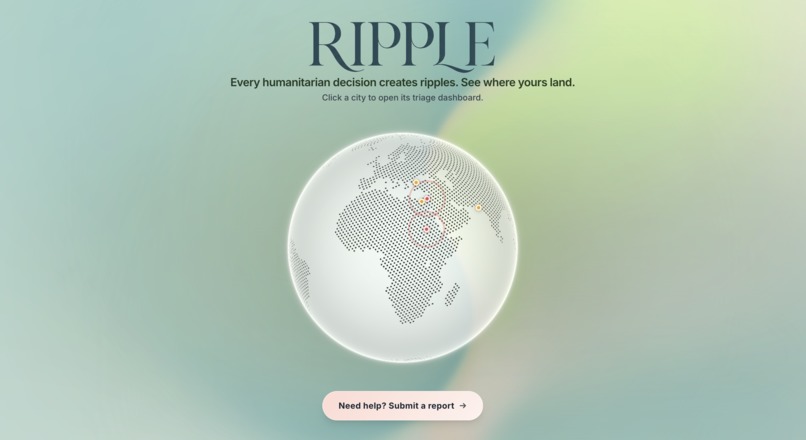
On the response side, those requests land in a responder dashboard built around a live map. Requests are plotted geographically, sorted into a color-coded priority queue, and rolled up into a computed Humanitarian Readiness Index that gives responders an at-a-glance read on conditions across five monitored crisis cities. Instead of a raw feed, responders see a triaged, spatial picture of who needs what, where, and how urgently.
The originality is in the constraints, not the category. Crisis tools exist, but almost none are engineered from the affected person's side of the network. A sub-30KB payload budget, RTL-first internationalization, and a 15-second submission ceiling are product decisions that most teams never make because they never imagine the user on the other end of a 2G connection.
Key Features
- Ultra-lightweight intake form: under 30KB page weight, sub-15-second submission, built for degraded 2G networks in active crisis zones
- Full multilingual support with RTL layouts via i18next, covering Arabic, Urdu, Turkish, and English
- Live responder map built on Leaflet.js, pulling real coordinates from the OpenStreetMap Overpass API
- Color-coded priority queue that triages incoming requests by urgency
- Humanitarian Readiness Index, a computed metric summarizing crisis conditions across five monitored cities
- Glassmorphic responder dashboard designed for fast scanning under pressure
Technologies Used
- React 18 and TypeScript for both the intake form and the responder dashboard
- i18next for internationalization and RTL language support
- Leaflet.js for interactive mapping
- OpenStreetMap Overpass API for live geographic data
- [Add: backend/data layer, hosting, and styling framework if applicable]
Target Users
Two groups on opposite ends of the same emergency. First, people inside crisis zones: displaced families, injured civilians, and communities cut off by disaster who need a way to ask for help that works on the phone and network they actually have. Second, responders and humanitarian organizations, who need incoming requests triaged and mapped rather than buried in noise. Ripple shortens the distance between "I need help" and "help is on the way," especially for the people mainstream tools quietly exclude: non-English speakers on slow networks.

Log in or sign up for Devpost to join the conversation.