-
-
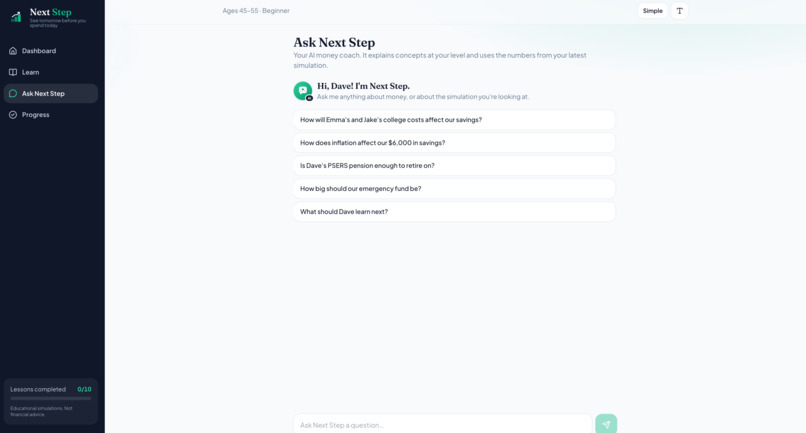
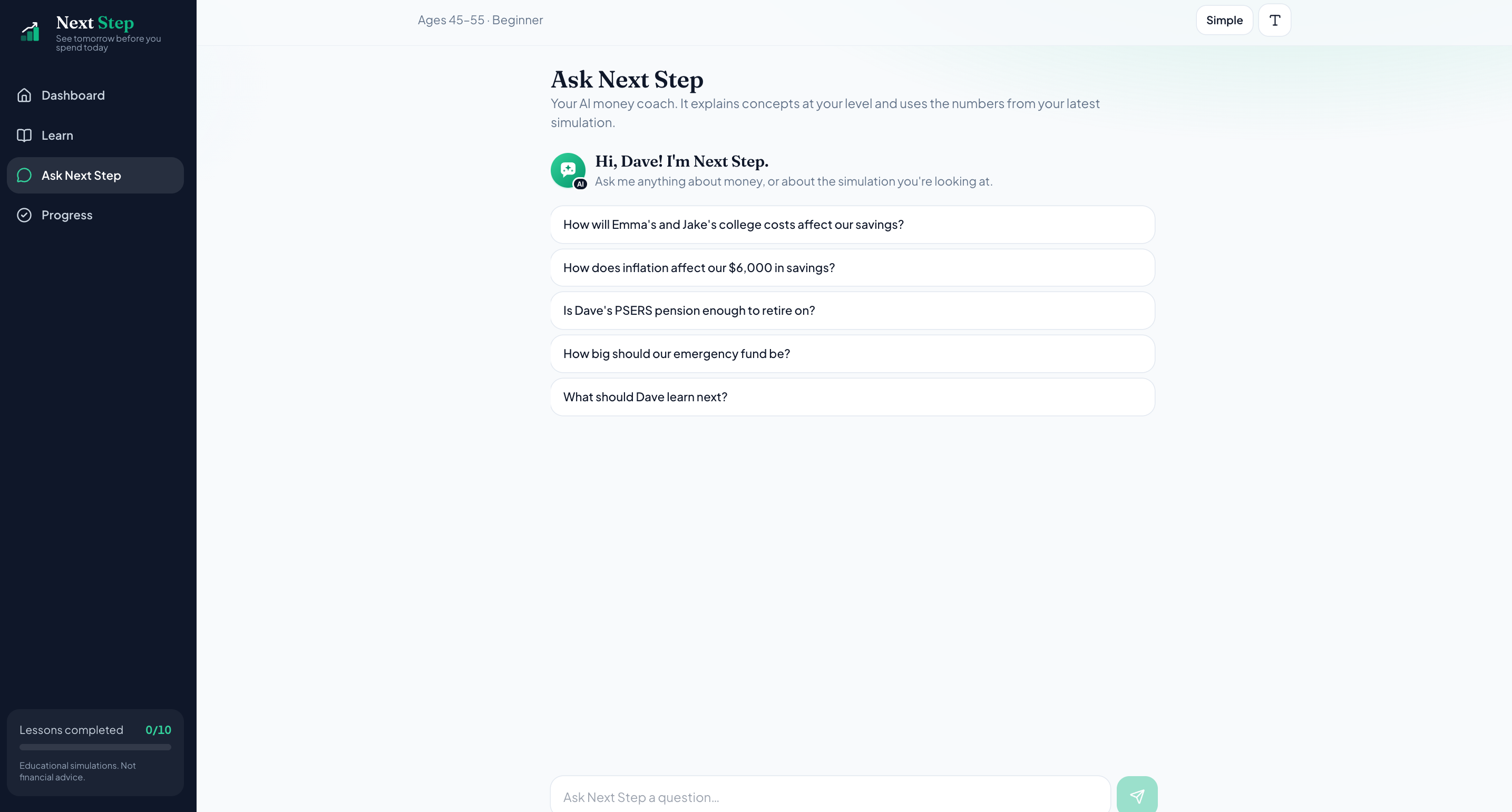
Ask Next Step, an AI coach that explains the app’s calculated numbers in plain English and never invents its own.
-
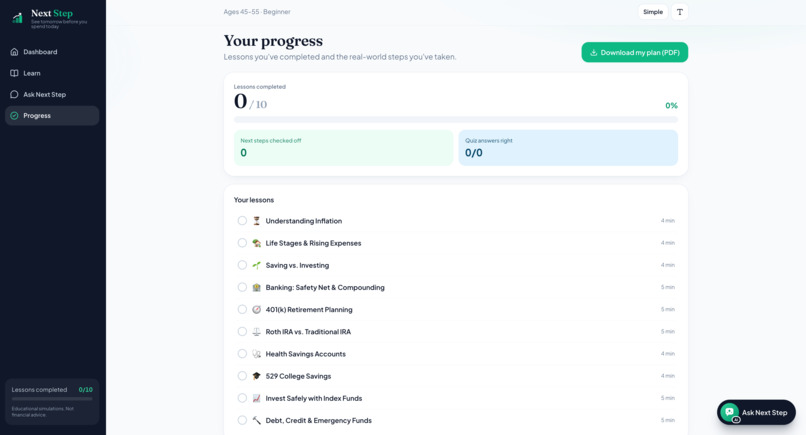
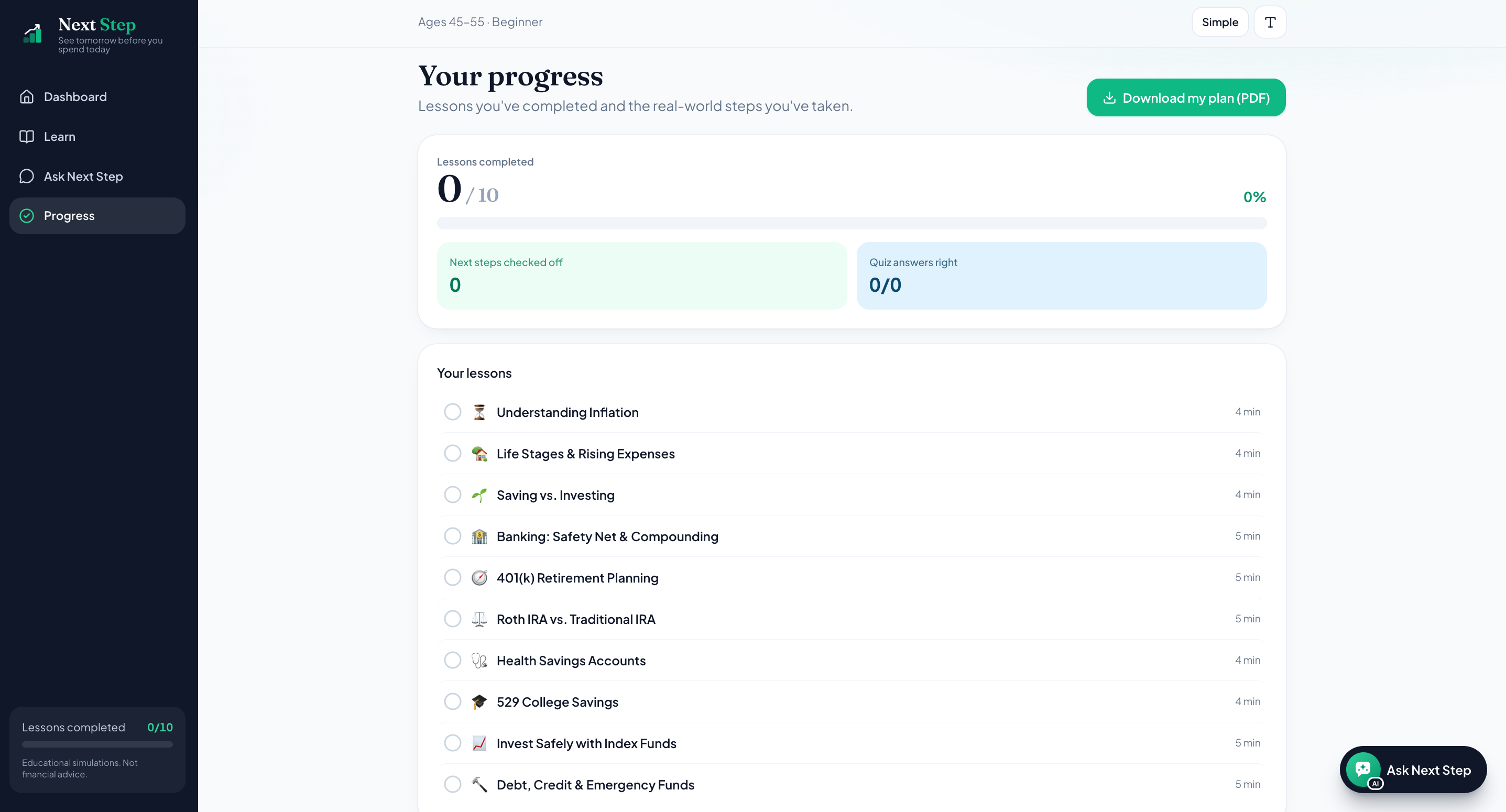
Track lessons completed, real-world steps checked off and quiz answers, then download the whole plan as a PDF.
-
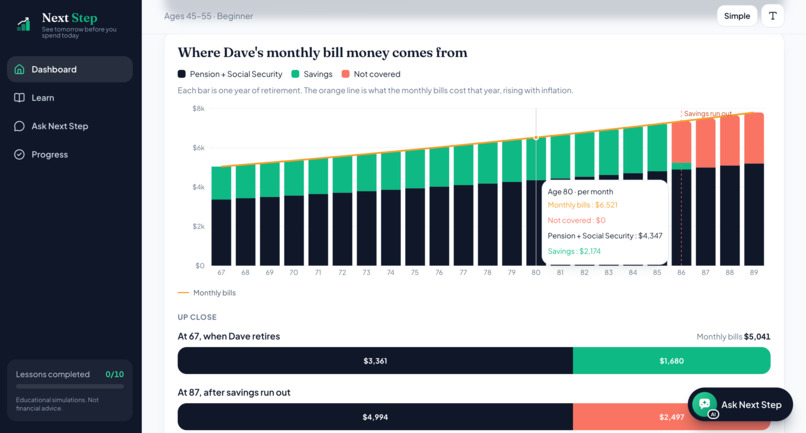
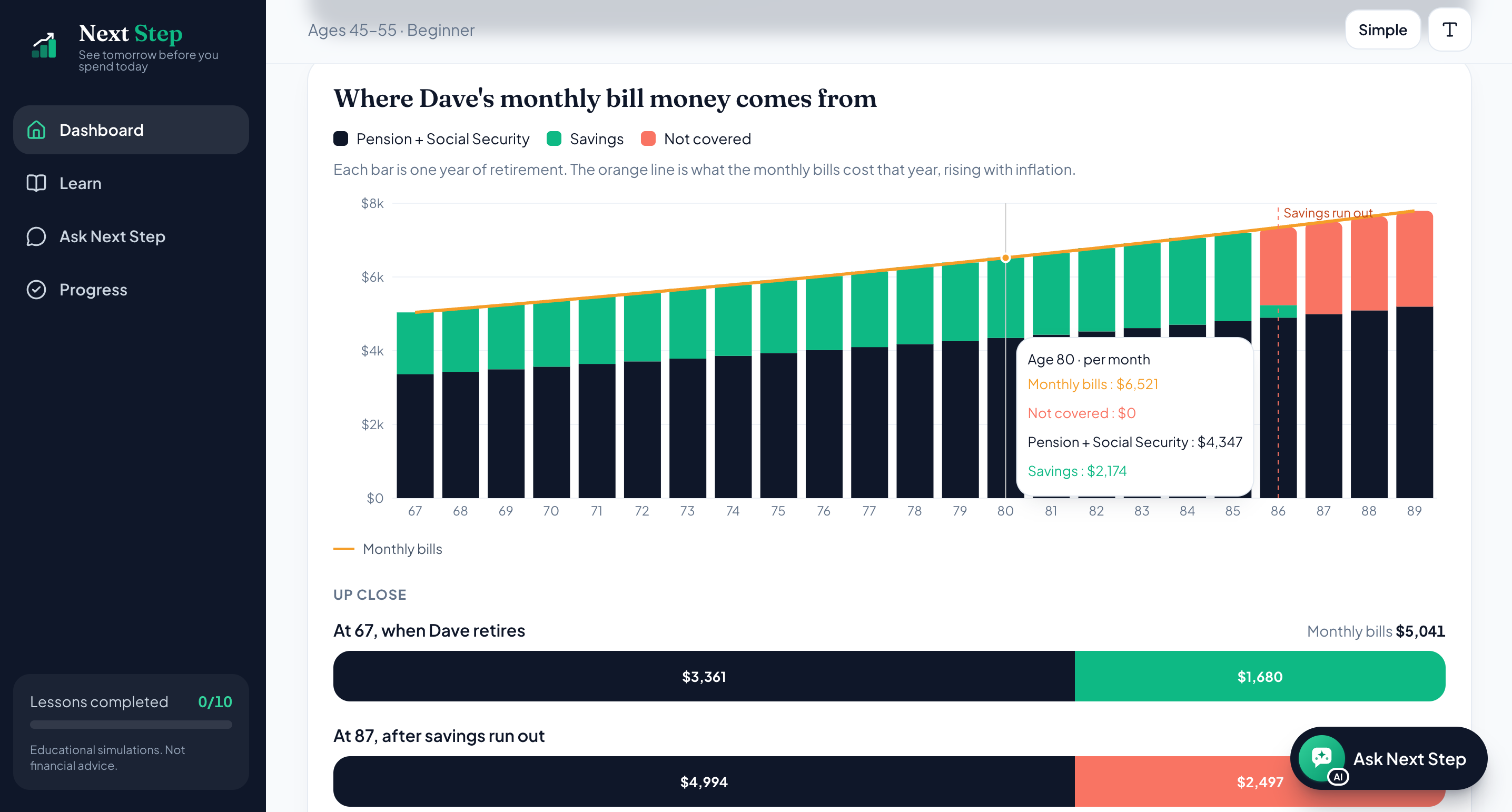
Every year of retirement, one bar: pension plus Social Security, savings, and what’s not covered. Hover any year for exact numbers.
-
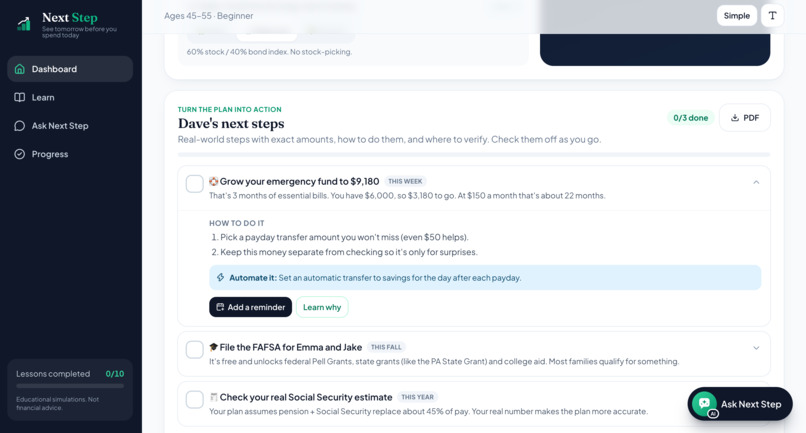
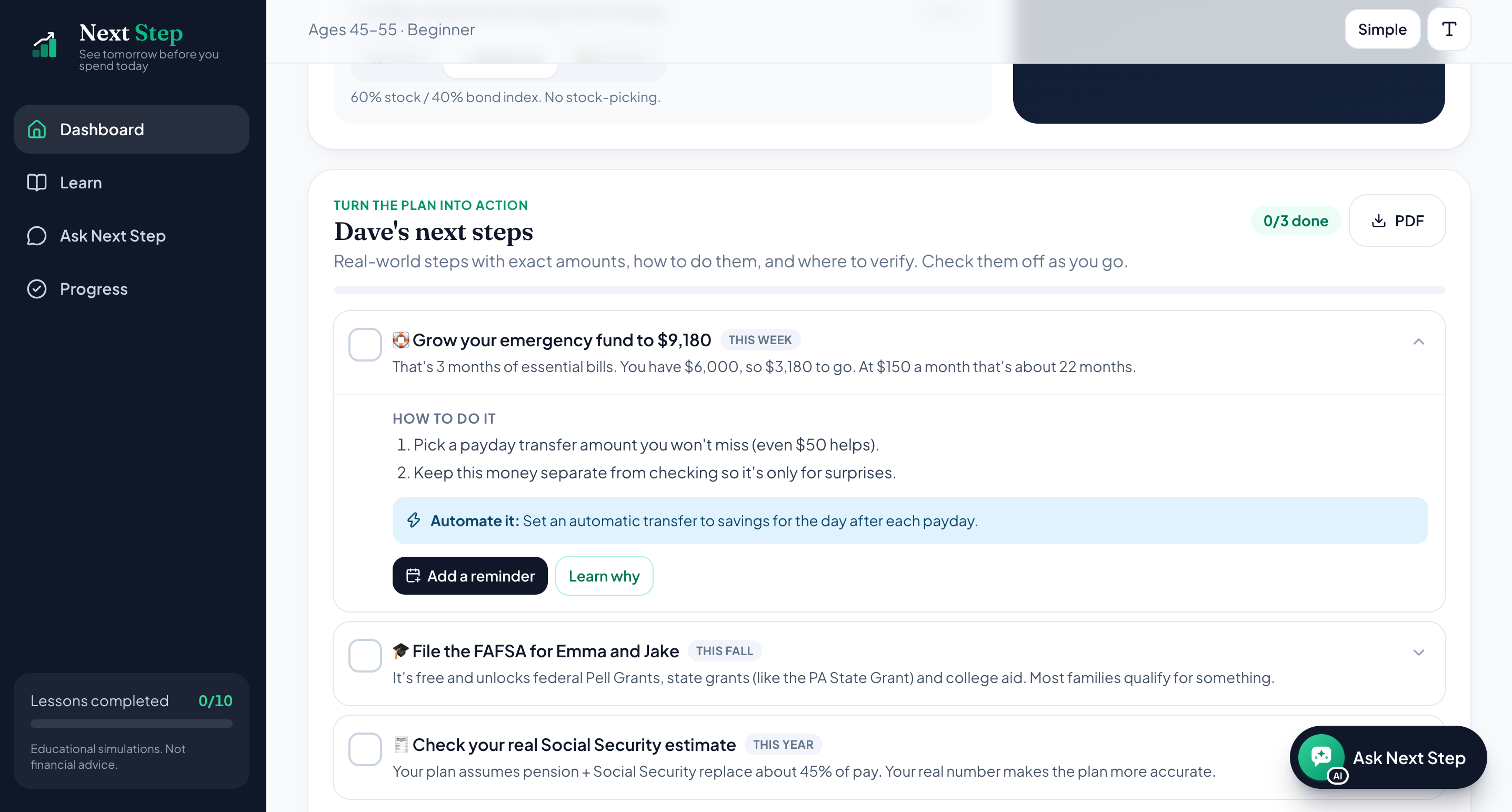
Plans become action: exact amounts, how-to steps, automate-it tips, calendar reminders and a PDF. FAFSA for Emma and Jake included.
-
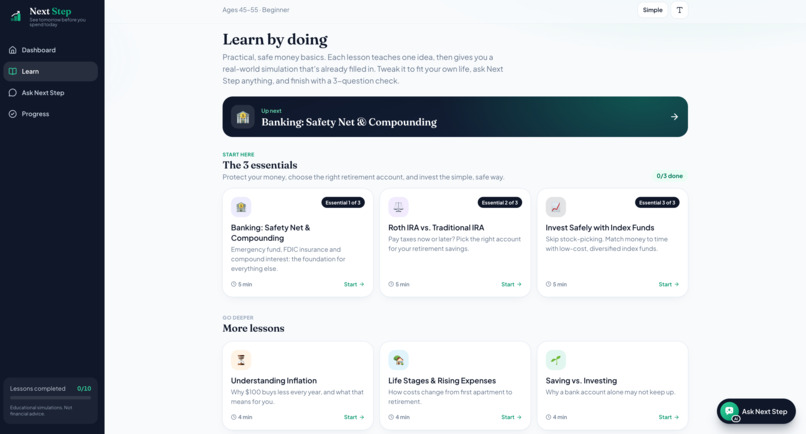
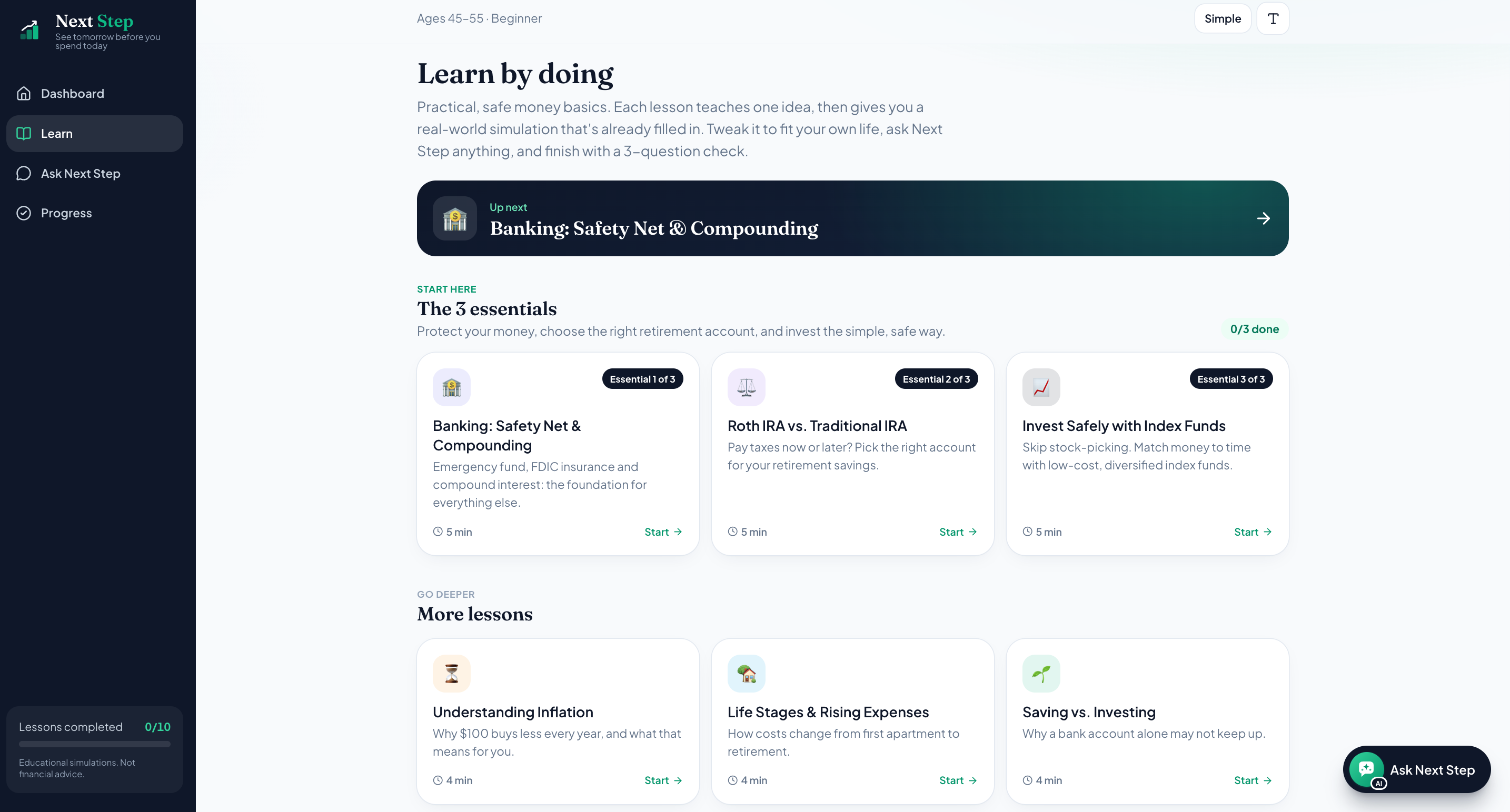
Learn by doing: short lessons starting with 3 essentials, each with a real-world simulation already filled in with your numbers.
-
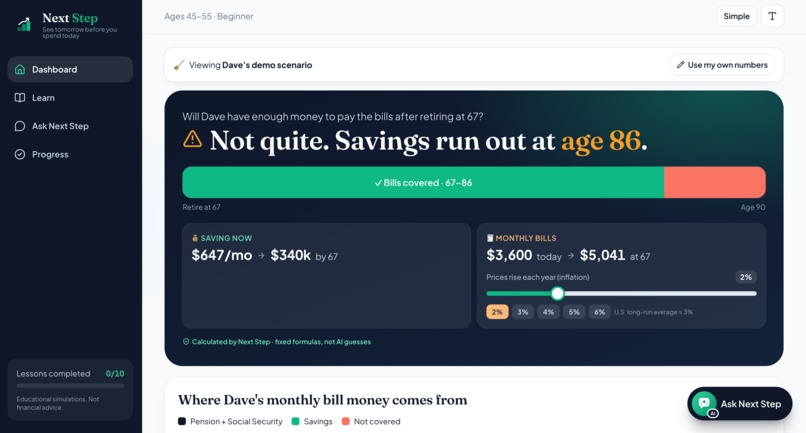
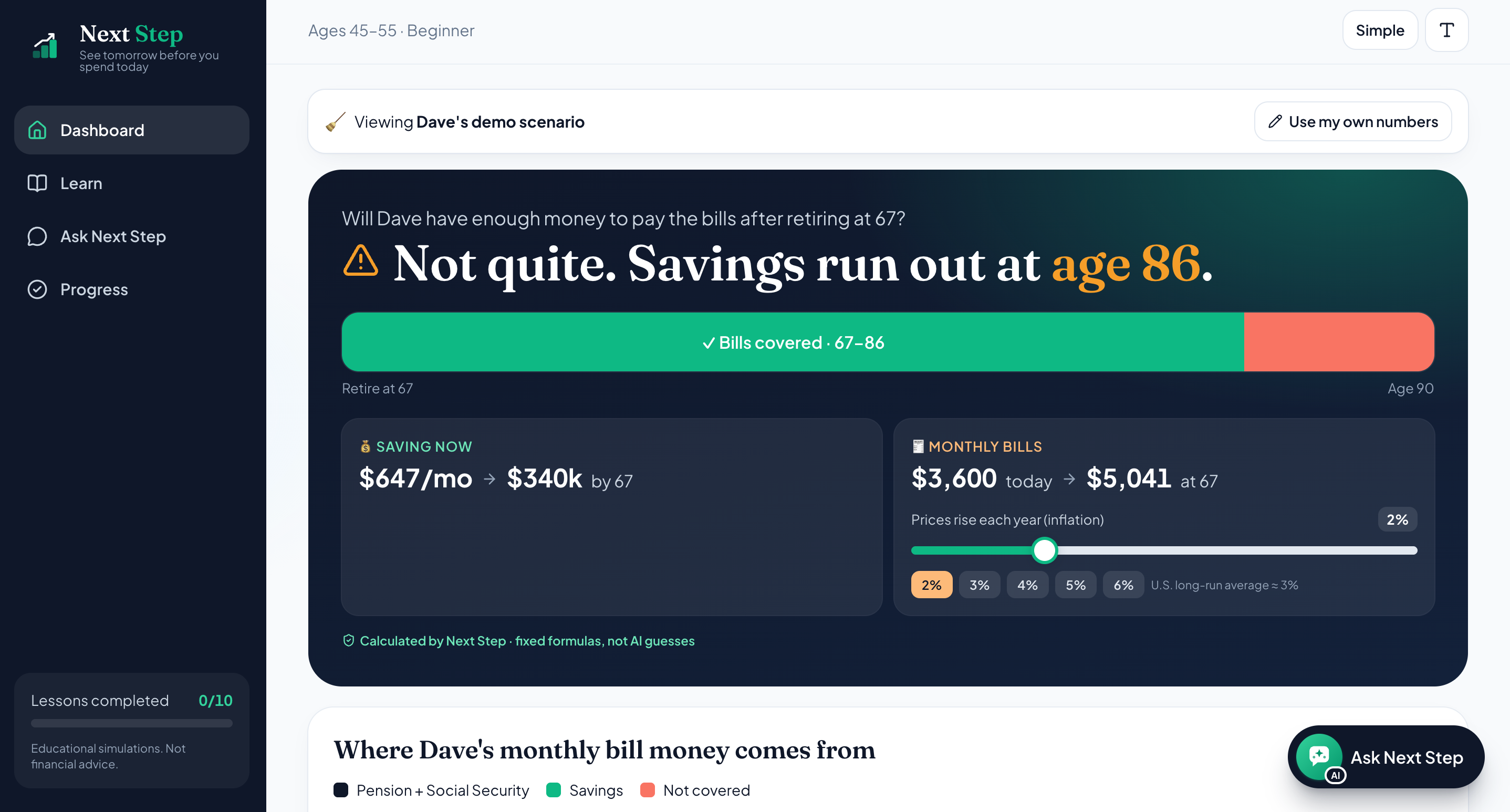
One honest answer: will Dave’s savings pay the bills after 67? Slide inflation and watch the age his money runs out move.
-
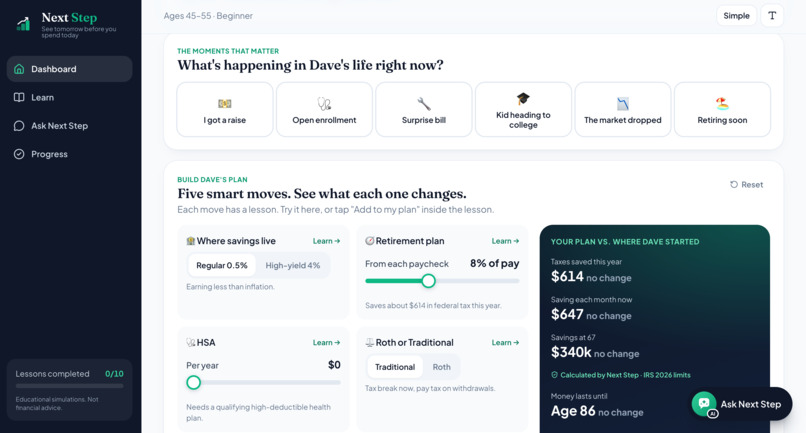
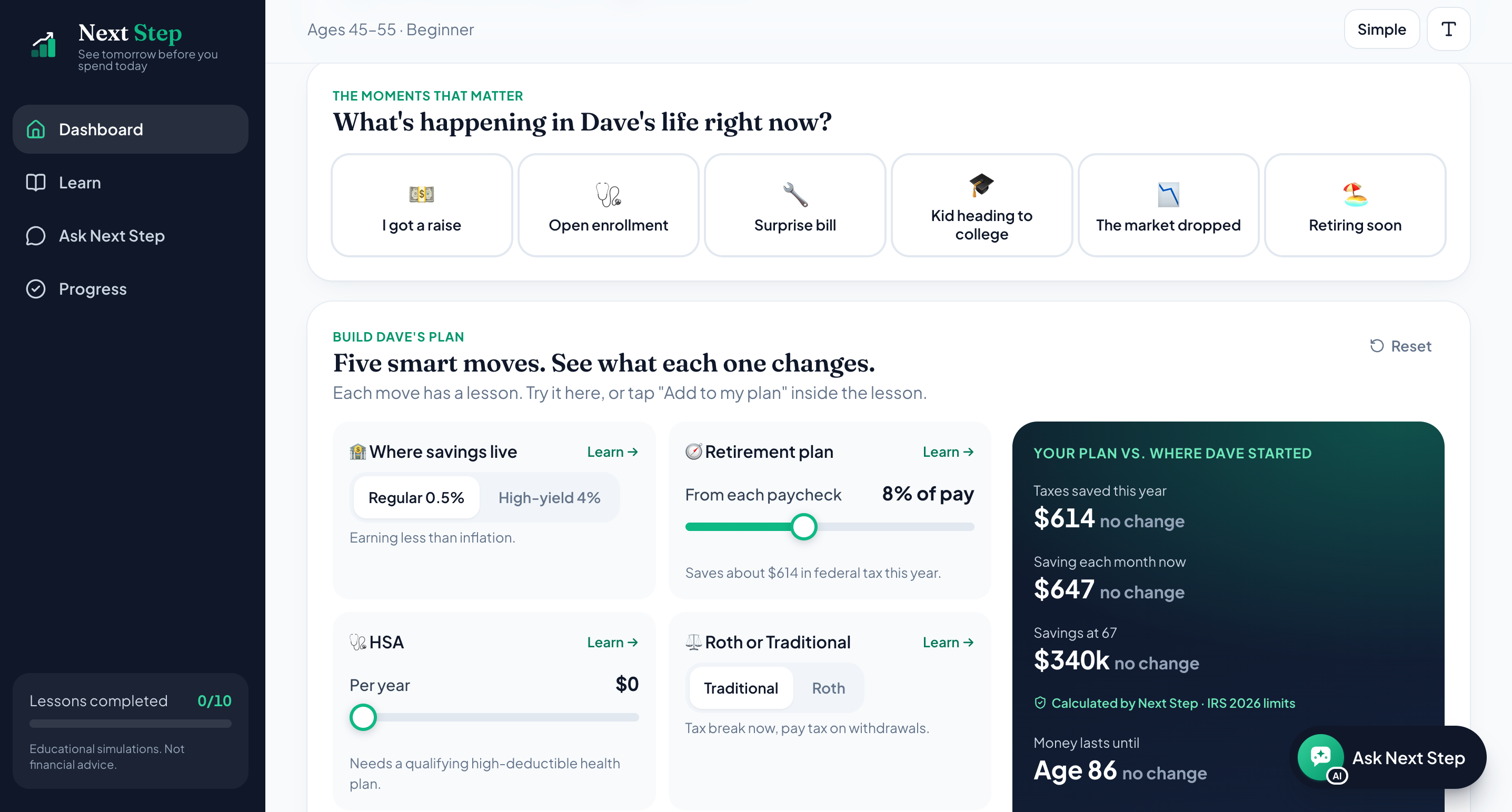
Life moments meet you when real decisions happen. Five smart moves show how taxes saved, savings and how long money lasts change.
Inspiration
I'm Josh Dcosta, a student at Drexel University from Warrington, Pennsylvania, and Next Step started with conversations at home.
Whenever contractors, plumbers and other tradespeople come to work on our house, my dad and I have a habit of getting to know them. We ask about their families, their work and what's ahead. Over many of those conversations, one theme kept coming up. These are skilled, hardworking people who earn an honest living, but almost no one has ever taught them how to plan with their money. Retirement, college for their kids, a surprise bill: the future feels unpredictable, and they feel unprepared for it.
It was heartbreaking to realize how much stress and heartache could be avoided with a little clear, trustworthy guidance. Financial literacy is deeply underserved in blue-collar jobs and in underprivileged communities, and the people there deserve that guidance just as much as anyone.
So I built Next Step for them, and I gave it a face: Dave. Dave is 50 and a head custodian at a Pennsylvania public high school, earning about $22 an hour. With his wife Linda's part-time cafeteria job, the family brings in $64,000 a year. They have $6,000 saved, about $22,000 in retirement savings, and two teenagers, Emma (17) and Jake (15), who start college in the next three years.
Dave works hard, but nobody has ever shown him the one thing that really matters:
If I keep going the way I am, will I have enough money to pay my bills after I retire?
For Dave, the honest answer is not quite. That question became Next Step, and its tagline: see tomorrow before you spend today. My goal was to turn information into understanding, understanding into confidence, and confidence into action.
What it does
Next Step is a simple, warm and judgment-free web app that anyone, even someone with no financial background, can use on a phone or computer.
- Two ways in. Every visit starts with a choice: explore Dave's demo scenario to see how it works, or use your own numbers (income, monthly bills, savings and children). Your numbers stay on your own device. No bank logins, no account numbers.
- One honest answer. The home screen answers one question: "Will I have enough money to pay the bills after retiring?" For Dave: not quite, his savings run out at 73. A simple chart shows how each year of retirement gets paid: pension and Social Security, then savings, then the part nothing covers.
- Inflation you can control. Dave's $3,600 in monthly bills grows to about $7,012 by age 67 at 4% inflation. At 3%, his money lasts until 79 instead of 73.
- The moments that matter. Tap I got a raise, Open enrollment, Surprise bill, Kid heading to college, The market dropped or Retiring soon to see exactly what changes (taxes saved, monthly saving, savings at retirement, how long the money lasts) plus what to do and what not to do. A $1,500-a-year HSA saves Dave about $295 in taxes this year and makes his money last a year longer.
- Build your plan. Five practical, low-risk moves, each taught by a lesson: an FDIC-insured high-yield savings account, retirement contributions, an HSA, Roth vs. Traditional, and a simple index-fund mix instead of stock picking.
- Learn by doing. Short lessons on emergency funds, FDIC insurance, compounding, Roth vs. Traditional, HSAs and index funds, each with a real-world simulation already filled in.
- Next steps you can actually do. A checklist with exact amounts, how-to steps, "automate it" tips, calendar reminders and links to verify with the IRS, FDIC or SSA, plus a downloadable PDF plan.
- Ask Next Step. An AI coach that explains everything in plain, kind English using only the numbers calculated on the page.
How I built it
Stack. A React + TypeScript web app built with Vite, styled with Tailwind CSS, with charts in Recharts, animation in Framer Motion and PDF export with jsPDF. A small Express server serves the app and a secure endpoint for the AI coach, deployed on Railway from GitHub. I used Claude as a coding partner during the weekend to move fast.
A trustworthy math engine. Every number comes from fixed, tested formulas, never from the AI. Future bills use compound inflation, where \(P\) is today's monthly bills, \(i\) the inflation rate and \(t\) the number of years:
$$ \text{Future bills} = P\,(1+i)^{t} \qquad \$3{,}600 \times (1.04)^{17} \approx \$7{,}012 $$
Savings grow month by month, where \(r\) is the yearly return and \(c\) the monthly contribution:
$$ B_{n} = B_{n-1}\left(1 + \frac{r}{12}\right) + c $$
In each retirement year, the app compares bills with pension and Social Security and draws the gap from savings. When savings reach zero, that is the age the money runs out. A pre-tax HSA contribution through payroll saves both income tax and the 7.65% payroll tax:
$$ \$1{,}500 \times (0.12 + 0.0765) \approx \$295 \text{ saved per year} $$
Sourced, dated rules. 2026 contribution limits and FDIC insurance limits live in one dated configuration file, with links to the IRS, FDIC and Social Security. A "How we calculate this" panel shows every assumption and source.
AI that explains, not invents. Ask Next Step uses the Anthropic Claude API. My server sends Claude the user's question plus the numbers the app already calculated, with instructions to explain them simply and kindly, never invent figures or tax rules, and suggest one concrete next step. The API key stays on the server, and a built-in explainer answers if the AI is unavailable.
Built on behavioral science. A relatable story (Dave) makes ideas stick. Loss framing ("savings run out at 73") motivates more than an abstract number. Just-in-time help meets people at real life moments. Small steps with deadlines, reminders and automation make action easy.
Challenges I ran into
- Simple beats impressive. My first version had a life-decision game, XP points, levels, badges and a separate simulations page. It was confusing and repetitive, so I cut it down to one question, one chart, one plan and one checklist. The people I built this for deserve clarity, not clutter.
- Making AI trustworthy. I didn't want an AI that confidently makes up numbers or tax rules. Separating the math (deterministic formulas) from the explanation (AI) took several iterations, plus a fallback for when the AI is offline.
- Showing the future honestly. "Future dollars vs. today's dollars" confused people, so I reframed everything around one question: are the bills covered each year?
- Realistic but simple assumptions. I researched real Pennsylvania custodian pay, state university costs and the school-employee pension, then made honest simplifications users can adjust.
- Buttons that changed nothing. One life-moment button applied a setting Dave already had, so nothing visibly happened. I redesigned every moment to show a clear before and after.
- Deployment. My first Railway build failed on a locked cache folder; I fixed it by letting Railway handle package installs.
Accomplishments that I'm proud of
- One clear, honest answer anyone can understand: "Savings run out at 73", and a slider that shows how 3% inflation changes it to 79.
- Life moments that show the exact impact of a decision in seconds, with clear do's and don'ts.
- An AI coach that never invents a number, backed by official sources anyone can verify.
- Real-world next steps with exact amounts, calendar reminders and verify links, not just advice.
- A ready-made example (Dave) plus a fully custom scenario for anyone, like Bob the plumber with three kids.
- It works on any phone, with large text and a simple mode, and needs no bank login.
What I learned
- People don't need more financial information. They need one clear answer and one clear next step, shared with respect.
- Small numbers compound into big ones: at 4% inflation, \(1.04^{17} \approx 1.95\), so Dave's bills nearly double before he retires.
- Trust comes from showing your work: the formulas, the assumptions and the sources.
- AI is most useful when it explains reliable results instead of generating them.
- Good design is mostly removing things.
What's next for NextStep
- Community partners: bring Next Step to the places people already gather and trust: credit unions, local workers' unions and local churches, where families can use the app together and plan their future.
- Personal outreach: I'll personally visit these credit unions, union halls and churches to share Next Step, walk people through it, and help them take their first steps.
- Multiple languages: so every family can plan their finances in the language they're most comfortable with.
- Real-moment nudges: reminders at open enrollment, on payday, when a raise starts, or before the FAFSA opens.
- A real pilot: start with tradespeople and school support staff like Dave, measure whether people actually take their next steps, and improve from what I learn.
Built With
- anthropic
- claude
- express.js
- framer-motion
- github
- jspdf
- node.js
- railway
- react
- recharts
- tailwindcss
- typescript
- vite

Log in or sign up for Devpost to join the conversation.