-
-
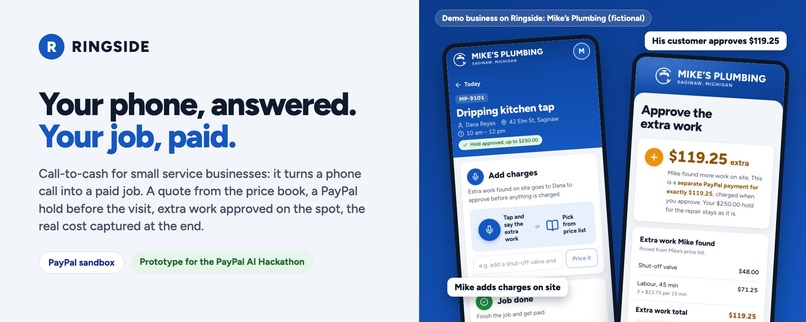
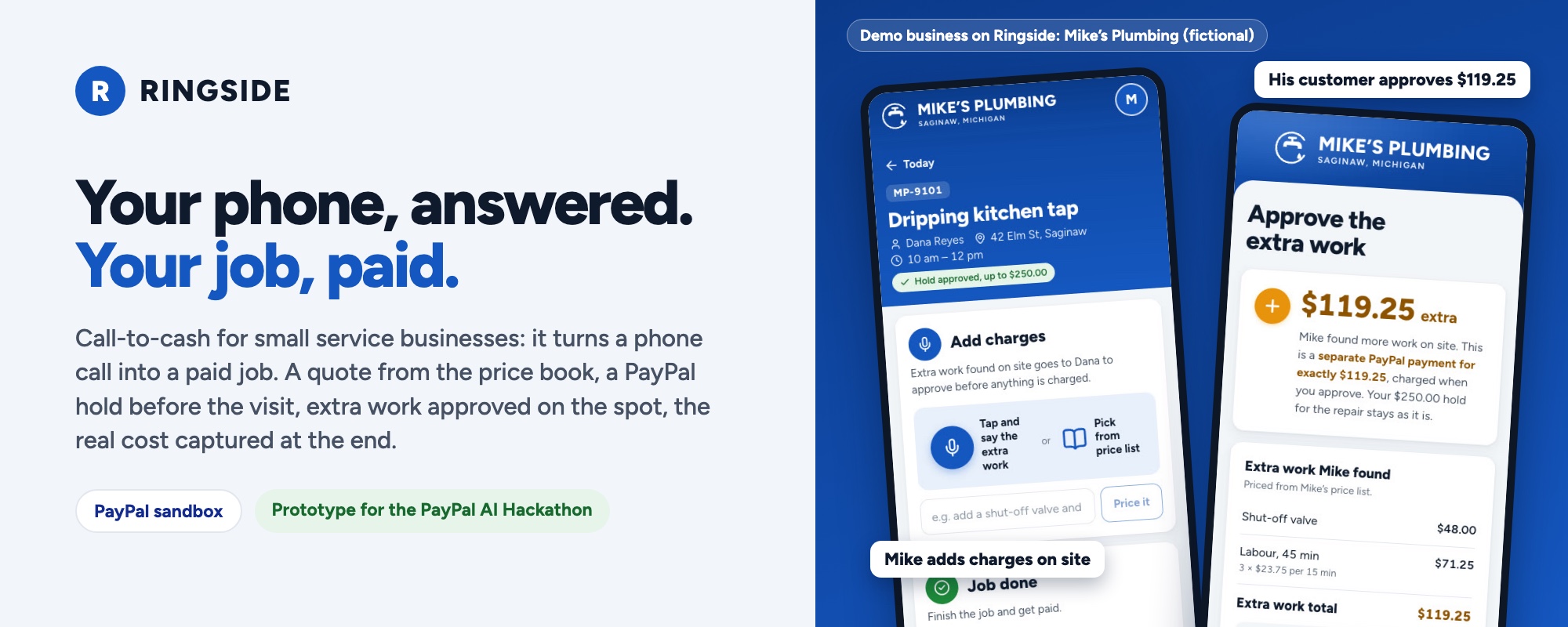
Ringside: call-to-cash for small service businesses. A phone call becomes a paid job, with PayPal at every step.
-
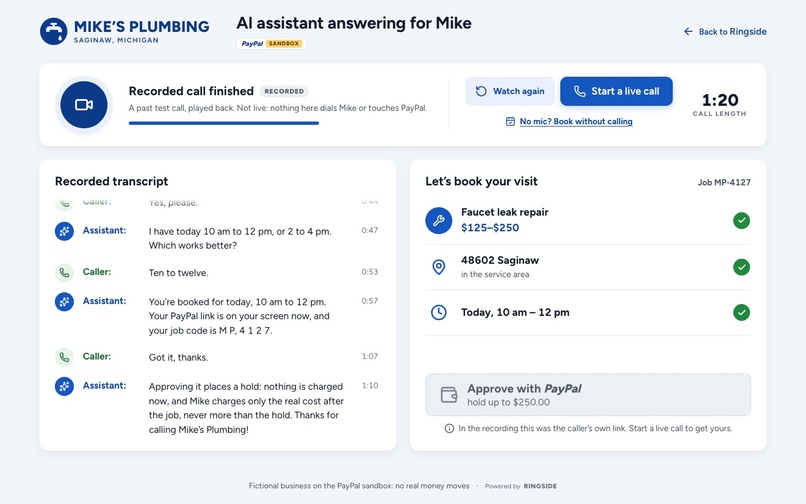
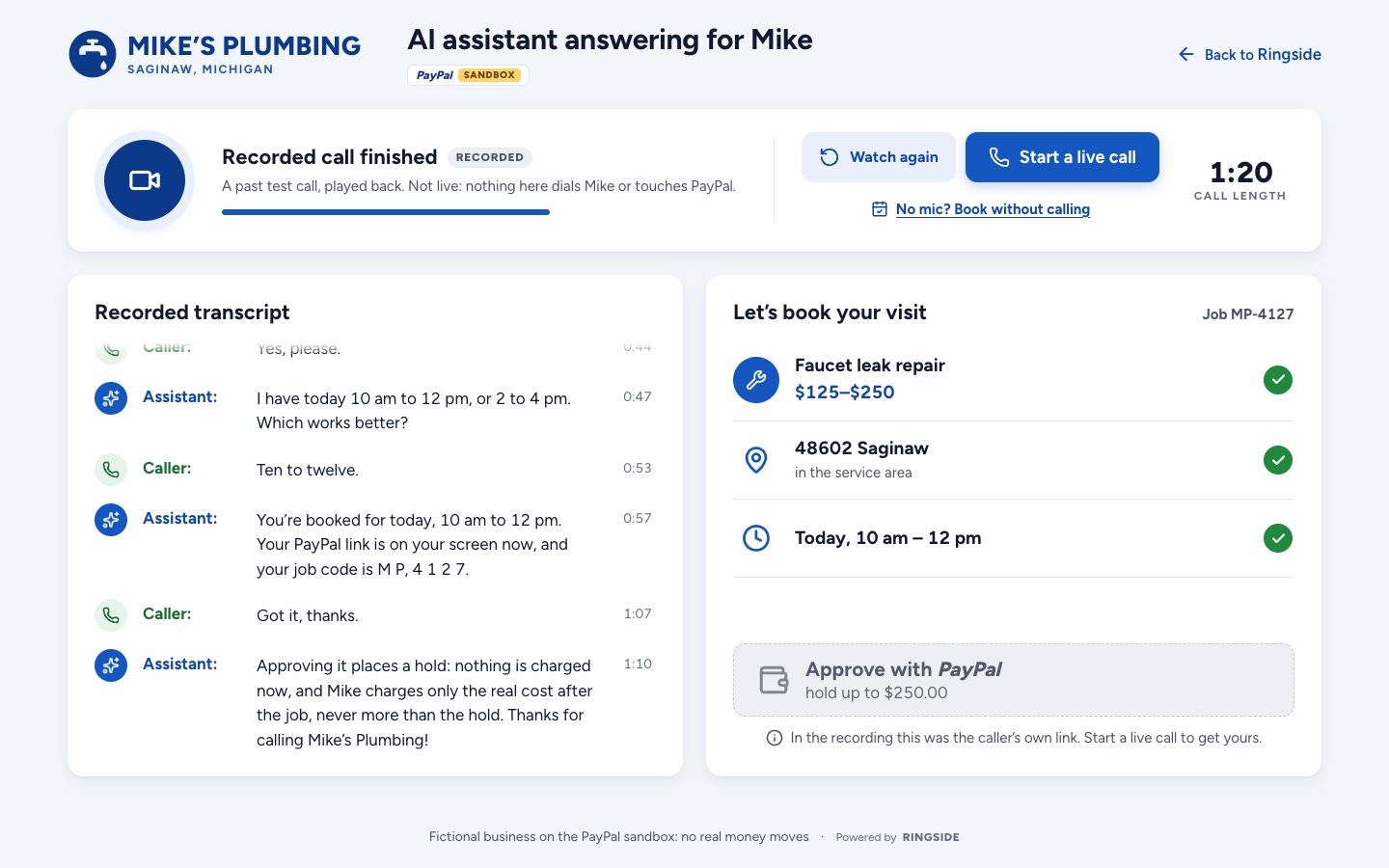
The call: the AI agent finds the job in Mike's price book, reads the price range back and offers a PayPal hold.
-
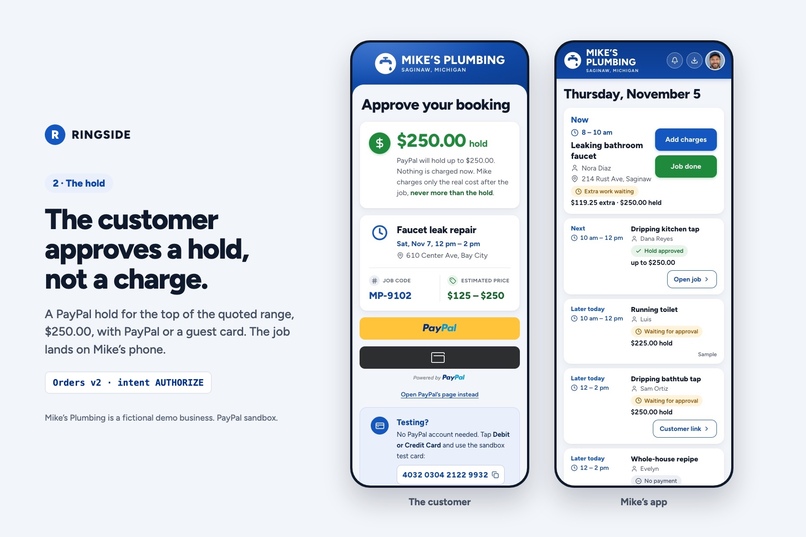
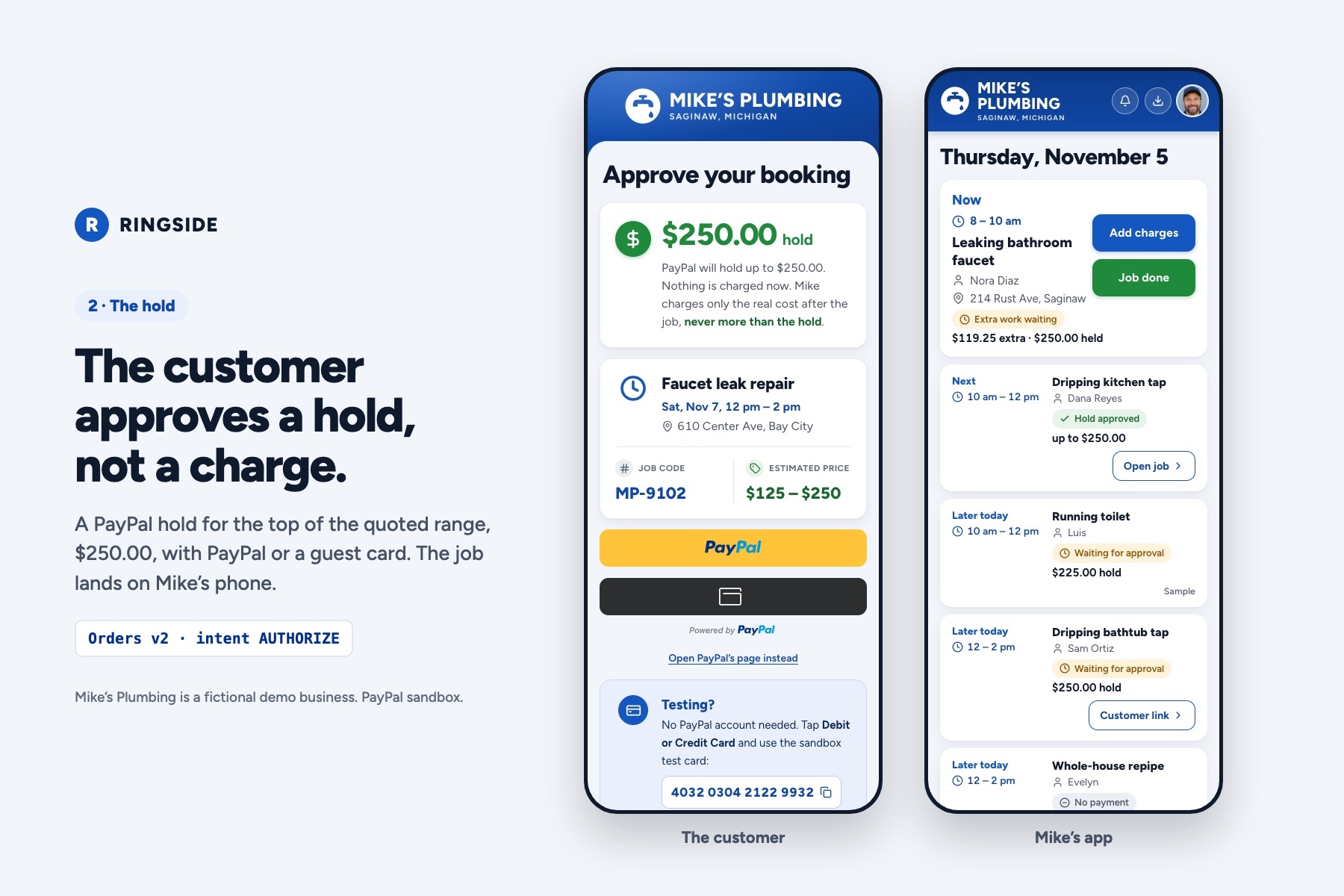
The hold: the customer approves a PayPal hold for the top of the range, not a charge, and the job lands on Mike's phone.
-
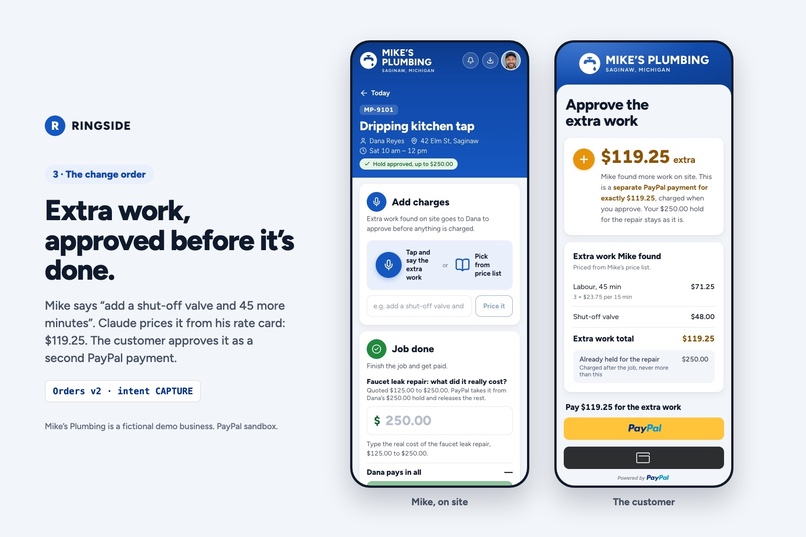
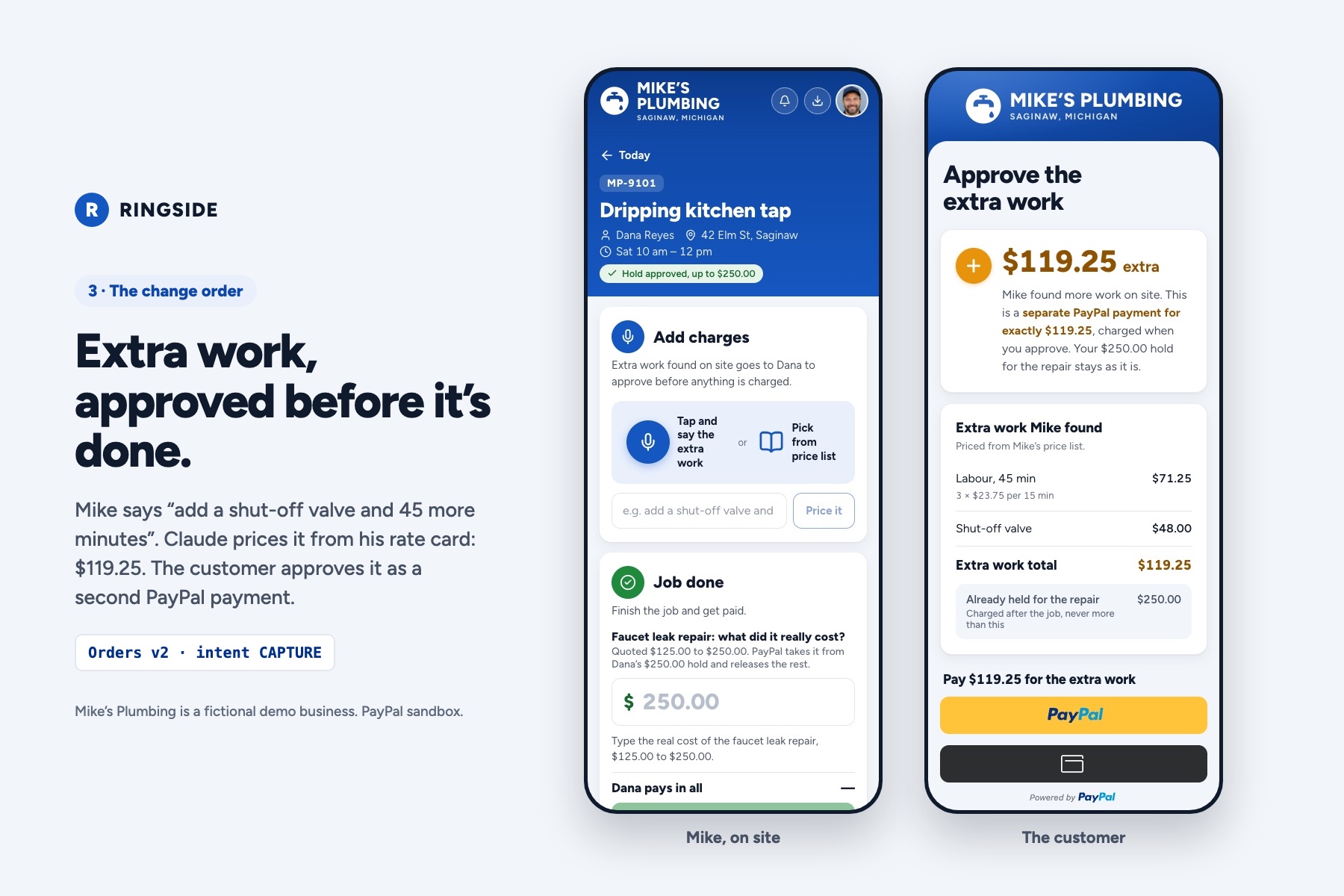
Extra work: Mike adds it on site from his price book; the customer approves it as a separate PayPal payment.
-
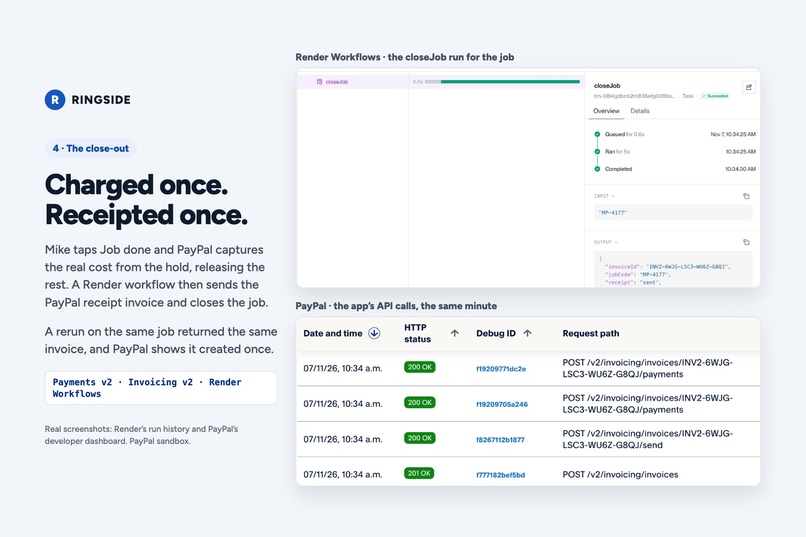
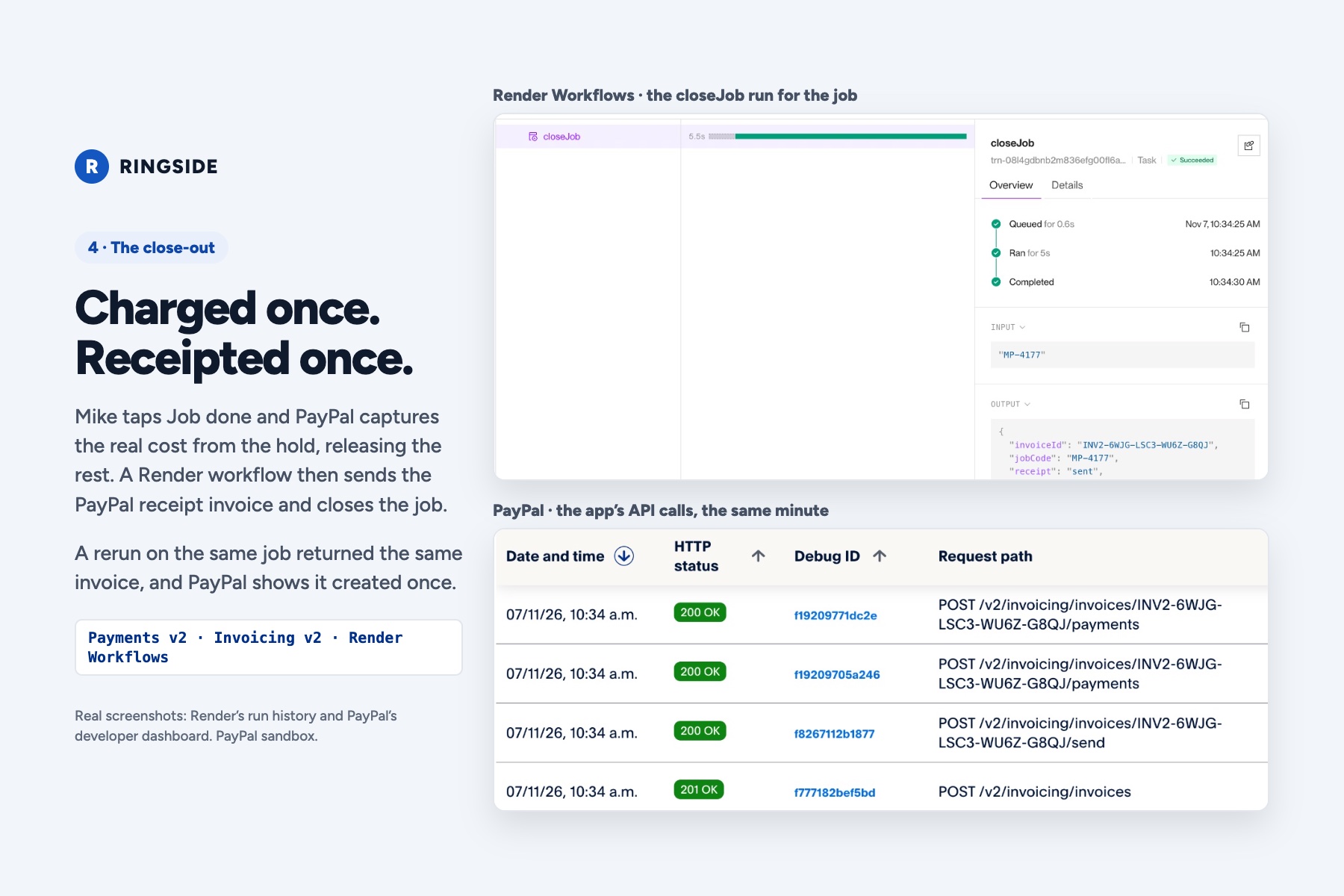
The close-out: after Job done, a Render workflow sends the PayPal receipt and closes the job. A rerun returned the same invoice.
-
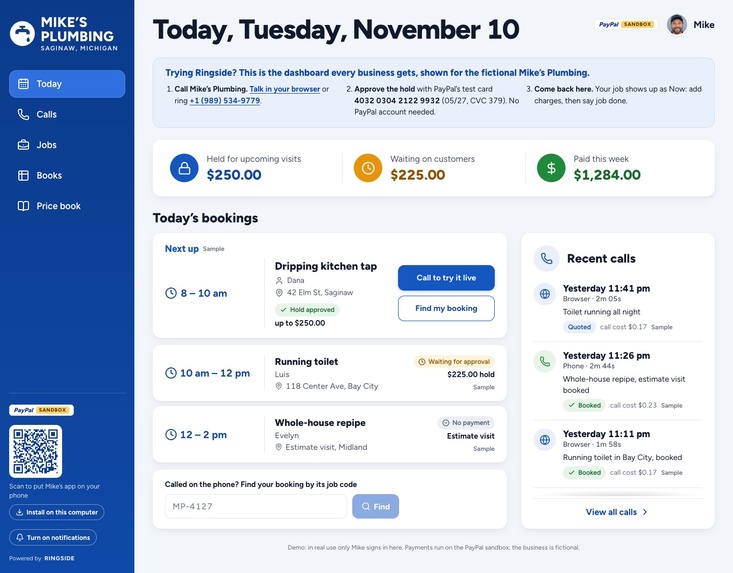
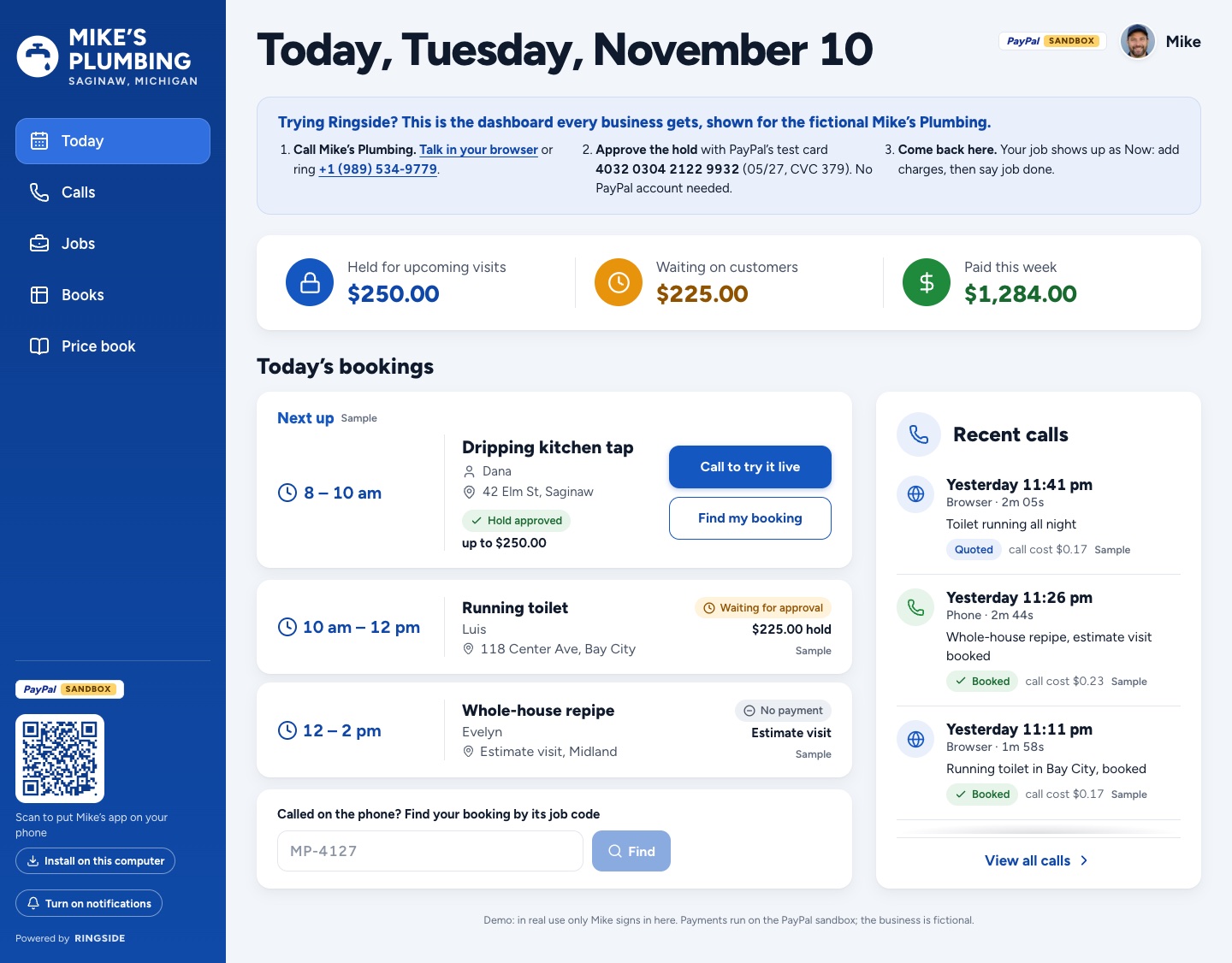
Mike's dashboard: money held for upcoming visits, waiting on customers and paid this week, today's jobs, and every call with its cost.
-
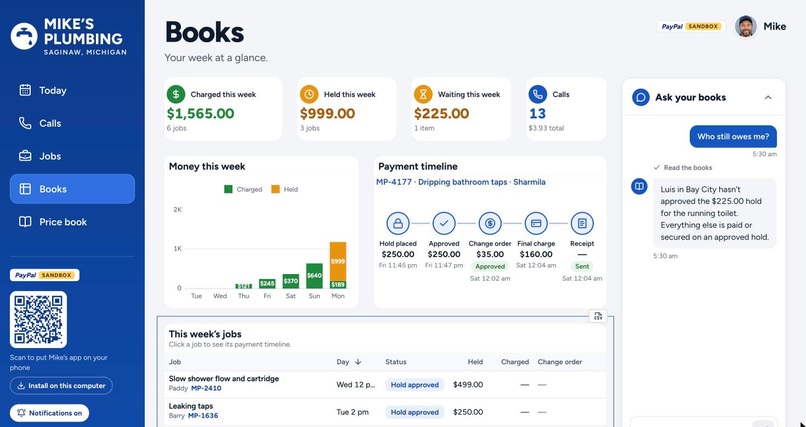
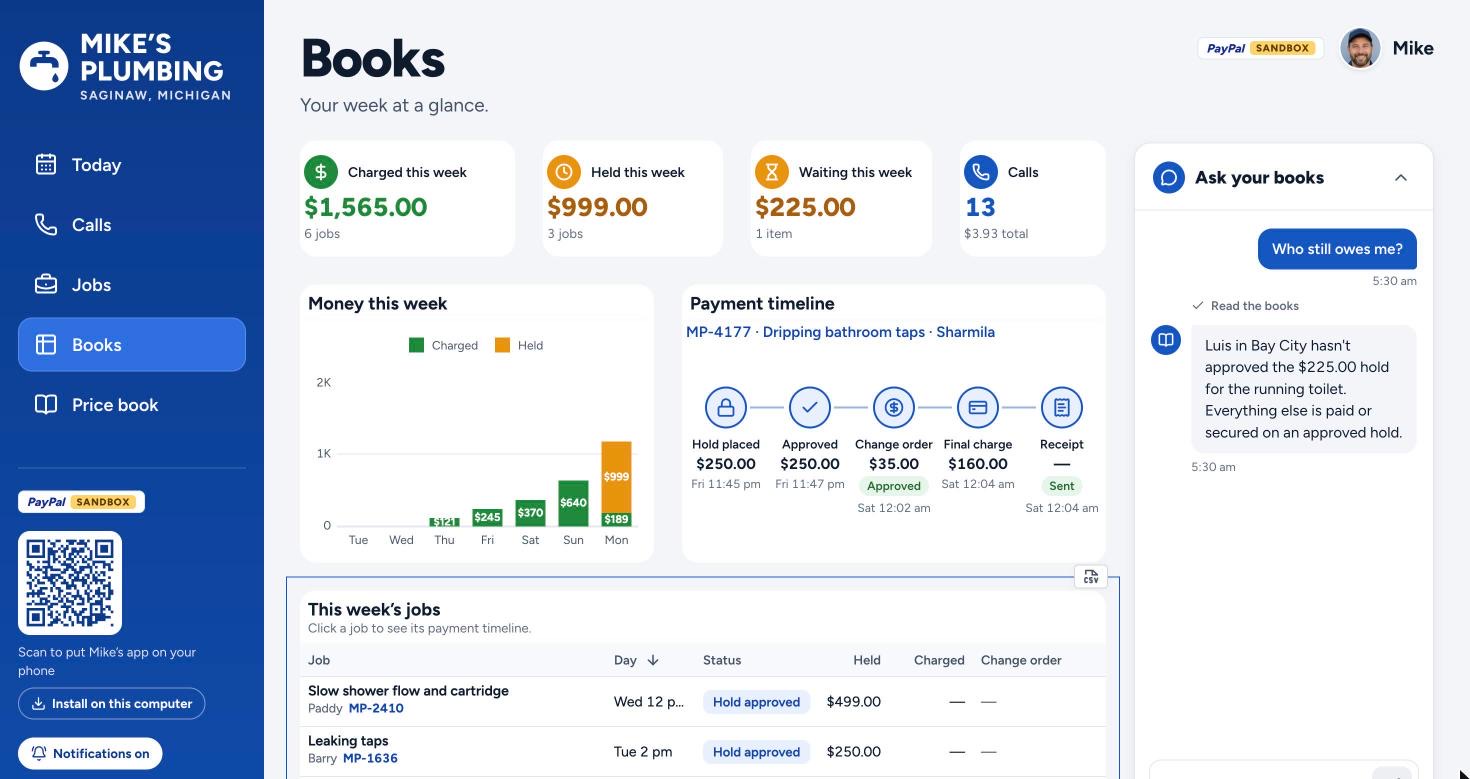
Mike's Books on AG Grid (AG Studio), with Ask your books answering who still owes money.
-
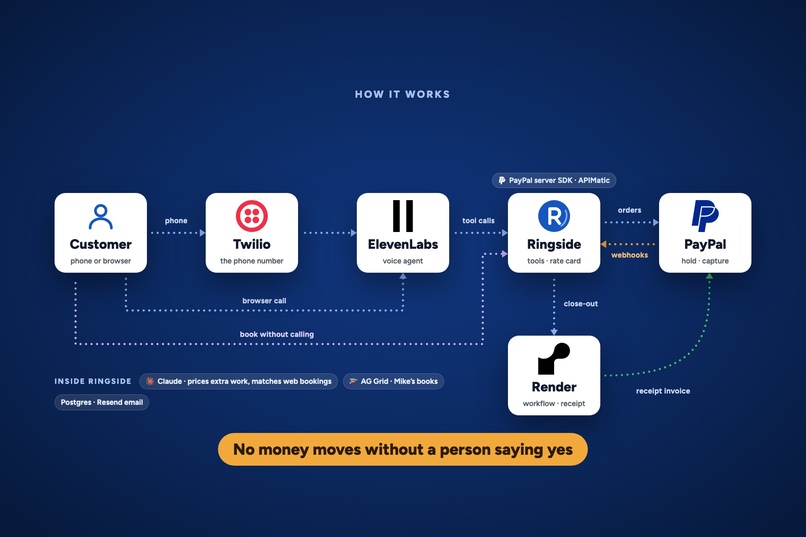
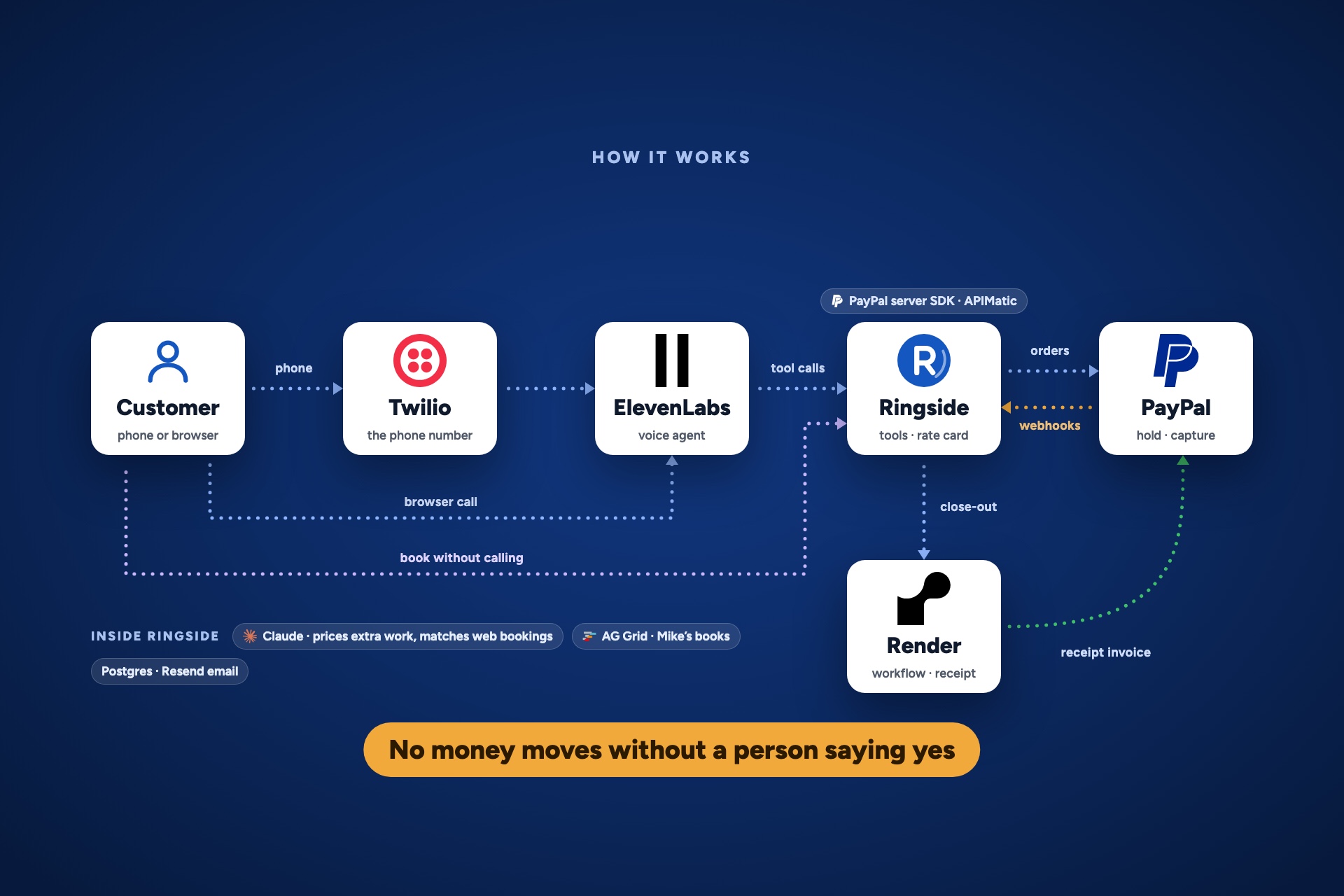
How it works: phone, browser call or web booking into Ringside; PayPal hold and capture; Claude, AG Grid, and a Render receipt close-out.
Inspiration
Small service businesses run on phone calls: electricians, plumbers, HVAC techs, cleaners and many more. Often one person is the business, the dispatcher and the cashier. Customers wait on callbacks to book. The business either takes payment up front, which customers dislike, or chases it after the job. And when a job grows on site, the owner has to ask for more at the door.
Both sides lose at the money step. 59% of US small businesses (up to 250 employees) have invoices overdue by 30 days or more, owed $17.7K on average (QuickBooks, 2026). Meanwhile the FTC tells homeowners: "Don't pay the full amount for the project up front" (FTC).
Most AI phone agents for trades stop at the booking. Ringside is agentic commerce for services: it goes on to the payment, with the agent setting up a PayPal hold during the call and the owner charging the real cost when the job is done. This project follows one scenario: a call to Mike's Plumbing, a fictional one-person plumber in Saginaw, Michigan.
What it does
A business gets its own phone agent, price book, PayPal payments and dashboard. A job goes like this:
- The call. A customer phones, or calls from the browser, and describes the problem in their own words. The agent says it's an AI, checks the service area and finds the job in the business's price book, where every job has a price range. Jobs too big to price on a call get a free estimate visit instead.
- The hold. The agent reads the price back, and after a yes it sends a PayPal link to hold the top of the range. Nothing is charged yet.
- Extra work. If the job grows on site, the owner says what's needed. Claude turns it into price-book items, the code prices them, and the customer approves it as a separate PayPal payment before the work goes on.
- Job done. The owner enters the real cost, never more than the hold. PayPal captures it and releases the rest, and a paid PayPal invoice is the receipt.
- The desk. Money held, waiting and paid, every call, and the books in AG Studio, where the owner can ask "Who still owes me?"
The agent can't charge or refund anything. Every price comes from the price book and is checked in code, and nobody pays more than they approved.
How I used PayPal
PayPal moves the money at every step, all on the sandbox:
- Orders v2 creates the hold at booking (
intent: AUTHORIZE) and a separate payment for extra work (intent: CAPTURE). - Payments v2 captures the real cost from the hold at job done (
final_capture), or voids the hold if the job is cancelled. - Invoicing v2 sends the receipt and marks it paid.
- Webhooks, signature-verified, finish an approval even if the customer closes the page.
- The JavaScript SDK shows the PayPal buttons and guest card checkout.
Orders and Payments go through PayPal's server SDK (@paypal/paypal-server-sdk 2.5, generated by APIMatic). Every POST carries a PayPal-Request-Id that's fixed before the first try, so a retry can never charge twice. The server won't start outside the sandbox.
Every PayPal call Ringside makes, with screenshots from PayPal's own API and webhook logs: PayPal in Ringside.
How I used AI
- The phone agent: ElevenLabs Agents running GLM 5.2. It has eleven tools (price book, service area, availability, quote, booking, the PayPal hold). After the caller's yes, it creates the PayPal order itself and checks that PayPal has the hold before it confirms the visit.
- Extra work: Claude Sonnet 5.5 turns what the owner says into price-book items. My code sets the prices and rejects anything that isn't on the book.
- Ask your books: Claude Haiku 5.5 through the AG Studio Agent Framework, reading the business's own data.
- Book without calling: Claude Haiku 5.5 matches a typed description of the problem to one job in the price book. A gas smell gets safety advice, not a booking.
No model can move money: the hold is captured only when the owner confirms Job done, and extra work only after the customer approves it in PayPal.
Sponsor tools
- AG Grid: the owner's books are an AG Studio 3.0 dashboard (AG Grid 36.2, AG Charts 14.2) with two custom widgets, money tiles and a payment timeline, and the Agent Framework behind "Ask your books". How Ringside uses AG Grid
- APIMatic: I used APIMatic's PayPal context plugin to build my Orders and Payments calls on the APIMatic-generated server SDK. Its eight TypeScript skills are in the repo (
.claude/skills/). How Ringside uses APIMatic - Render: one Blueprint runs the web app, Postgres and a Render Workflows task that sends the receipt and closes the job, with retries and idempotent steps. Every production run succeeded, and a rerun on a closed job didn't create a second invoice. How Ringside uses Render
How I built it
Next.js 16, React 19 and TypeScript on Render. A Twilio US number connects to the agent, the browser call uses @elevenlabs/react, and emails go out through Resend. Money is stored as integer cents behind a job state machine. 169 Vitest tests replay recorded PayPal and Claude responses, and a GitHub Actions check visits the live demo every 30 minutes.
Challenges I ran into
- How far can a hold stretch? PayPal's docs disagreed. In the sandbox a capture could go only about 15% over the hold, so extra work became its own payment.
- Invoicing ignores
PayPal-Request-Id. A replay recorded a second payment, so receipts now check the invoice's own state. - A caller got stuck at PayPal's login. I added guest card checkout and a longer pause before the agent asks "are you still there?"
Accomplishments that I'm proud of
How smooth the whole thing feels. On the phone the agent sounds natural: it reads prices and email addresses back, waits quietly while the customer approves in PayPal, and answers quickly enough that the call feels like a normal conversation. It handles the messy parts of real calls too: a caller who changes the day mid-sentence, cuts in on its goodbye, or adds more work after approving the hold. And the money underneath is solid: a hold is placed or captured in about two seconds, and a retried capture returns PayPal's original answer, so nothing is ever charged twice.
What I learned
Test PayPal's rules in the sandbox before building on them. A hold fits service work: the customer sees the most they'll pay, and the business knows the money is there. Let the model pick the items and the code set the prices. And always read amounts and email addresses back out loud.
What's next
About $49 a month per business, with calls included up to a limit, plus PayPal's usual fees. To launch: a company and a PayPal business account; PayPal partner approval, so each business is paid into its own PayPal account (the Partner Referrals API needs a Platform app, my next step); subscriptions through the PayPal Subscriptions API; self-serve onboarding with a price book from a trade template or an AI import; then a pilot with local trades.
Built With
- ag-charts
- ag-grid
- ag-studio
- anthropic
- apimatic
- claude-haiku-5.5
- claude-sonnet-5.5
- elevenlabs
- elevenlabs-agents
- glm-5.2
- next.js
- paypal
- paypal-invoicing-v2
- paypal-javascript-sdk
- paypal-orders-v2
- paypal-payments-v2
- paypal-server-sdk
- paypal-webhooks
- postgresql
- react
- render
- render-workflows
- resend
- twilio
- typescript
