Inspiration
Anyone who has tried to arrange one date for six people knows the shape of the problem: three reply to the group chat straight away, two never do, and one calls back and tells you out loud. A poll link does not fix it, because the people who ignore links are exactly the people whose answer is missing.
So you call them. And then you do the part that actually goes wrong: you work out the overlap in your head, over the people who answered — and quietly treat the two who never answered as fine with anything.
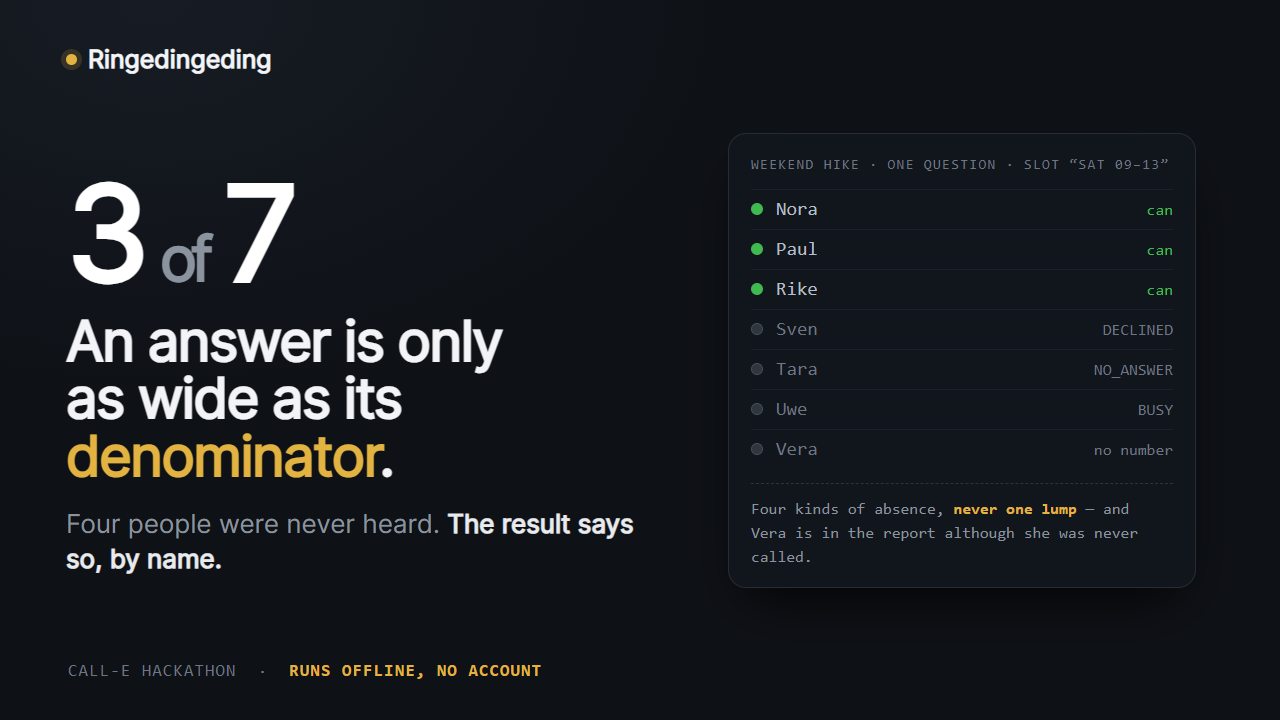
That is the mistake this project exists to make impossible. An intersection over four of six people is a different fact from an intersection over six of six, and it has to look different.
What it does
- Takes one brief — the occasion, some candidate dates, a guest list — and turns it into one call per person through the CALL-E batch API.
- Shows exactly what would happen before anything is dialled: who gets called, the complete order text as it will leave the machine, how many calls that is, and what it costs.
- Merges the replies into a single board that keeps five states apart: can, cannot, said
nothing about that one, not reached — which is itself
NO_ANSWERorBUSYorVOICEMAILorDECLINED, never one lump — and has no phone number at all. - Never reports an aggregate over "everyone". Every result carries its denominator and names who is missing.
- Catches up later without a special mode: add a number that was missing, run the same round again, and exactly that one call is placed.
- Runs the whole flow with no account, no network and no telephone, against bundled scripted answers.
There are two products on the same mechanism. Find a Date asks "when can you?" and intersects availability. Ask Your Advisor asks "what do you think?" and reports the leading tendency, the countervoices, the reasons and the concerns — it never turns dissent into a false consensus.
The one thing to try first
One command, about a second, no account and no API key:
python -m ringedingeding proof
It builds a seven-person round in a temporary database, replays scripted answers, and then checks its own result against the four ways a merge can quietly lie — a disagreement counted as a majority, silence read as a "no", three kinds of absence folded into one failure, and the invitee whose number is missing dropped from the report. Exit code 0 means all eight checks passed.
Its last step is the argument in miniature. One invitee has no phone number, so she is never called, and the round reports a slot that "works for all 3 who answered". Add her number, run the same round again — one call is placed, and that earlier result turns out to be wrong.
Why not just use the CALL-E app?
Use it. For a single call the CALL-E chat is faster than anything anyone could build here, and this project does not try to replace it.
The difference is the set, not the call:
- Count — the app makes one call, started by hand. This makes many from one brief.
- Answer shape — the app returns prose plus the agent's reading of it. This returns a schema-validated result per recipient, so answers are comparable.
- Outcome — the app leaves a human reading N transcripts. This produces one merged result, with the number of people it rests on attached.
- State — every chat starts fresh. This remembers who has answered, who is still open, and who cannot be called at all, between runs.
The four categories the app offers — Personal Message, Ask a Business, Book or Reschedule, Follow Up — are all one-to-one patterns, and so are the other integrations in the ecosystem. Asking a group the same thing and merging the answers is the gap.
How we built it
- Python 3.11+, standard library only for the command line and the whole dry run. The optional web interface adds FastAPI, uvicorn and Jinja2; htmx is vendored into the package so no page needs a CDN.
- SQLite for everything that persists. Answers are written the moment they arrive, so an interrupted run resumes exactly where it stopped.
- One flow, three ways in: a command line, a
SKILL.mdfor somebody else's agent, and a browser interface. All three call the sameservice.py. If a rule appears in one of them that the other two do not have, that is a bug. - The result schema is designed first and the spoken instructions written to match it. Whatever the schema demands, the voice agent has to find out during the call — it is the stronger of the only two levers CALL-E offers.
- The browser displays; the server drives. Placing calls happens in a thread inside the server process, so the window can be closed and reopened without ending a round.
Challenges we ran into
Everything below was measured against the real service, in one real call, and several of these contradict the documentation:
statusis useless as a progress indicator. It sat onPREPARINGfor an entire conversation and only moved toCOMPLETEDabout 24 seconds after the call had ended. Progress is readable, but fromactivity, not fromstatus.- That measurement found a real bug by inspection.
PREPARINGwas not in our status enum, an unrecognised status parsed toFAILED, andFAILEDcounted as terminal — so every live call would have been abandoned and recorded as failed on the first poll, roughly 40 seconds in, while the person was still speaking. Fixed by splitting "map a status" from "decide whether to keep waiting"; an unfamiliar status now keeps the call alive. - The transcript is not where the documentation puts it. Top-level
transcriptstayednull; the text is inresult.transcript, as a string. - Result schemas are a REST-only feature.
plan_callover MCP/CLI has noresult_schema, and a call started over MCP is not retrievable over REST at all — the two are separate ID spaces. Anything that needs comparable answers has to start the call over REST. - Speech recognition streams and corrects itself. The same line arrives twice, a rough version and a correction fractions of a second later, so the newest line is held back for one poll rather than shown and then contradicted.
- A late phone number made somebody disappear. Adding a number to a contact who was already on the guest list did not make them a participant of the running round: they were then neither called nor listed as uncontactable — they simply vanished from the report, which is the one outcome the whole project is built to prevent. Found by hand, fixed, and pinned by a test.
Accomplishments that we're proud of
- The dry run is not a stub that returns "OK". It runs schema generation, per-recipient payload assembly, status mapping, merging and reporting, and validates every scripted answer against the schema a real call would have received. A fixture that could not have come out of a real call fails the dry run instead of quietly passing it.
- The core sample checks itself, and the test suite tampers with the scenario one answer at a time to prove the checks can actually fail.
- 575 tests passed in the current offline suite; the local evidence also records the fixture-only proof command and its eight self-checks.
- Interrupting mid-run was tested with a real signal, not simulated: three answers saved, three never started, exit code 130, and re-running picked up exactly where it stopped without dialling anybody twice.
EVIDENCE.mdrecords what was executed with real output, and — at greater length — what was not.
What we learned
- Design the result schema before the prose. What the agent must fill in determines what it must find out.
- Text in quotation marks is spoken verbatim, character for character; text outside them is rephrased and even extended by the planning agent. A deliberate typo in a quoted sentence came back in the transcript unchanged. So the question and the disclosure sentence are quoted and the rest is guidance, on purpose.
- Keep the upstream status set intact.
NO_ANSWER,BUSY,DECLINEDandVOICEMAILare four different pieces of news, and collapsing them throws away precisely what the report needs. - Roughly 40 seconds of every call is dialling before a word is spoken, independent of how long anybody talks. Cost is per call; time is not.
What's next for Ringedingeding
- A field test with real, informed participants. It has not happened yet.
- The four remaining kinds of date (a whole week, a month, several consecutive days, a recurring weekday), which need a new slot generator and nothing else.
- E-mail as a second channel for the people a telephone cannot reach.
- Group profiles, so "my hiking club" is a thing you name once.
Links
- Repository: https://github.com/ellmos-ai/ringedingeding
- Merged contribution PR #77 (multi-recipient response aggregator): https://github.com/CALLE-AI/awesome-phone-call-agents/pull/77
- Contribution package: https://github.com/CALLE-AI/awesome-phone-call-agents/tree/main/apps/python/ringedingeding
- Demo: https://bzd5z52jjghhe2lnoyq4hlh52e0vrujz.lambda-url.eu-central-1.on.aws/
- Organization portfolio: https://github.com/ellmos-ai
Update — live field trial and retest (Aug 11 + Aug 22)
Since recording the demo video, Ringedingeding went through a live field trial with real batch participants (2026-08-11 and 2026-08-22), including a same-day live retest of a critical bug found during that trial: retrying a participant could reuse an already-spent idempotency key from CALL-E's API, risking a lost or duplicated retry attempt. The fix was verified on a real live retry call, which received a fresh key and completed cleanly. The identity-confirmation question is now marked as a never-skippable, hard-gated step in the call script; when the underlying voice agent still occasionally skips it, the app now treats that as "unconfirmed" rather than silently miscounting the answer, and the report says so explicitly. A new invitation-round call type — agreeing on one shared appointment slot across several people, not just aggregating separate answers to one question — was exercised live for the first time during the retest and completed successfully end-to-end. When an identity went unconfirmed live, a follow-up correction call (identity first, then the question again) recovered the vote — the final live round closed at 2 of 2 counted. The project now ships an honest "How We Tested" README section. Current test suite: 575 passing.


Log in or sign up for Devpost to join the conversation.