-
-
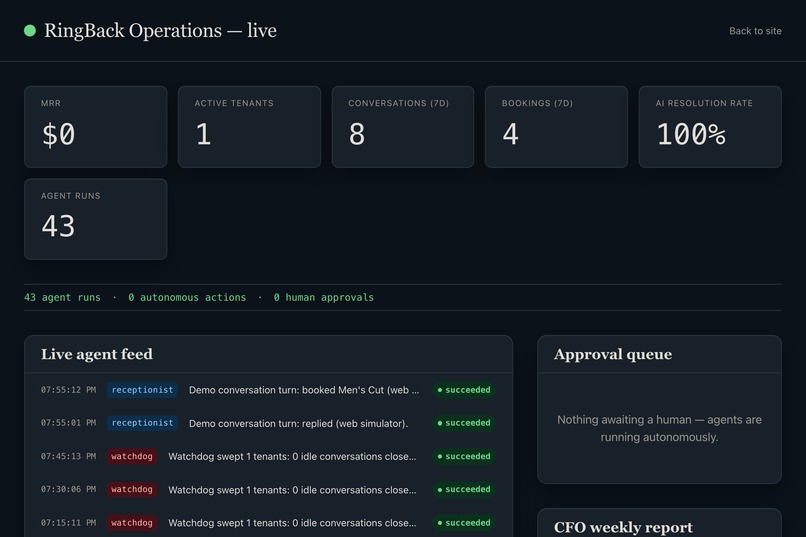
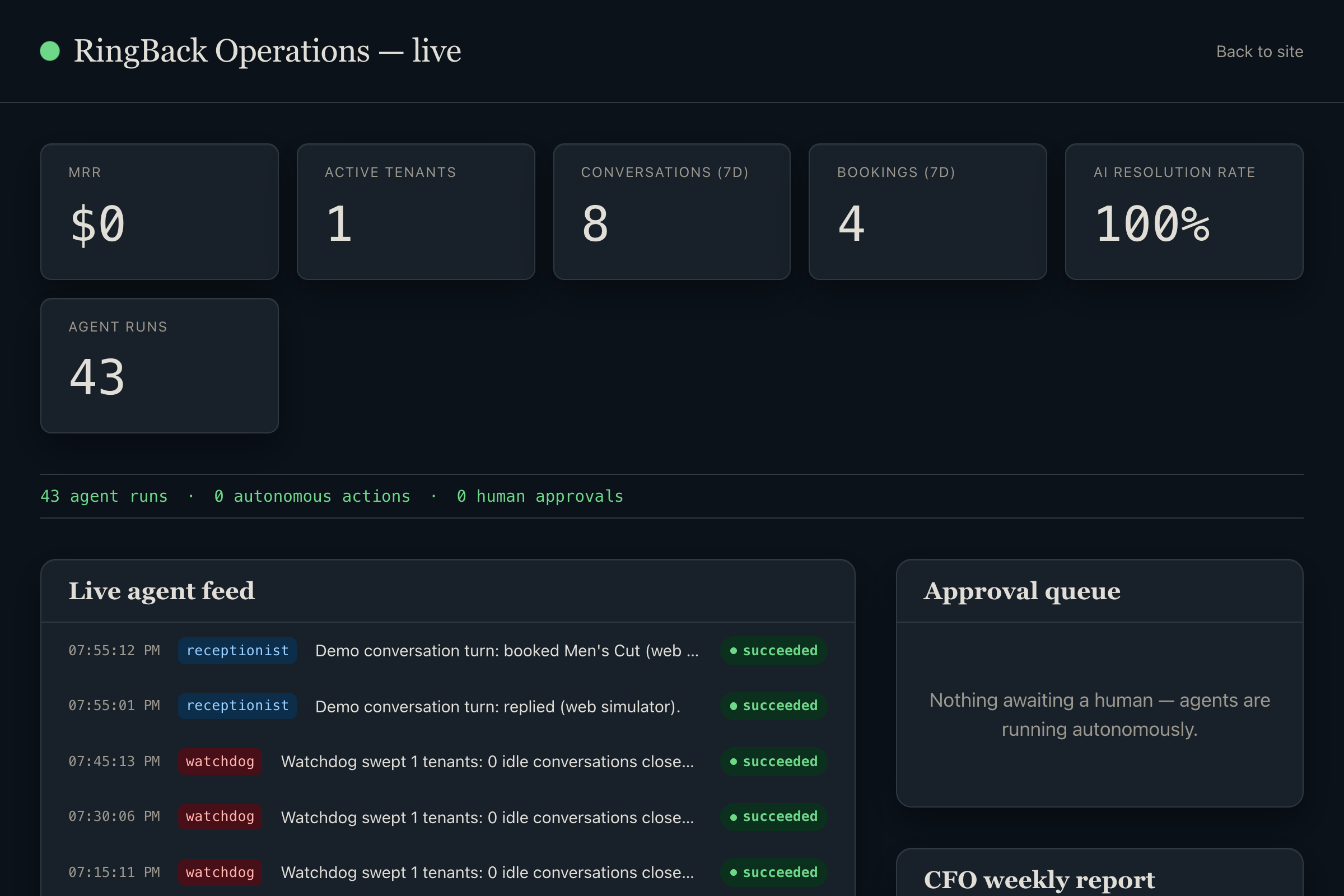
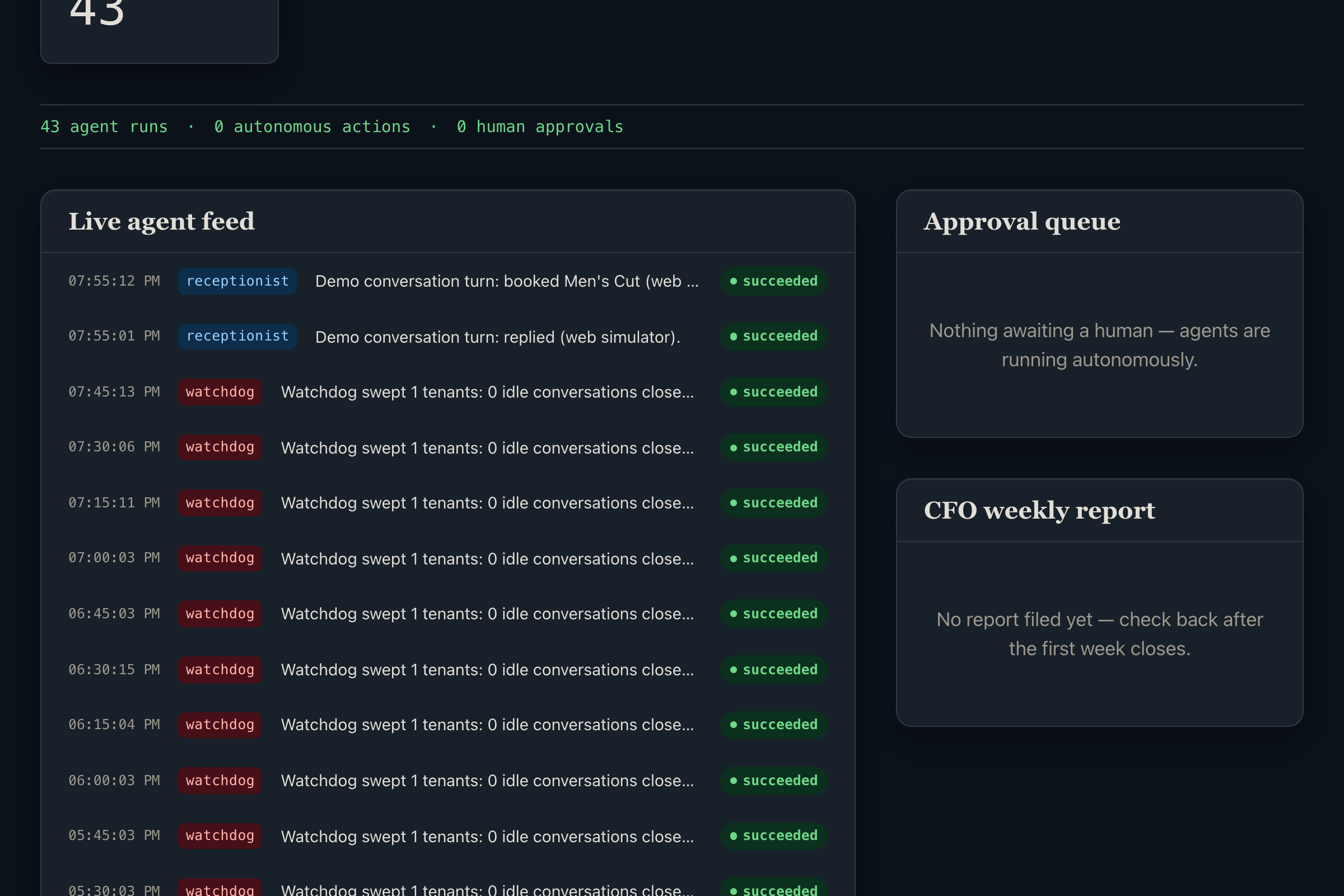
The public operations console: live KPIs across every agent, updated continuously in production.
-
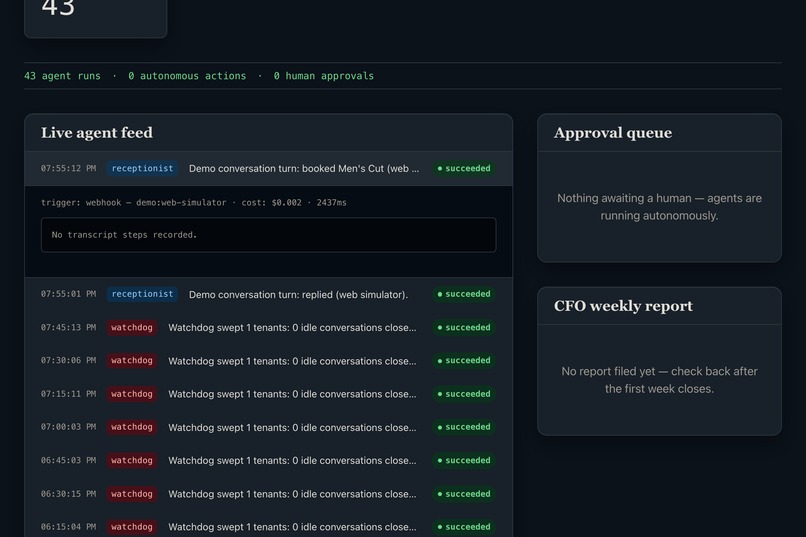
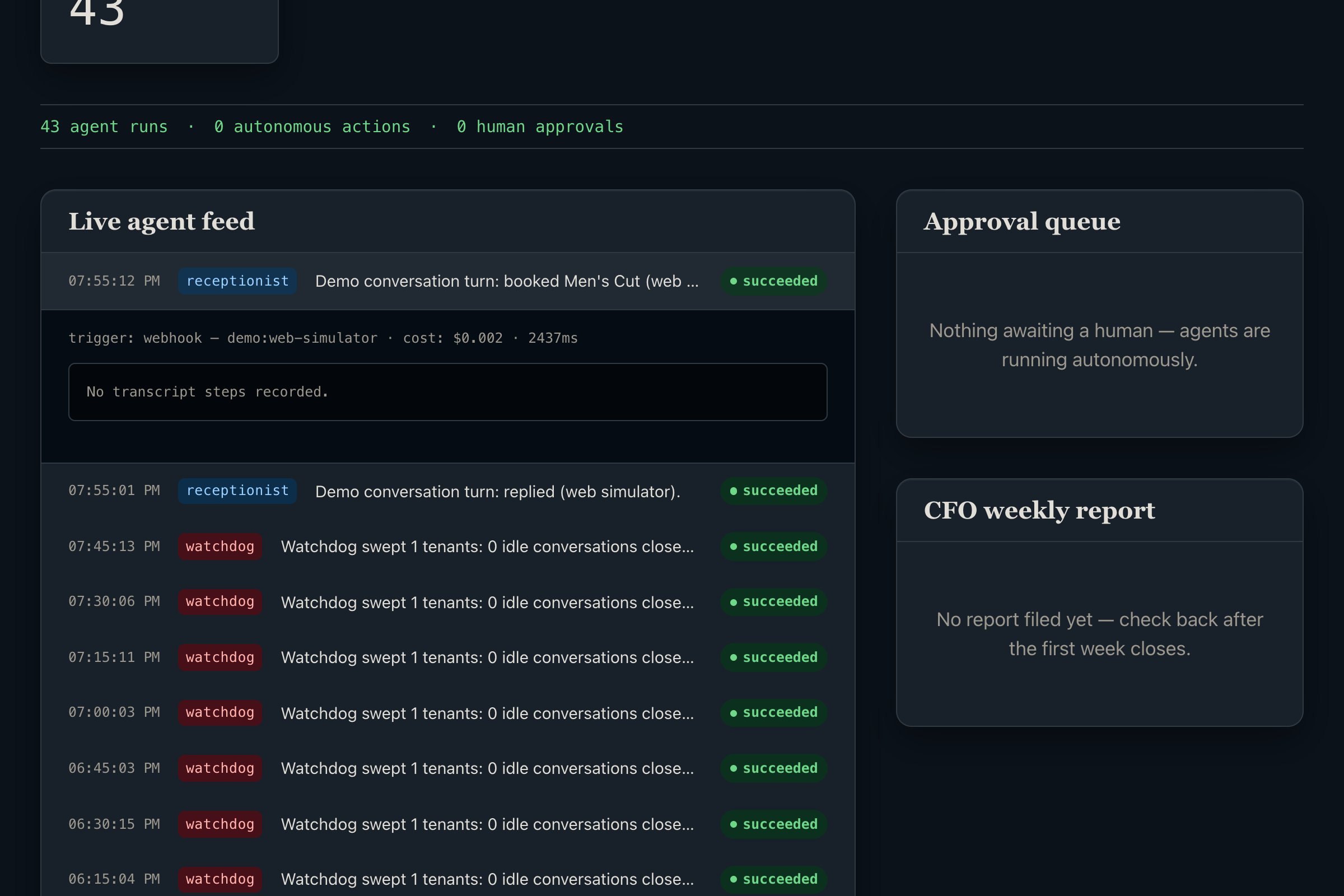
Expand any run to see its trigger, duration and exact Gemini cost. Nothing awaiting a human — agents run alone.
-
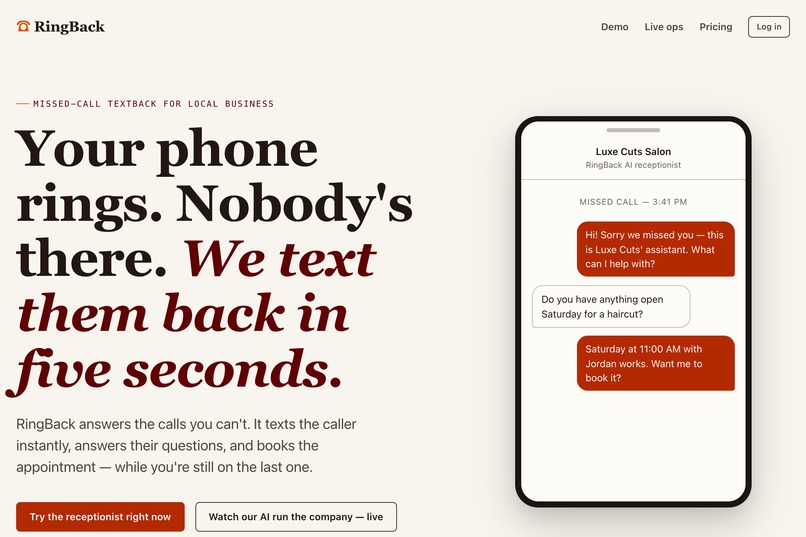
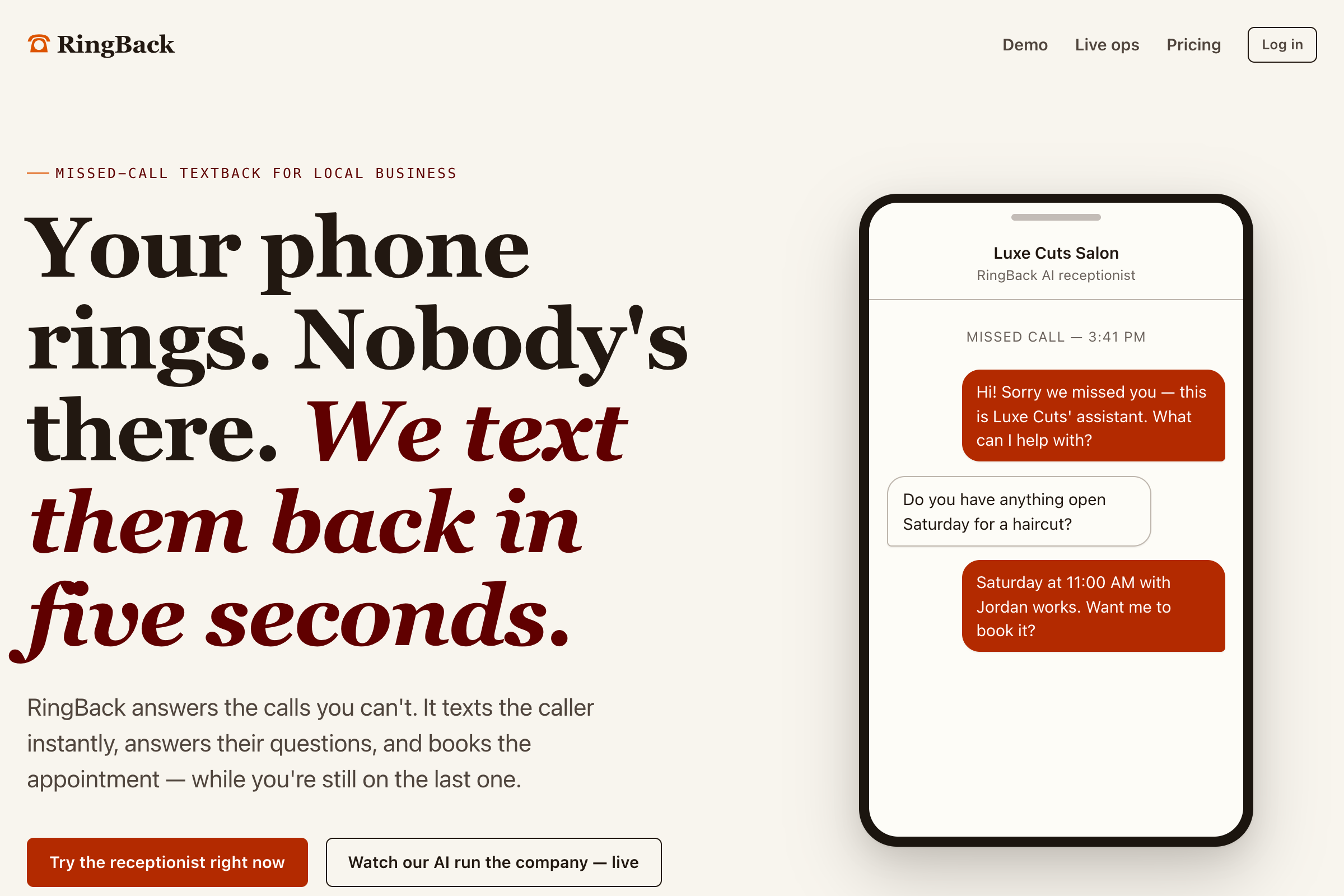
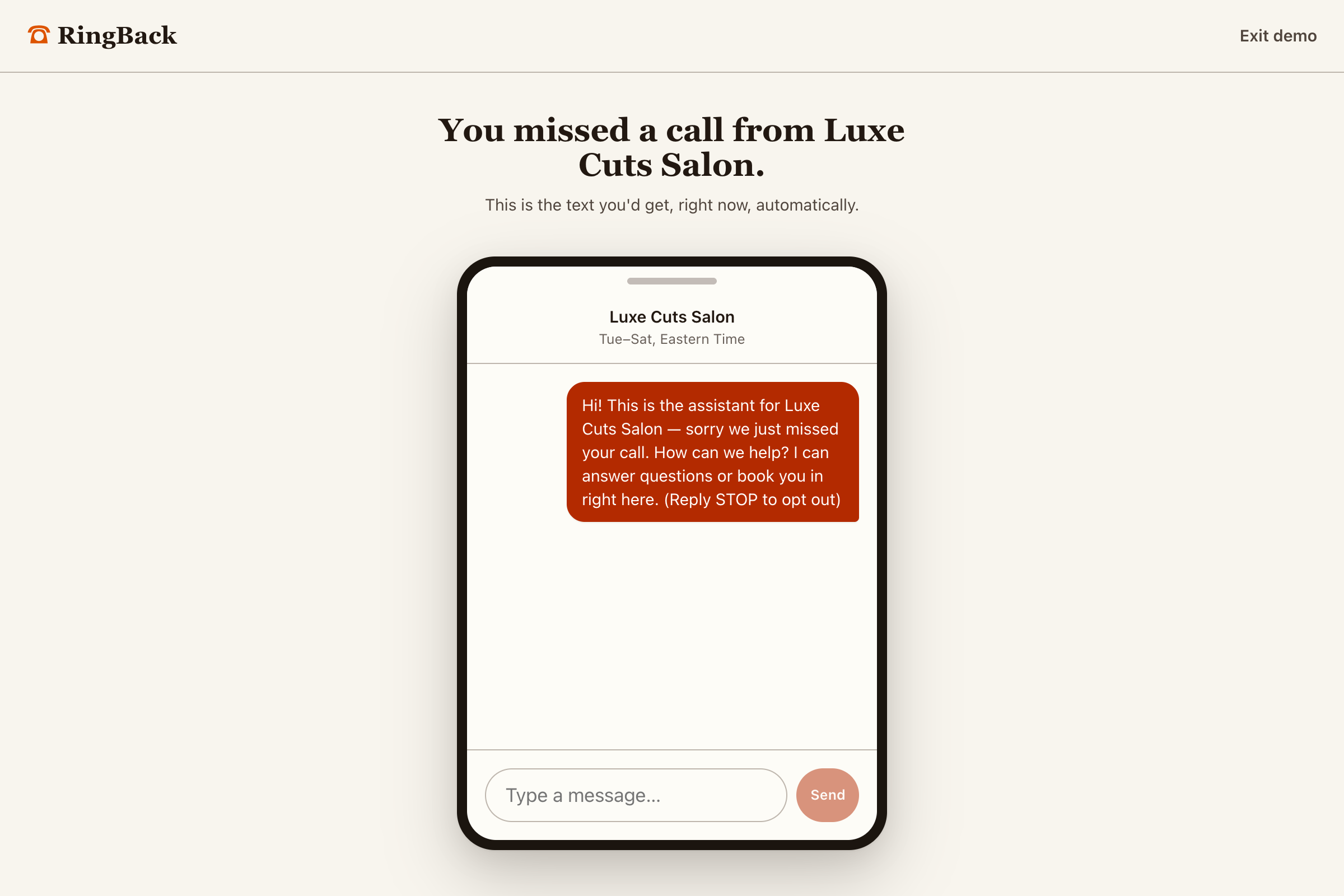
Your phone rings, nobody's there. RingBack texts the caller back in five seconds and books the appointment.
-
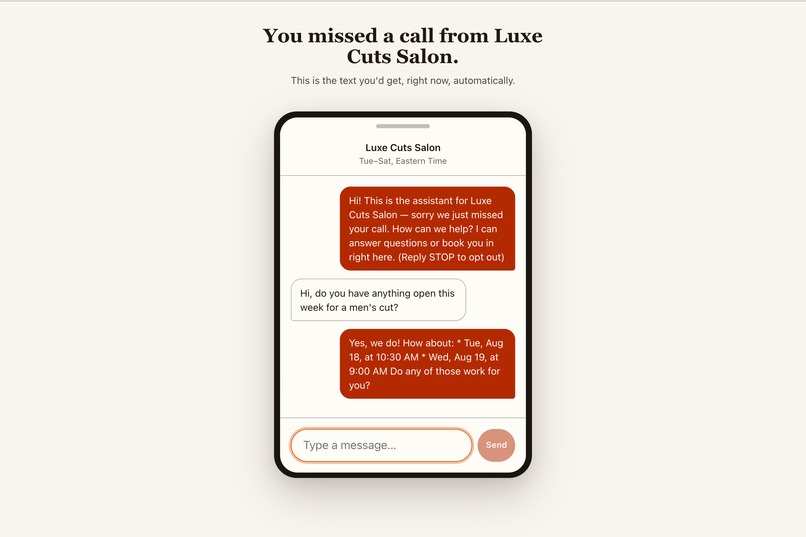
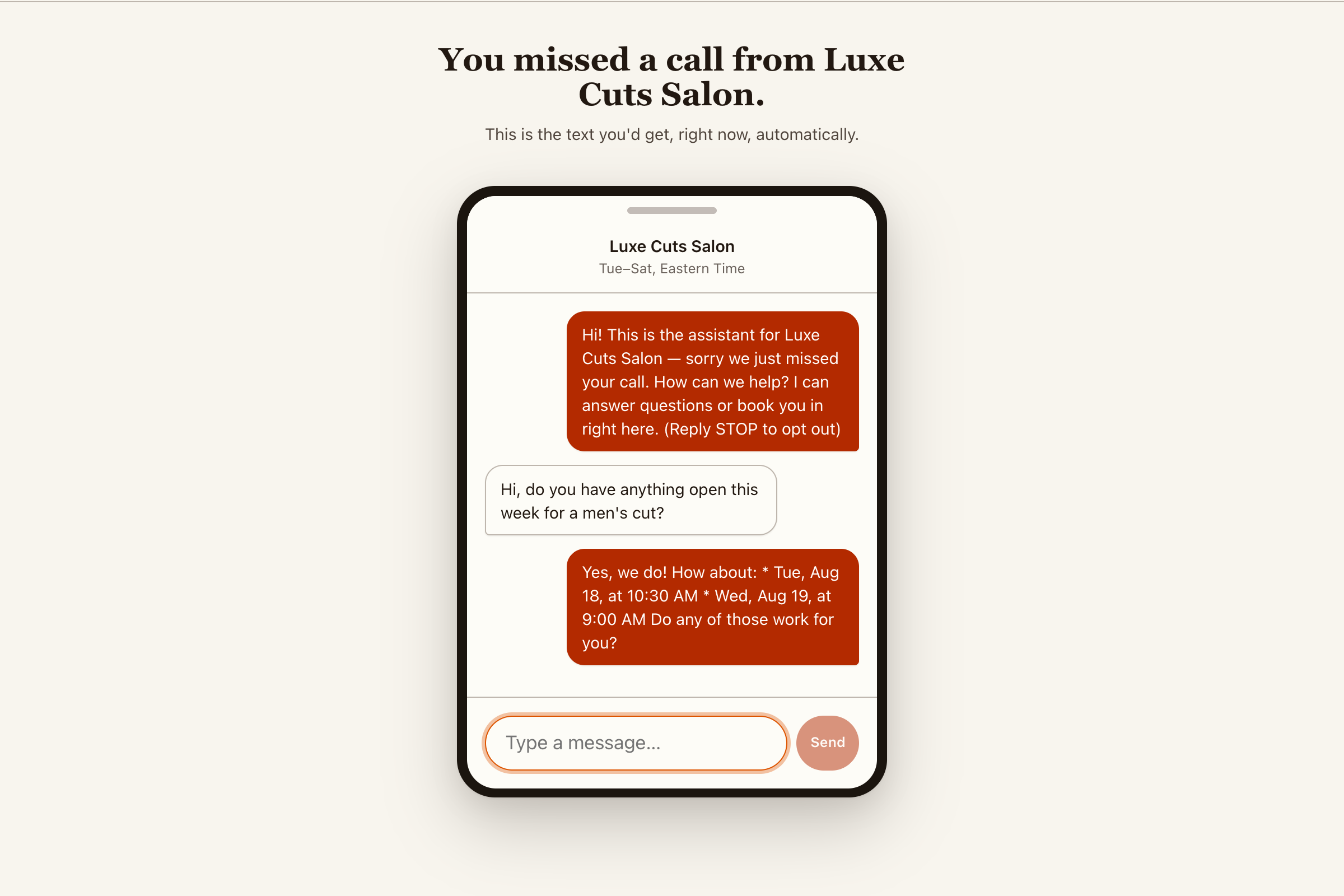
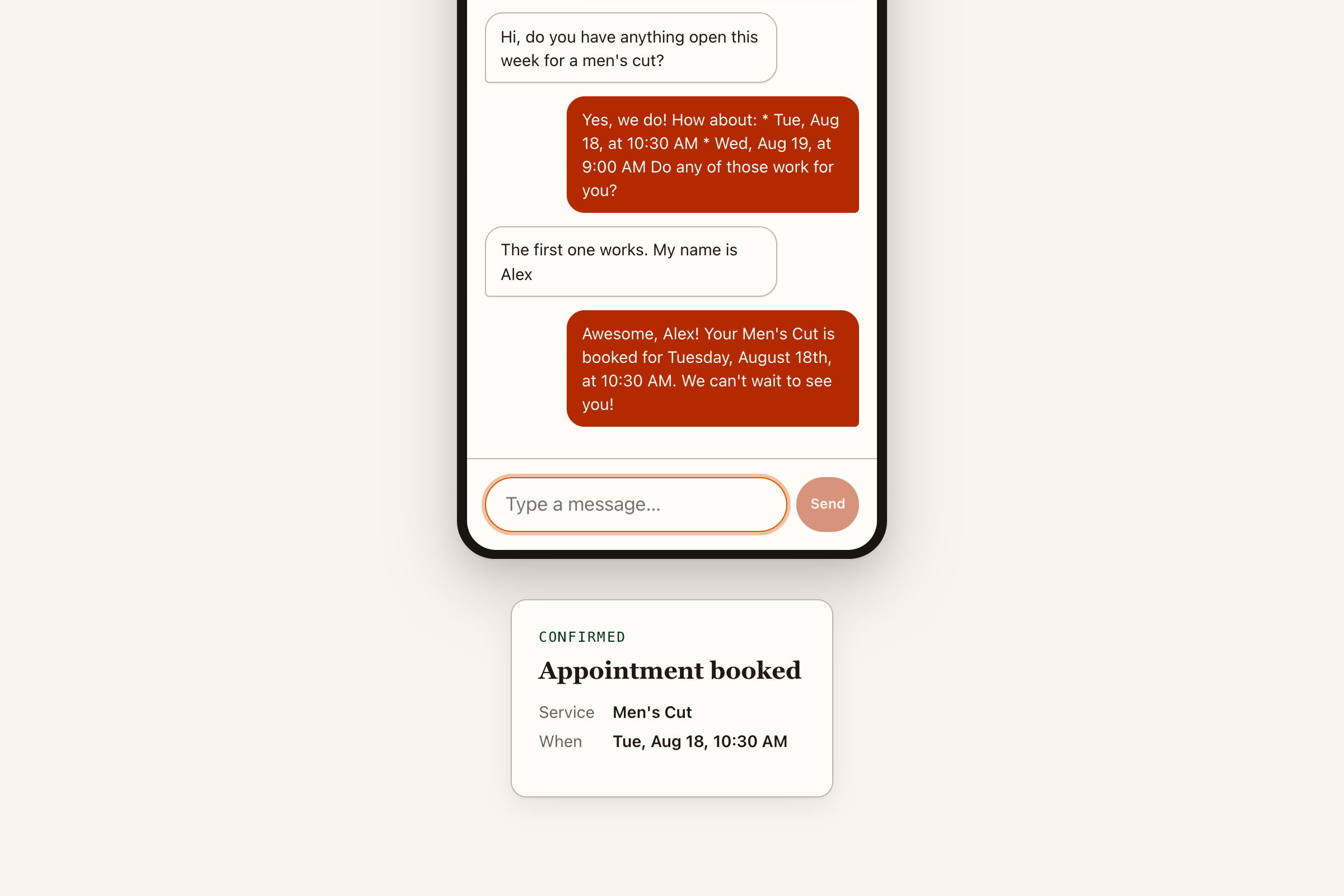
Gemini reads the question and returns real open slots pulled from the salon's live calendar, not canned replies.
-
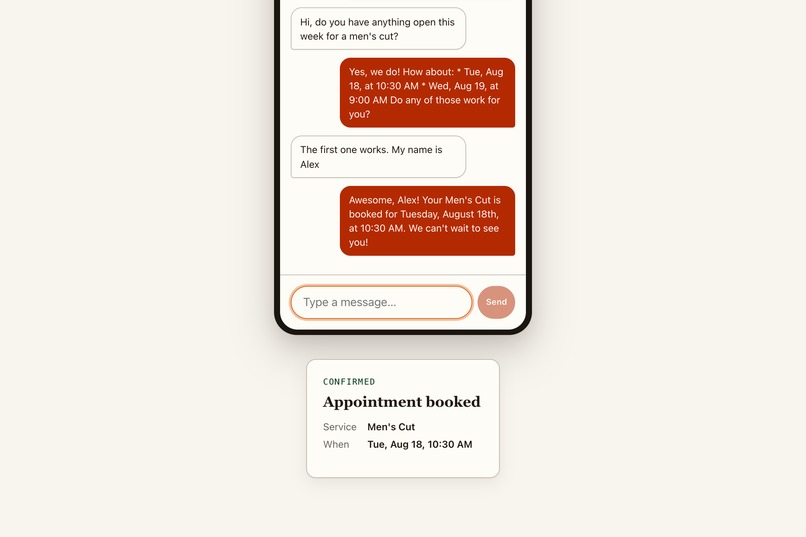
Two messages to a confirmed booking. A real appointment written to Firestore by the AI through validated tools.
-
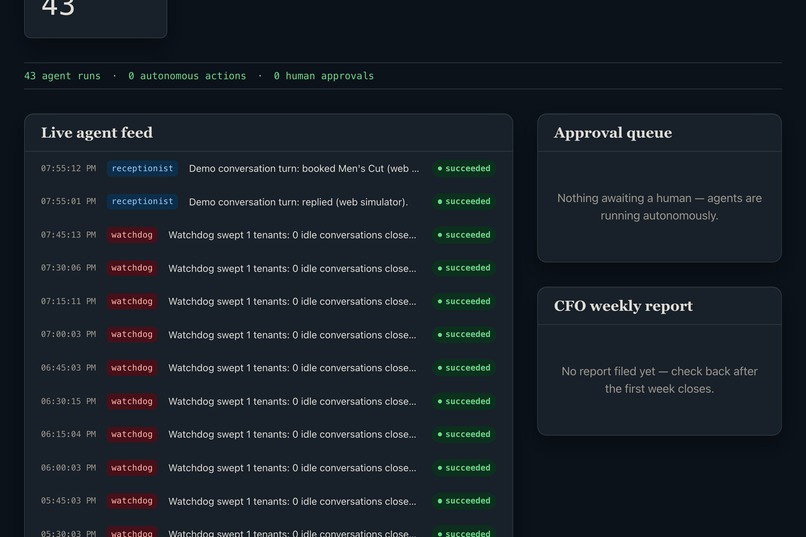
Live agent feed — the receptionist and the watchdog firing every 15 minutes on Cloud Scheduler, all succeeded.
-
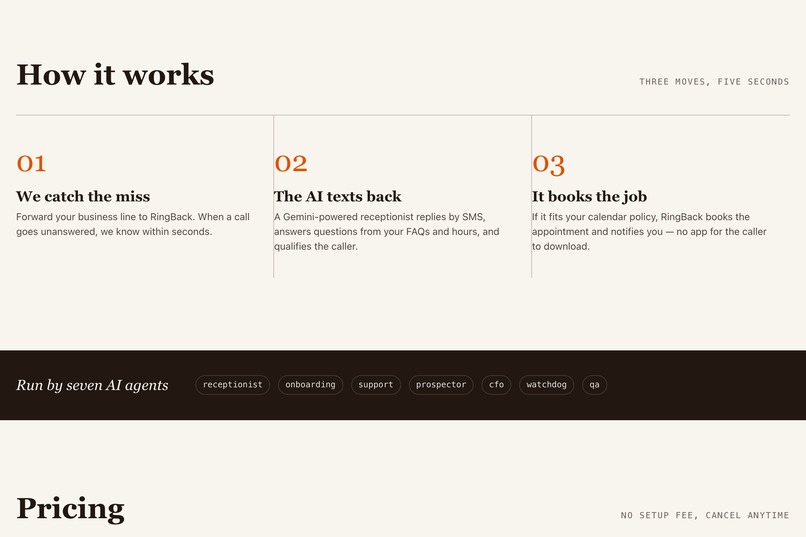
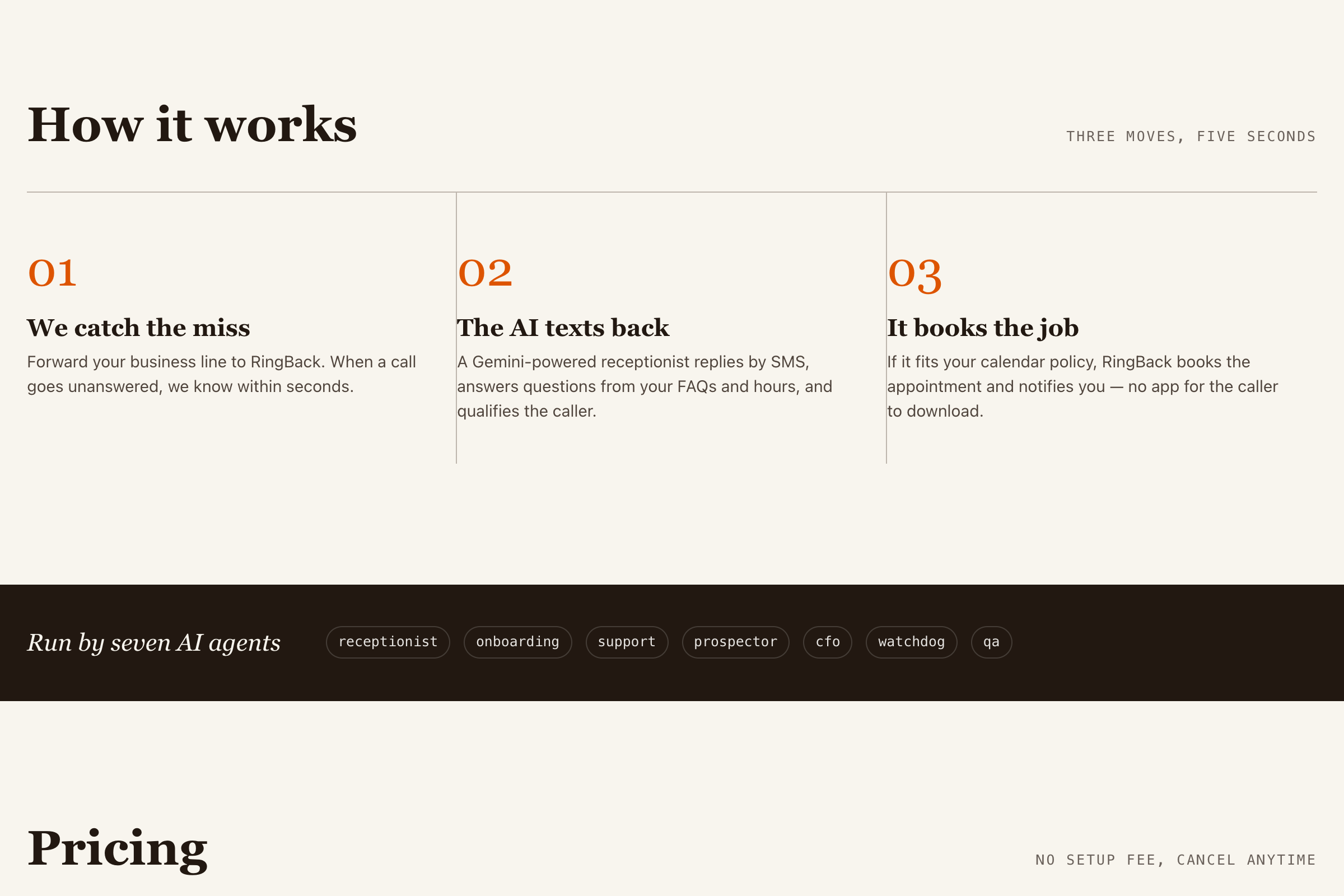
How it works: forward your line, miss a call, and a Gemini receptionist takes the conversation from there.
-
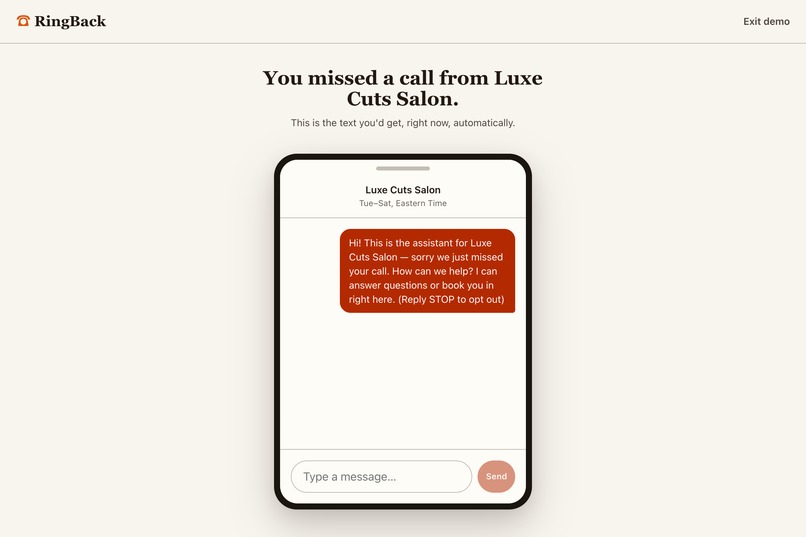
The textback a missed caller receives within seconds — identifying the business, with STOP opt-out built in.
Inspiration
Call a barber at two in the afternoon and there's a good chance nobody answers. They're mid-fade, hands busy, phone across the room. Studies of small local businesses put unanswered calls somewhere between 40% and 60% — and most people who reach voicemail don't leave one. They call the next shop on Google.
For a one-chair salon or a two-person plumbing outfit, that's rent walking out the door while the owner is doing exactly what they should be doing: their job. They don't need a receptionist they can't afford. They need the call answered.
That's the product. But the bigger question this hackathon asks is whether a business can be run by AI — so we set out to prove both at once, in a way a judge could verify rather than take on faith.
What it does
A business forwards its line to a RingBack number. If nobody picks up, the caller gets a text within seconds, and a Gemini-powered receptionist takes the conversation from there: it answers questions strictly from that business's own services, hours and FAQs, pulls genuinely open slots from their calendar, and books the appointment. The owner gets a summary and can take over any thread with one tap.
The receptionist is only agent #7. Six more agents run the company:
Onboarding — fires on Stripe checkout, provisions the phone number, reads the customer's website with Gemini, drafts their service list and FAQ, sends the welcome email Support — classifies inbound email and answers from a knowledge doc; anything billing escalates to a human Prospector — researches local businesses and drafts outreach, but never sends — a human approves and sends from their own inbox CFO — writes the weekly P&L narrative from real Stripe, Twilio and Gemini numbers Watchdog — every 15 minutes: closes idle threads, pauses tenants over budget, pages the founder QA — nightly, scores conversations 1–5 against a rubric and proposes prompt fixes
Every execution is logged and rendered on a public operations page at /ops — a live URL, not a screenshot, showing each run with its Gemini transcript, tool calls, cost and outcome.
How we built it
Node 22 + TypeScript + Fastify on Cloud Run, Firestore for data, Cloud Scheduler driving the agents on cron with OIDC auth, Secret Manager for credentials, BigQuery for the log sink, Cloud Build for CI. Gemini 2.5 Flash handles conversations with function calling (get_availability, book_appointment, escalate_to_owner); Gemini 2.5 Pro writes the CFO reports and QA scoring. Twilio for telephony, Stripe for billing, React for the dashboards.
The design decision that mattered most: write the agent charter before the agents. Each one has a documented authority limit — what it may do alone, what needs a human click, what it may spend. No agent can move money. No agent sends cold outreach. Those aren't technical limits, they're product decisions.
Guardrails, because this talks to real customers: STOP/HELP opt-outs handled deterministically in code before any model call; the AI is blocked from quoting a price that isn't in the business's own config; 20-turn cap; per-tenant daily SMS budget with an automatic kill switch; quiet hours; webhook signature verification; two-phase idempotency; one-tap owner takeover.
Challenges we ran into
US carrier registration (A2P 10DLC) takes weeks — longer than this hackathon existed. That's the honest reason there's no live SMS traffic. Rather than describe a product we couldn't deliver, we made the conversation engine fully exercisable over the web so anyone can evaluate the real thing today.
Three bugs that only production would have found, all caught by adversarial review rounds before launch:
The textback ran after the HTTP response on scale-to-zero Cloud Run, where CPU is throttled the moment a response completes. The core product promise could have silently never fired. No Firestore composite indexes existed. The first production SMS would have thrown, returned a clean 200 to Twilio, and failed every message after it with no alert. Business hours were modelled as nested arrays — which Firestore rejects outright. Every test passed (the in-memory test store accepts them) while production was impossible to deploy.
Each was invisible to a green test suite. That's the lesson.
Accomplishments that we're proud of 41 agent runs logged, 100% success rate, running unattended in production — verifiable by anyone at /ops A public, live evidence trail rather than claims: every agent execution with its Gemini transcript and cost Guardrails that hold: opt-outs handled before the model, prices the AI cannot invent, money and outreach gated on a human 74 automated tests and three rounds of adversarial robustness review before launch Total spend: $0.02. Zero marketing spend. The operations layer is agents, not staff. What we learned
Agents build fast and confidently wrong. The value was never in generating code — it was in the loop: build, review adversarially, verify against evidence, keep a human on anything irreversible. Every serious bug we shipped past was caught by pointing a skeptical reviewer at the builder's output, not by the builder being careful.
We also learned to report honestly. Revenue is $0 — no customer has been charged. We could have dressed that up. But the rules let judges request live demos and financial documentation, and a claim that collapses under a follow-up is worth less than a small true number. What we do have is fully checkable: a working product, real logged agent operations, and no customers yet.
What's next for RingBack
Carrier registration clears in weeks, not months — at which point the SMS path that's already built and tested goes live and the first missed call belongs to a real business. From there: the first paying customers at $49/month, AI-answered voice calls (the same tools, a different channel), and Google Calendar sync.
Longer term, the interesting model isn't selling one salon at a time. It's the people who already serve Main Street — bookkeepers, local marketers, IT consultants — reselling RingBack setups while the onboarding agent does the technical work and they keep the relationship. The operating pattern is documented publicly in the repo for exactly that reason.
Built With
- bigquery
- cloud-build
- cloud-run
- cloud-scheduler
- docker
- fastify
- firestore
- gemini
- google-cloud
- node.js
- react
- secret-manager
- sendgrid
- stripe
- twilio
- typescript
- vite
- vitest
- zod

Log in or sign up for Devpost to join the conversation.