-
-
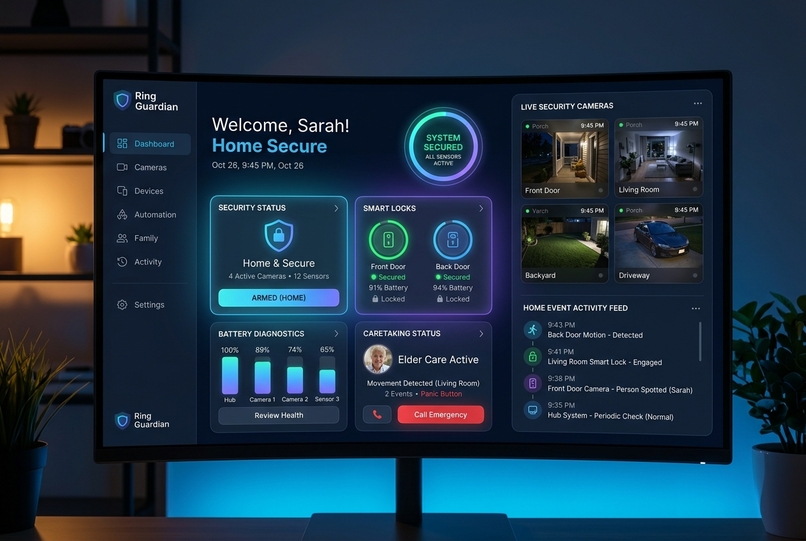
Overview Dashboard: Status cards, device battery diagnostics, live event activity feed, and system status.
-
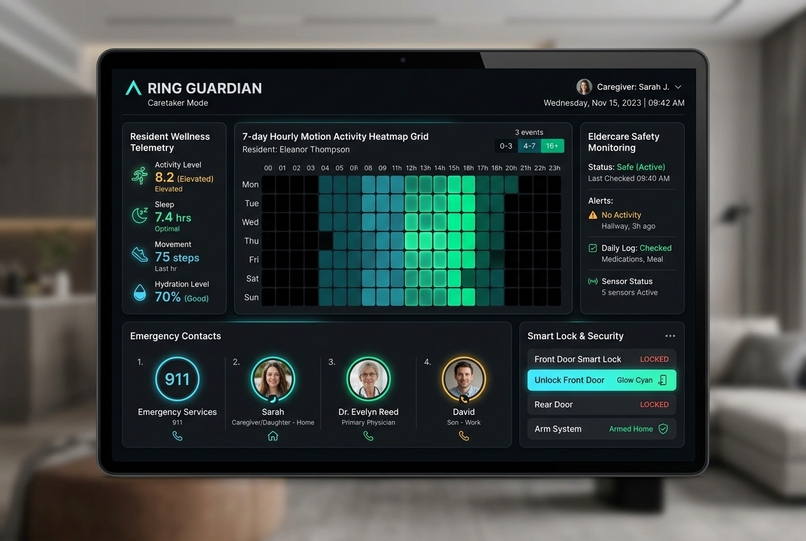
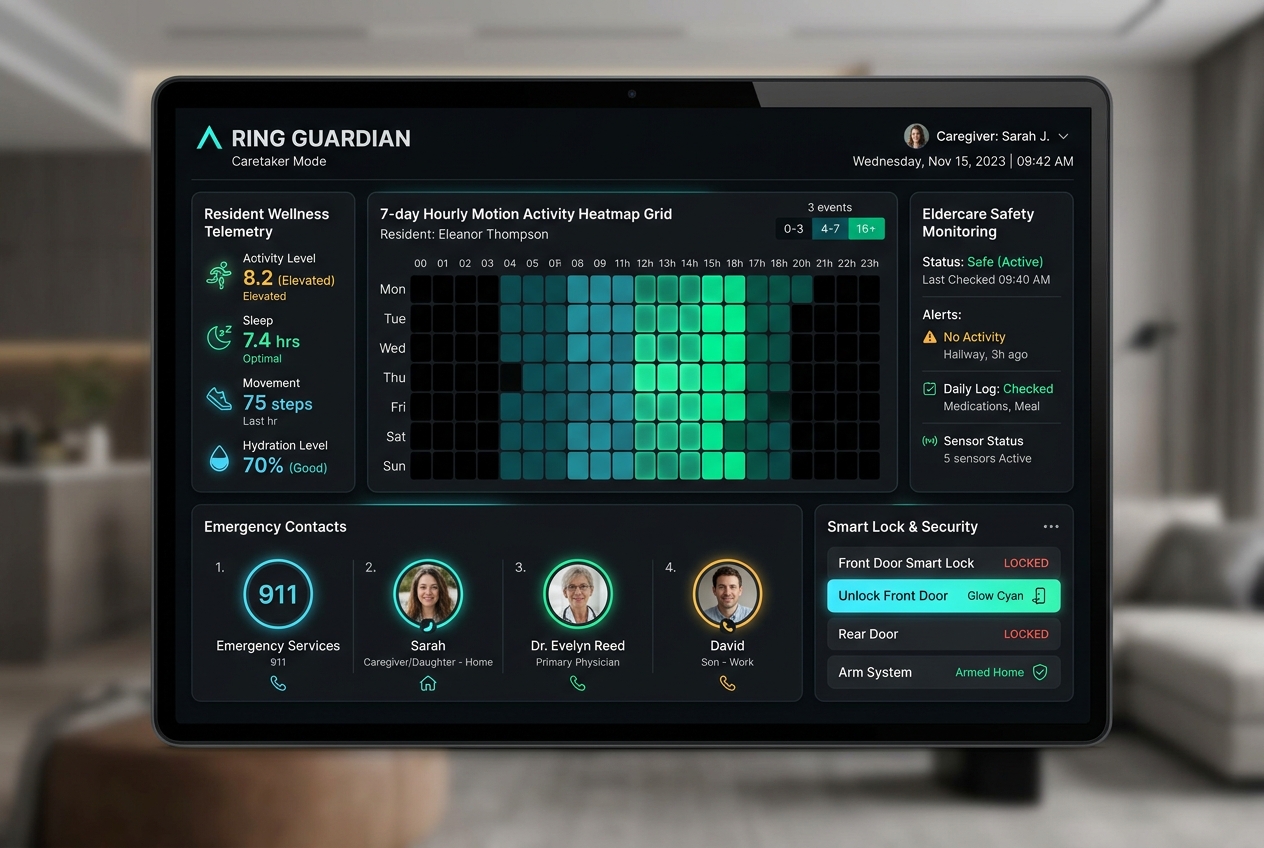
Caretaker Mode: 7-day hourly motion activity heatmap grid, wellness telemetry, and emergency contacts.
-
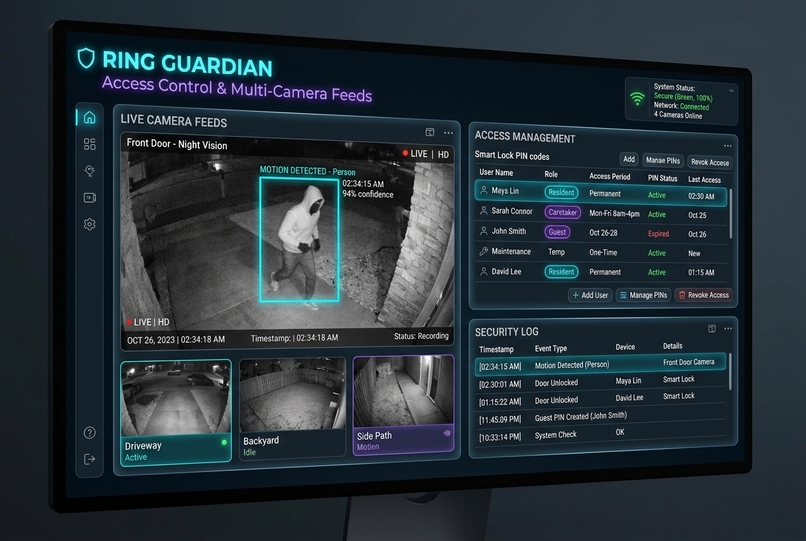
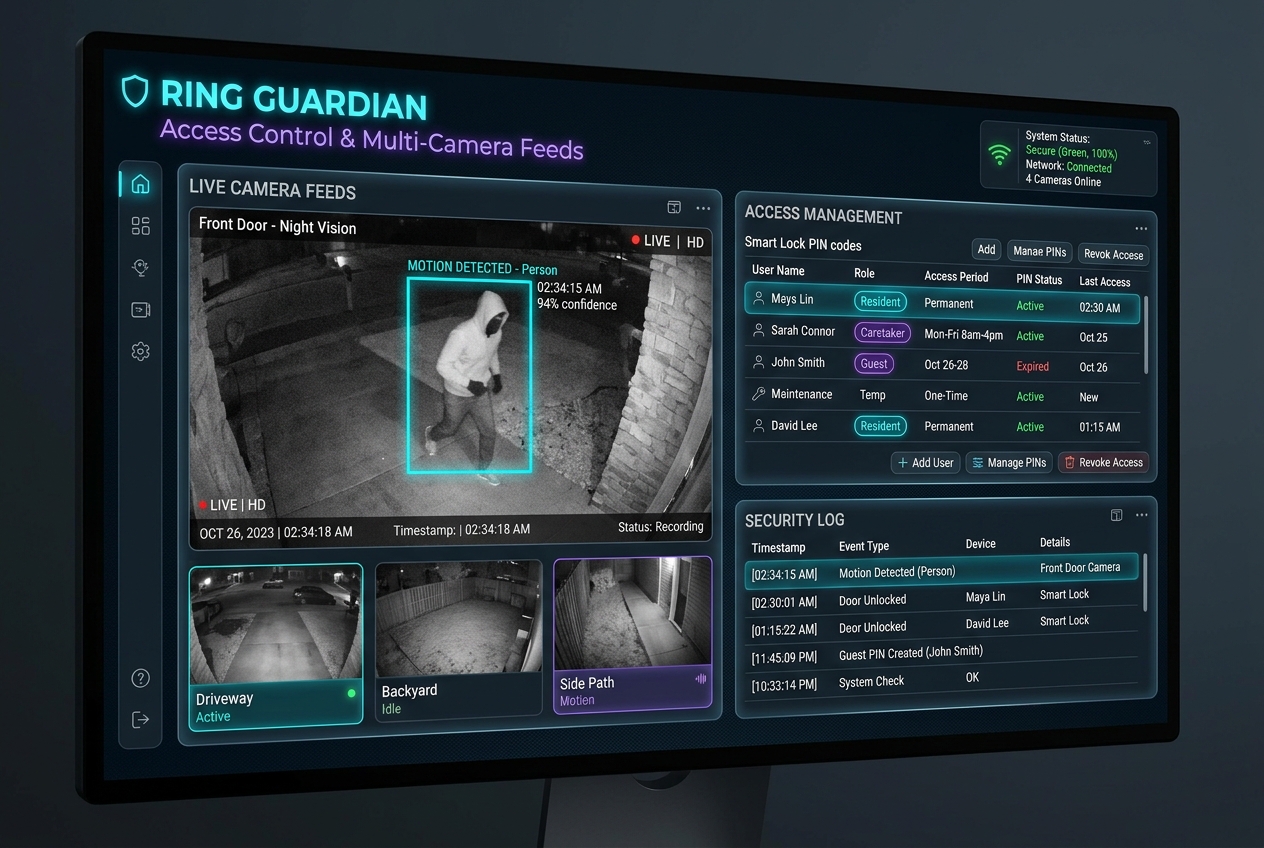
Access Control & Feeds: Smart Lock PIN management, live camera streams with motion detection bounding boxes.
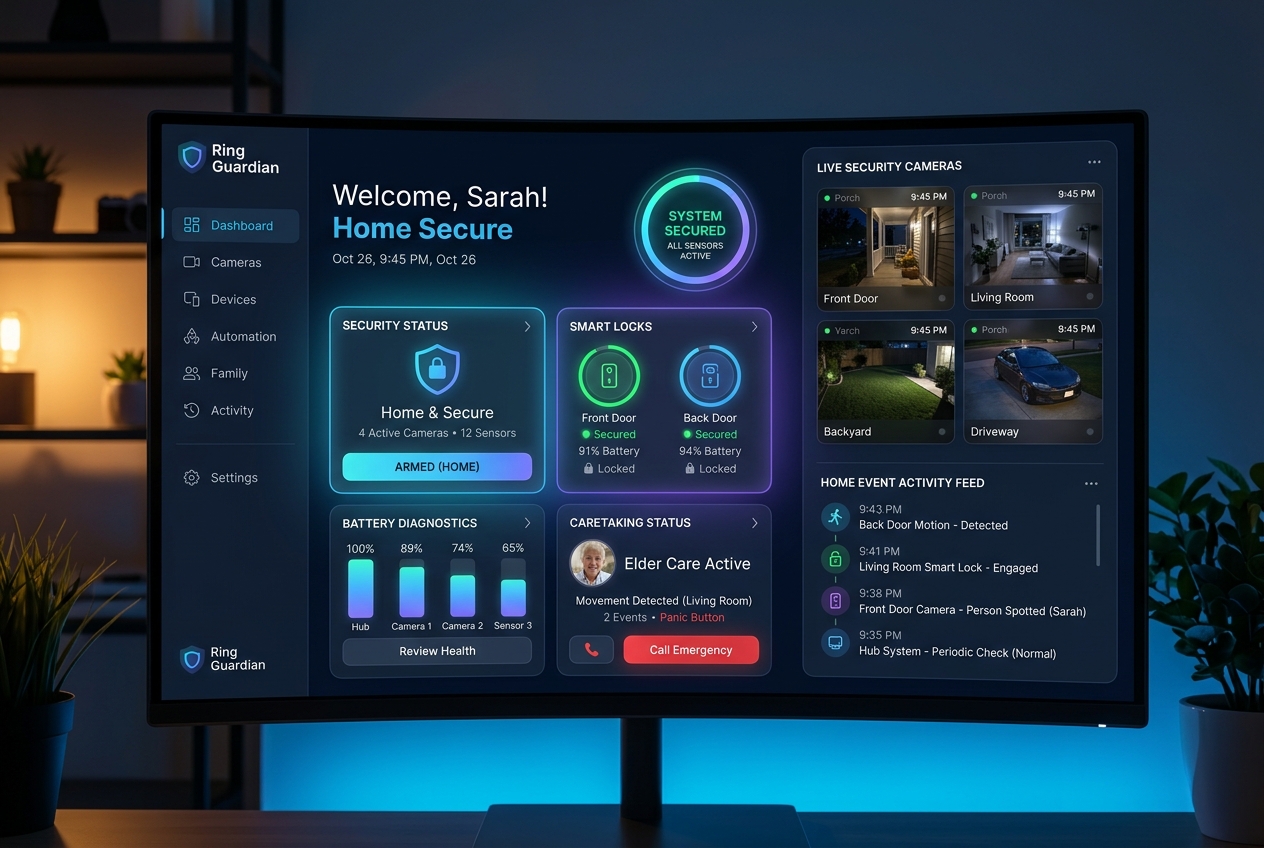
Millions of families face a difficult challenge: how do we ensure our aging parents or vulnerable relatives are safe at home without stripping away their privacy or independence?
Traditional smart home security solutions focus almost exclusively on keeping strangers out—detecting intruders, alerting on perimeter breaches, or monitoring package deliveries. However, for eldercare and assisted living, the most critical risks happen inside: prolonged morning inactivity, missed routines, delayed medical responses, or unauthorized access during emergencies.
We were inspired to reimagine what the Ring ecosystem can achieve. Instead of treating Ring devices purely as passive video doorbells and alarm sirens, we asked: What if Ring devices could work together as an ambient, intelligent wellness guardian?
This led to Ring Guardian—a modern smart home platform that combines access control, real-time camera telemetry, and non-intrusive ambient activity monitoring to give families total peace of mind.
What It Does
Ring Guardian turns Ring cameras, smart locks, sensors, and chimes into a cohesive caretaking and security hub:
Interactive Central Dashboard: Provides a unified overview of all hardware nodes, quick-action front door lock/unlock toggles with audit logging, and instant notification of critical wellness alerts. Caretaker Mode & Ambient Wellness Monitoring: Tracks routine motion events passively (without intrusive indoor cameras in private living areas) and flags anomalies, such as lack of expected morning activity or unusual nighttime departures. 7-Day Activity Heatmap: Visualizes hourly motion intensity across the week, helping families identify long-term mobility trends and daily rhythms. Smart Access Control & Keypad Provisioning: Manages digital credentials for family members, routine caregivers, service professionals, and first responders, complete with temporary validity windows and emergency bypass codes. Multi-Stream Live View Simulator: Simulates high-definition video feeds with dynamic motion bounding boxes, recording status indicators, and audio diagnostics. Chronological Audit Log: Maintains a searchable, filterable log of every motion trigger, doorbell ding, lock actuation, and system alert.
How We Built It
We built Ring Guardian as a responsive single-page application engineered with a clean separation between state management, hardware simulation, and user presentation:
Frontend Core: Built with React 19, TypeScript, and Vite for blazing-fast Hot Module Replacement (HMR) and strict type safety. Ring Telemetry & API Simulator: Designed a robust client-side event bus that mirrors official Ring REST endpoints and WebSocket live feeds. It simulates real-time device status changes, periodic motion events, and door state transitions. Design System & UI: Crafted a custom dark-mode design system with glassmorphic cards, CSS micro-animations, and responsive layouts using pure CSS variables and tokens. Automated Testing: Integrated Vitest, React Testing Library, and JSDOM to guarantee component reliability across all 6 views.
Mathematical Formulation for Activity & Anomaly Detection
To detect wellness anomalies without intrusive monitoring, we model daily movement as a normalized hourly activity density vector $\vec{A}d = [a_0, a_1, \dots, a{23}]^T$, where each hour $h \in [0, 23]$ records the cumulative trigger count $C_{d, h}$ from PIR sensors.
The normalized hourly intensity index $I(d, h) \in [0, 1]$ used to generate the 7-day activity heatmap is computed as:
$$I(d, h) = \frac{C_{d, h}}{\max_{d, h} (C_{d, h}) + \epsilon}$$
where $\epsilon = 10^{-6}$ prevents division by zero in low-activity baselines.
An Inactivity Anomaly Score $\mathcal{S}_{\text{alert}}$ is triggered during active hours (e.g., $08:00 \le h \le 20:00$) when the observed motion falls significantly below the historical expected mean $\mu_h$ by more than two standard deviations:
$$\mathcal{S}{\text{alert}} = \frac{\mu_h - C{\text{current}, h}}{\sigma_h} > 2.0$$
When this condition is met, Ring Guardian automatically fires a high-priority Wellness Alert to designated emergency contacts.
Challenges We Ran Into
Simulating Asynchronous Hardware Events: Without access to physical proprietary test hardware for all review environments, we needed the simulator to faithfully represent the latency, intermittent connectivity, and WebSocket ping cycles of real IoT devices. We designed custom React hooks (useRingSimulator) to manage concurrent background timers and immutable state queues. Preventing Scroll-Trapping in Multi-Pane Dashboards: Building dense telemetry views with sticky top bars, fixed sidebars, and expansive heatmaps created layout overflow issues across different device resolutions. We refactored the layout hierarchy from nested scroll containers to a clean, document-level smooth scroll architecture with sticky blurred backdrops. Cross-Platform Static Asset Resolution: Deploying a unified Vite build to both subpath-hosted environments (GitHub Pages at /Ring-Guardian/) and root-hosted domains (Vercel at /) caused 404 asset errors until we configured dynamic relative base paths (./) in Vite's bundling pipeline. Accomplishments That We're Proud Of 100% Zero-Crash Architecture: Achieved a clean, production-ready build with 0 TypeScript compiler errors and a comprehensive Vitest automated test suite covering all views. Live Cloud Deployment: Seamlessly deployed to Vercel with global CDN caching and automated CI/CD via GitHub Actions. Human-Centric UX: Created an interface that feels like a native Amazon/Ring device ecosystem product—modern, dark-themed, and accessible.
What We Learned
How to architect complex IoT state machines where hardware actions (e.g., toggling a smart deadbolt) dynamically generate downstream audit events and affect multiple UI widgets simultaneously. Best practices for optimizing React 19 component lifecycles when dealing with frequent real-time data ticks and simulated WebSocket events. The immense potential of repurposing security sensors into preventative healthcare and assisted-living technology.
What's Next for Ring Guardian
Alexa Voice Integration: Add Alexa Skills kit support to announce wellness summaries ("Alexa, check on Mom's home") and trigger lock commands hands-free. Predictive ML Routine Modeling: Train lightweight on-device models to adaptively learn personal sleep/wake routines rather than relying on fixed threshold hours. Ring Intercom & Chime Integration: Enable two-way automated voice check-ins when an inactivity alert is triggered before escalating to external emergency contacts.
Built With
- access-control
- accessibility
- caregiving
- css3
- eldercare
- git
- github-actions
- home-automation
- html5
- iot
- javascript
- lucide-react
- react
- responsive-design
- rest-api
- ring-api
- security
- smart-home
- testing-library
- typescript
- vercel
- vite
- vitest
- websockets

Log in or sign up for Devpost to join the conversation.