Inspiration
Most embedded systems rely on blocking loops like delay(), forcing microcontrollers to run at full power while idle. I wanted to build a zero-overhead tool to help developers visualize and eliminate these processor serialization leaks instantly.
What it does
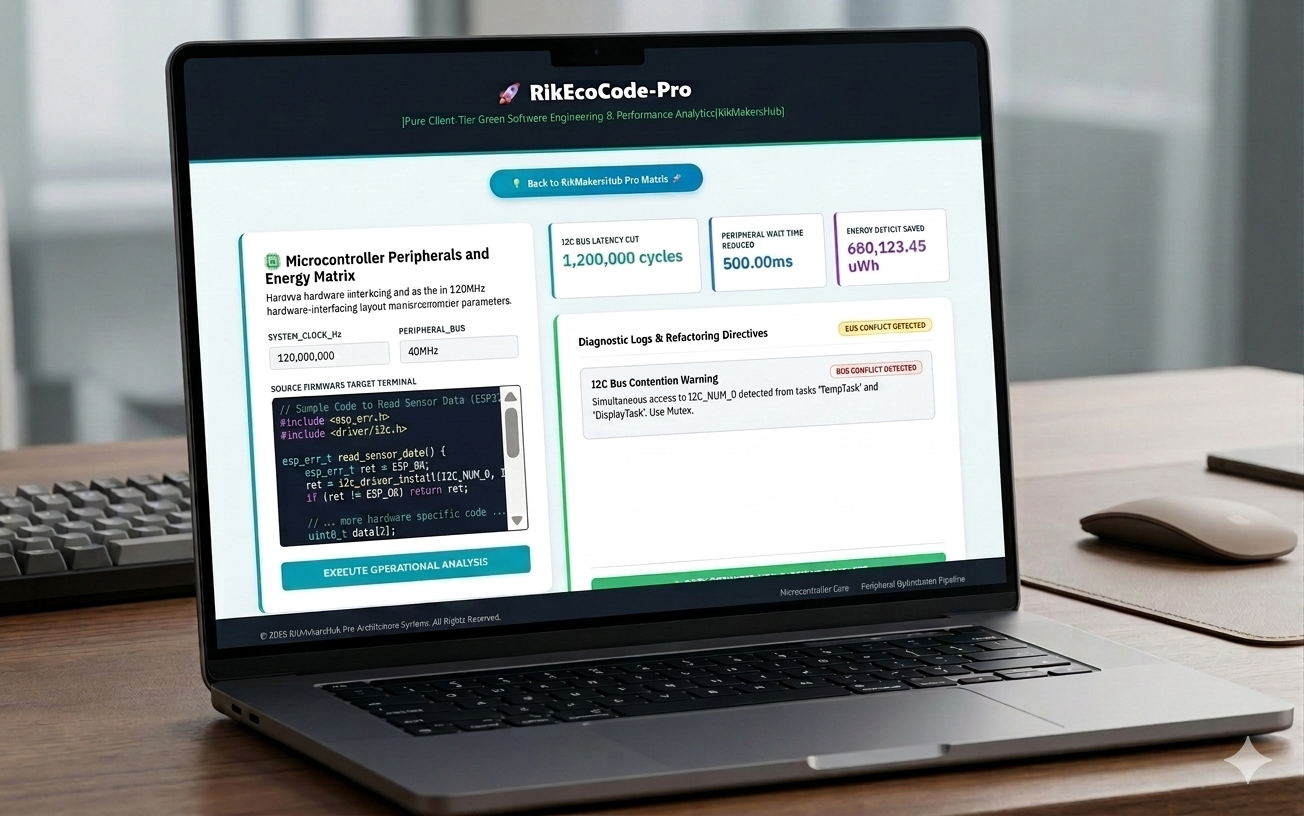
RikEcoCode-Pro is a client-tier GreenTech analyzer for firmware optimization. It inputs target clock speeds (16 MHz to 240 MHz) and operations to output real-time sustainability metrics: Wasted Cycles Cut, CPU Compute Saved, and Energy Deficit Saved (μWh).
How I built it
I built the entire application using semantic HTML5, CSS Grid, and raw JavaScript time-to-clock transformation algorithms. The logic runs completely on the client side, meaning the application itself uses minimal computation and consumes zero server-side energy.
Challenges I ran into
The biggest challenge was accurately mapping execution paths across vastly different hardware architectures. Translating an abstract code loop array into precise physical micro-watt hours (μWh) required careful profiling of microcontroller idle current draws.
Accomplishments that I'm proud of
I succeeded in making a fully functioning sustainability telemetry tool that operates with 100% serverless, static architecture. The one-click non-blocking code template generator provides immediate, actionable refactoring fixes for developers.
What I learned
I deepened my understanding of firmware execution efficiency and mathematical modeling for green software engineering. I learned how adjusting hardware clock constraints at the software tier drastically improves battery life for remote nodes.


Log in or sign up for Devpost to join the conversation.