-
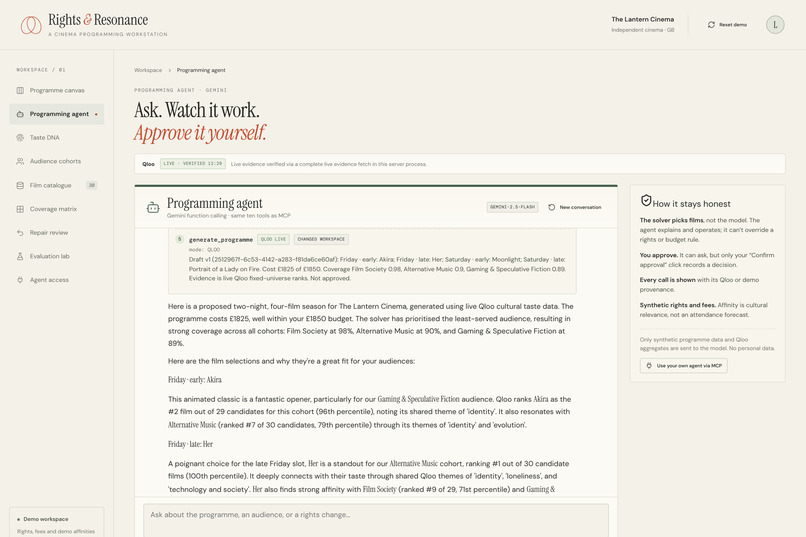
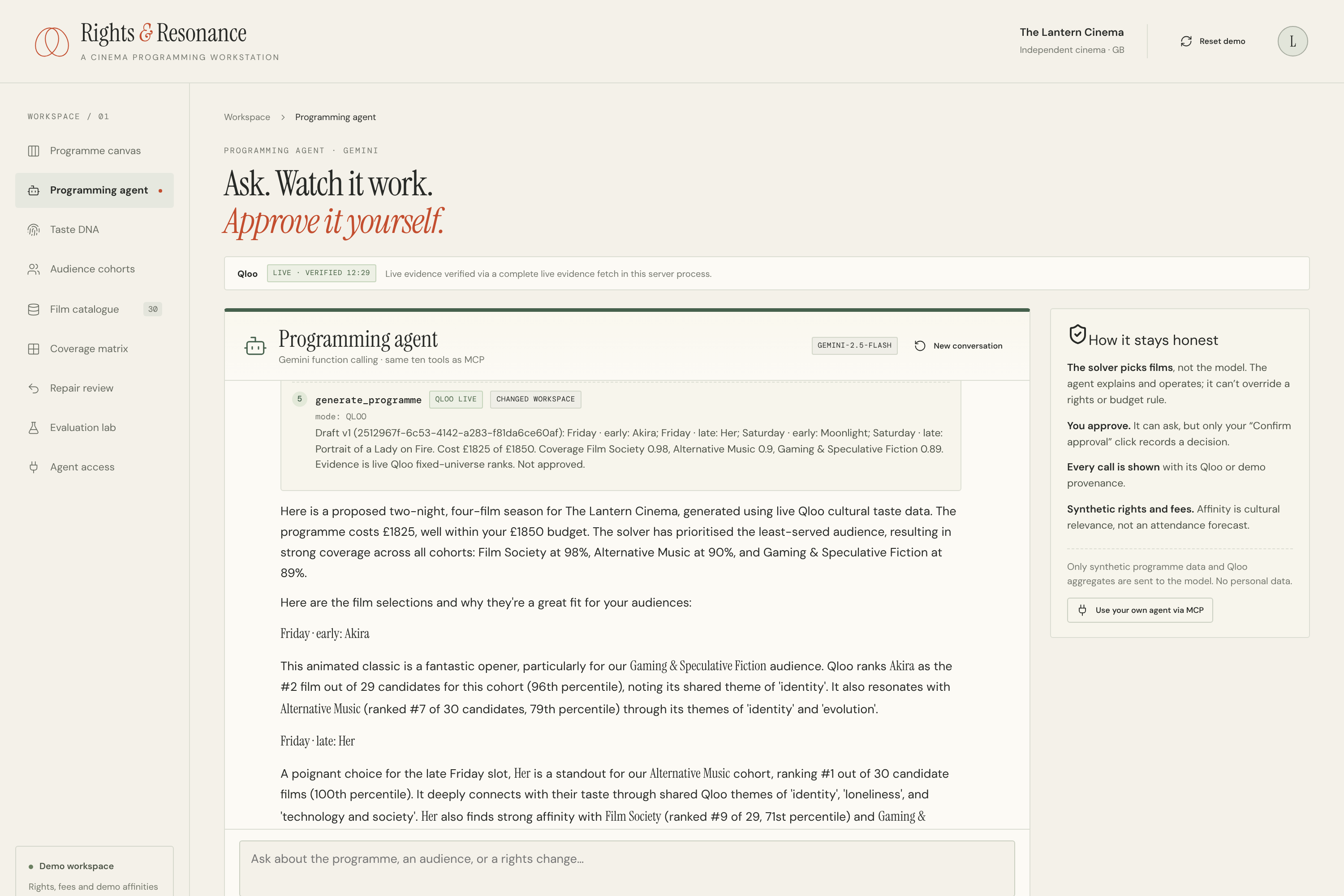
The agent plans the season, with each Qloo call marked “Qloo live”
-
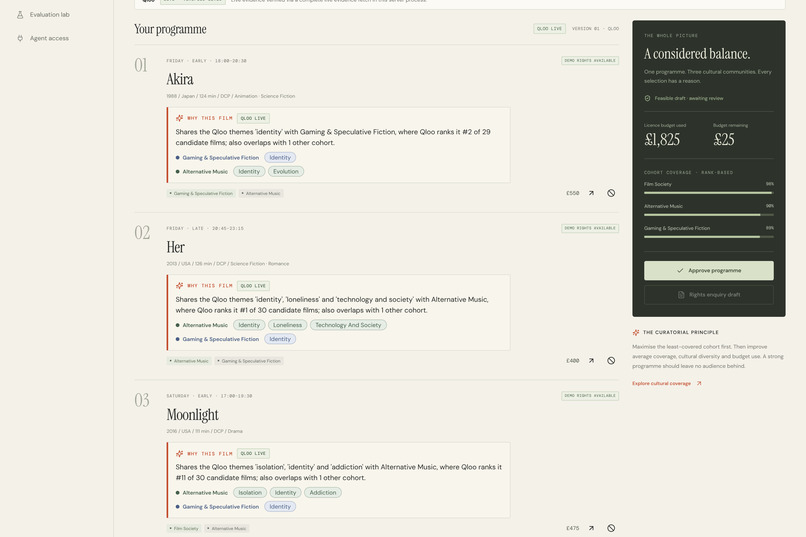
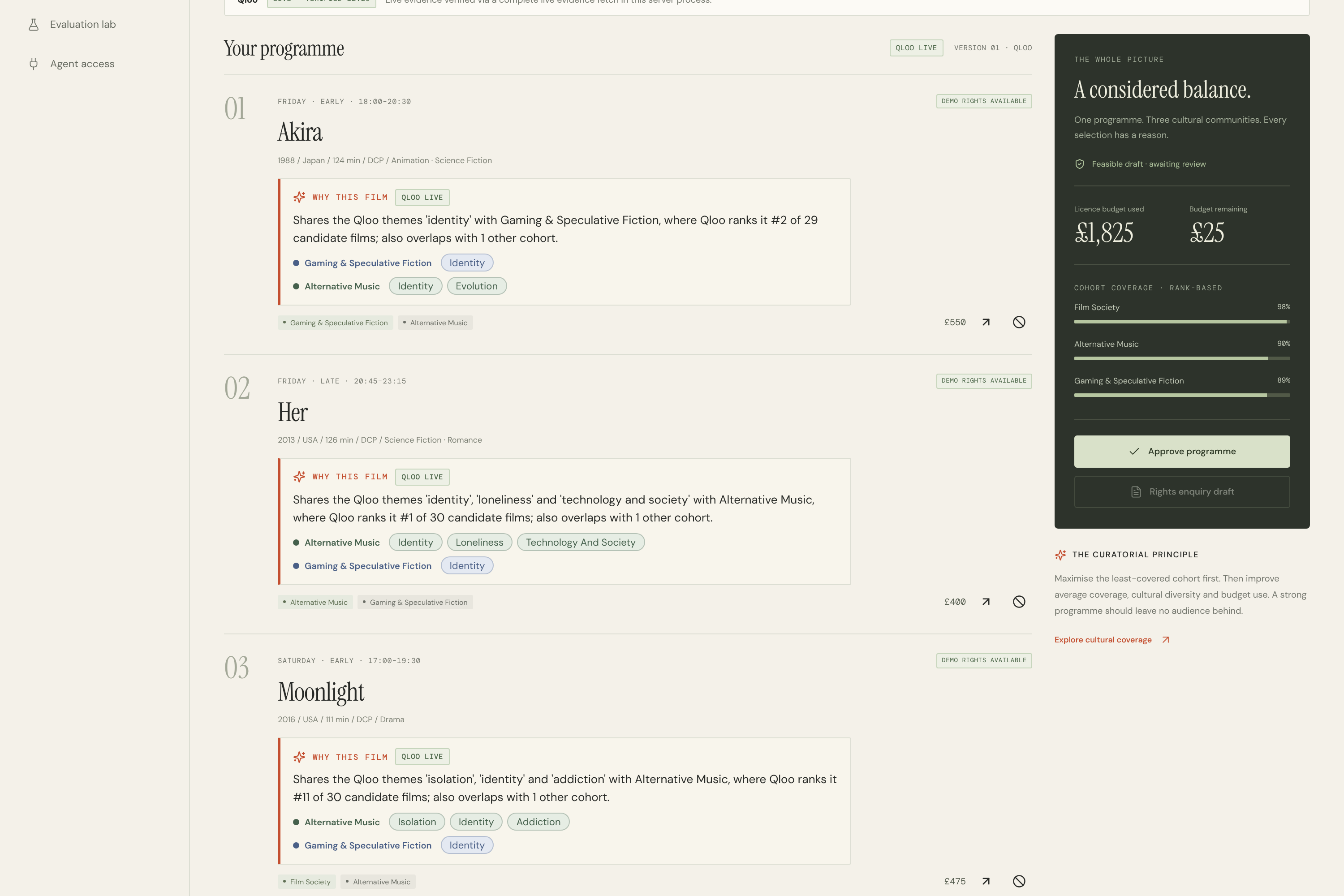
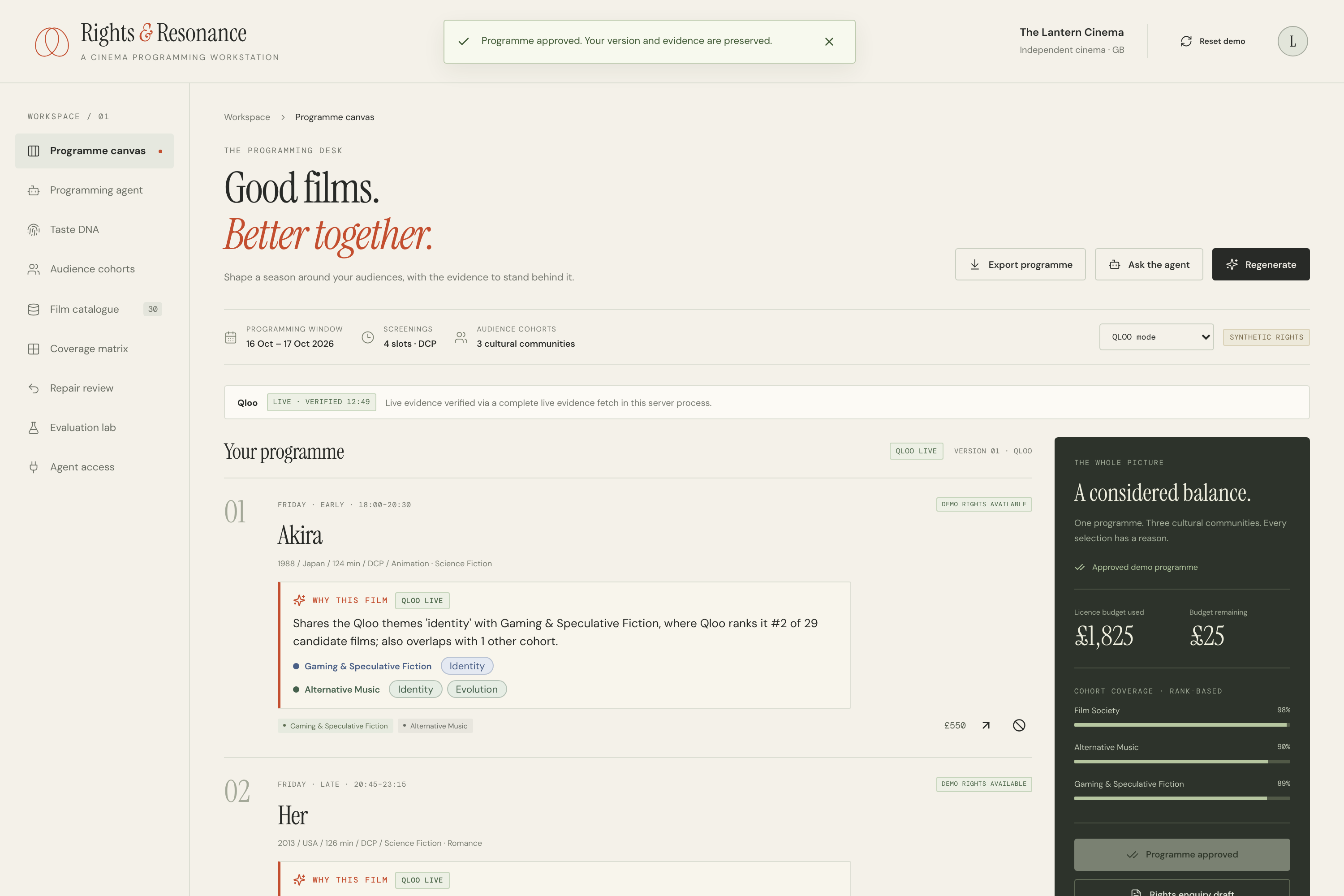
The four-film programme, with a “why this film” line for each pick
-
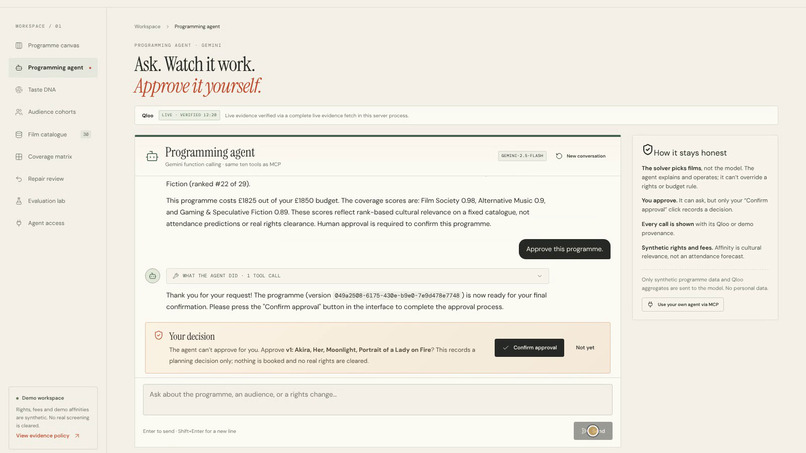
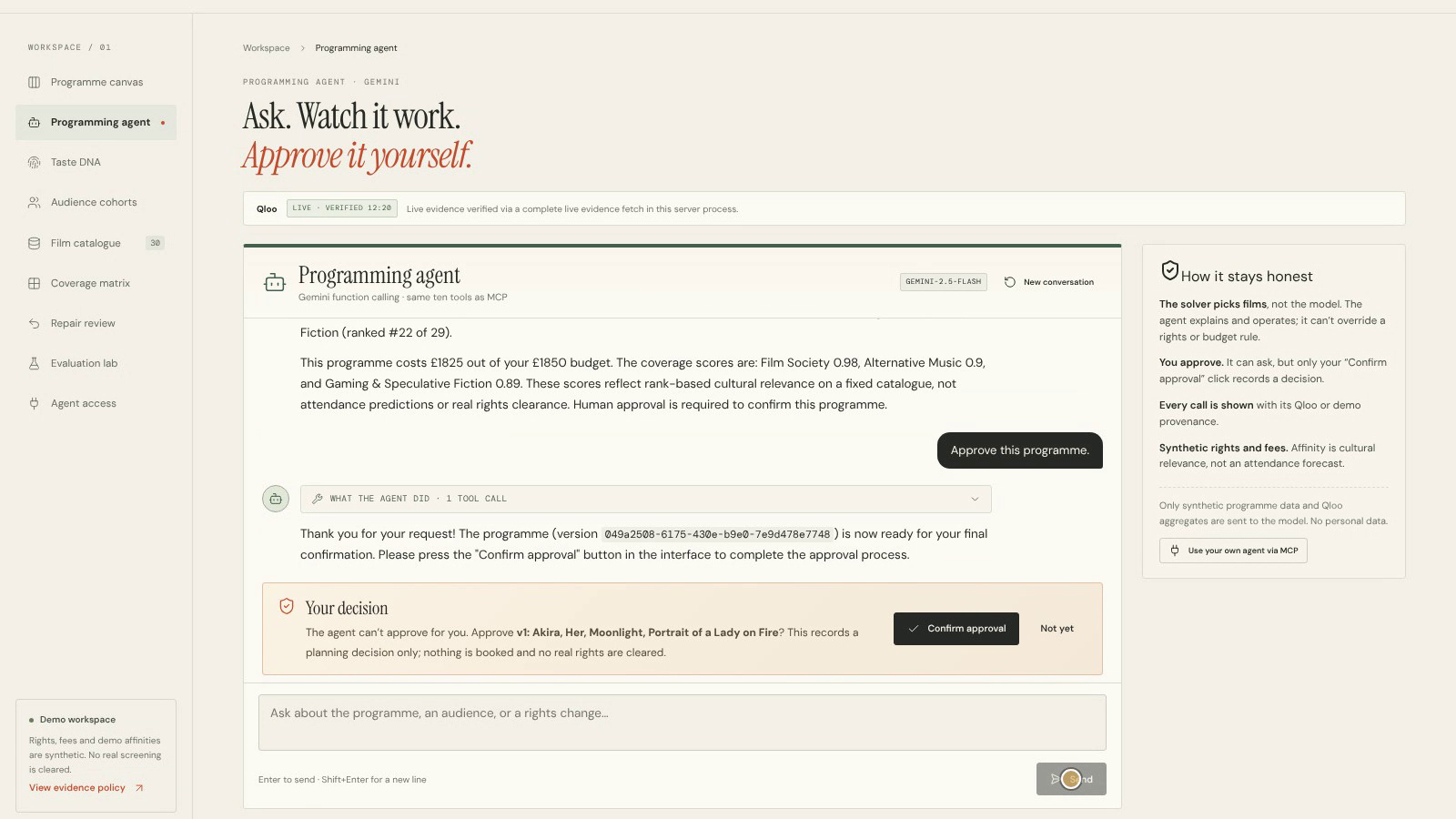
The agent asks for approval and the human confirms (taken from the recording)
-
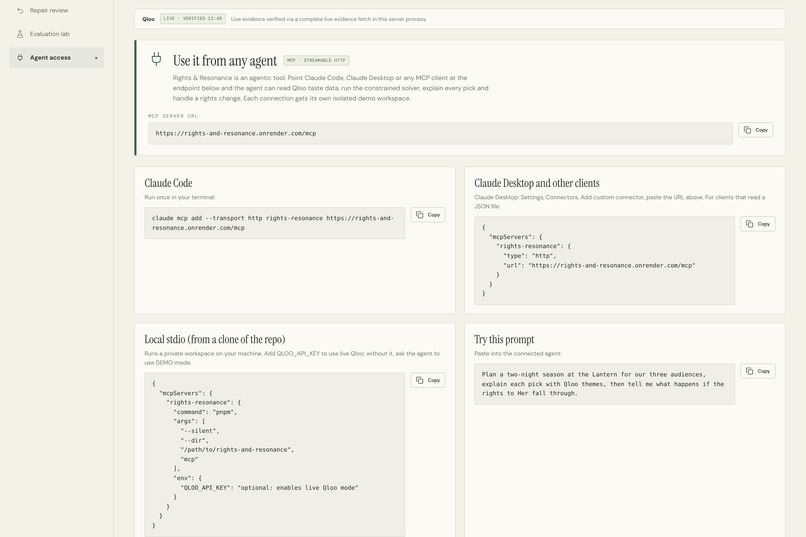
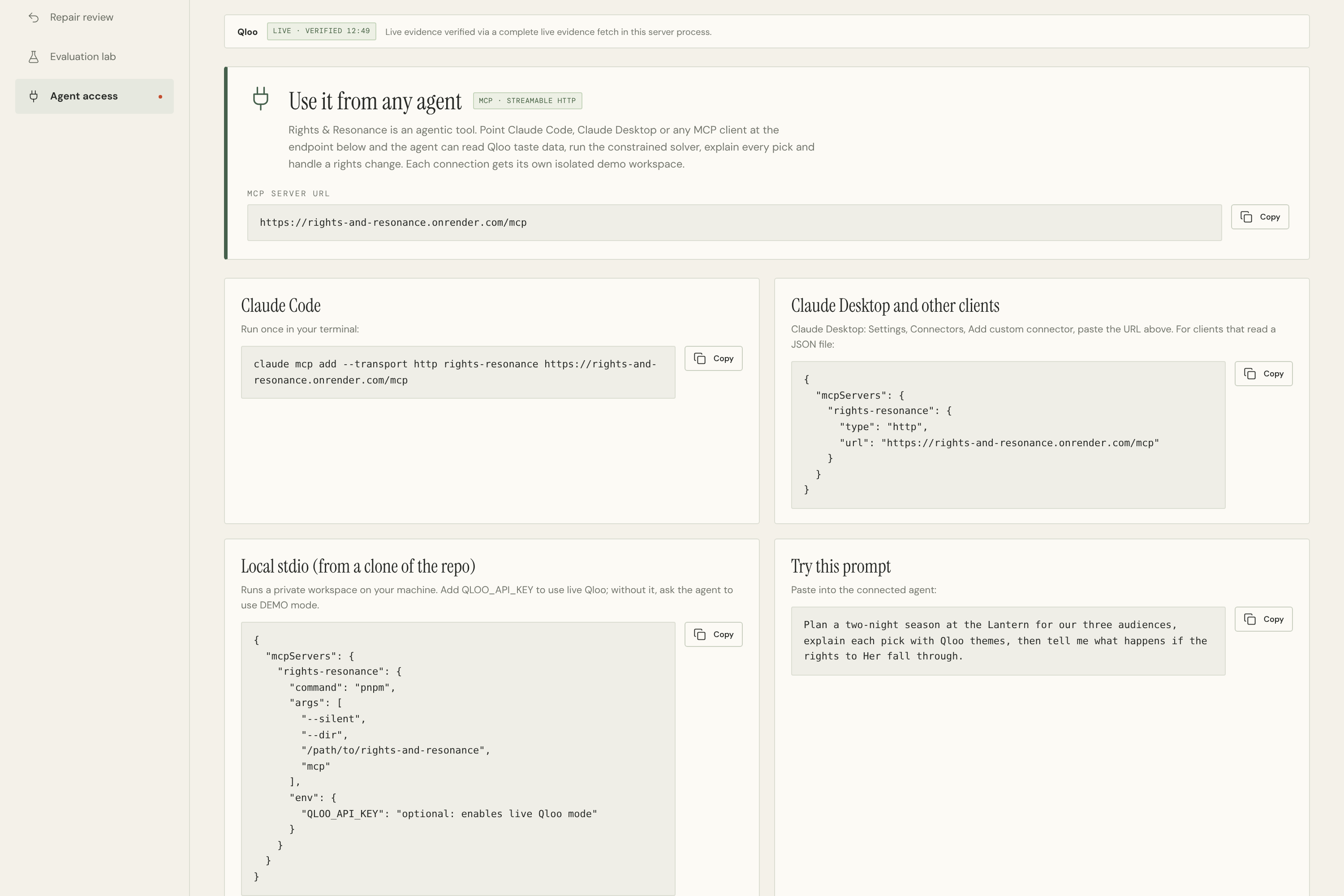
MCP setup page
-
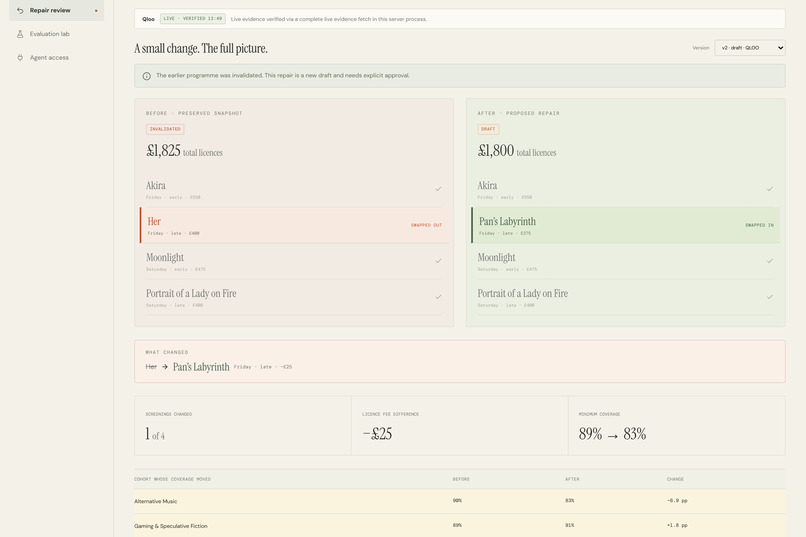
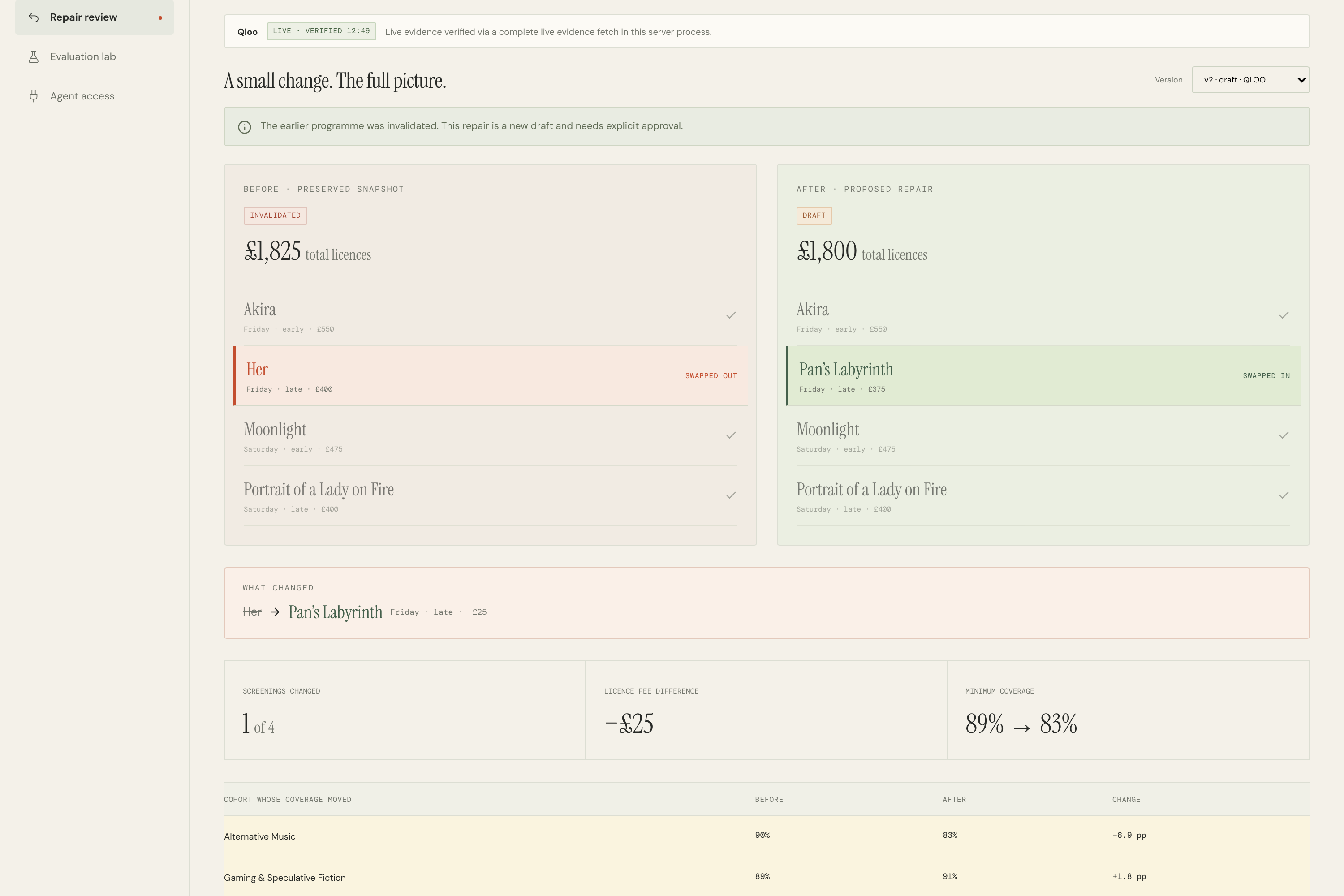
Repair review: Her swapped for Pan’s Labyrinth, £1,825 → £1,800
-
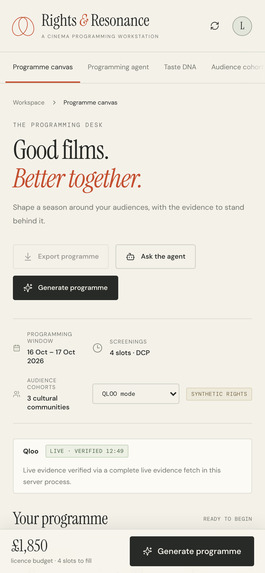
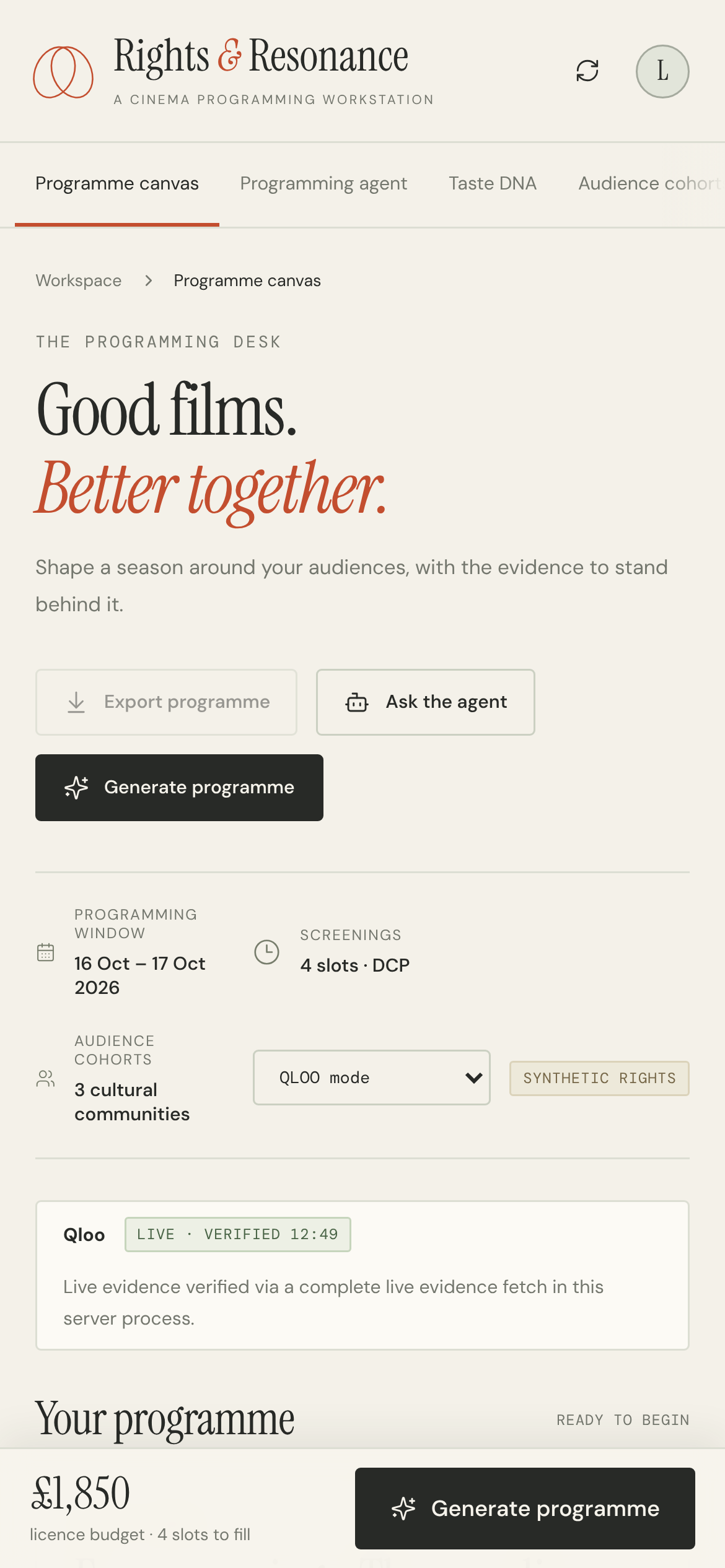
Phone view
-
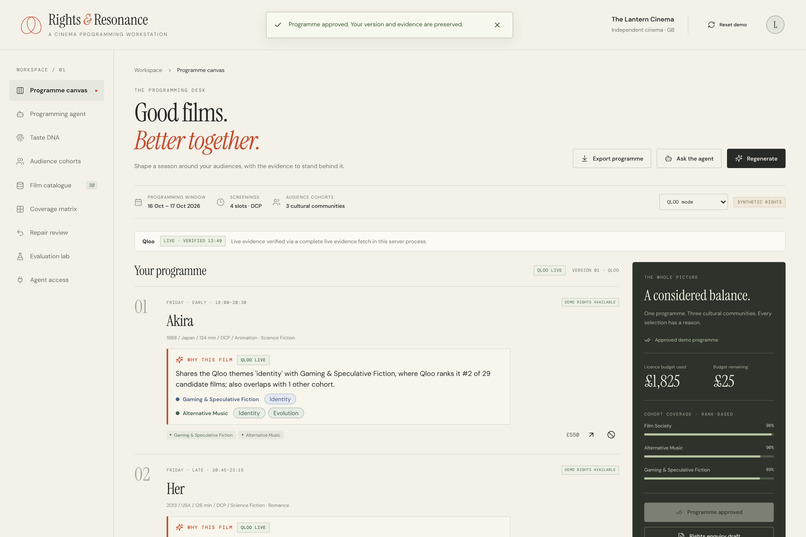
The approved programme
-
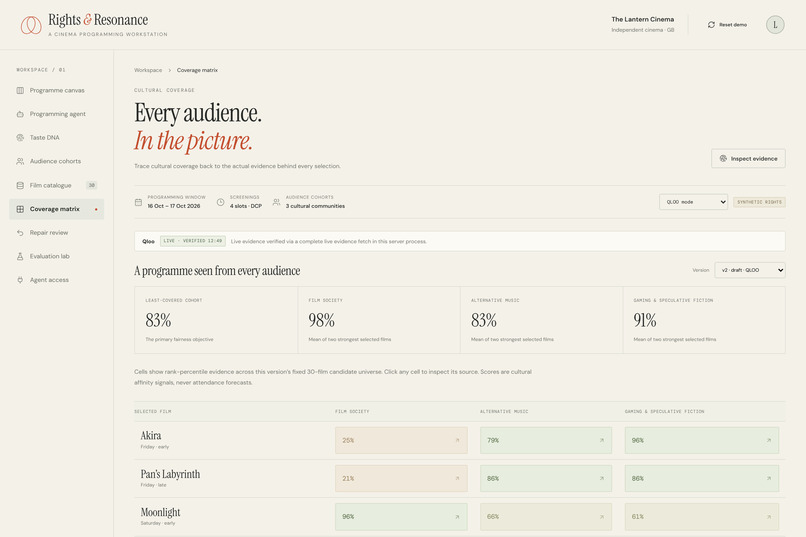
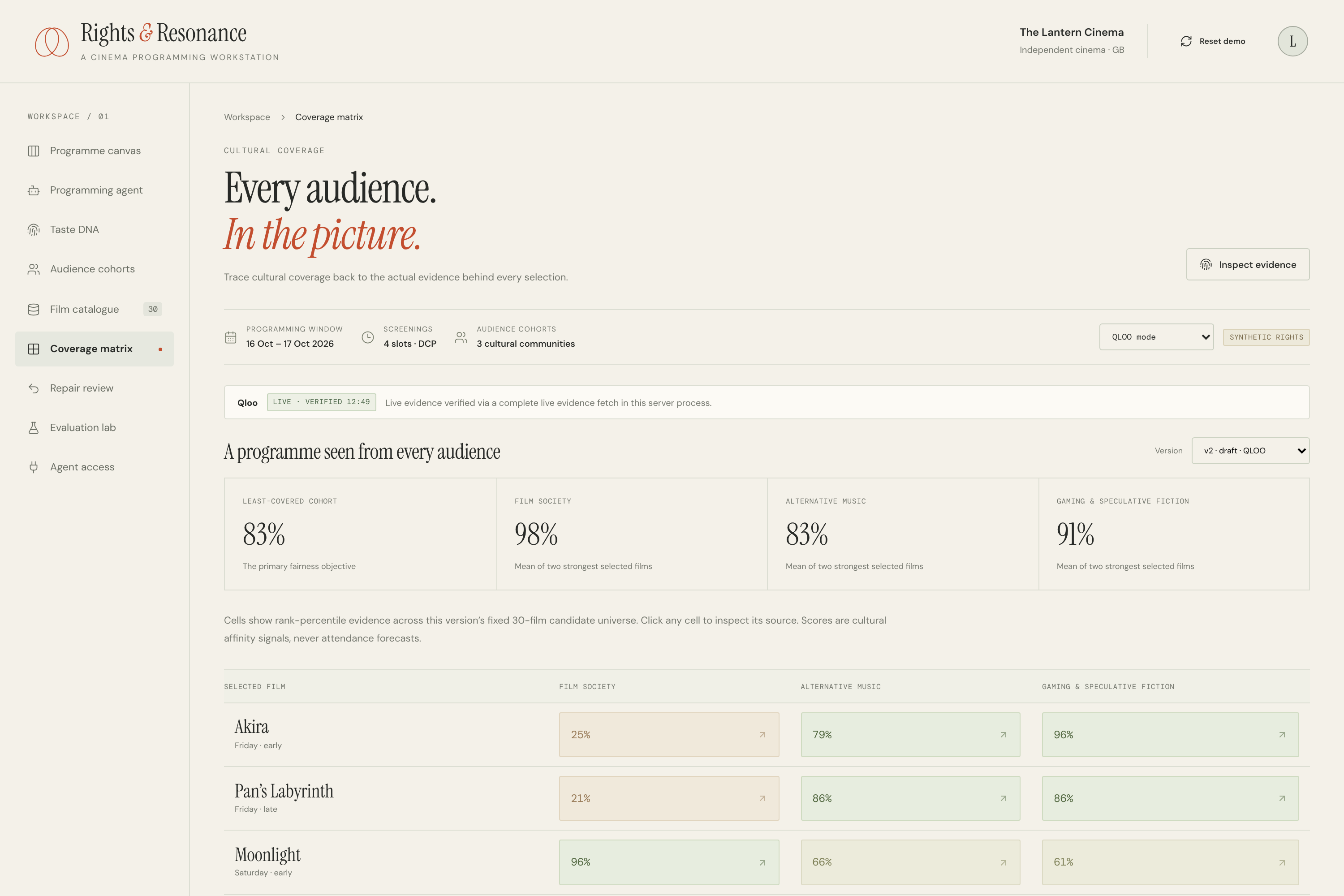
Coverage matrix
-
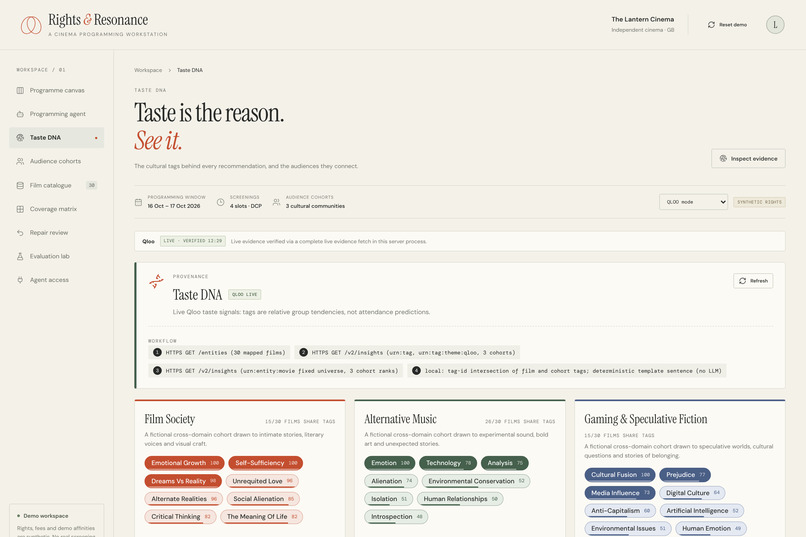
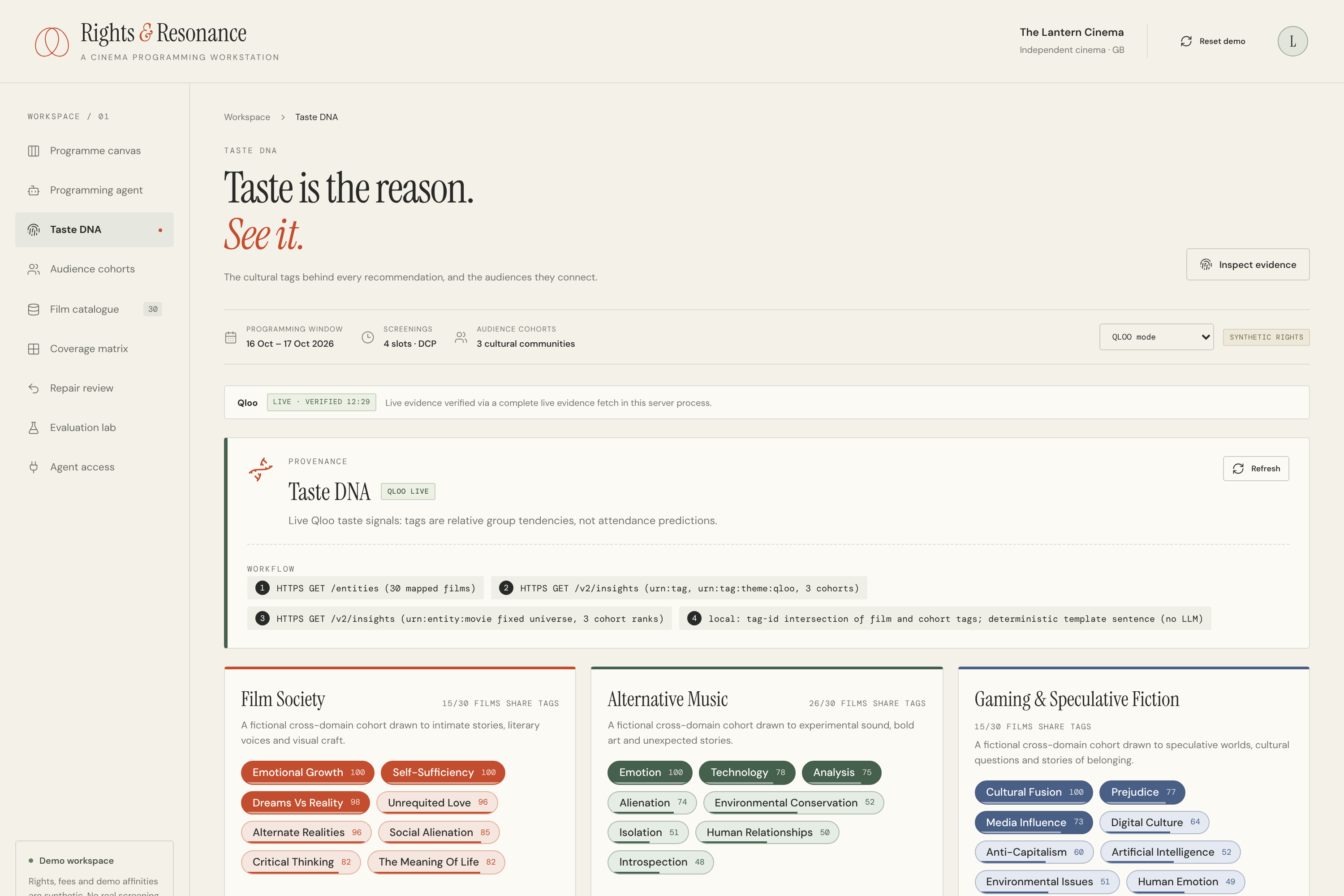
Taste DNA
-
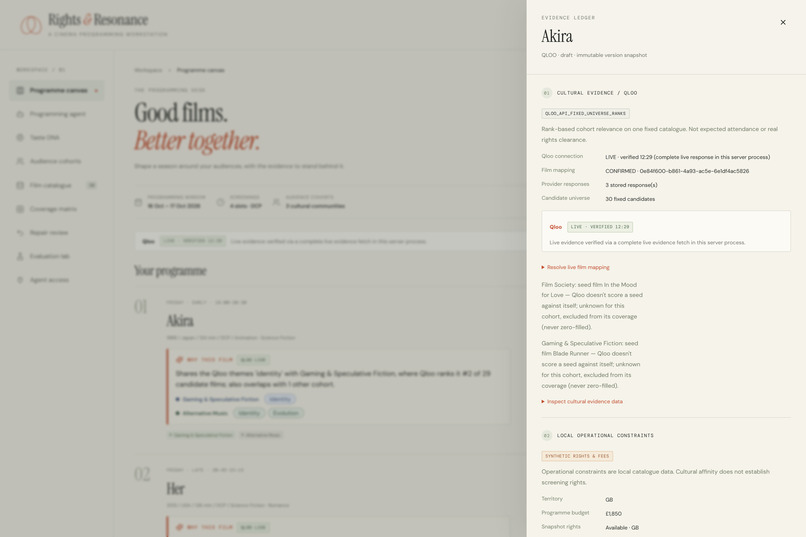
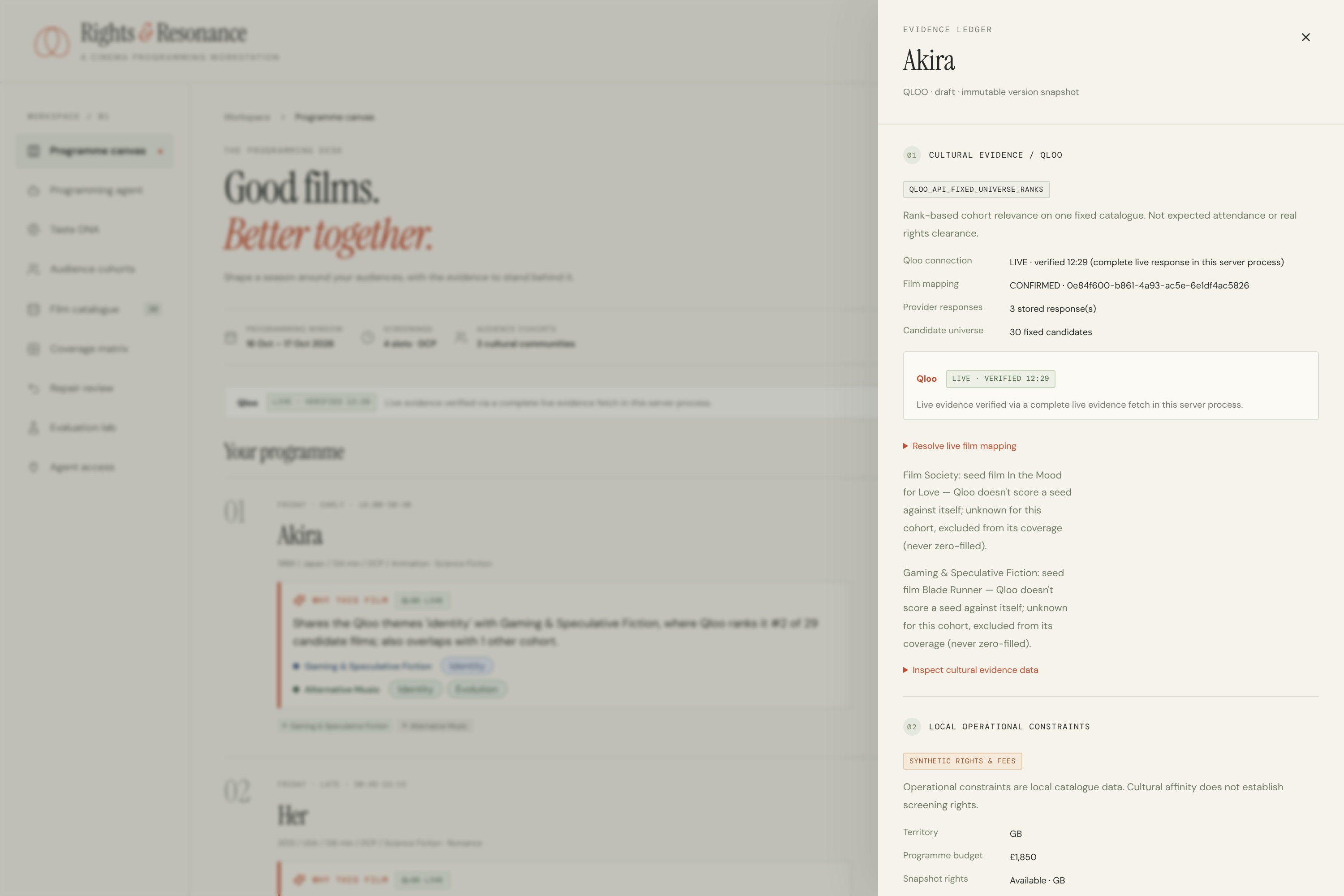
The evidence panel
Eligibility at a glance
Project status. Created during the submission period. First commit 2 October 2026; the period opened 30 September 2026. No code predates the period.
Stage One (pass/fail): met under (a) and (c)
| Rule | How this project meets it |
|---|---|
| (a) Functions as an agentic tool | Ten agent tools (get_workspace to export_programme) run behind two front doors: the in-app Programming agent and an MCP server at https://rights-and-resonance.onrender.com/mcp. |
| (b) Built using an agent framework | Not claimed. The in-app agent is a Gemini function-calling loop written directly against the REST API, with no agent framework. |
| (c) Integrates Qloo into an existing agent | Existing MCP clients connect to the same tools, for example Claude Code (claude mcp add --transport http rights-resonance https://rights-and-resonance.onrender.com/mcp) and Claude Desktop. |
Criterion 1: Technological Implementation
- Four Qloo endpoints in use.
/searchresolves films and cross-domain seeds./entitiesre-verifies IDs and fetches theme tags./v2/insightsbuilds cohort theme profiles (theme tags only)./v2/insightsscores all 30 films per cohort with explainability on. - Live gate passed on 18 October 2026 against
hackathon.api.qloo.com: 30/30 films mapped, 9/9 cross-domain seeds resolved, 3 complete and distinct cohort profiles. - Non-trivial working code. Constrained solver, immutable evidence snapshots with request and response hashes, a server-enforced approval gate, an MCP server with per-session isolation, and 139 unit/integration tests plus 3 Playwright end-to-end tests.
Criterion 2: Design
- A complete product, not a proof of concept. Programming agent, Taste DNA, programme canvas, evidence view, approval, rights withdrawal, repair review with diff, export, and an "Agent access" page for MCP.
- Every number carries its source. Badges read QLOO LIVE, DEMO or UNAVAILABLE. Missing data is shown as unknown, never as zero.
- Runs with no keys. DEMO mode runs the full generate, approve, withdraw, repair and export workflow, so judges can test it without setup.
Criterion 3: Potential Impact
- Real audience. Independent cinema programmers who choose one slate for several communities, under a fixed licence budget, while rights change after the slate is agreed.
- Specific pain. When a licence falls through, the usual fix is to rebuild the slate by hand. Here the agent changes the fewest slots, shows the diff with cost and coverage moves, and waits for a person to re-approve.
- Honest scope. One fictional cinema (The Lantern, Bristol). Rights and fees are synthetic. A real pilot would need an authorised rights feed first (see "What's next").
Criterion 4: Quality of the Idea
- Cross-domain taste seeds. Each audience is seeded with a film, a book and a music artist. Qloo's theme tags then describe a group's shared taste, not one genre label.
- Comparable scores. All films are scored over one fixed universe, so percentiles compare fairly across audiences. A seed film is marked unknown for its own audience, not zero.
- Division of labour. The agent proposes and explains. The solver chooses films under hard constraints. A person approves. A repair keeps the original approved version in history.
Inspiration
Cinema programmers pick a slate from a mix of instinct, distributor catalogues and what sold last time. Three things are usually missing from that process:
- Evidence about how a slate serves different audience groups, rather than one average audience.
- A record of why each film was chosen, which holds up when someone asks later.
- A way to recover when a licence is withdrawn after a slate has been approved.
We wanted an agent-shaped workflow that uses real cultural taste data from Qloo as evidence, keeps a person in charge of the decision, and repairs the programme transparently when its inputs change. "Taste" here means relative affinity between a fictional audience group and a film. It does not mean a prediction about any individual.
What it does
Start with the Programming agent. Type a goal, for example:
Plan a two-night season at the Lantern for our three audiences, explain each pick with Qloo themes, then tell me what happens if the rights to Her fall through.
The agent calls the tools in turn and shows each step with its provenance badge:
get_taste_dnareturns live Qloo themes for each audience (QLOO LIVE).generate_programmeruns the solver and returns a draft (not approved).explain_filmgives each pick's rank per audience and the Qloo themes it shares.- The agent asks for approval. A Confirm approval button records it. The model cannot approve on its own.
- If you then report that a licence has fallen through,
withdraw_rightsinvalidates the approved version. The agent runs the repair and shows the diff for you to review.
The workstation behind the agent is for a single fictional cinema, the Lantern Cinema in Bristol. It has 30 catalogue films, three audience cohorts, four screening slots on 16 and 17 October 2026, and a budget of GBP 1,850.
- Live Taste DNA. For each cohort, the top theme tags Qloo returns for its cross-domain seeds. Each film shows the shared tags that link it to a cohort, with a source label and timestamp.
- Constrained slate generation. The solver picks four films that satisfy rights availability, territory, licence window, runtime, format, non-overlapping slots and budget. It serves the least-covered cohort first, using Qloo affinity percentiles over the fixed 30-film universe.
- Explicit approval. Generating a programme creates a draft. A person approves that exact version. Generation never approves anything.
- Repair when inputs change. If a selected film's rights are withdrawn, the approved version is invalidated. A repair draft is generated with the fewest slot changes, and the diff is shown. The replacement also needs a person's approval.
- Honest labelling. Every evidence source is labelled QLOO (live), DEMO (synthetic) or UNAVAILABLE. Missing data is shown as unknown.
- Use it from any agent. The same ten tools are served over MCP, so Claude Code or Claude Desktop can run the same workflow.
What decides what
| Part | Type | Role |
|---|---|---|
| Programming agent (Gemini, or any MCP client) | Model-driven | Plans, calls tools, explains results and asks for approval. |
| Solver | Deterministic | Picks the films and enforces every constraint. The model cannot override rights, format, runtime or budget. |
| Why-lines | Deterministic templates | A fixed sentence filled with real shared Qloo tags and Qloo's rank. No model writes them. |
| Approval | Human | Only a person's explicit action (the Confirm approval button, or a confirmed MCP call) approves a version. |
How we built it
Qloo is load-bearing in this product. Taste evidence drives the cohort profiles, the film "why" lines, the solver objective and the agent's explanations. Without live Qloo data, the app falls back to a labelled synthetic DEMO, and the Qloo-specific claims do not apply.
Qloo workflow
Qloo calls are made server-side only. The API key is read from the server's QLOO_API_KEY environment variable and is never sent to the browser. No personal data is sent.
Transport. Local development and the live gate use the official @qloo/qloo-harness 0.1.26 (QLOO_TRANSPORT=harness, the default). The hosted Render demo uses direct HTTPS to the same hackathon origin (QLOO_TRANSPORT=direct-http, set in render.yaml). The reason is practical: the harness takes about 20 seconds to cold-load on the 0.1 CPU free tier, which breaks interactive use. The choice is explicit. The two transports never switch automatically.
| Qloo call | Purpose | Why it fits |
|---|---|---|
GET /search (types: movie, book, music artist) |
Resolve each catalogue film and each cross-domain cohort seed to a Qloo entity ID. | Titles are ambiguous. A film maps automatically only on a unique normalised title and release-year match. Anything else needs a person to confirm it. |
GET /entities?entity_ids=... |
Re-verify each confirmed ID and its type, then fetch the film's theme tags. | Confirms the exact requested set. It also gives tags that can be compared with cohort tags. |
GET /v2/insights?filter.type=urn:tag with signal.interests.entities = cohort seeds, filter.tag.types=urn:tag:theme:qloo, filter.parents.types=urn:entity:movie |
Build each cohort's taste profile as a ranked list of theme tags (top 50 kept, top 8 shown). | Cross-domain seeds (a novel, a musician, a film) produce cohort-level themes, not one domain's genre labels. |
GET /v2/insights?filter.type=urn:entity:movie with the cohort seeds, filter.results.entities = the fixed 30-film UUID list, feature.explainability=true, take=30 |
Score every catalogue film for each cohort, then compute within-cohort percentiles. | Every cohort scores the same universe, so percentiles are comparable. Films that are themselves seeds are reported as unknown, not zero. |
Live gate, 18 October 2026: 30 of 30 films mapped, 9 of 9 seeds resolved, three complete cohort profiles over the same universe. Pairwise mean absolute percentile differences were 0.29, 0.32 and 0.15, with different top-five sets. A full probe makes roughly 45 provider calls. A cold Taste DNA load makes 7 requests and is cached in process for 15 minutes.
Agent layer
- One tool registry, two front doors.
apps/api/src/agent-tools.tsdefines ten tools. Both the in-app agent and the MCP server call the same code, which uses the same workspace logic as the REST routes. There is no second implementation. - Programming agent. Gemini function calling over REST (no SDK). A bounded tool loop runs up to 8 rounds per message. Each step is recorded in a trace with its tool, sanitised arguments, outcome and provenance, and shown in the UI.
- Approval gate, enforced by the server.
approve_programmeis declared to Gemini without theuserConfirmedfield. When the model calls it, the server returnsAPPROVAL_REQUIREDand records a pending approval. Only the Confirm approval button, which posts the exact version ID, approves it. Typing "yes, approve" in chat does nothing. - MCP server. Streamable HTTP at
/mcp, plus a local stdio entry. Each MCP session gets its own in-memory workspace. It exposes two prompts,plan_seasonandhandle_rights_change.
Application architecture
- Server: Fastify API with session isolation. The slate-generation pipeline is a bounded, acyclic LangGraph workflow: load, validate, collect evidence, solve, verify, save draft.
- Solver: exhaustive deterministic search over at most 30 films, four slots and three cohorts. It returns a complete feasible slate or an explicit failure, never a silent partial slate.
- Evidence: each Qloo observation keeps its endpoint, request hash, response hash, fetch and serve times, attempts, HTTP status and transport. Solver inputs are stored in an immutable snapshot linked to the version.
- Front end: React and Vite, with TanStack Query for server state and Zustand for local UI state.
Request-to-result walkthrough (redacted)
This is one request, traced from the seed names to the programme. Entity IDs, API keys, session cookies and raw payloads are omitted.
1. Seeds in. Each cohort has seeds of mixed type. Examples from the fixture include the films In the Mood for Love and Blade Runner, and the books Normal People and Just Kids. Seed IDs are resolved with /search, one type per seed. All 9 seeds resolved.
2. Catalogue mapping. Each of the 30 catalogue films is searched with types=urn:entity:movie. Most map automatically on a unique title and year match. Five cases were ambiguous, because Qloo holds duplicate records (two 2022 Aftersun records and two Just Kids book records, for example). A person confirmed those after checking name, year, director and type. Each confirmed ID is then re-verified through /entities. Result: 30 of 30 films mapped.
3. Cohort taste profile. For the Film Society cohort, the app calls /v2/insights with filter.type=urn:tag, the cohort's seed IDs as interest signals, and filter.tag.types=urn:tag:theme:qloo. The top themes came back as Emotional Growth (weight 1.00), Self-Sufficiency (0.998) and Dreams Vs Reality (0.982). Weights are relative within that cohort's top-50 pool. The app does not show them as probabilities.
4. Why these tags. We tested tag types before choosing one. urn:tag:keyword:media returned noisy trivia. urn:tag:audience:qloo returned generic labels such as "Teen-Oriented". urn:tag:theme:qloo returned short, cross-domain concepts, so Taste DNA uses themes only. Without the tag-type filter, results mixed places, music and amenities.
5. Film ranking. The app calls /v2/insights with filter.type=urn:entity:movie, the same cohort seeds, and the fixed list of 30 film UUIDs as filter.results.entities. Each film gets a raw affinity per cohort, which becomes a percentile over the full universe (ascending midrank divided by N minus 1). Seed films are absent from their own cohort's response, so they are recorded as unknown and excluded from that cohort's percentiles. They are never scored as 0.
6. Why-line. Each film's explanation is a fixed template over real shared tags and Qloo's rank in the best-ranking cohort. It is not model-generated. For example, from the live sample: Aftersun "Shares the Qloo themes 'memory' with Film Society, where Qloo ranks it #17 of 29 candidate films". The rank comes from Qloo, and the shared tag comes from the film's and the cohort's Qloo tag lists. The sentence itself is ours.
7. Solver. The solver receives the percentiles and a synthetic rights ledger (rights, fees, territories and dates are synthetic in this build). It maximises, in order: the minimum cohort coverage (mean of each cohort's best two selected films), mean coverage, metadata diversity (distinct genres plus countries), budget savings, and then a deterministic tie-break.
8. Effect on the slate. Recorded live QLOO-mode run (18 October 2026): Akira, Her, Moonlight, Portrait of a Lady on Fire. Licence cost £1,825 of £1,850. Rank-based cohort coverage: Film Society 98%, Alternative Music 90%, Gaming & Speculative Fiction 89% (minimum 89%). Against the synthetic DEMO slate (Aftersun, Akira, Her, Sound of Metal), live Qloo evidence swapped in Moonlight (Qloo themes 'isolation', 'identity', 'addiction'; ranked #11 of 30 for Alternative Music) and Portrait of a Lady on Fire (theme 'memory'; ranked #1 of 29 for Film Society). Seed films (In the Mood for Love for Film Society, Blade Runner for Gaming) are left unscored for their own cohort, never zero-filled.
9. Repair. After approval, withdrawing the rights to Her invalidated the approved version. The repair draft (v2) swapped in Pan's Labyrinth (£1,800 total), reusing cached evidence with no extra Qloo calls. Minimum coverage moved from 89% to 83%, and the diff shows this before anyone re-approves.
10. Through the agent or MCP. The same tools run in the same order whether the Programming agent or an MCP client asks for them. Each call appears in the trace with its provenance.
Challenges
- Entity resolution is not automatic. Qloo holds duplicate catalogue records, and titles alone are ambiguous. We do not pick the first search hit. Only a unique normalised title-and-year match maps automatically. Five cases were resolved by a person and then re-verified through
/entities. - Qloo omits seed entities from insights results. A film that is also a cohort seed does not appear in that cohort's response. Treating the absence as zero would bias the ranking, so the app stores it as unknown and excludes it from that cohort's percentiles.
- Response shapes differed from our first reading of the docs. Live
/searchand/entitiesreturn a bareresultsarray with nosuccesskey. The parser accepts that for those endpoints, still rejectssuccess:false, and still requiressuccess:truefor insights. - Tag types have very different quality. Picking the wrong tag type would have put noisy or generic labels in front of users. We chose themes after comparing the options.
- Comparable scores need a fixed universe. If a rights withdrawal removed a film from the denominator, coverage could appear to improve for no real reason. Rankings are always computed over the same 30 films, and rights are applied afterwards.
- The agent must not approve. Approval is not something the model can satisfy with a plausible argument. The tool is withheld from the model's approval path, and a model attempt returns
APPROVAL_REQUIREDuntil a person clicks Confirm approval. - Free hosting. The harness cold start on a 0.1 CPU instance is too slow for interactive use, so the hosted demo uses direct HTTPS to the same origin. The first load after idle also takes about a minute.
Accomplishments
- A live gate passed on the Qloo hackathon origin: 30 of 30 films, 9 of 9 seeds, and three complete, distinct cohort profiles.
- A Programming agent and an MCP server that share one tool registry, so the agent and an external client produce the same results.
- Taste DNA and film why-lines built only from real Qloo tags and ranks, with a labelled fallback when no key is present. The app never makes up live data.
- A missing or incomplete Qloo response blocks a live solve and is shown as unavailable. It is never turned into a plausible-looking slate.
- Repair that keeps the original approved version, its evidence and its history, and never re-approves a replacement automatically.
- A zero-key path: DEMO mode runs the full workflow with no network calls.
- 139 unit and integration tests and 3 Playwright end-to-end tests.
What we learned
- Qloo's value depends on choosing the right entity types and tag types. A cross-domain seed set gives a useful cohort profile only when the tag filter keeps themes and drops noisy categories.
- Percentiles are only comparable when the candidate universe is fixed, and the universe has to be stated in the output.
- Not having a score is different from having a score of zero. The system keeps those apart all the way to the UI and to the agent's answers.
- Affinity is a useful ordering signal. It is not a forecast of attendance, and the interface has to say so.
- A tool-using model is only as trustworthy as its tools' guardrails. Putting the approval gate on the server, not in the prompt, was the decision that made the agent safe to demonstrate.
What's next
- Replace the synthetic rights ledger with an authorised rights source, starting with one real distributor feed, before any real programming decision.
- Add a natural-language brief, so a programmer can describe an audience in words. Qloo's
find_tagsanddescribewould resolve those terms, and a person would confirm any ambiguous ones. - Add accounts, roles and approval identity, plus per-user quotas, so a public deployment cannot spend the shared key without limit.
- Persist state in PostgreSQL in a verified deployment.
- Repeat the live probe on a schedule and record how stable the rankings are across runs.
Built With
- docker
- fastify
- google-gemini
- langgraph
- model-context-protocol
- node.js
- playwright
- postgresql
- qloo-api
- react
- render
- tanstack-query
- typescript
- vite
- vitest
- zod
- zustand

Log in or sign up for Devpost to join the conversation.