Inspiration
Film and media production depends on rights: music, footage, images, talent, territories, licenses, and permitted usages. But rights information can be fragmented across systems, while production teams often need answers quickly.
Generative AI can make complex information easier to access, but an AI model should not be the authority deciding whether an asset is cleared.
That led to the core idea behind RightsReady:
AI ORCHESTRATES • RULES GOVERN • DATA PROVES
We wanted to demonstrate an architecture where Gemini provides the intelligence and conversational experience, deterministic rules remain responsible for authoritative clearance decisions, and live operational data provides the evidence behind AI-assisted answers.
What it does
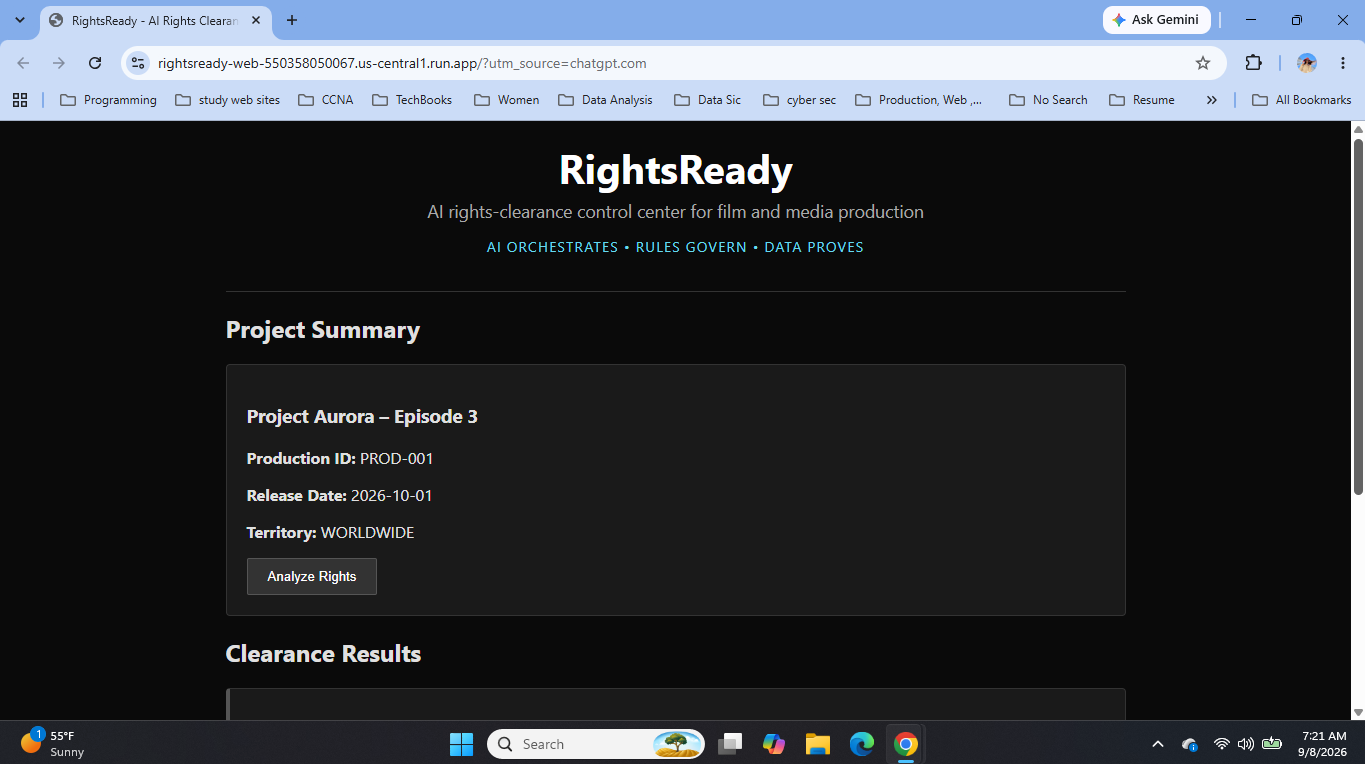
RightsReady is an AI-powered rights-clearance control center for film and media production.
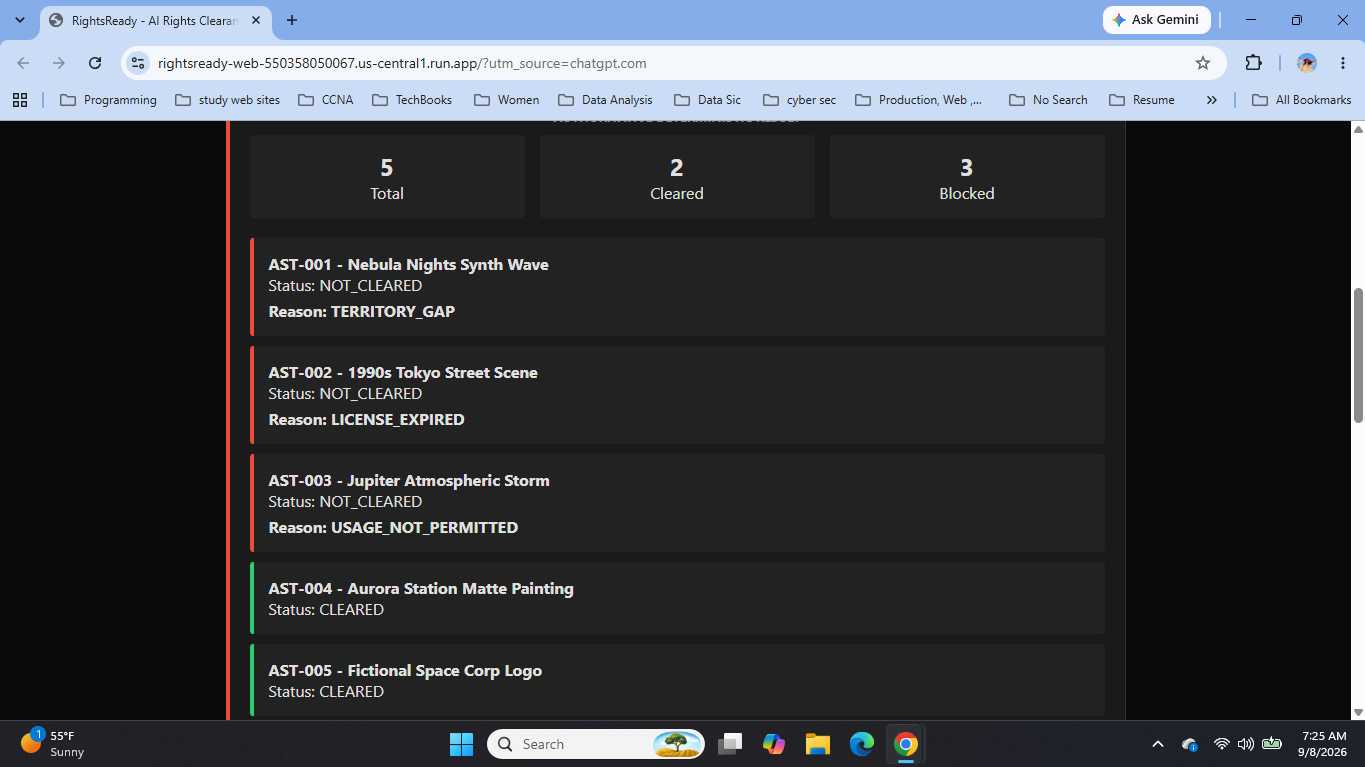
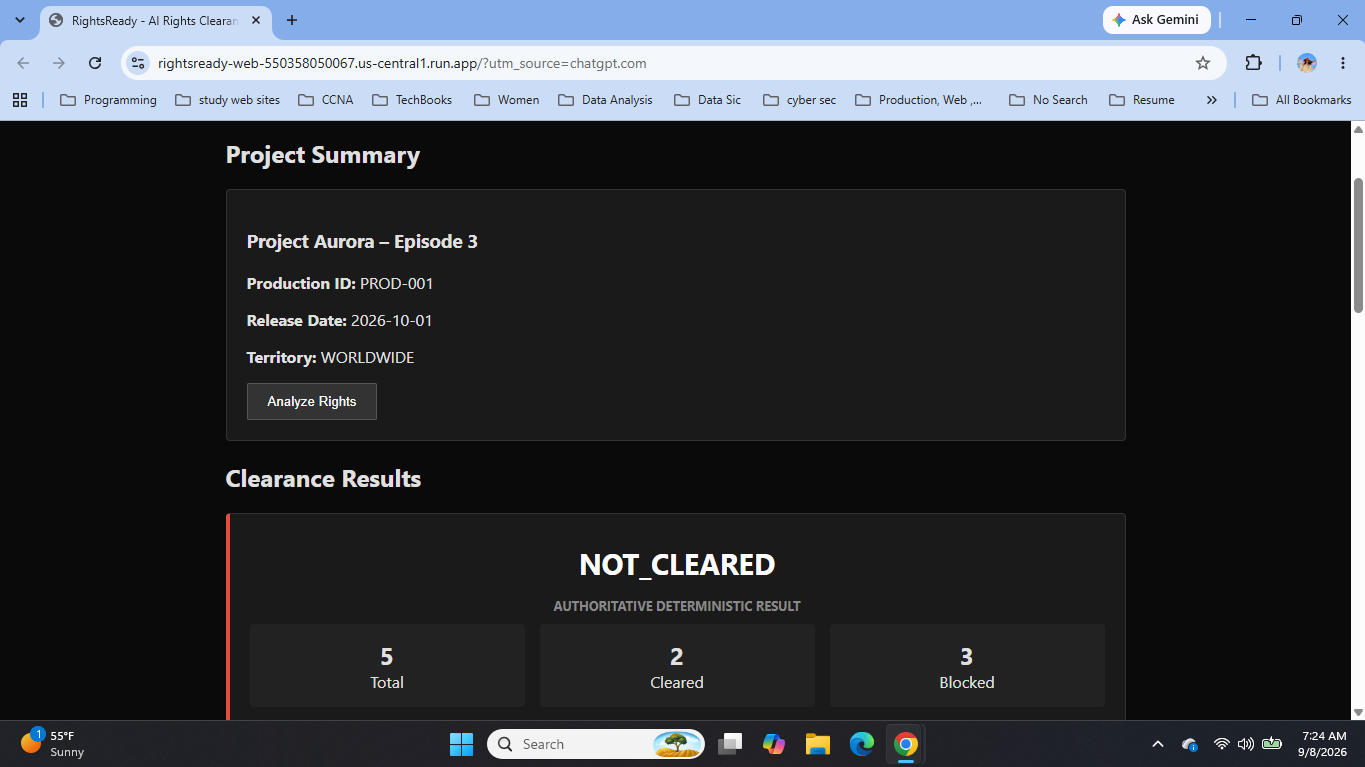
A production user can analyze a project and receive an authoritative clearance result across its assets.
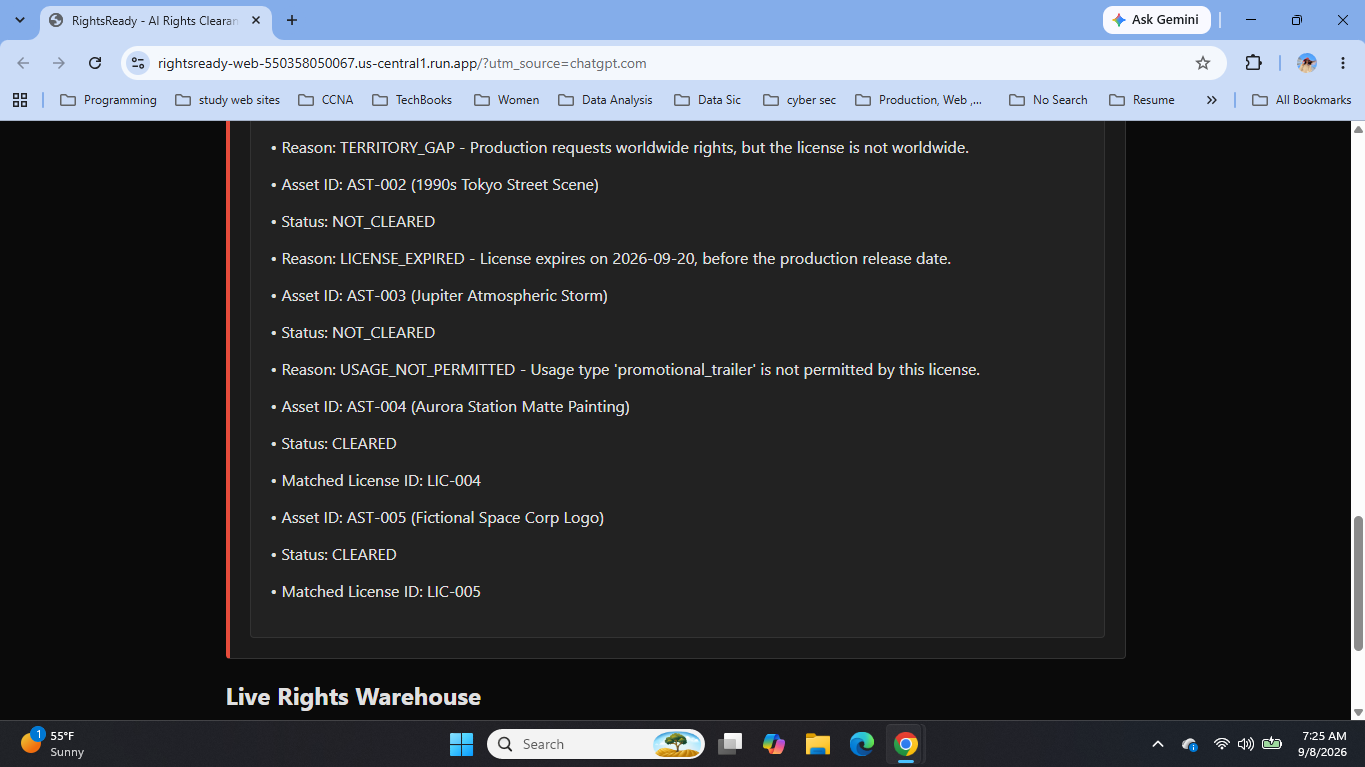
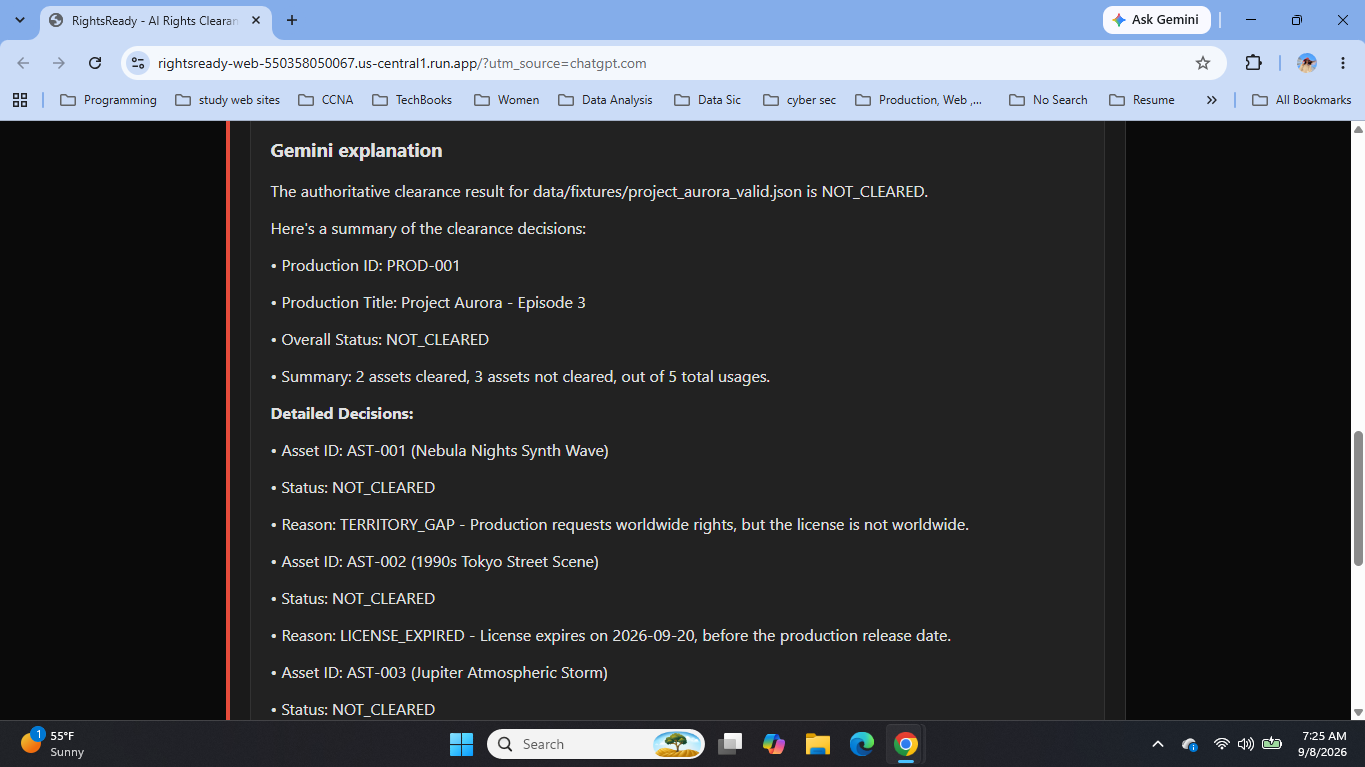
For our Project Aurora demonstration, RightsReady evaluates five assets and returns an authoritative NOT_CLEARED result: two assets are cleared and three are blocked with explicit deterministic reason codes such as TERRITORY_GAP, LICENSE_EXPIRED, and USAGE_NOT_PERMITTED.
Gemini then transforms those governed results into a clear, human-readable explanation without becoming the clearance decision authority.
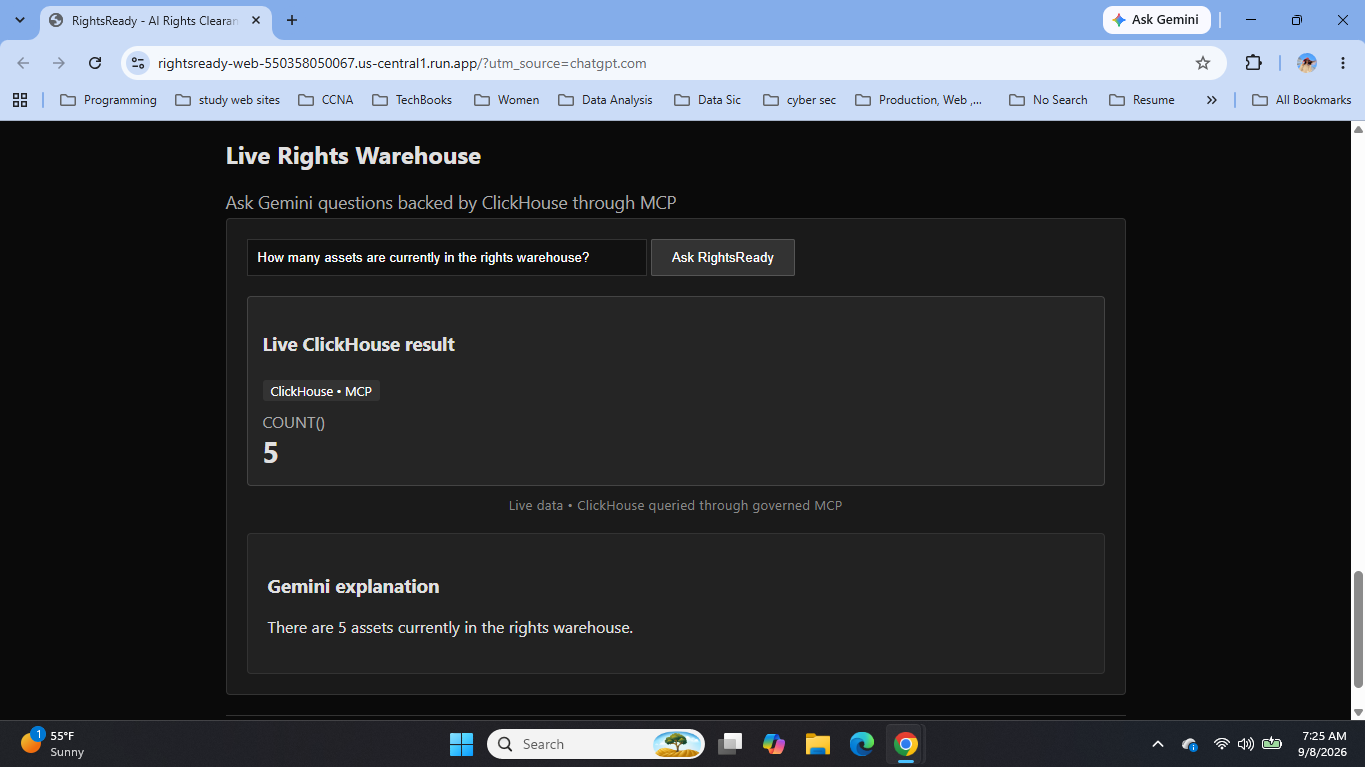
RightsReady also provides a Live Rights Warehouse experience. Users can ask natural-language questions such as, “How many assets are currently in the rights warehouse?” Gemini orchestrates a governed MCP tool call to ClickHouse, retrieves the live result, and explains it to the user.
The principle is simple:
Gemini interprets and explains. Deterministic rules decide. ClickHouse provides live evidence.
How we built it
RightsReady combines AI orchestration, deterministic governance, live data, and a production web application.
We built the application backend with FastAPI and deployed the production application on Google Cloud Run.
For the AI layer, RightsReady uses Gemini with Google Cloud Vertex AI Agent Engine / ADK to understand user intent, orchestrate workflows, invoke governed tools, and explain results.
The authoritative rights-clearance path is deliberately separated from the generative model. A deterministic clearance tool evaluates production, asset, license, territory, expiration, and usage conditions and produces the authoritative CLEARED or NOT_CLEARED result.
For live rights intelligence, RightsReady integrates ClickHouse through MCP. Gemini can orchestrate a warehouse query through the governed MCP boundary, while ClickHouse remains the source of the returned data.
The architecture therefore supports two governed paths:
Clearance: Production Context → Gemini/Agent Orchestration → Deterministic Clearance Tool → Rule Evaluation → Authoritative Result → Gemini Explanation
Rights Intelligence: Natural-Language Question → Gemini/Agent Orchestration → MCP → ClickHouse → Live Evidence → Gemini Explanation
Challenges we ran into
The biggest challenge was not simply connecting an LLM to data. It was defining where AI should have authority and where it should not.
Rights clearance needs predictable, reproducible outcomes. Allowing a generative model to independently decide whether an asset is cleared would undermine that requirement.
We therefore separated orchestration and explanation from authoritative decision-making.
A second challenge was integrating several layers into one working production path: Gemini/Agent Engine, deterministic clearance logic, MCP, ClickHouse, FastAPI, and Cloud Run.
We also had to make the system's provenance visible in the user experience so a user could distinguish an authoritative deterministic clearance result from a Gemini explanation and a live ClickHouse-backed answer.
Accomplishments that we're proud of
We are especially proud that RightsReady became more than an AI interface or conceptual prototype.
We built and deployed a working end-to-end system in which:
- deterministic rules produce authoritative asset-level clearance decisions;
- Gemini explains those governed results instead of replacing them;
- blocked assets receive explicit reason codes;
- cleared assets can be associated with matched license evidence;
- Gemini can orchestrate natural-language warehouse questions;
- ClickHouse returns live rights data through MCP;
- the complete experience runs as a production application on Google Cloud Run.
Most importantly, the architecture demonstrates our central principle in a working system:
AI ORCHESTRATES • RULES GOVERN • DATA PROVES
What we learned
The most important lesson was that adding more AI is not necessarily the same as building a better AI system.
For high-accountability workflows, the more important question is: What should the model control?
Gemini is extremely valuable for understanding intent, orchestrating tools, synthesizing information, and explaining complex results. But deterministic systems can remain responsible for decisions that require predictable rules and reproducibility.
We also learned that AI becomes considerably more useful when it can work with live operational evidence through controlled tool boundaries rather than relying only on model knowledge.
RightsReady became an experiment in combining those strengths instead of asking one technology to do everything.
What's next for RightsReady
The current RightsReady implementation demonstrates the architecture with a focused rights-clearance workflow and live rights warehouse.
The next stage is to expand it into a broader production rights-control platform.
Future development can include richer rights and licensing datasets, additional asset and usage categories, expanded deterministic policy rules, more sophisticated remediation workflows for blocked assets, and deeper warehouse intelligence.
We also want to expand traceability so production teams can move from a clearance result to the underlying license and evidence quickly, while preserving the separation between AI assistance and authoritative governed decisions.
The long-term vision is for RightsReady to become an intelligent control layer across fragmented production-rights systems: allowing teams to ask questions naturally, coordinate workflows with AI, and make decisions based on governed rules and verifiable operational data.
AI ORCHESTRATES • RULES GOVERN • DATA PROVES
Built With
- agentengine
- agenticai
- aiagents
- aisafety
- clickhouse
- cloudbuild
- cloudrun
- docker
- enterpriseai
- fastapi
- filmtechnology
- gemini
- generativeai
- github
- githubaction
- google-cloud
- googleadk
- governance
- mcp
- mediatechnology
- modelcontextprotocol
- pytest
- python
- rightsmanagement
- vertexai

Log in or sign up for Devpost to join the conversation.