-
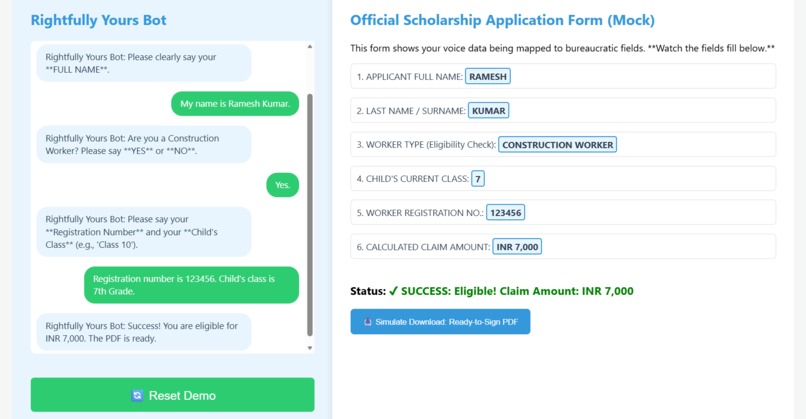
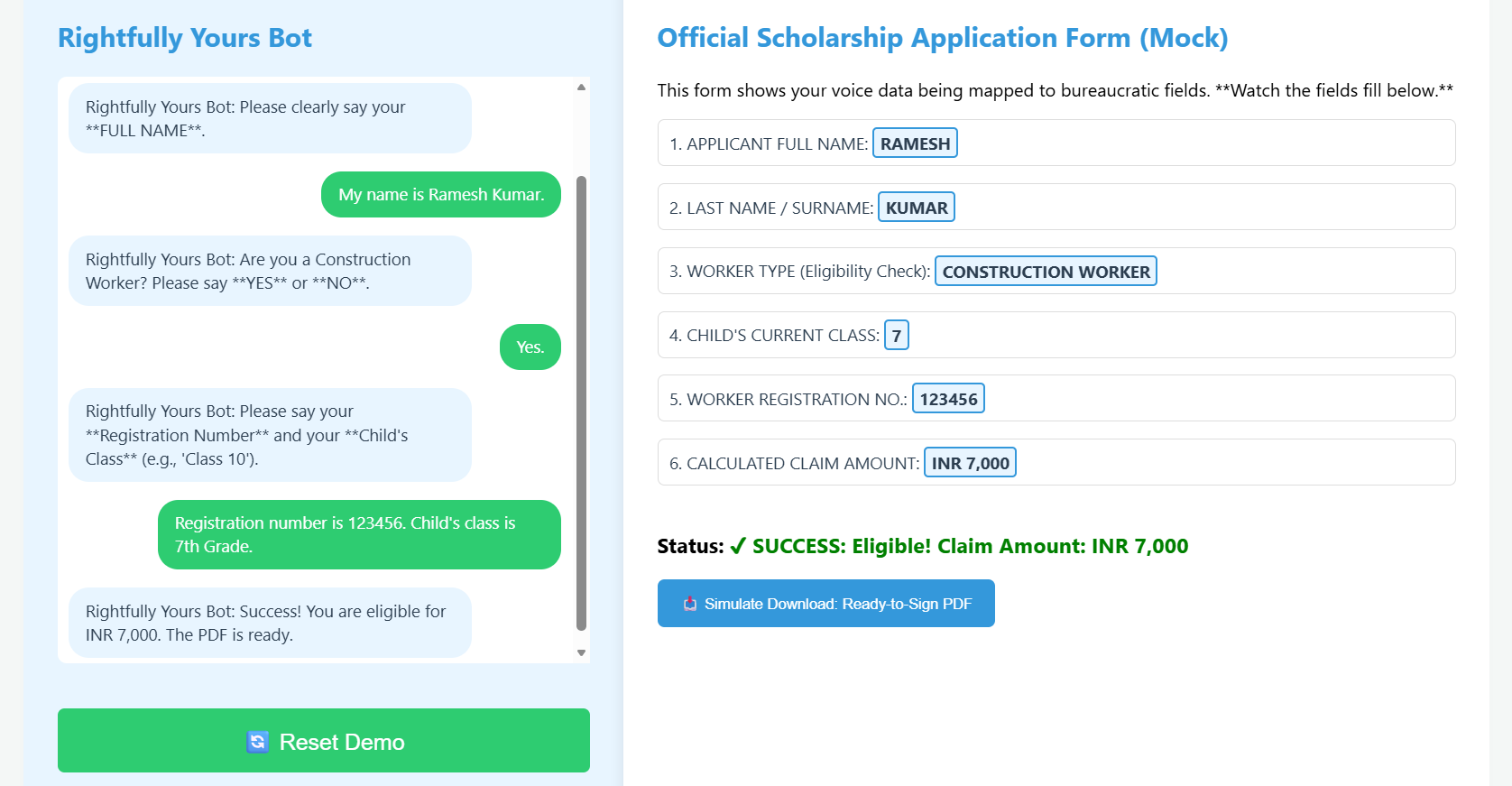
Rightfully Yours MVP-Successful filling of form based on voice input
-
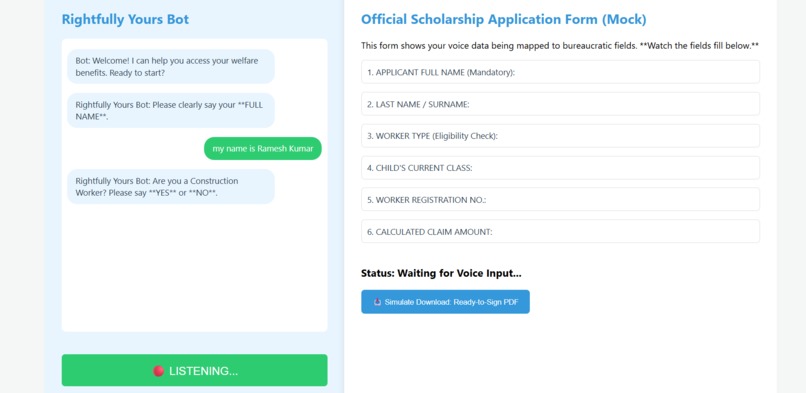
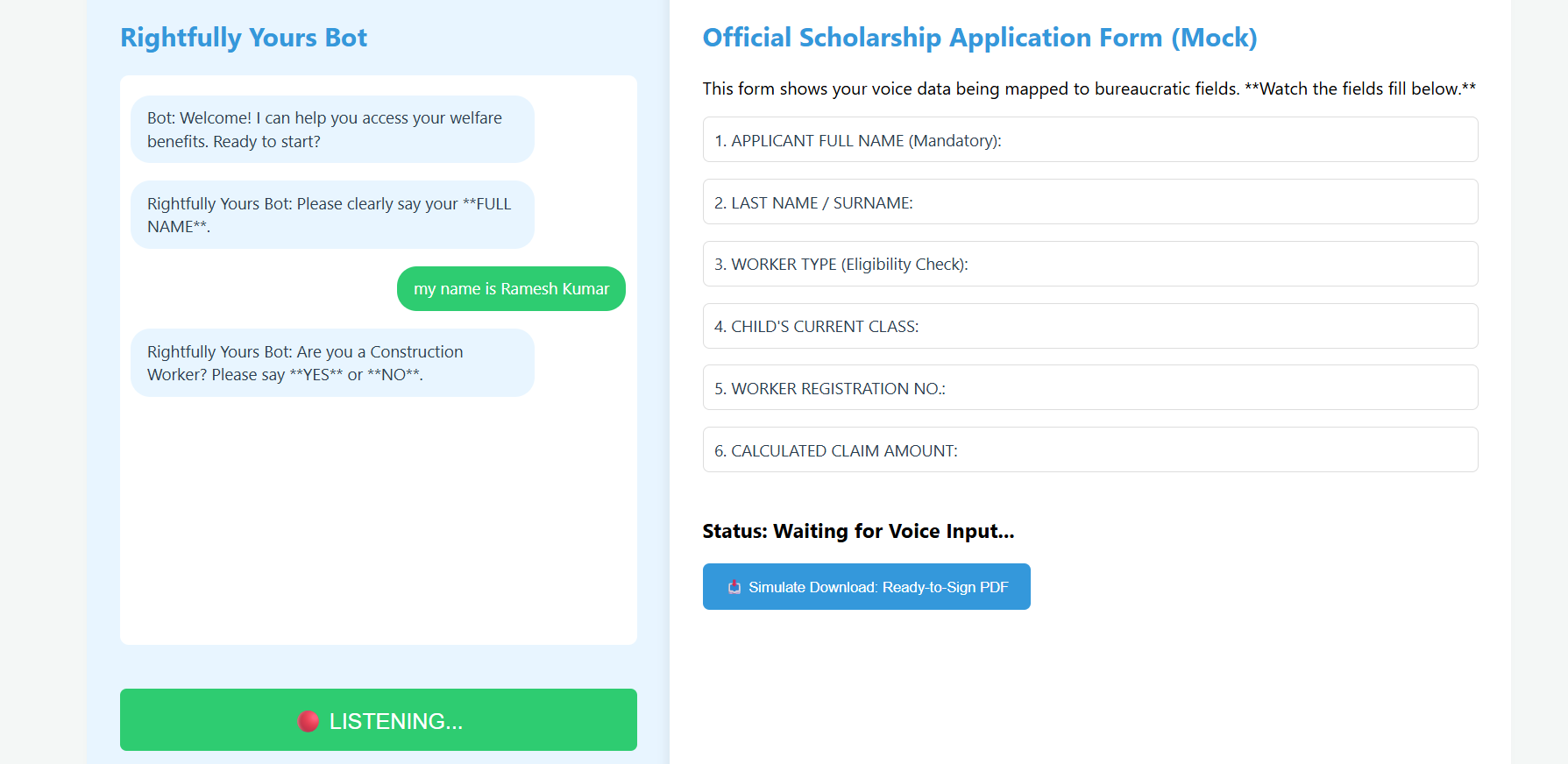
Waiting for voice input from user
Inspiration
The ₹1.5 Lakh Crore Silence. I was stunned to discover that over ₹1.5 Lakh Crore ($17 Billion) in government welfare and charitable funds sits locked in Indian accounts, unclaimed. I dug deeper and realized the root causes: People either aren't aware of their incentives or get intimidated by complex forms and procedures, which is why I built Rightfully Yours . We see how coal miners or construction workers-people who build our nation-are defeated not by hard labor, but by an 8-page English PDF. They cannot read the form, so they cannot claim their child's scholarship or pension that is rightfully theirs. I was inspired to break this "Paperwork Wall." I wanted to prove that access to legal rights should not depend on digital literacy.
What it does
Rightfully Yours is a "Digital Scribe" that turns voice into bureaucracy. It creates a bridge between the illiterate worker and the rigid government system. 1)It Listens: A worker simply sends a voice note (e.g., "I need a scholarship for my daughter, she is in Class 9"). 2)It Understands: The system uses speech recognition and custom logic to extract critical data points-Name, Registration Number, and Class Level. 3)It Delivers: It instantly maps this data onto the official government PDF coordinates and generates a perfectly filled, ready-to-sign application. I have replaced hours of travel and expensive middleman fees with a 30-second conversation.
How I built it
The Interface: I built a browser-based prototype using HTML5 and CSS, designed to mimic a chat interface. The Ears: I leveraged the Web Speech API for real-time, native browser voice-to-text transcription, ensuring zero latency during the demo. The Brain: I wrote a custom JavaScript Logic Engine powered by Regular Expressions (Regex). The Output: I designed a dynamic system that visualizes the mapping process, showing the judges exactly how unstructured voice data gets locked into structured form fields in real time.
Challenges I ran into
1) Human speech is messy. When a user said "My registration number is 12345 and my son is in class 5," my initial code would get confused about which number was which. I had to write layered Regex patterns to extract the Registration ID first, remove it from the string, and then look for the Class level.
2)The primary challenge was figuring out dynamic form maintenance. Government forms are living documents; they can change without warning. If PDF coordinates are even one pixel off, the form is rejected. To mitigate this ,one can use a Change Detection System-a script that monitors the official government URL daily to compare file hashes. If the hash changes, pause processing and notify an admin for a quick re-mapping. The second major challenge was strictly enforcing the Zero-Retention privacy policy to ensure we handled sensitive ID data without ever storing it on our servers. This is the next step for scaling up from mvp to product.
Accomplishments that I'm proud of
Proving the Protocol: I successfully demonstrated that a complex bureaucratic form can be filled using only voice. The concept works. The Zero-UI Breakthrough: Seeing the form fill itself up automatically based on a spoken sentence was a massive moment of victory. Immensely proud to have built a working, interactive MVP that tackles a national-scale crisis.
What I learned
I learned the true complexity of human-to-bureaucracy interaction. I learned that the difference between an unspent fund and a child's education is often just the simple presence of a trustworthy, easy-to-use interface. I also gained profound insight into the power of open-source tools: demonstrating that a massive national problem can be solved with inexpensive, readily available technology, bypassing the need for huge government IT contracts.
What's next for Rightfully Yours
1)Backend Integration: I will move the logic to a Python/Flask backend to integrate the PyPDF2 library, allowing me to generate the actual downloadable PDF files. 2)WhatsApp Integration: I will connect the system to the Twilio API, moving the experience from a web browser to WhatsApp, where the users actually live. 3)Vernacular Voice: I plan to integrate OpenAI Whisper to handle Indian dialects (Hindi, Bengali, Marathi), ensuring language is truly no longer a barrier.

Log in or sign up for Devpost to join the conversation.