Inspiration
Somebody writes a pub quiz every week. At pubs, libraries, social clubs, church halls and school fund raisers. The hard part is not finding questions. It is finding questions that land for this crowd: not so easy the room is bored, not so obscure nobody scores. Hosts guess. We wanted a ruler.
What it does
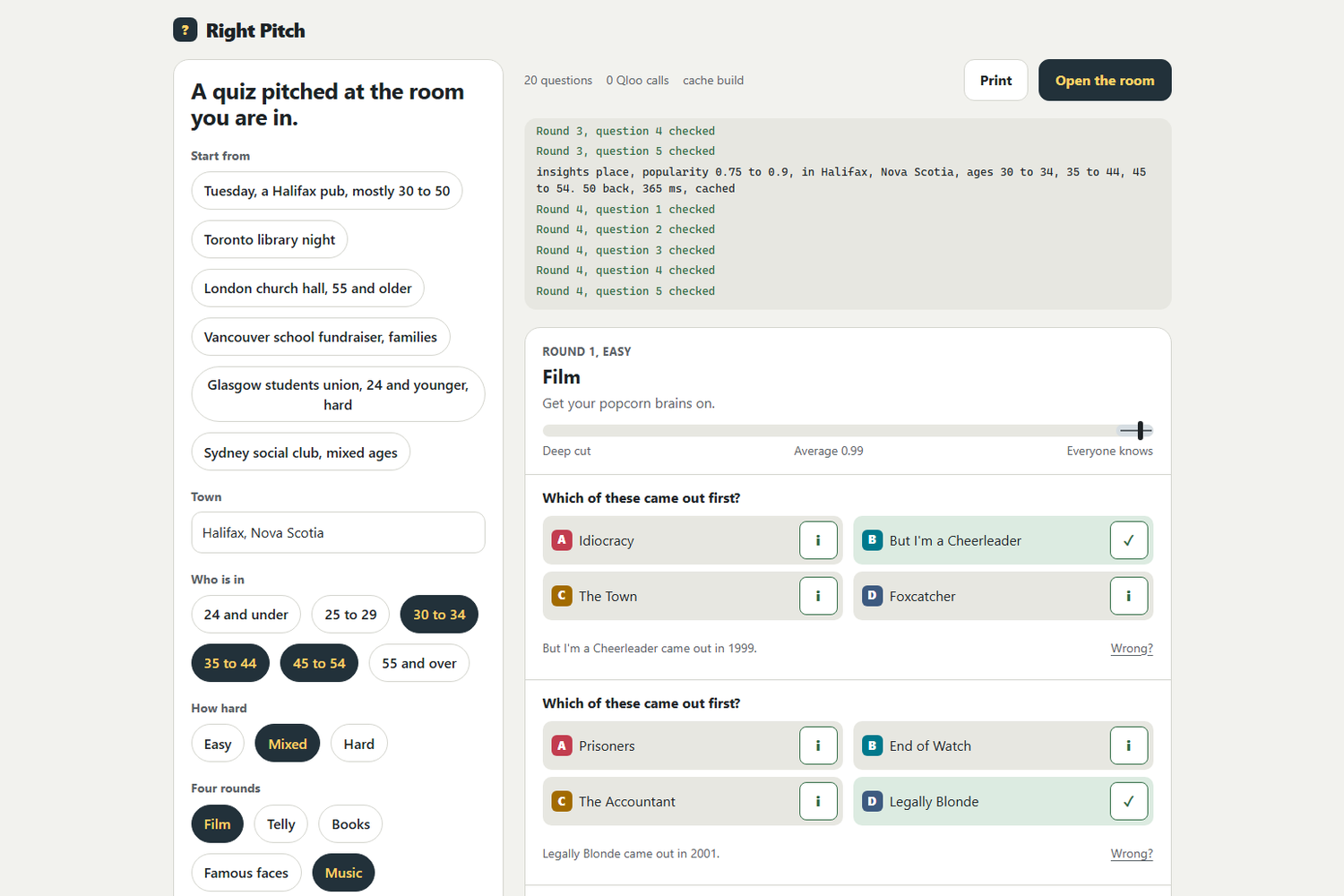
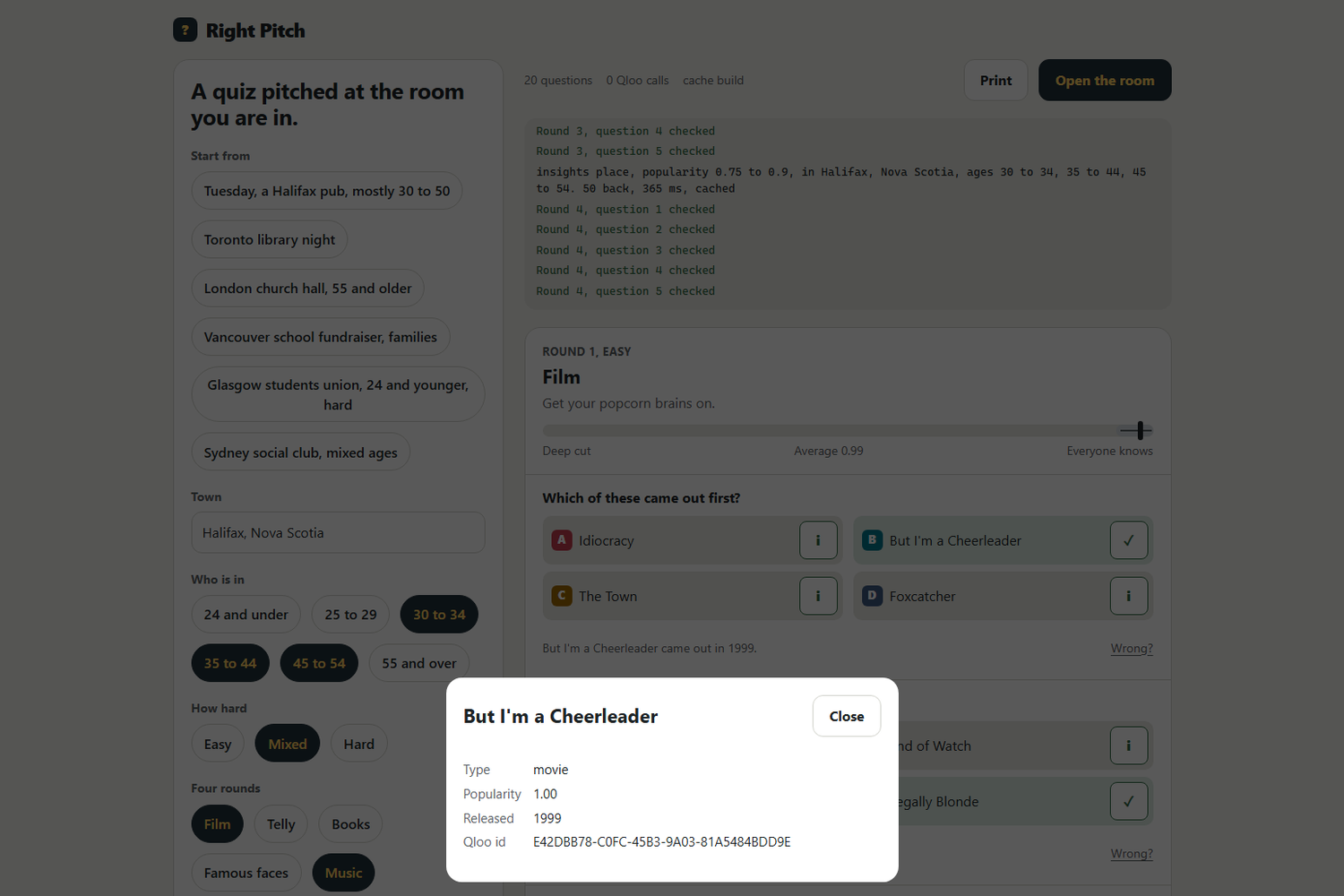
Pick the town and the crowd (age groups, how hard). Press Build. Right Pitch asks Qloo for films, shows, books, people, music acts and local places that this town's crowd knows, inside a popularity band for each round. It builds four rounds of five questions in about 5 to 15 seconds. Each round has a difficulty meter: the target band and the measured popularity of what made it in. Tap any question to see the Qloo record behind the answer.
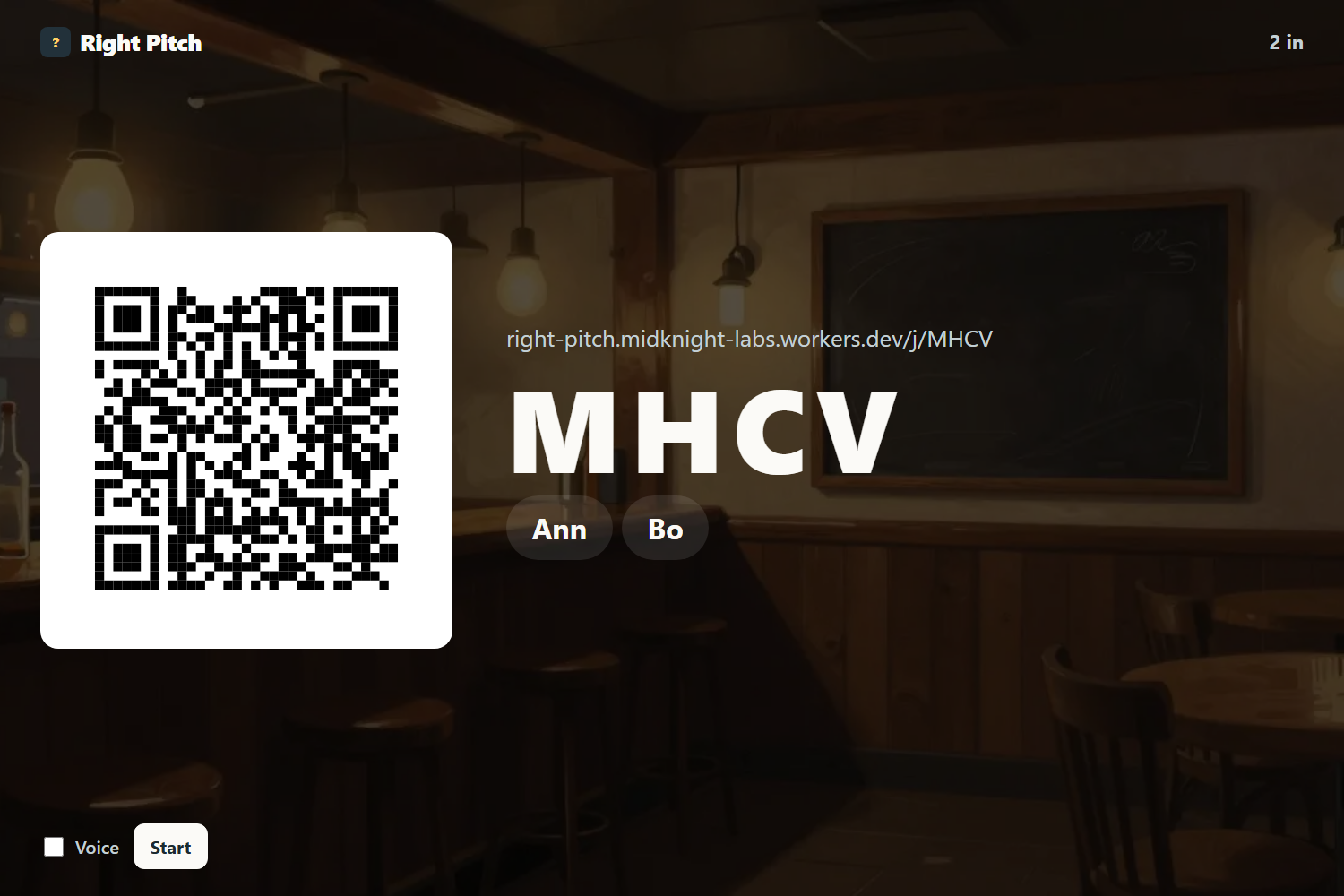
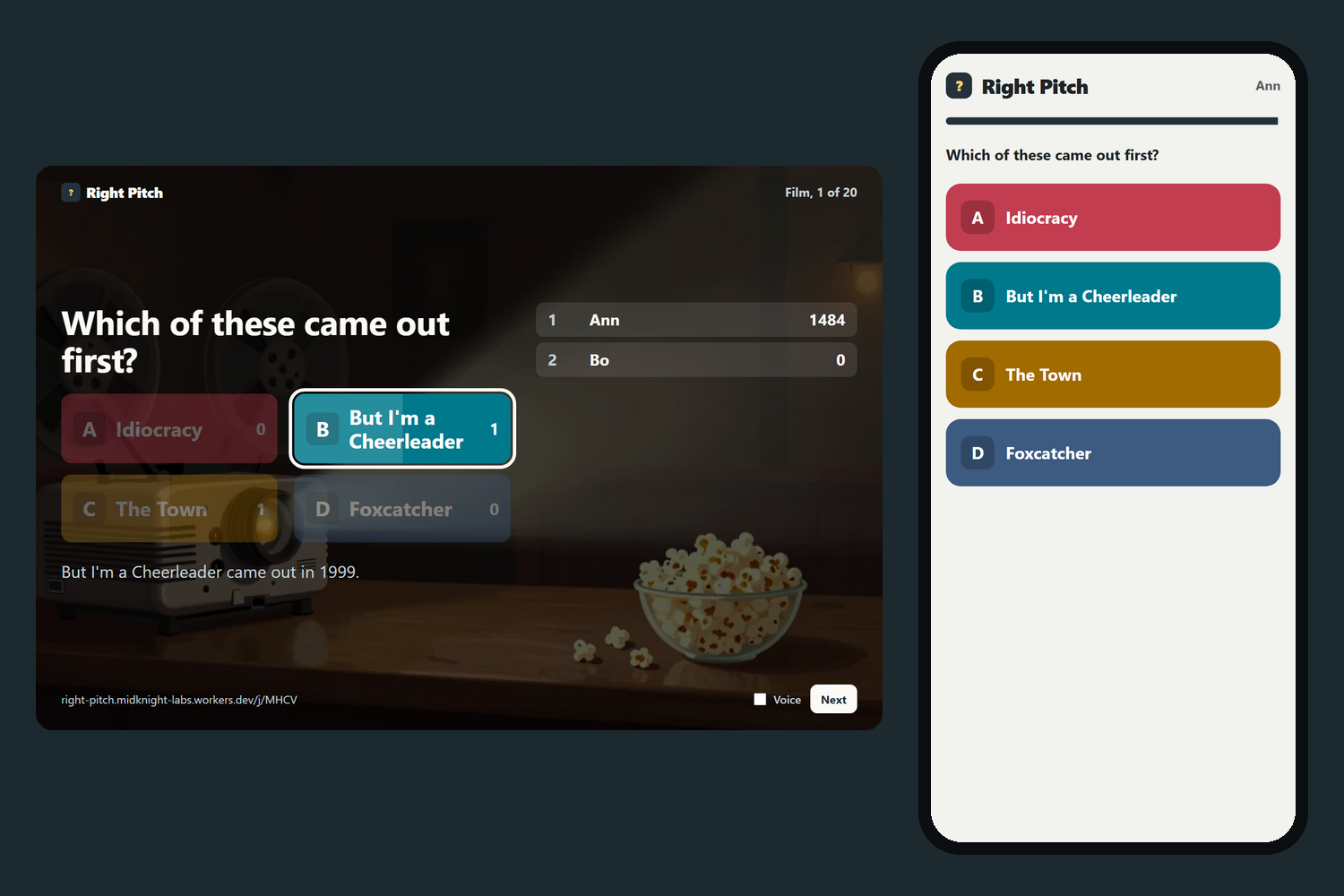
Then open the room. The host screen shows a QR code. Phones join with a nickname, no app, no account. Questions go to every phone, answers lock after 20 seconds, and the scoreboard moves. A right answer scores 1,000 plus up to 500 for speed. A phone that drops comes back where it was.
The generation round asks who leans to a thing more, the 24 and under crowd or the 55 and over crowd. The answer comes from Qloo's affinity for the same item under each age lens, and the reveal shows both bars.
There is a printable copy too, with the answers on the last page.
How we built it
It runs on Cloudflare Workers. A build is a small agent loop:
- Plan. A model with a planning tool turns the setup into four round plans: kind, level and the years that suit the crowd. It never writes a question or an answer.
- Ask Qloo. One insights call per round, with the town and the crowd's ages as signals and a popularity band for the level. The generation round scores 20 items under each age lens.
- Fill. Fixed templates turn records into questions: which came out first, who was born first, best rating, which part of town, who leans to it more.
- Check. A question is kept only if the marked answer is the one the field picks, with a clear margin (3 years, or 0.2 to 0.3 on a rating), every option sits in the band, and no name repeats in the quiz.
- Plan again. A round short of five good questions is planned again, wider, at most twice.
- Name. The model names each round from what it really holds.
A build uses 4 to 7 Qloo calls and about 7 model neurons. The same setup built again comes from a cache with 0 calls. Each room is a Durable Object with hibernating WebSockets and alarms for the timer, so a quiet room costs nothing. It keeps only nicknames and scores and deletes itself after 24 hours.
It is free to run by construction: 500 Qloo calls a day for the whole app, 16 per build spaced under 10 a second, 2 fresh builds per visitor a day, 450 model neurons a day, 60 rooms a day. Fresh builds pause if the shared key's month runs under 3,000 calls. Past the model budget a build still runs from Qloo with house titles. Playing a quiz costs no Qloo calls at all.
The measured claim
We asked the same model, with no tools, for 24 hard pub quiz rounds of films, TV shows and music acts: 120 items. We looked each one up with Qloo search. 96 of the 118 it found were household names, popularity 0.97 or more. That is 81% (films 61%, TV 85%, music 98%).
Across 17 quizzes built on the hosted app, our hard rounds held 268 options. None was a household name. The most popular was 0.947.
Challenges
With no taste signal, Qloo returned a band's results stacked at its top edge. Sending the town as a signal on every round spread them across the band, so the meter reads a real spread.
The age lens had to drop the town signal. With it, 0 of 15 items cleared our 0.15 affinity gap.
"Glasgow" on its own found Glasgow, Kentucky. Towns now carry their region.
Films one year apart made coin toss questions. The margin is now 3 years.
Accomplishments we are proud of
Every answer traces back to a field of a real Qloo record, and the host can open it. A whole night plays end to end: build, QR join, two phones, a dropped phone coming back, the podium. The screens are measured at 14 phone widths with no layout faults.
What we learned
Popularity alone does not make a fair question. Affinity for the crowd and a clear margin do.
What's next
A team mode for tables. A host's past nights following them to any device (today the app skips names from a host's recent quizzes on the same connection). More round kinds as Qloo adds fields.
Try it
No login. Press one of the six presets, then Build. Open the room and join from your phone with the QR code, or open the join link in a second browser tab.
Built With
- cloudflare-workers
- d1
- durable-objects
- qloo-taste-ai-api
- typescript
- workers-ai

Log in or sign up for Devpost to join the conversation.