Inspiration
Every room has an invisible layer: Wi-Fi routers broadcasting, phones searching for networks, and Bluetooth devices quietly announcing themselves. We use this infrastructure constantly, but rarely get to see what surrounds us.
Rift started with a question: what would the world look like if we could see radio signals? Inspired by science-fiction scanners, we wanted to turn everyday wireless activity into something spatial, interactive, and understandable.
What it does
Rift makes the radio world visible. Distributed sensors listen for Wi-Fi and Bluetooth signals and send readings to a central hub, which estimates where those signals originate.
A live browser map displays detected sources, signal strength, and uncertainty. Our iPhone AR prototype brings those estimates into the camera view, placing signal visualisations within the room after the user aligns the sensors.
Radio positioning is imperfect, so Rift shows uncertainty through clouds and rings. With fewer sensors or weaker observations, the estimate becomes less precise—and the interface reflects that.
The system works with radio metadata, with device identifiers hashed on the sensors using a shared session salt.
How we built it
We split Rift into three parts: sensing, estimation, and visualisation.
Python sensor agents collect Bluetooth advertisements and supported Wi-Fi observations on macOS and Linux hardware, including Raspberry Pi and the Linux side of the Arduino UNO Q. They send batches of readings over the local network to a Python hub.
The hub uses NumPy and a Bayesian grid filter to maintain a probability map for each detected source. It combines signal-strength measurements, accounts for sensor gain and differences in transmitter power, and updates estimates over time. Reference-point calibration helps correct sensor placement and gain errors.
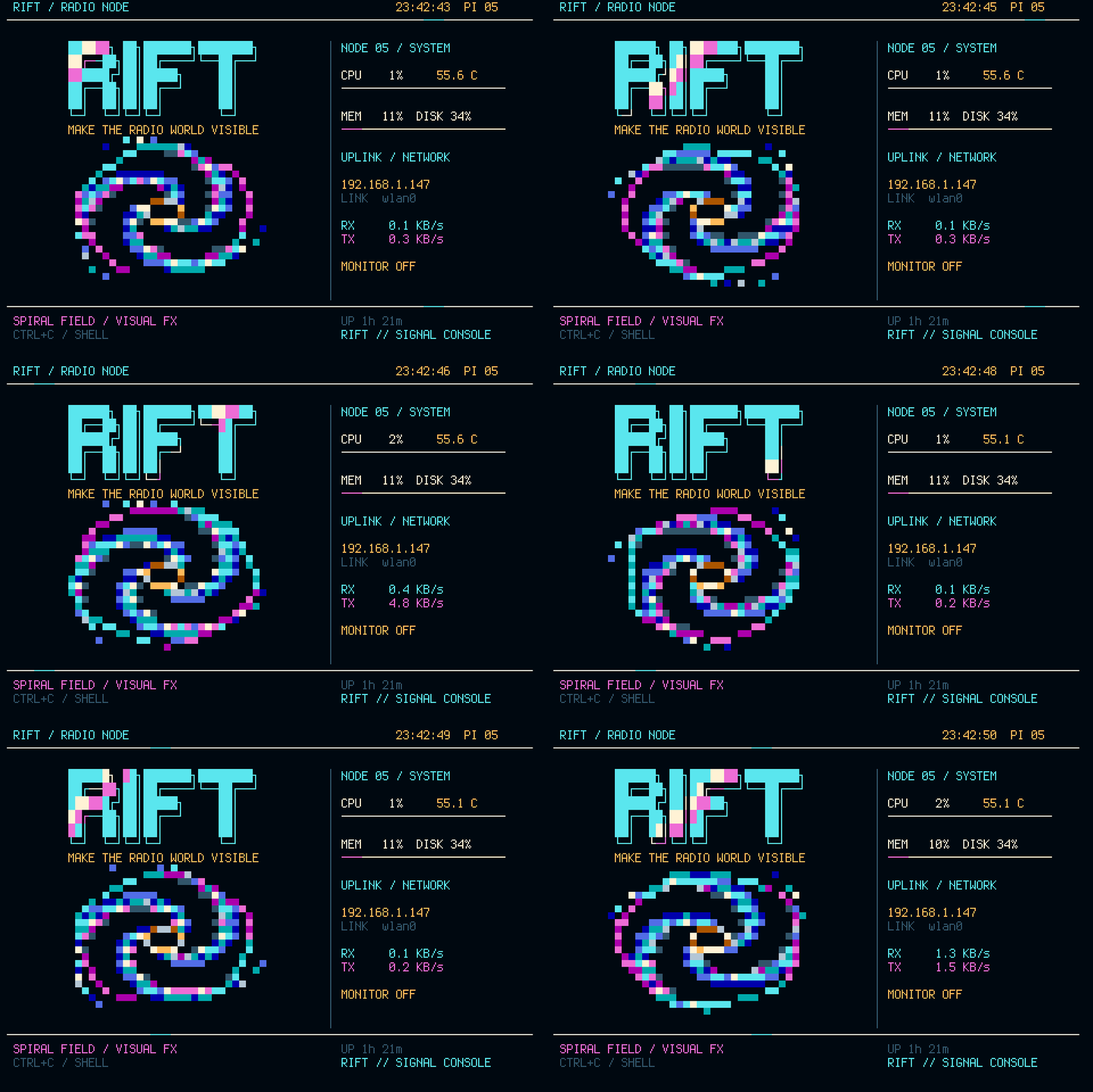
For visualisation, we built a browser dashboard and an Expo/React Native mobile app, with a custom native ARKit module for room alignment. Rift’s visual identity combines point clouds, pixel typography, scanlines, and original digital sound effects.
Challenges we ran into
The hardest problem was turning signal strength into a useful position. Indoor signals reflect off surfaces, pass through obstacles, and fluctuate as people move. Different devices also transmit at different power levels, making a simple “stronger means closer” approach unreliable.
Combining observations across platforms added another challenge: macOS and Linux expose different Bluetooth identifiers and Wi-Fi capabilities. We also had to distinguish uncertainty in the radio estimate from errors in sensor placement and AR alignment.
These challenges shaped both the estimator and the interface. Calibration, repeated observations, and visible uncertainty became central to the experience.
Accomplishments that we're proud of
We’re proud of connecting real radio observations to a live spatial visualisation, and of building a simulator that lets us test the estimation pipeline without a room full of hardware.
We also developed reference-point calibration and extended the project into an AR prototype. Bringing sensing, mathematical modelling, and a distinctive visual language together made Rift feel like a coherent instrument for exploring an otherwise invisible environment.
What we learned
We learned that collecting more readings only helps when we understand their limitations. Sensor placement, calibration, and correlated noise matter as much as the estimation algorithm.
We also learned that uncertainty can be useful interface information. Showing a broad cloud gives users a clearer understanding of the evidence than presenting an overly confident point.
What's next for Rift
Our next priority is controlled testing in real rooms: measuring positioning error, improving calibration, and making setup easier. Adding more well-placed receivers will help resolve ambiguities in the current estimates.
We also want to improve AR stability and room mapping, expand hardware support, and explore Wi-Fi channel-state information for anonymous motion sensing.
The goal is to make Rift a practical, accessible way to explore the wireless environment around us.