-
-
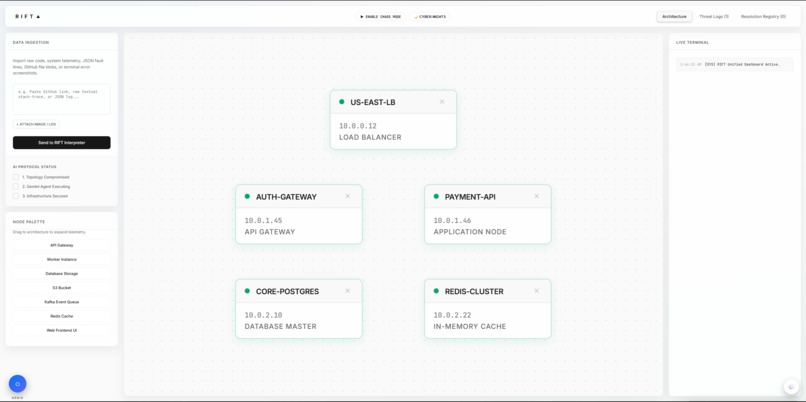
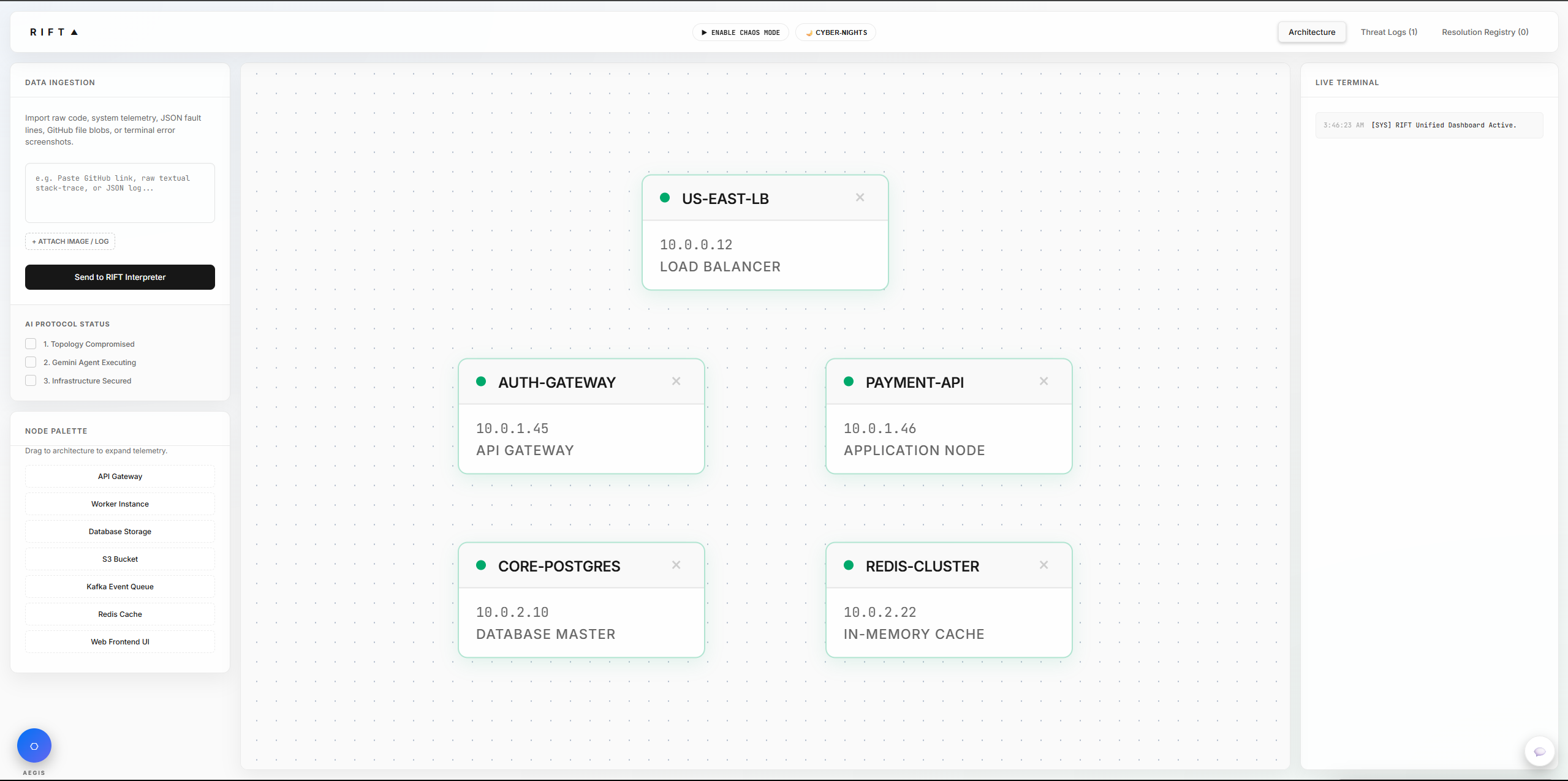
Landing page
-
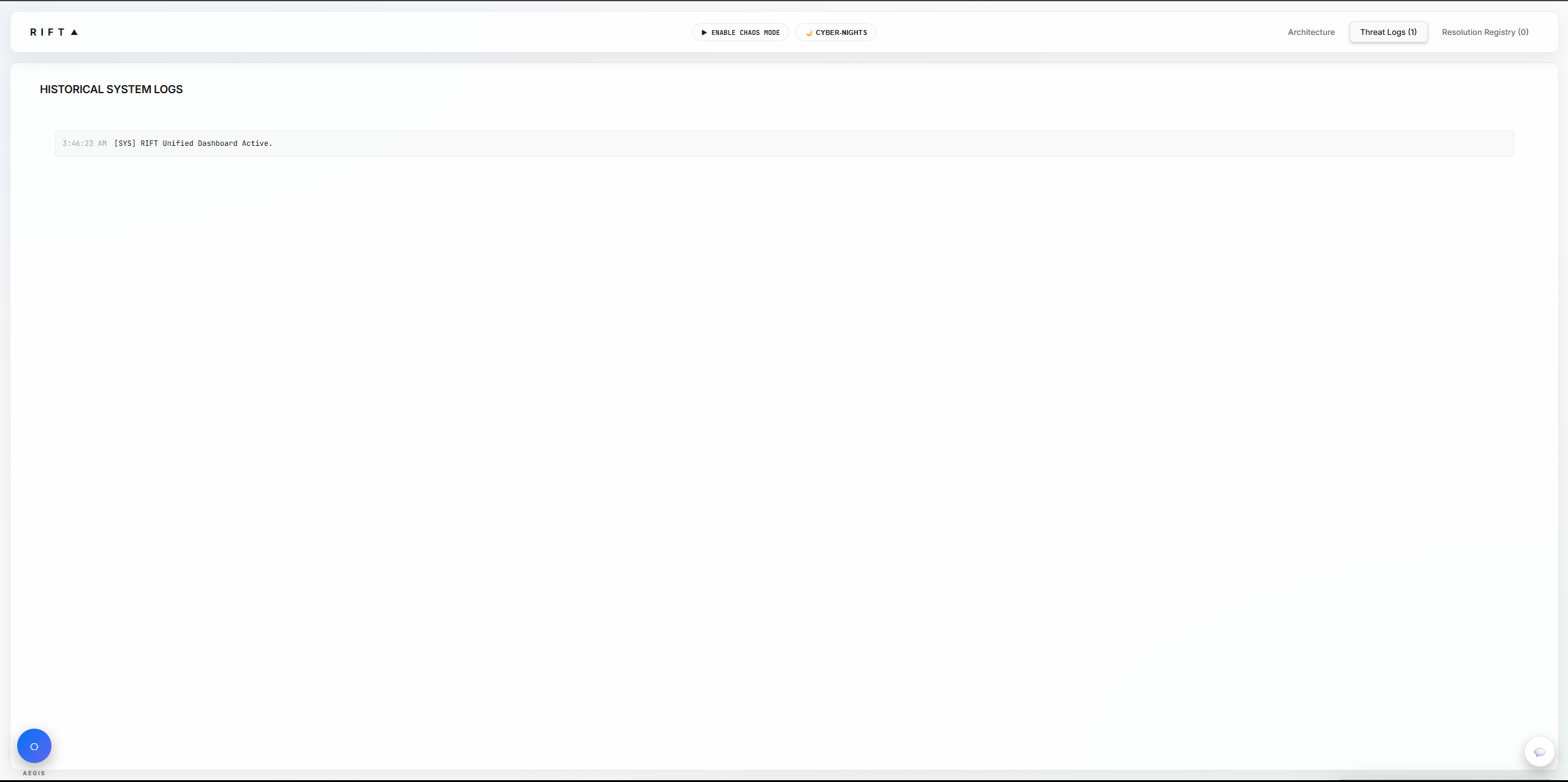
Threat logs
-
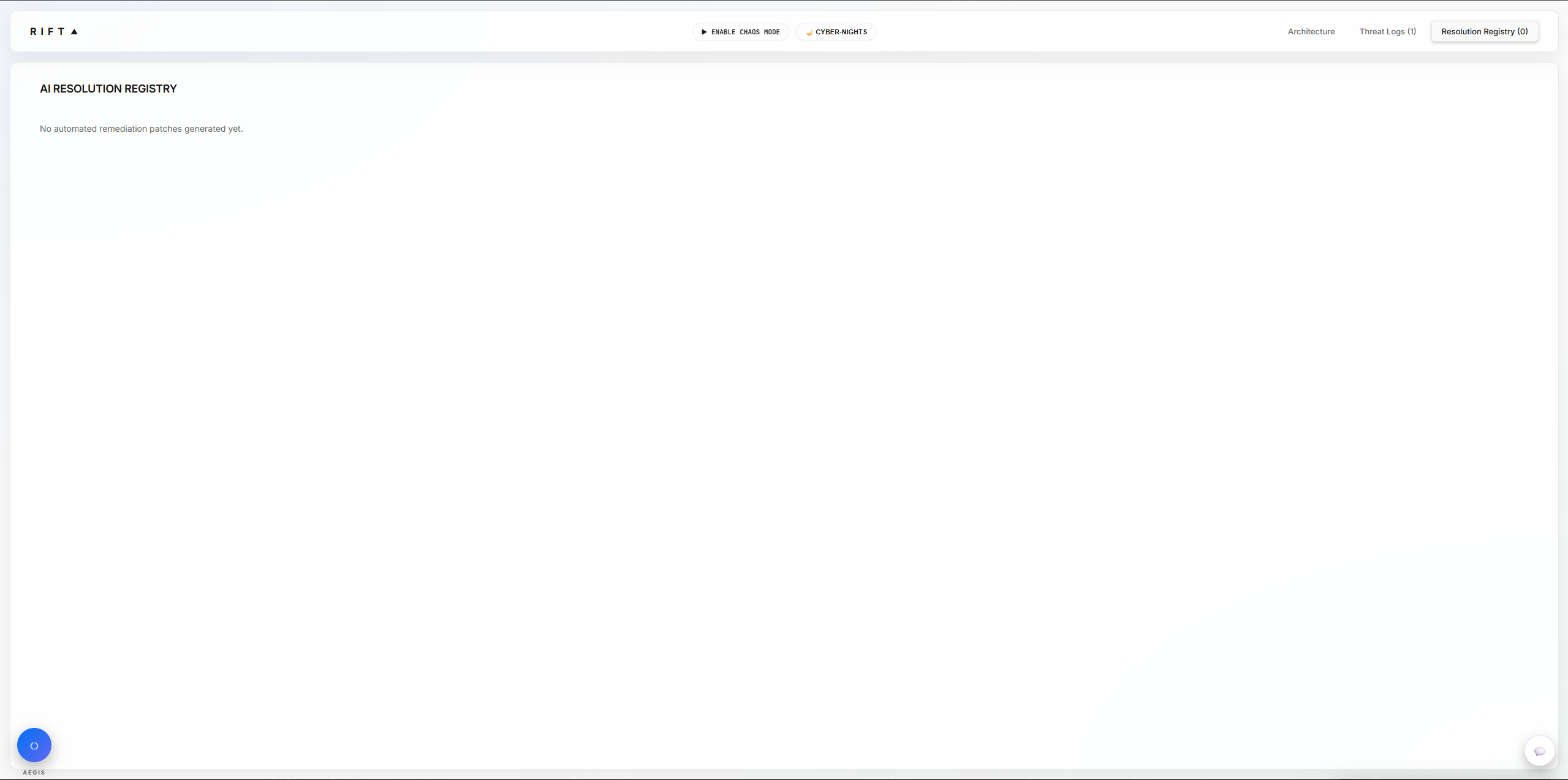
Resolution Repository
Inspiration
Modern infrastructure is breaking — not because systems are weak, but because humans are forced to understand them through the wrong interface.
Logs are linear. Systems are not.
We kept running into the same bottleneck:
Engineers don’t lack data — they lack clarity.
At the same time, AI has evolved from answering questions to reasoning about systems. That led to a sharper question:
What if infrastructure wasn’t debugged — but **observed, reasoned about, and repaired in real-time by AI?
This led to a complete redefinition of observability:
$$ \text{Observability} = f(\text{Topology}, \text{State}, \text{Autonomy}) \quad \text{not} \quad f(\text{Logs}) $$
RIFT was built to make infrastructure visible, reactive, and self-healing — not just monitored.
What it does
RIFT is a multi-agent cyber-topology engine that turns raw, chaotic inputs into live, visual, autonomous system behavior.
Instead of reading logs, users watch their infrastructure think and respond.
- Systems are rendered as a live topology graph
- Threats are mapped spatially, not abstractly
- AI doesn’t just explain — it acts
The core loop is brutally simple and powerful:
- Any input (logs, images, GitHub, voice) enters the system
- AI maps it to a specific node in the architecture
- The attack is visualized instantly (node turns red)
- A real DevSecOps patch is generated
- The system heals itself in real-time (node turns green)
Mathematically:
$$ G_{t+1} = \text{Heal}\big(\text{Detect}(\text{Input}, G_t)\big) $$
This is not monitoring.
This is closed-loop autonomous infrastructure.
Key systems:
- AEGIS → continuous voice AI (hands-free control)
- AI Assist → instant contextual chat
- Chaos Mode → live attack simulation
- Temporal VCR → replay system history
- Resolution Registry → exportable AI-generated postmortems
How we built it
RIFT is built as a zero-backend, real-time AI system — everything runs in the browser.
Core stack:
- React 19 + Vite
- ReactFlow (graph engine)
- Gemini 2.5 Flash (multi-agent AI)
- Web Audio API + MediaRecorder (voice system)
- Native TTS (speech synthesis)
- WebGL + WASM (visual computation layer)
- jsPDF (report generation)
We engineered RIFT around three specialized AI agents:
- Intake Agent → understands and maps threats
- Resolution Agent → generates precise remediation
- Conversation Agent → powers voice + chat
Pipeline:
$$ \text{Input} \rightarrow \text{Parse} \rightarrow \text{Map}(G) \rightarrow \text{Act} \rightarrow \text{Update}(G) $$
The critical innovation:
$$ \text{AI Context} = \text{System State, not just User Input} $$
This makes RIFT fundamentally different — the AI is not answering questions, it is operating inside a system.
Challenges we ran into
1. Making AI spatially aware AI models don’t naturally think in graphs. We had to force structure:
$$ \text{Output} = {\text{target node}, \text{attack type}, \text{action}} $$
Getting consistent, reliable mapping across modalities was difficult.
2. Real-time system coherence Every part of RIFT — graph, logs, AI, animation — had to behave like a single organism.
Even small delays break the illusion of intelligence.
3. Natural voice interaction We eliminated push-to-talk and built continuous voice using silence detection:
$$ \text{Latency} \leftrightarrow \text{False Activation} $$
Balancing this took multiple iterations.
4. Controlled autonomy We needed AI outputs that feel real and actionable without being unsafe.
Accomplishments that we're proud of
- Built a system where AI closes the loop — not just observes it
- Transformed observability from text → visual causality
- Achieved real-time detect → attack → heal cycles
- Created a dual-interface AI system (voice + chat)
- Designed time-travel debugging for infrastructure
- Delivered a fully client-side AI architecture (no backend dependency)
Most importantly:
We made infrastructure legible, reactive, and alive.
What we learned
- The biggest bottleneck in engineering is understanding, not data
- AI becomes exponentially more powerful when given structure + context
- Interfaces define capability — not just models
- Autonomy is a design problem, not just a technical one
Core insight:
$$ \text{Insight Speed} \propto \text{Visual Clarity} $$
What's next for RIFT
Immediate roadmap:
- Live integrations (AWS, GCP, Kubernetes)
- Streaming observability (real-time logs)
- Executable remediation (actual system actions)
- Collaborative infrastructure graphs
Intelligence layer:
$$ \text{Risk Score} = \sum_i w_i \cdot \text{Vulnerability}_i $$
Long-term vision:
RIFT becomes an autonomous AI-SRE (Site Reliability Engineer):
$$ \text{Human} \rightarrow \text{Strategic Oversight} \ \text{AI} \rightarrow \text{Operational Control} $$
From dashboards… to decision-making systems.
Built With
- app-engine
- assemblyscript
- css3
- gemini-2.5-flash
- google-cloud
- google-gemini
- html5
- javascript
- jspdf
- mediarecorder-api
- node.js
- react
- reactflow
- speechsynthesis-api
- vite
- voice-activity-detection
- web-audio-api
- webassembly
- webgl

Log in or sign up for Devpost to join the conversation.