Inspiration
What it does
Inspiration
In many parts of Algeria and across low-connectivity regions of Africa, access to quality English-language tutoring is limited by three compounding barriers: unreliable internet, the cost of premium hardware, and instructional tools that default to English-only explanations — leaving Arabic-speaking learners without support in their own language when they need it most. Rifqa was built to remove all three barriers at once: an AI tutor that runs entirely offline, on modest hardware, and explains itself in Arabic and Darija alongside English.
What it does
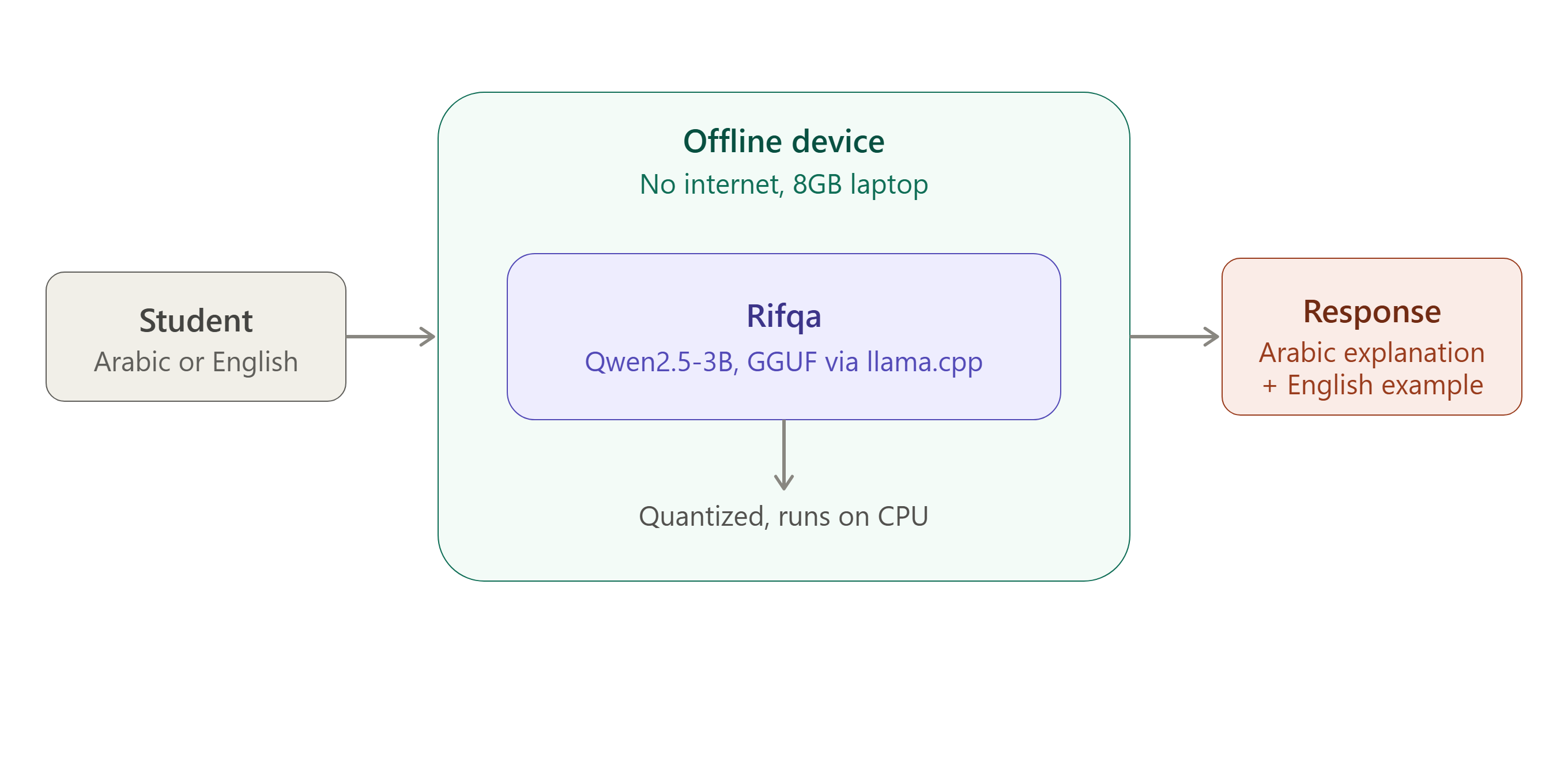
Rifqa is an offline English-tutoring companion that runs fully on-device — no internet connection required after setup. Students can practice English reading, writing, and speaking, and receive explanations and feedback in Arabic or Algerian Darija, making the learning experience accessible to students who are typically forced into English-only digital tools.
How we built it
Rifqa runs on a quantized, GGUF-format language model deployed via llama.cpp, allowing it to operate on an 8GB RAM laptop with no GPU. [Add specifics once complete: which model size you landed on, how you handled the Arabic/Darija prompting layer, and details of your RAG component over your local learning corpus.]
Challenges we ran into
[Fill in honestly once you hit them — e.g., quantization tradeoffs between model size and response quality, tuning Arabic/Darija output consistency, memory constraints on the target hardware.]
What we learned
[Fill in once you've been through the build — e.g., what you learned about quantization, edge deployment, or prompting for a dialect like Darija that has limited training data.]
What's next for Rifqa
[Your genuine plans — e.g., expanding language coverage, refining the corpus, testing with real students.]
How we built it
Challenges we ran into
Accomplishments that we're proud of
What we learned
What's next for Rifqa (رِفقة Arabic for "companionship")
Built With
- arabic-nlp
- edge-ai
- education-technology
- gemma
- gguf
- llama.cpp
- natural-language-processing
- offline-first
- python
- quantization