Math skills are so often tightly coupled with music skills. Scientific American, in a March 2012 study (see references below), noted that children who pair their math education with simple music exercises consistently outperformed their peers. Experiments at Rutgers University have also demonstrated the powerful interaction between music and math education.
The relationship between musical pitches is purely numerical, as is rhythm. Placing notes into meaningful patterns and manipulating those patterns creatively helps strengthen your natural, intuitive understanding of numbers. Musicians are typically quick with mental arithmetic, and most of history's greatest scientists and mathematicians were also skilled musicians.
We recommend that anyone, particularly students and children whose cognitive skills are still developing, spend a little time every day creating their own music. But not every child can play an instrument, and most music-making software either requires more traditional musical skills, or significantly limits the complexity and stimulation of what you can achieve as a non-musician.
Riff Machine erases this barrier to musical creativity and exploration so anyone can experience the great satisfaction from generating rich, organized original music, while using parts of their brain they didn't know existed.
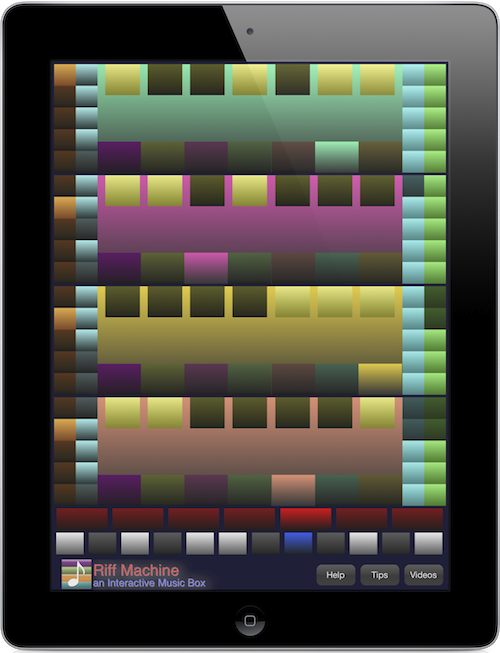
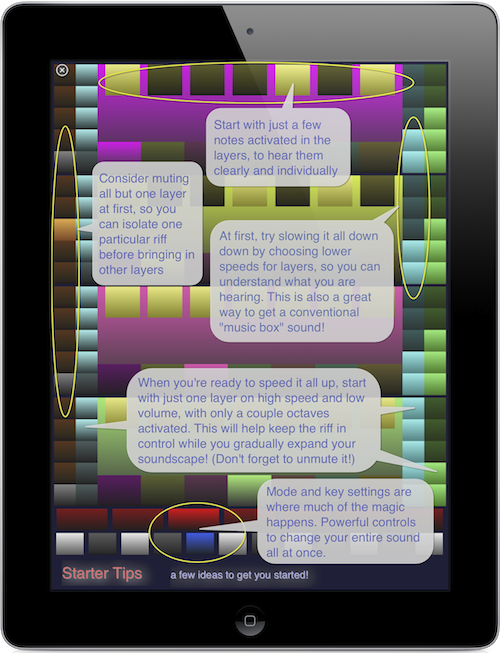
You build textured music by manipulating simple sets of patterned buttons and playing with the relationships between octaves, the distances between notes, and the interaction of different rhythms. This massaging of the musical centers of the brain has extraordinary benefits for learning and opening up connections in your thinking. Riff Machine provides a simple interface where it is impossible to play a wrong note. It is a gentle app designed for anyone of any age or background, without regard for existing musical skills.
Most importantly, while the interface is simple, the music you generate can be complex. For the first time, a non-musician can learn to control advanced harmonies and modulations without any application of traditional music knowledge. However, students with musical skills will also appreciate its easy control of all the keys and modes of music (major, minor, dorian, etc) without needing explicit academic understanding of these structures.
We strongly believe that cognitive skill is a dynamic state, and given a gentle push, anyone can spark new forms of thinking that will open up learning and creativity in ways otherwise not possible.
---References--- Scientific American: http://www.scientificamerican.com/podcast/episode.cfm?id=rhythm-and-music-help-math-students-12-03-27
The Telegraph: http://www.telegraph.co.uk/education/9159802/Music-helps-children-learn-maths.html
Rutgers University: http://urwebsrv.rutgers.edu/focus/article/Music%20helps%20students%20retain%20math/1779/
Log in or sign up for Devpost to join the conversation.