-
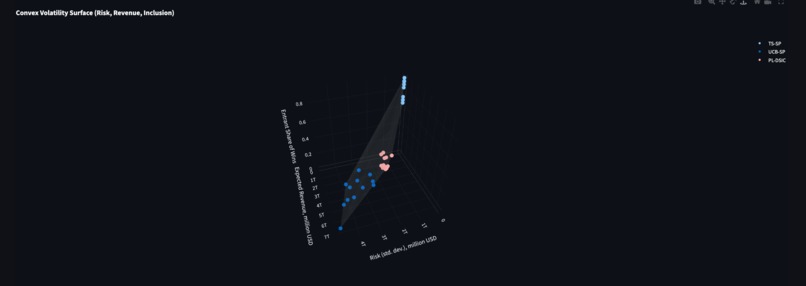
Convex Volatility Surface
-
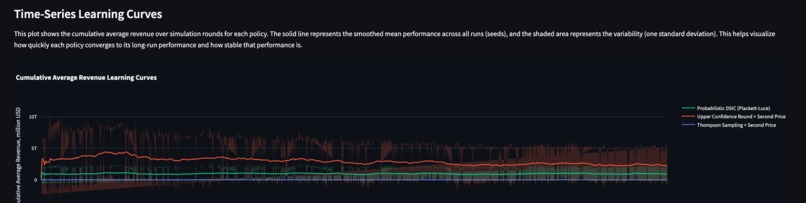
Cumulative Average Revenue Learning Curve
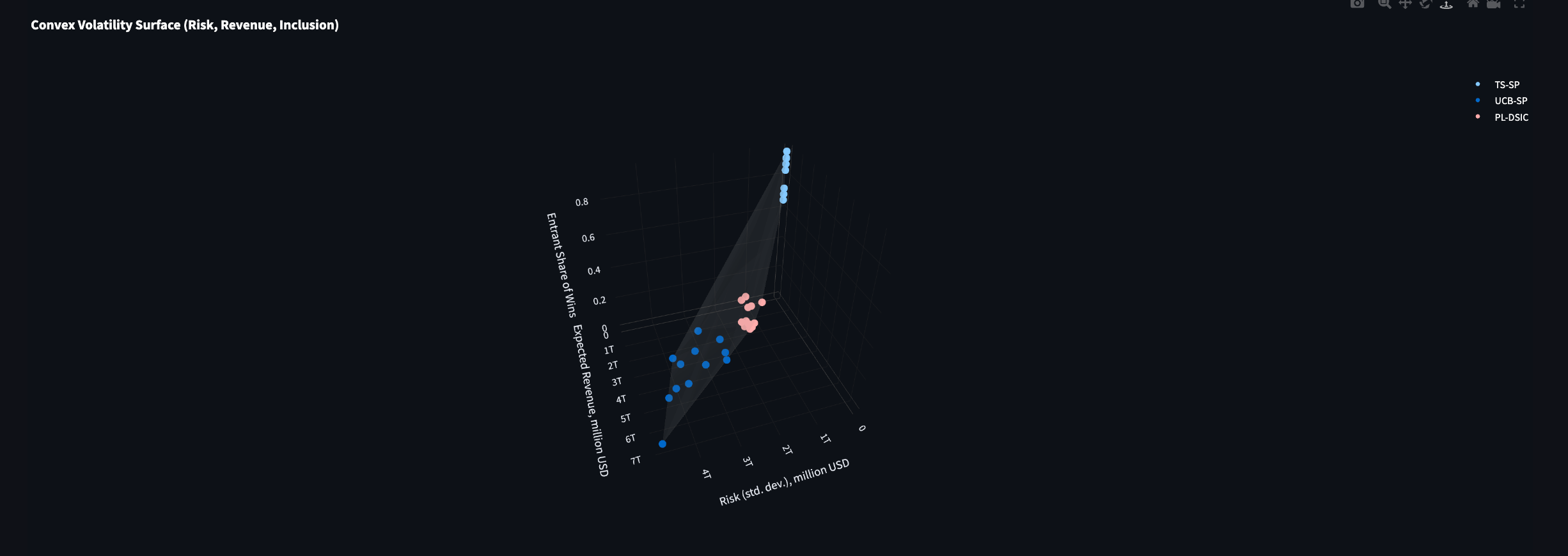
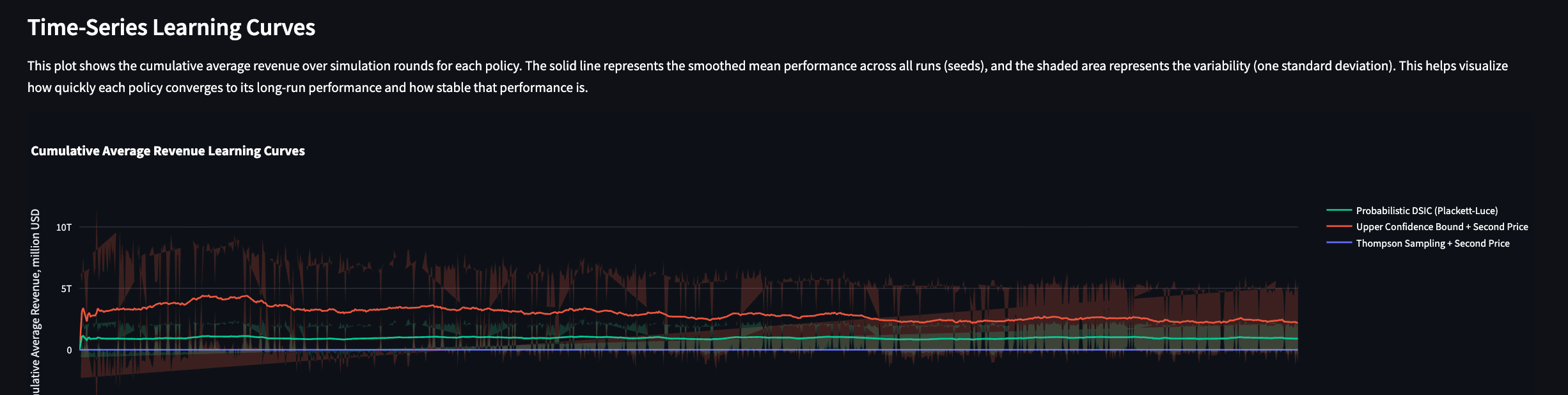
Smallsat Rideshare Simulation
Inspiration
My experience at Rocket Lab provided firsthand insight into the challenges within the rapidly growing small satellite market. Working there, I witnessed how access to space remains a significant bottleneck, with traditional allocation methods often prioritizing the highest bidder, stifling innovation and market diversity.
This challenge became even more compelling with Rocket Lab's development of their new medium-class rocket, Neutron, which is expected to dramatically increase payload capacity and carry significantly more satellites per launch. This presents both an opportunity and challenge: how do we optimally allocate these expanded rideshare slots?
Our goal was to explore a more sophisticated, data-driven approach, drawing inspiration from reinforcement learning and financial engineering to design a marketplace that balances profitability, risk management, and fostering a diverse, competitive market that encourages innovation across the entire smallsat ecosystem.
What it does
Our project is an interactive simulation of a small satellite rideshare marketplace. It allows users to:
- Test different auction mechanisms (like Second-Price) augmented with Multi-Armed Bandit algorithms (Thompson Sampling, UCB) to manage the exploration–exploitation trade-off.
- Analyze the impact of these strategies on key metrics: expected revenue, revenue volatility (risk), market diversity (entrant vs. incumbent win rates), and allocative efficiency.
- Visualize the results through a dashboard that applies concepts from Modern Portfolio Theory, plotting an Efficient Frontier to reveal the optimal balance between risk, return, and market inclusion.
How we built it
We built the entire pipeline in Python, leveraging a number of open-source libraries:
- Data Processing:
pandasfor data manipulation, creating an ETL pipeline (etl/) to process real-world data from sources like the Bureau of Economic Analysis, SpaceX launches, and global mission catalogs. - Simulation Core: The simulation logic in the
sim/directory usesnumpyandscipyto model auction dynamics and implement the multi-armed bandit algorithms. - Interactive Dashboard: The user interface is a
Streamlitweb application (app.py), which allows for interactive configuration and visualization. - Visualization: All plots are generated using
matplotlib, including a 3D visualization of the multi-objective opportunity set. - Configuration: Simulation parameters are managed externally in a
config.yamlfile for easy modification.
Challenges we ran into
- Mathematical Complexity: Learning the mathematics behind multi-armed bandit algorithms and determining when to use Thompson Sampling vs. UCB required deep dives into reinforcement learning theory.
- Convex Hull Optimization: Creating the convex hull on the revenue–efficiency surface involved implementing computational geometry algorithms to identify the optimal frontier of solutions. This was mathematically intensive and required careful handling of edge cases in multi-dimensional optimization space.
- ETL Difficulties: Integrating heterogeneous data sources to create a realistic simulation environment proved challenging. Cleaning and aligning economic data, launch manifests, and satellite catalogs required significant ETL effort.
- Environment Setup: Technical issues with build dependencies (e.g.,
matplotlib) on certain architectures slowed progress.
Accomplishments that we're proud of
- Convex Hull Implementation: Successfully implemented the convex hull on the revenue–efficiency surface, mastering computational geometry and optimization techniques. The resulting 3D visualization uniquely shows the trade-offs between revenue, efficiency, and risk.
- Interdisciplinary Approach: Blended reinforcement learning, auction theory, and Modern Portfolio Theory to solve a space-logistics problem.
- End-to-End Product: Built a complete pipeline from raw data processing to simulation engine and interactive dashboard—an engineering achievement showcasing breadth and depth.
What we learned
- Gained deep understanding of multi-armed bandit algorithms and their nuances (Thompson Sampling vs. UCB), and how they apply to auction scenarios.
- Experienced the exploration–exploitation problem firsthand in simulation and how these abstract concepts map to business decisions.
- Learned that simulation is a powerful decision-making tool, but strategies depend on operator goals—no “one-size-fits-all.”
- Discovered that frameworks from other domains (like Modern Portfolio Theory) can be effectively adapted to resource allocation in space logistics.
What's next for Rideshare Simulation
The current simulation is a strong foundation, and can be extended in several exciting directions:
- More Complex Models: Add sophisticated bidder behaviors (budget constraints, strategic bidding) for greater realism.
- Advanced Algorithms: Explore context-aware bandit algorithms that react more dynamically to market conditions.
- Prescriptive Analytics: Evolve into a prescriptive tool recommending optimal allocation strategies based on risk tolerance and goals.
- Generalization: Adapt the framework to other allocation problems, e.g., scheduling ground station access or managing bandwidth allocation.

Log in or sign up for Devpost to join the conversation.