-
-
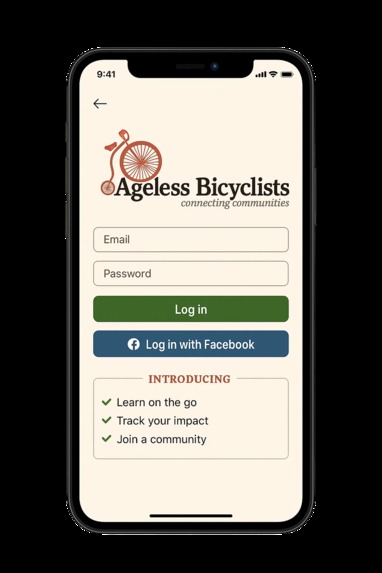
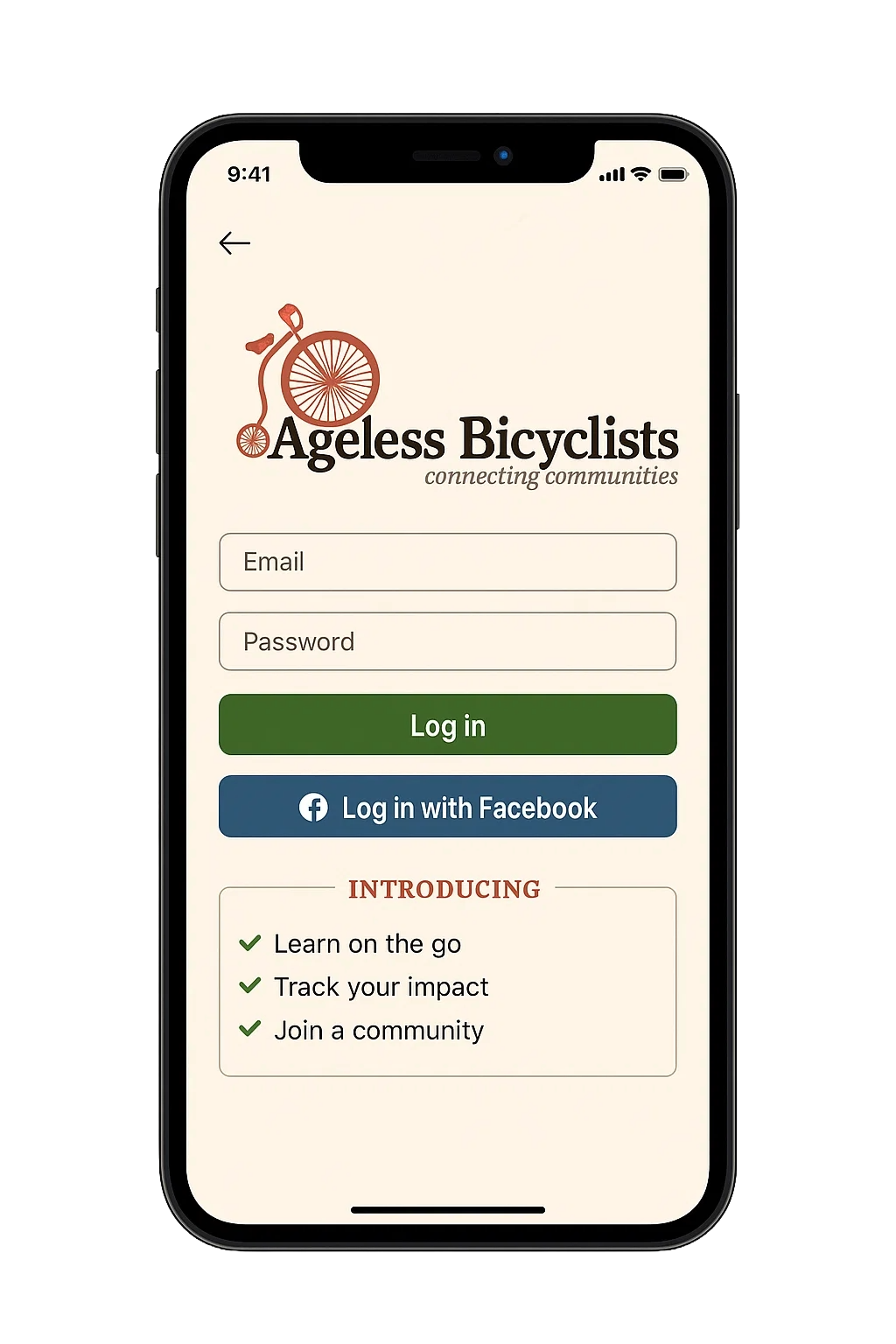
Log In Page
-
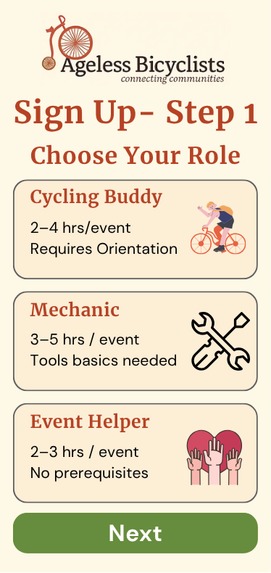
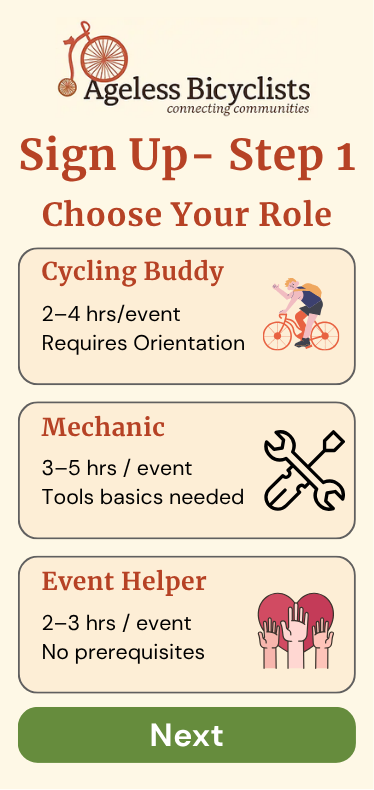
Step 1 — Choose Your Role
-
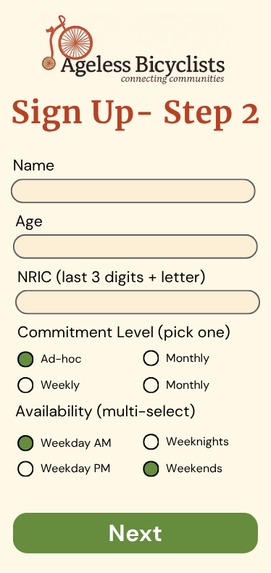
Step 2 — Essentials
-
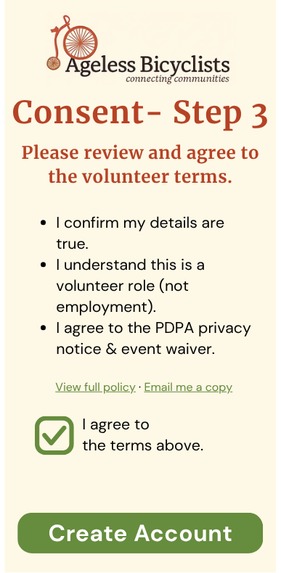
Step 3 — Consent & Safety
-
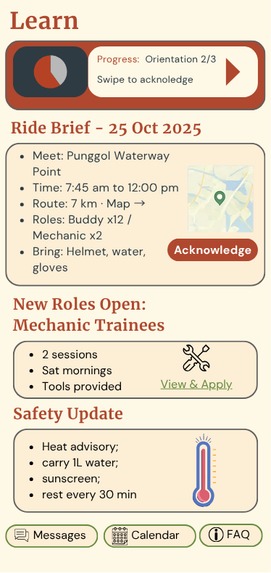
Learn page — Comms Hub & Announcements
-
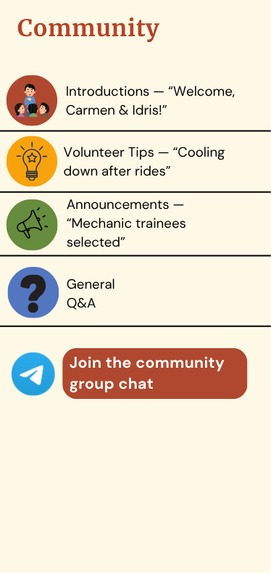
Community page — Channels & Chat
-
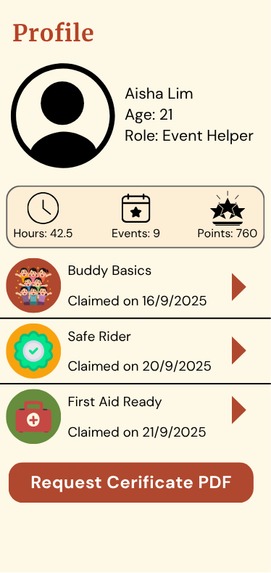
Profile page — Recognition & Certificates
-
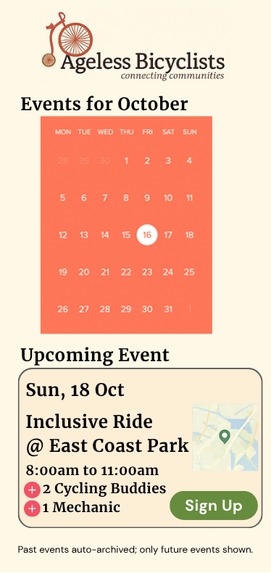
Events Hub — Upcoming First (fixes outdated events Problem)
-
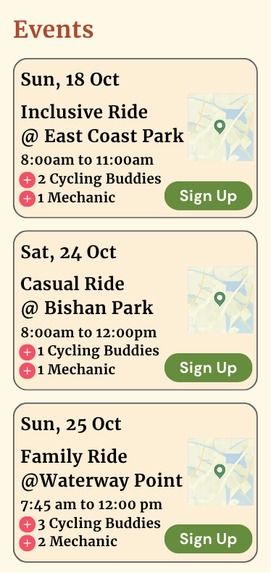
Events List — Clear Roles & Actions
-
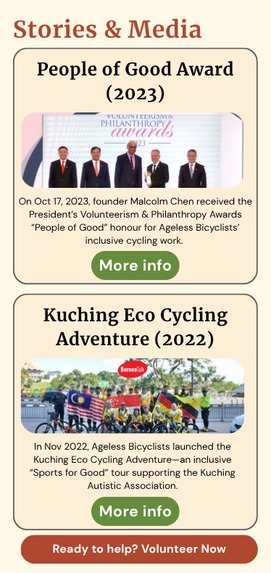
Stories & Media — With CTA (fixes misaligned media)
RideReady — The Volunteer Hub for Inclusive Cycling
Inspiration & Problem
We began with the story of Aisha, a keen volunteer who signed up with Ageless Bicyclists but then heard nothing back – no briefing, no training. Her first event was anxiety-filled, as she had to improvise and felt unsure without guidance. We discovered Aisha’s dilemma is common: many volunteers sign up and face silence, unclear roles, and weak training, which ultimately leads to churn. In fact, 1 in 3 volunteers leave when expectations aren’t met (≈35% annual churn). Younger volunteers also expect a faster onboarding process (33% of 18–24 year-olds) and need to feel recognised for their efforts (only 69% feel appreciated) – gaps the current system isn’t addressing.
Digging deeper, we audited Ageless Bicyclists’ existing volunteer onboarding and communication channels. We found a lengthy 8-page sign-up form (with repeated fields and heavy legal text) that causes friction – only ~35% of mobile users complete it, compared to ~51% on desktop. Communications are scattered across emails and WhatsApp with no single hub, meaning volunteers often miss updates or briefing info. To make matters worse, the public website’s events page was outdated (showing 2022–23 events, giving a stale impression) and even had broken links. This undermines credibility and fails to inspire new volunteers. All these pain points boil down to the core challenge: How might we train and onboard volunteers effectively while building their long-term commitment?
What Our Project Does
RideReady is our solution to empower and retain volunteers at Ageless Bicyclists. It’s a unified volunteer hub (mobile app + web) that consolidates everything – role info, onboarding, training, event sign-ups, communications, and recognition – in one accessible platform. By directly addressing the identified gaps, RideReady ensures that new and existing volunteers are ready to ride from day one. Here’s how it tackles each problem:
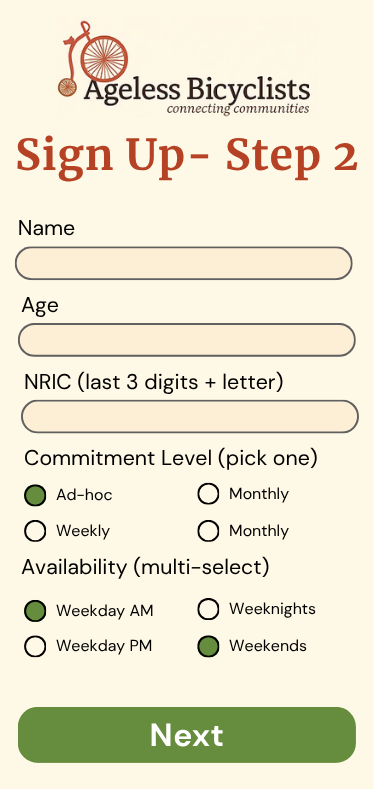
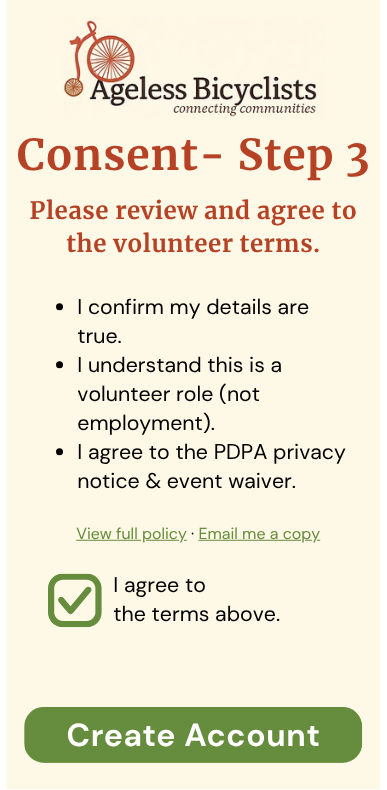
Simplified 3-Step Onboarding Form: We replaced the cumbersome sign-up process with an easy, guided form broken into three steps. In Step 1: Choose Your Role, volunteers pick a role (Cycling Buddy, Mechanic, or Event Crew) and immediately see the time commitment and any training required for that role. This sets clear expectations upfront and prevents sign-ups for roles that require prior training without completion. Step 2: Essentials collects only the necessary info – name, contact, a partial ID, emergency contact – plus volunteer preferences like commitment level (ad-hoc/weekly) and availability. We cut out extraneous questions to avoid overwhelm. Volunteers can even save progress and resume later, reducing drop-off. Step 3: Consent & Safety presents one compact consent checkbox covering the PDPA privacy notice and liability waiver (auto-filled with the volunteer’s name as a signature). A single tap submits the form and instantly emails them a copy for the record. This streamlined flow dramatically lowers the barrier to signing up – no more eight-page slog. By showing role requirements first and shortening the form, we reduce form fatigue and ensure every volunteer understands their commitments, addressing the major dropout cause.
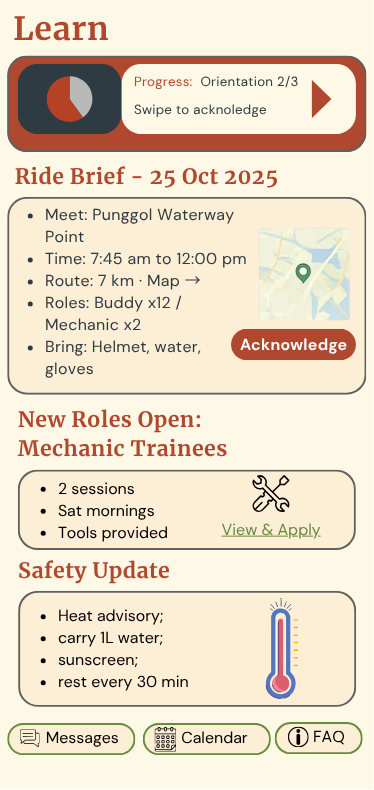
Central Hub for Communication & Training (Learn Page): RideReady serves as the one-stop hub for all volunteer communications, ending the fragmentation. The “Learn” page functions as a bulletin and training centre: Ageless Bicyclists staff can post ride briefings, safety updates, and new role openings, which volunteers see in-app in real time. Volunteers can tap “Acknowledge” on a briefing to confirm they’ve read it or hit “Message Coordinator” to ask questions, enabling quick alignment before events. Important alerts (like weather advisories or safety notices) can be pushed here with an easy “Got it” confirmation. This centralised channel with timely reminders helps reduce missed info and makes volunteers feel more prepared – boosting retention and readiness. We also envision integrating a bite-sized training library (for example, short modules or tips for each role) accessible here, so volunteers can learn at their own pace. No more important announcements lost in email; everything lives on the app.
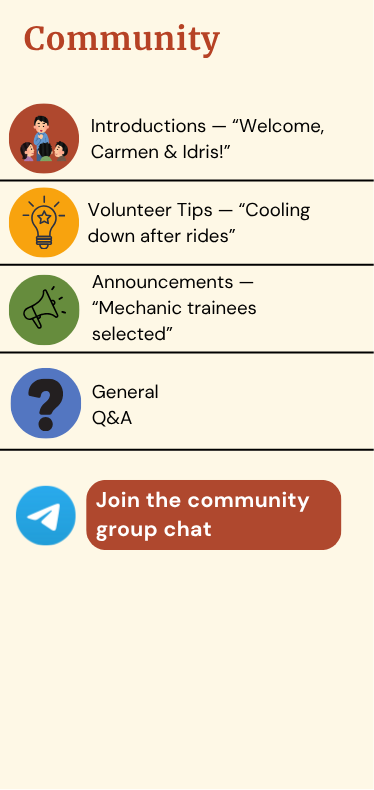
Community & Support (Community Page): Volunteering is as much about community as it is about service. RideReady includes a Community page with discussion channels and chat features to connect volunteers with organisers. There are dedicated channels for Introductions (welcoming new members), Volunteer Tips, Q&A, and general Announcements, each fostering peer support and knowledge sharing. Volunteers can start threads, seek advice (“Any tips for helping first-time riders with disabilities?”), or just share experiences. We’ve integrated options to join external groups like a Telegram chat or use the in-app chat if preferred. By providing a social space, new volunteers feel a sense of belonging and can get quick answers from experienced peers, building camaraderie. This community aspect accelerates learning and keeps enthusiasm high, addressing the challenge of long-term commitment. In short, no volunteer ever feels alone – help or friendly banter is always a click away.
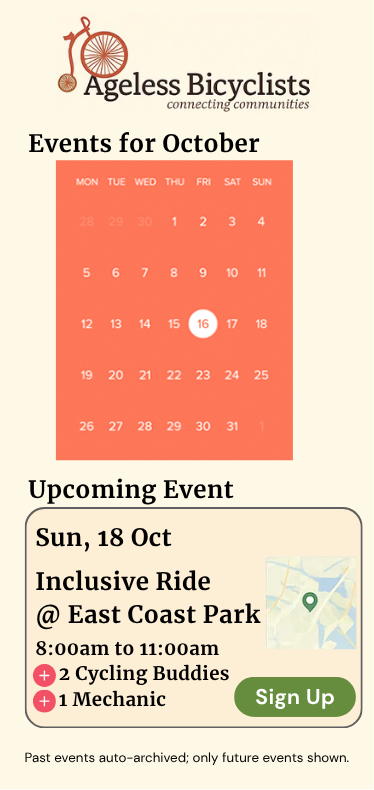
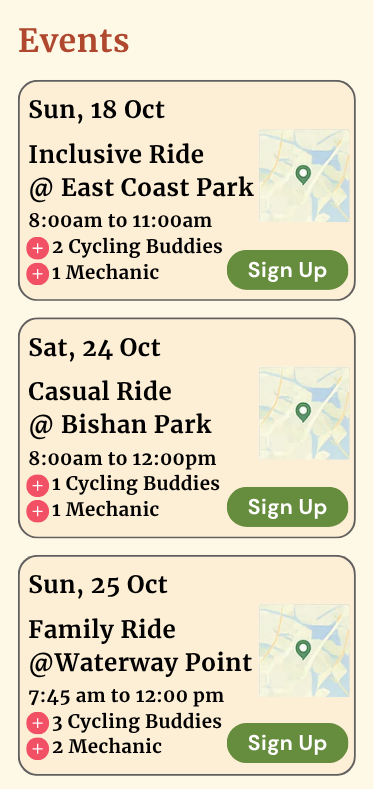
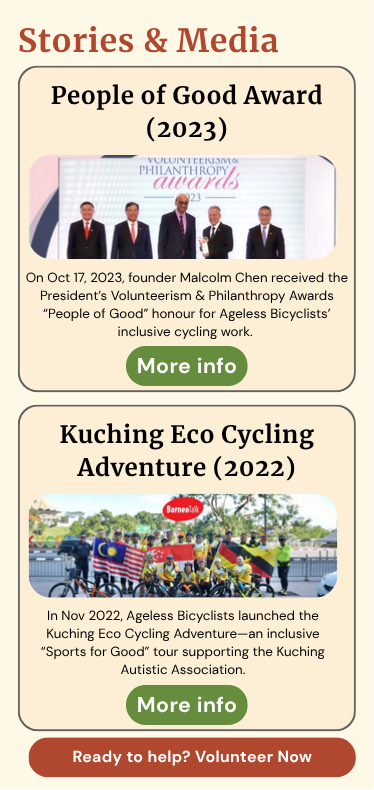
Events & Updates – Always Fresh: To combat the “stale info” problem, RideReady revamps how events and stories are showcased. The Events Hub in our app prominently features the next upcoming event and a calendar of what’s coming up, while auto-archiving past events. This means volunteers (and potential volunteers) always see that Ageless Bicyclists is active with future rides, eliminating confusion from old dates. Each event listing clearly shows the date, time, and location, along with how many volunteer roles are needed (e.g. “Buddies x12 / Mechanics x2 needed”) and one-tap buttons to Sign Up or view the route map. By making the call-to-action obvious and the info current, we inspire more sign-ups and fill roles sooner. We also fixed the media and stories section: Stories & Media now highlights recent success stories, photos, or volunteer spotlights with working links and thumbnails (replacing any broken links). Importantly, we added a sticky “Volunteer Now” call-to-action on these pages – if someone feels inspired by a story of an inclusive ride, they’re one click away from joining as a volunteer. This constant freshness and clear navigation boost credibility (users judge an organisation’s trustworthiness quickly, so up-to-date content is key) and excite volunteers about upcoming activities. Essentially, RideReady makes sure the organisation’s momentum is always visible to keep volunteers engaged.
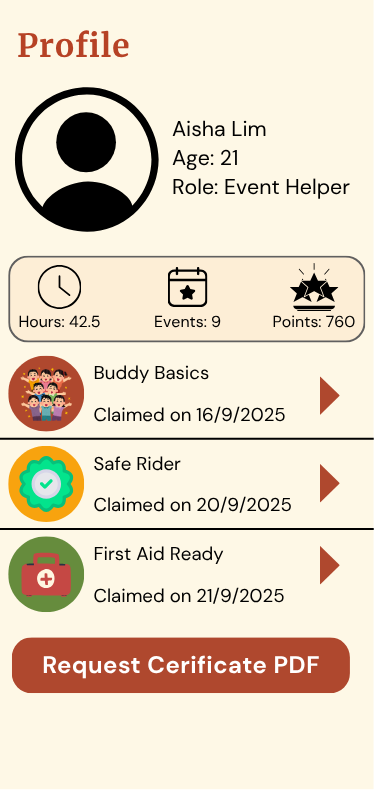
Volunteer Recognition & Progress (Profile Page): To address the motivation and retention aspect, our app includes a personalised Profile dashboard for each volunteer. Here they can track their impact – hours contributed, number of events participated, and points earned – all in one glance. Volunteers earn badges for milestones and complete training modules (for example, a “Buddy Basics” badge when they finish orientation, or a “Safe Rider” badge for completing safety training). These digital badges, along with a points system, gamify the experience and recognise volunteers for their commitment. The profile also shows progress towards goals (like completing all training for a certain role) and even allows downloading a certificate PDF of their cumulative volunteer hours and achievements. This certificate can be used for school credit, NYAA log, or a CV reference – tangible recognition that many youth volunteers value. By celebrating achievements and making growth visible, RideReady ensures volunteers feel appreciated (directly tackling that “only 69% feel recognised” issue) and encourages them to continue long-term. We want every volunteer to feel proud seeing their contributions add up, and to share their certificate or badge collection as a mark of honour.
In summary, RideReady transforms volunteer onboarding and engagement by providing one integrated platform that streamlines registration, centralises information, and builds community. It fixes the long sign-up and scattered comms by offering one convenient app for all volunteer needs. The solution is directly aligned with Ageless Bicyclists’ mission of inclusive cycling – we built the features around their core volunteer roles (Cycling Buddy, Mechanic, Event Helper) and safety practices, ensuring relevance.
Uniqueness & Innovation
Our approach stands out in several ways. First, RideReady introduces creative solutions like auto-archiving past events and link-health checks to keep content fresh – the platform essentially “spring cleans” itself, which is not something typical volunteer portals do. We also implemented a role-gated onboarding: volunteers see role-specific requirements and must complete mandatory training before full sign-up, ensuring no one falls through the cracks unprepared. The 3-step form with save/resume is an innovative departure from standard one-size-fits-all forms, dramatically improving the mobile experience (multi-step mobile forms have been shown to boost completion rates by up to 50%). Another unique aspect is the integration of a communications hub with acknowledgement tracking – volunteers can confirm they’ve seen important announcements, giving organisers immediate feedback and accountability which emails can’t provide. Our combination of community chat plus an automated FAQ bot (via Telegram integration) brings both human and AI support together to answer questions quickly. And by gamifying volunteerism with points, badges, and shareable certificates, RideReady fosters a culture of recognition that is often missing in volunteer programs. This mix of features – an end-to-end volunteer journey in one app – is what makes RideReady special. It’s not just a sign-up tool or just a chat, but a holistic ecosystem to train, engage, and reward volunteers. From our research, no existing solution in the inclusive sports volunteering space has this all-in-one approach, which we believe gives RideReady a strong, innovative edge.
Design-wise, we also paid special attention to make RideReady unique and welcoming. We chose a “vintage” theme inspired by the Ageless Bicyclists founder’s love for vintage bikes and posters, using warm retro colour tones (#8B3A3A, #3D7F5A, #E57A1F, on a paper-textured #FFF6E9 background) to set a friendly tone. This nostalgic vibe helps older volunteers feel at home, while still being clean and modern for youth. We ensured the UX is highly accessible: large text and buttons, good contrast, and readiness for bilingual content (English and Mandarin copy), given the diverse volunteer base. The branding and UX consistency make our solution feel cohesive and tailored, which is uncommon in quick hackathon projects. All these creative choices in functionality and design combine to make RideReady a one-of-a-kind volunteer hub.
Usage Scenario: How RideReady is Used
Picture a new volunteer, Aisha, using RideReady: She downloads the app and is prompted to create an account by choosing a volunteer role that suits her skills and schedule. She selects “Cycling Buddy”, sees that it requires a short orientation session (which she’s willing to take), and proceeds to fill in just her basic contact info and emergency contact. She agrees to the privacy waiver with one tap and voilà – she’s registered in minutes instead of slogging through a long form. Immediately, Aisha receives a warm welcome message and a checklist of micro-training modules to get started (e.g., “Buddy Basics” video). Over the next few days, Aisha logs in to the Learn page, where she finds a Ride Brief for the upcoming Saturday inclusive ride. She taps Acknowledge to confirm she’s read the meetup details. On the Community page, she introduces herself (“Hi everyone, I’m new!”) and is greeted by other volunteers. Someone from the Mechanics channel shares a tip about adjusting bike seats, which Aisha finds useful to know.
Come Saturday, Aisha arrives at the event confident and prepared. Afterwards, the app logs her volunteer hours automatically. She earns a “First Ride” badge on her profile, and her hours contribute toward a certificate she can later download for her NYAA portfolio. The following week, Aisha gets a notification on RideReady: a new event is posted for next month, and more Cycling Buddies are needed. She checks the Events Hub, sees the date works for her, and with one tap signs up to volunteer again. All event info (time, place, what to bring) is right there on the event card for easy reference. Aisha feels appreciated when the coordinator gives her a shout-out in the app after the event, and she can see her volunteer points increasing. Meanwhile, Ageless Bicyclists staff use the app’s admin features to see how many volunteers have acknowledged the brief, send a reminder to those who haven’t, and know early that all needed roles for the event have been filled. In essence, RideReady becomes the daily go-to app for volunteers like Aisha – for onboarding, for staying informed, for connecting with the community, and for tracking their personal impact.
Tech Stack & Development Process
Built With: We designed and prototyped RideReady using Figma (for the UI/UX design and interactive prototype) and Canva (for graphic design elements and the vintage-themed visuals). The current submission is a high-fidelity prototype demonstrating all key screens and flows.
Try it out: You can explore the prototype here: RideReady Figma Prototype – navigate through the onboarding and main app interfaces to get a feel of the volunteer experience.
While we did not have time to develop a full code implementation during the hackathon (no live app or repo yet), we have a clear plan for the tech stack moving forward. We aim to build RideReady as a cross-platform mobile app using FlutterFlow (a no-code/low-code builder that leverages Google’s Flutter framework) connected to Firebase for the backend. This choice enables rapid development and easy maintenance – important for a volunteer-driven nonprofit context. We plan to integrate with services like Google Calendar and Maps API for event scheduling and directions. We will also incorporate a Telegram Bot that ties into the app: for instance, when volunteers have FAQs or need quick tips, they can invoke the bot in-app, which pulls answers from a preset knowledge base (common questions about bike maintenance, etc.). The bot can also broadcast announcements to a Telegram group as a backup channel. To ensure content stays fresh, we can use a scheduled cloud function (cron job) as a link checker – automatically flag or disable any broken links in the events/media section. On the analytics side, we’d use Firebase Analytics or Google Analytics to track key metrics: sign-up funnel drop-off rates, training module completion, event no-show rates, etc.. These will inform ongoing improvements.
From a design and UX perspective, we iterated quickly. After creating initial wireframes in Figma, we sought feedback from a few peers (including some with volunteer experience) to refine the user flow. We focused on making the interface mobile-first and accessible to a wide age range. For example, we kept navigation simple with a bottom tab bar (Learn, Community, Events, Profile) and used text labels with icons for clarity. Given Singapore’s bilingual environment, we designed text layouts with potential translation in mind (e.g., ensuring text containers can expand for longer Malay or Chinese text if needed). We also adhered to accessibility best practices – sufficient colour contrast, larger font options – because some volunteers might be seniors or persons with slight visual impairments. The vintage colour palette and fonts (Merriweather for titles, Inter for body text) were chosen to reflect the brand personality while maintaining readability.
Impact and Sustainability
We anticipate a significant impact if RideReady is implemented at Ageless Bicyclists. By solving the three main blockers – outdated info, long forms, and scattered comms – the platform will make volunteering more attractive and retention-worthy. We expect to see more people completing the volunteer sign-up (our target is a +20–25 percentage point increase in completion, especially closing the mobile drop-off gap). With better onboarding and engagement, volunteers should stay committed longer – we aim for a +10% increase in 90-day retention of new volunteers. Success will also reflect in operational metrics: for instance, forms that took days of back-and-forth could be completed 40% faster, and even no-show rates could drop as volunteers feel more accountable and prepared. We set a goal to have >95% of event volunteer slots filled at least 48 hours before each event, thanks to the improved visibility and reminders. Ultimately, the biggest impact we seek is qualitative: a smoother, more fulfilling volunteer experience that translates into inclusive cycling events running with full crews and happy volunteers. We’ll capture success stories – e.g. a volunteer who, thanks to RideReady’s training, confidently assists an elderly rider for the first time – to inspire others and show the value of the platform.
Crucially, we designed RideReady with sustainability and scale in mind. The solution can serve as a reusable template for any NGO with similar volunteer management needs. It’s not hard-coded to Ageless Bicyclists; features like events, training modules, and badges can be adapted to other contexts (for example, a different charity could use the 3-step form and comms hub by just changing the content). We deliberately chose a low-cost tech stack – Firebase has a generous free tier, and Telegram bots are free – to ensure the platform is affordable to run long-term. Once proven with Ageless Bicyclists, RideReady could be expanded to partner organisations or even integrated with national youth volunteer networks. For instance, we could tie into something like a “Youth Bank 4.0” model, where volunteers from schools find opportunities through a common portal. RideReady could power the onboarding for that, given its focus on rapid training and recognition (key for youth programs like NYAA). To maintain content freshness (a risk area), we plan to assign an “owner” for updating events and to use the auto-archive and link-check features so nothing stale lingers. In terms of data privacy and safety, all PDPA requirements are built in from the start, with explicit consent collection and secure data storage, ensuring trust with users. We believe this project can live well beyond the hackathon: by handing over the admin controls and providing documentation, Ageless Bicyclists staff or even a volunteer task force can continue running the app with minimal technical expertise (especially since much is no-code). If needed, a professional vendor or our team can provide support for major updates, but day-to-day usage should be straightforward, much like updating a Facebook page.
Our Team’s Journey & What We Learned
We are The Ascendants, a team of youth passionate about active living and community service. Our diverse experiences came together to shape RideReady. Notably, one team member drew from his National Youth Achievement Award (NYAA) journey – a program requiring sustained volunteering and reflection. Through NYAA, he experienced firsthand how crucial proper onboarding and recognition are to sticking with a volunteer program. Those reflections directly influenced features like the badge/certificate system (to document volunteer achievement for awards or personal milestones) and the idea of micro-trainings to keep young volunteers engaged. Another team member had led a community outreach initiative (our internal “PAL campaign”) with the People’s Association, where they faced challenges in recruiting and retaining volunteers for ad-hoc events. In that campaign, they learned the importance of clear role definitions and consistent communication – lessons we baked into RideReady’s role picker and comms hub. We even created a mini promotional poster during ideation (as part of the PAL campaign) to distil our solution’s value proposition: 3-Step Volunteer Form, Connect & Celebrate, and Fresh Updates as the three pillars of improvement. This helped us validate that our messaging was understandable and appealing to the target audience (we got thumbs-up from a few potential volunteers we surveyed informally).
Building RideReady during IdeateCOMM 2025 was both intense and rewarding. On the research side, we analysed the current Ageless Bicyclists processes (thanks to resources like their volunteer form and website) and even browsed similar volunteer platforms for inspiration. We didn’t find any existing app that perfectly met ABL’s needs, which motivated us to innovate from scratch. We also received mentorship on user-centric design and leveraged hackathon workshops (e.g., a FlutterFlow crash course) to solidify our implementation approach. One challenge we faced was scope creep – we had so many ideas (from AI chatbots to IoT bike trackers), but had to trim down to the most critical features that solve the core problem. This taught us the importance of focusing on impact first. We constantly revisited our challenge statement to ensure each feature directly contributes to training volunteers better or keeping them committed.
Another challenge was translating a formal process (the long volunteer form) into a modern UX without losing necessary information. We iterated the form design multiple times to balance brevity with completeness. For example, we debated if collecting availability was too much to ask at sign-up; ultimately, we included a simple multi-select for availability in Step 2 because the organisers indicated it’s valuable for planning. We learned to prioritise essential data and defer the rest. We also encountered design/tech feasibility questions – could a no-code tool handle our feature set? By consulting the FlutterFlow documentation, we confirmed features like multi-step forms, in-app chat, and linking with external APIs are doable within that ecosystem, which gave us confidence in our tech approach.
Throughout development, we kept the judging criteria in mind as a guiding checklist. We believe our project delivers Impact & Relevance by directly addressing real pain points backed by data (e.g., increasing mobile sign-ups, reducing churn). We pushed for Innovation & Creativity, coming up with new combinations of features (auto-archive content, volunteer badges in this context) not seen in current solutions. In terms of Technical Execution, even though we are at the prototype stage, we have a solid execution plan and used realistic technologies that can be implemented quickly (our choice of FlutterFlow/Firebase shows we considered actual deployment, not just concept). The Design & UX have been crafted carefully to be user-friendly and visually appealing, aligning with the inclusive and vintage theme of Ageless Bicyclists. For Implementation, we developed a phased roadmap (from pilot to scale-up) to ensure the solution can be rolled out effectively and tested with metrics along the way. Lastly, we honed our Pitch & Communication by using storytelling (Aisha’s journey), clear visuals, and even a campaign poster to communicate our idea compellingly to judges and stakeholders. We practised explaining not just what our solution is, but why it matters, in simple terms like our elevator pitch, to make sure we connect with both technical judges and community partners.
No matter the outcome of the competition, our team is proud of what we’ve built. RideReady encapsulates our passion for helping others: it lowers barriers for volunteers and empowers Ageless Bicyclists to scale their impact of bringing cycling to all ages and abilities. We’re excited by the prospect that this project could improve volunteer experiences not just here, but for many community organisations in the future. We’re ready to pedal this forward and see RideReady make a real difference on the ground!
Built With
- canva
- figma


Log in or sign up for Devpost to join the conversation.