Prototype link (Please submit a link to a playable prototype, not a link to your design file) Link
Describe your project (max 150 words)
We designed Shell-We, a mobile application that empowers undergraduate students to cook their own meals while fostering a community of like-minded individuals. We aim to combat food insecurity and dissatisfaction with dining halls by connecting students with the resources and community they need to cook.
ChefGPT harnesses an AI-based recommendation system implemented using support vector machines to recommend recipes that can be created given a set of ingredients. It additionally displays whether there is an event/cooking group corresponding with that recipe.
The “Explore Events” page enables the user to find cooking groups and events near them. When registering for events, students can pledge to bring ingredients, allowing students to pool ingredients together.
Finally, the “Explore Communities” page allows users to find and join communities of students with the same interests or dietary preferences. It features a social platform and discussion feature where students can share tips and recipe ideas.
Describe your research process and findings. If you conducted any surveys or interviews, please include the survey form and/or interview questions here. If you conducted secondary research by pulling from online sources, please include a link to your sources. (Max 500 words)
We began by brainstorming research questions—defining the problem context, our general understanding of the problem, and addressing common issues present within it. Then, we settled on producing a comprehensive solution to address food insecurity on campus. Initially, we conducted statistical analysis and researched the effects of wasted dining hall ingredients on exacerbating campus food insecurity. However, we determined that both on- and off-campus students are often unsatisfied with food options—whether it be due to dietary restrictions, personal preferences, or any other varying factors. Researchers estimate that over 40% of college students face food insecurity. Additionally, 87% of college students across the US live off-campus and a majority of them have limited or no meal plans, leading to them having to cook their own meals. This common trend led to the realization that students often rely on frozen/microwave/instant meals, which often do not carry ideal nutritional value.
Thus, we decided to pivot from focusing on dining hall waste to emphasizing the need for a community-based solution to bring college undergraduate students together to pool resources in the form of recipes and ingredients to curb food waste. We then decided to conduct secondary research. We found that according to the Journal of the Academy of Nutrition and Dietetics, 40% of college students face food insecurity. Furthermore, dining hall food can oftentimes be inadequate, and cooking for oneself exclusively can be stressful and can lead to wasted food, due to the fact most recipes are not single serve. We also conjectured that college students could oftentimes feel lonely in environments where they have to cook for themselves when in many universities, meal times are the most social intervals of the day. Thus, we questioned: cooking for yourself takes away one of the most important things people look for in a dining hall—besides food—a community to create and eat with. As a result, our main concern was this: how can we build a community around cooking?
We continued our exploration by conducting 9 interviews among undergraduate students in universities spanning across the nation. We asked questions regarding cooking habits, dietary preferences and restrictions, and whether students would be interested in joining a community of their peers to cook together. The primary concerns expressed by students in these interviews revolve around the limited dining hall food options, particularly for those with dietary restrictions.
We also conducted research on existing solutions targeting our problem statement. While we found several initiatives aimed at reducing food waste (such as TooGoodToGo, ZotBits, GrinEats), we did not come across a single community-based cooking initiative for college students.
Lastly, we sent out a survey that garnered over 35 responses; from this we found two main takeaways: first, students tend to cook about two or three times a week; and second, the top three reasons deterring undergraduate students from cooking are that they have limited access to ingredients (61% of responses), are unaware of simple and healthy recipes they can follow, and that they prefer to not cook alone.
Survey Link: https://forms.gle/SvYMV8iSy4Qwm8Uz7 Interview Questions: https://docs.google.com/document/d/1iY73Zne9UP32IgXhNbP1ewh1ZqDTvHjo4xNGsDkXsF0/edit?usp=sharing Research Links: https://www.nytimes.com/2016/08/07/education/edlife/how-much-does-living-off-campus-cost-who-knows.html https://www.washingtonpost.com/lifestyle/food/why-college-students-should-ditch-the-dining-plan-and-learn-to-cook/2016/09/02/b6c6ecaa-6e03-11e6-8365-b19e428a975e_story.html https://www.jandonline.org/article/S2212-2672(21)01430-1/fulltext https://www.ncbi.nlm.nih.gov/pmc/articles/PMC7468761/
Describe your most important design decisions. What research findings and/or user testing results led you to make these decisions? (Max 500 words)
Before starting the prototyping on Figma, we conducted extensive brainstorming sessions and surveyed students on issues affecting them. Once we identified our problem statement, we immediately seeked user feedback through quick interviews and polls to confirm that it was truly an issue that other students face. We then created pen-and-paper wireframes to organize our thoughts and plan our design. We simultaneously developed a virtual survey and conducted 9 user interviews focusing on our problem statement.
Many of our interviewees emphasized the importance of cooking with others. While we originally centered most of our app around the ChefGPT feature, we decided to pivot towards emphasizing the community and social aspect of our app. We didn’t want to solely focus on ChefGPT because our user interviews and surveys indicated that group and community-building was more valuable to them than solely gaining access to recipes.
We designed a dashboard page to make an easily-accessible home-base for our users. Our trial users recommended that we include a section displaying the upcoming events that the app user has registered for. After a user suggestion, we also decided to integrate a badge feature to motivate and celebrate users’ achievements and milestones on the app. A user can earn a badge for initiating or attending a certain number of events, cooking a certain type of food, or volunteering to bring ingredients.
Furthermore, we decided to make users fill out a survey before starting to use the app so that they would have a personalized dashboard ready for them. The ChefGPT feature uses their responses in order to select and order recipes based on how closely they fit their preferences and dietary restrictions.
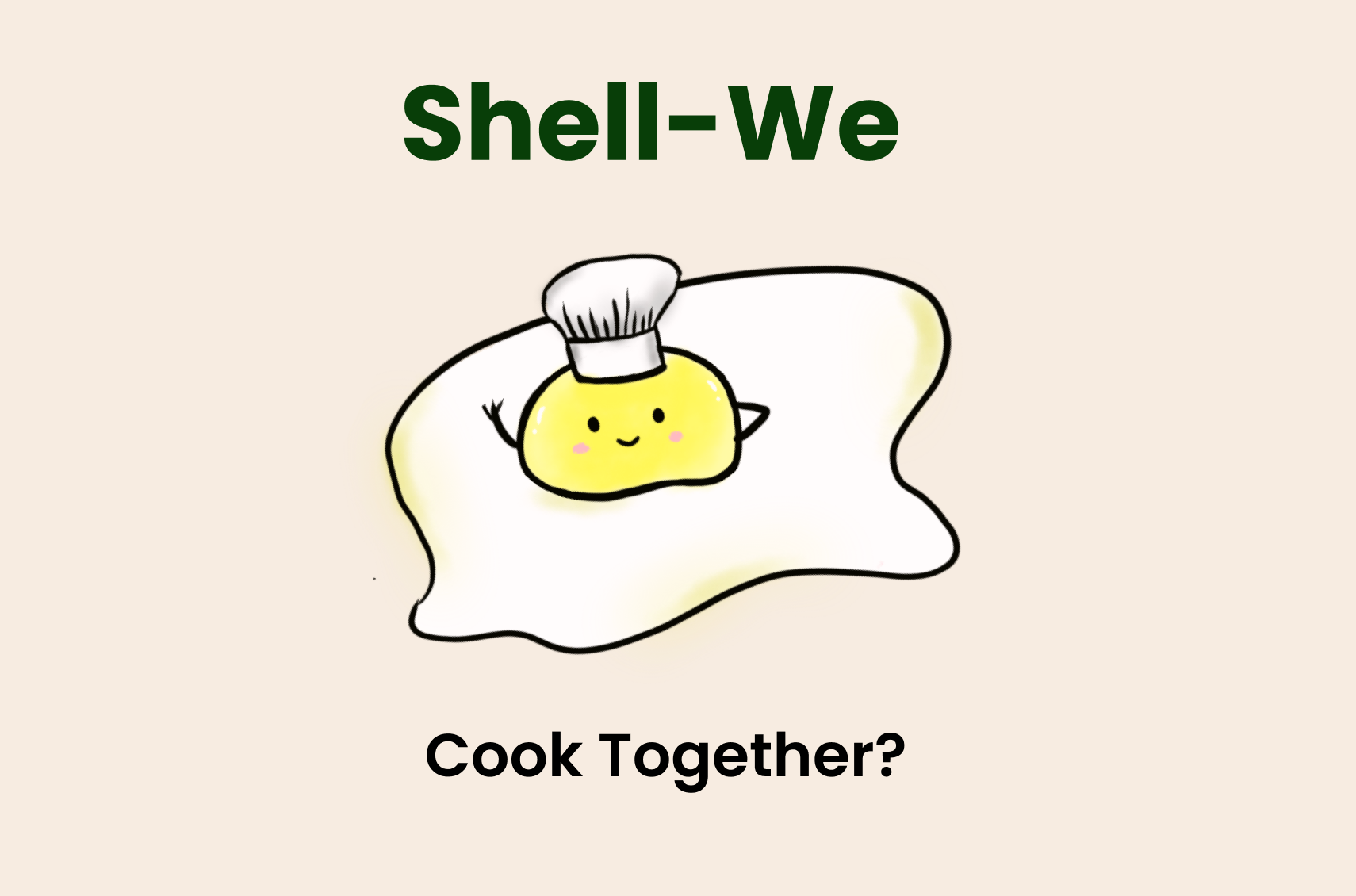
We decided to include a mascot—an egg named Shelldon—to give the app a more playful and personal feel. We hand-drew all images of Shelldon to make In doing so, we wanted to make the app look approachable and easy to utilize for the users, especially for those who may be interested in cooking but have always been intimidated by the idea of it. Also, we believed that it would resonate well with our audience of college students.
In regards to the user interface, we originally used rectangular cards to display events and communities throughout our app. Our users indicated that they would prefer to see more visual variation throughout our app, so we decided to pivot to alternate display options and add variation through more ellipses, images, and unconventional layouts.
Throughout our design process, we also made several changes to the colors of our app. Originally, we wanted to incorporate yellow into the buttons to match Shelldon’s colors; however, through our user testing, we concluded that the yellow buttons are difficult to see for the users, while also creating an uncomfortable visual experience. As such, we settled on using green buttons instead, matching our overall green scheme.
Built With
- figma

Log in or sign up for Devpost to join the conversation.