-
-
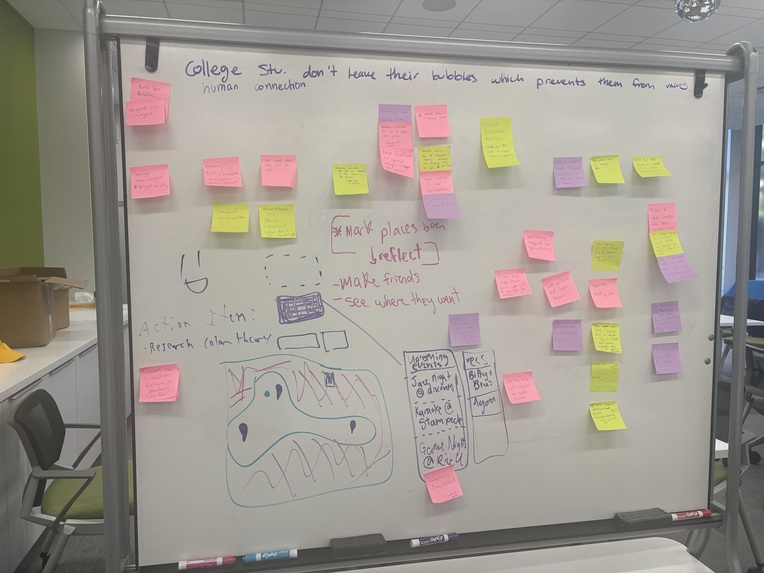
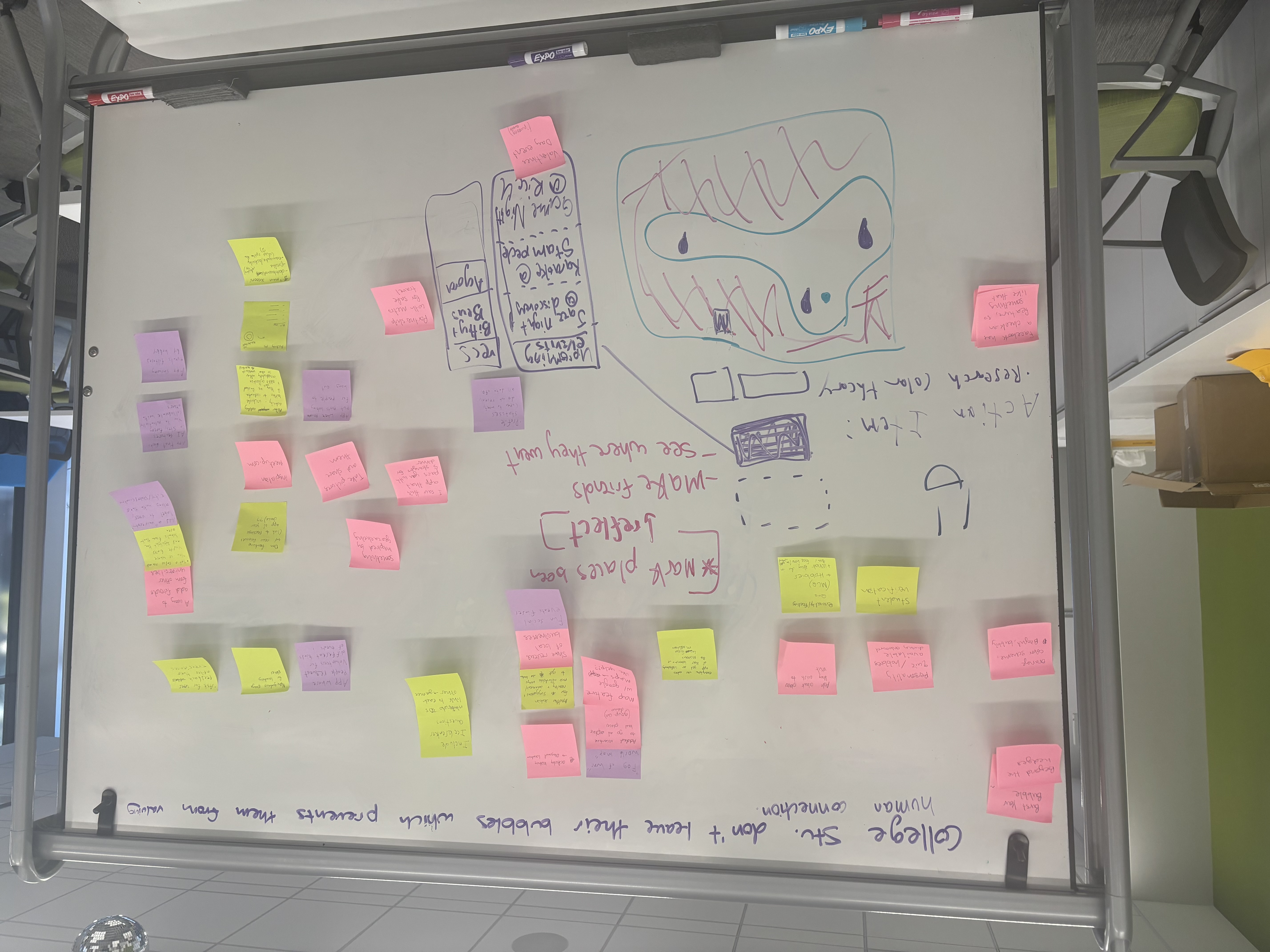
Sticky Notes from Brainstorming Solutions
Describe your project (Max 150 words) Rice students often regret not leaving campus by graduation to explore the broader Houston community. Further research and questioning revealed this is a recurring issue across other universities. Students felt stagnant in their campus environment. While the rise of AI is quickly germinating throughout all aspects of our lives, we must understand what it means to be human. With the endless empathy of AI chatbots, emotional development is at risk, and people stop challenging their ideologies and exploring new interests. One facet our team has identified that is critical to preserve is our storytelling ability which stems from our ability to experience. Thus, we created an app that would “burst their bubble” so that college students could have more memories and enrich and diversify their interactions. We approached our project utilizing a fun and interactive way to engage users while prioritizing human-centered interactions.
Describe your research process and findings. If you conducted any surveys or interviews, please include the survey form and/or interview questions here. If you conducted secondary research by pulling from online sources, please include a link to your sources. (Max 500 words) For the UI/UX design-a-thon, we conducted extensive user research to understand the needs, frustrations, and behaviors of college students. Our research process included both primary and secondary research methods to gain insights into their daily lives, emotional needs, and pain points. To gather firsthand insights, we interviewed over 50 students on campus, ensuring a diverse range of perspectives. The goal was to explore students' values, frustrations, and aspirations to design a meaningful and impactful user experience. The interview questions focused on defining what it means to be human, personal hobbies, and associated challenges regarding individual and collective values. These conversations revealed that many students highly value meaningful social interactions and are concerned about the increasing influence of artificial intelligence (AI) on human relationships. To supplement these interviews, we conducted secondary research by analyzing existing studies and articles about the role of AI in human interaction and the general needs of college students. One key article from The New York Times discussed the rising trend of AI companions and the potential emotional reliance on them, raising concerns about AI replacing genuine human connection. Another article from Psychology Today explored the psychological effects of prolonged AI interaction, warning that excessive reliance on AI could diminish essential social skills and emotional intelligence. From our research, we have identified two key insights. First, many students desire authentic human connections and fear that the digital age is reducing face-to-face interactions. Lastly, students worry that our ever-increasing reliance on AI will lead to poor development of emotional skills.
Works Cited: Hill, K. (2025, January 15). She is in love with chatgpt. The New York Times. https://www.nytimes.com/2025/01/15/technology/ai-chatgpt-boyfriend-companion.html
Sussex Publishers. (n.d.). Spending too much time with AI could worsen social skills. Psychology Today. https://www.psychologytoday.com/us/blog/urban-survival/202410/spending-too-much-time-with-ai-could-worsen-social-skills
- Describe your most important design decisions. What research findings and/or user testing results led you to make these decisions? (Max 500 words) Many students highly value meaningful social interactions and are concerned about the increasing influence of artificial intelligence (AI) on human relationships. We designed an interface that encourages in-person interactions and community engagement rather than isolating users in digital spaces. To address digital overload, we opted for a clean, minimalist design with limited notifications, reducing unnecessary distractions while still keeping users engaged. Our design decisions were guided by extensive research findings and user testing, ensuring that the final product is both engaging and meaningful. One of the most important choices we made was the inclusion of an interactive ‘fog map,’ which serves as an incentive for users to actively engage with the platform. Research indicates that gamification enhances user retention, and by gradually revealing different areas of their personal memory landscape, we encourage users to continue recording their experiences. Unlike traditional journaling methods, which can feel like a chore, this feature makes the process of reflection feel rewarding and interactive. Another crucial design element is the reflection component at the end of every activity, allowing users to visually map their memories. Actively processing different memories helps to prevent misremembering and helps differentiate similar experiences over time. Since many users struggle with recalling specific events accurately, and by anchoring memories to specific locations, we provide a tool that enhances recollection and emotional connection. This visual representation of memories makes our platform more dynamic and personal compared to standard text-based journaling apps, where entries often become buried and forgotten. A key insight from our research was that users expressed a desire for a more engaging and emotionally rewarding experience. This led us to design our platform as an interactive journal rather than a structured log. By focusing on core memories and keeping the process simple, we avoid overwhelming users with unnecessary details while still allowing them to capture the essence of their experiences. Simplicity in design was another crucial factor, as overly complex journaling tools often deter users from maintaining a consistent habit. By emphasizing core memories rather than requiring exhaustive entries, we ensure that the experience remains enjoyable rather than burdensome. During user testing, we found that many individuals struggled with deciding what to do next, often defaulting to familiar activities instead of exploring new experiences. By offering relevant and personalized suggestions, we not only help users create new memories but also encourage continued interaction with the platform. We made several key design decisions for our project based on these research findings. To prioritize social well-being, we designed an interface that encourages in-person interactions and community engagement rather than isolating users in digital spaces. Each of these decisions was informed by our research findings, ensuring that the final design addresses real user needs while fostering a healthier and more balanced digital experience.
Works Cited: Pennebaker, J. W. (1997). Writing about emotional experiences as a therapeutic process (link) Brown, P. C., Roediger, H. L., & McDaniel, M. A. (2014). Make It Stick: The Science of Successful Learning
Hamari, J., Koivisto, J., & Sarsa, H. (2014). Does gamification work? A literature review of empirical studies on gamification (DOI: 10.1109/HICSS.2014.377)
Brown, P. C., Roediger, H. L., & McDaniel, M. A. (2014). Make It Stick: The Science of Successful Learning
Built With
- figma


Log in or sign up for Devpost to join the conversation.