-
-
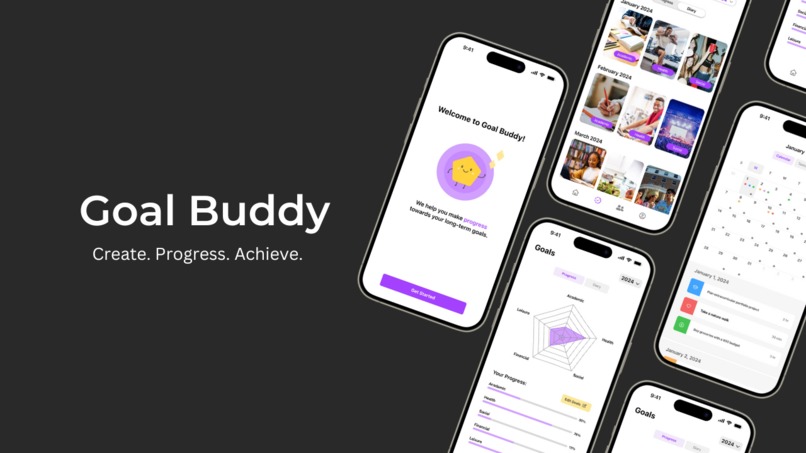
Goal Buddy
Project Description:
Goal Buddy transforms New Year's resolutions from daunting tasks to achievable milestones. This AI-powered app effortlessly syncs undergraduate students' personal and academic calendars with their quarterly goals, fostering an environment where progress toward self-development and growth is not just a solo journey but a shared experience. It introduces a layer of friendly competition among peers, promoting accountability and motivation.
Students can visually track their advancements in the five critical areas of undergraduate life: Academic, Health, Social, Financial, and Leisure. The app's Self-Growth chart and percentage indicators for each goal provide a clear measure of progress with every task completed. Additionally, Goal Buddy offers a unique feature where daily journals are presented in a photo-album style, organized by category, making reflection on personal growth both intuitive and engaging.
Research:
Recent research by Allen (2023) reveals a striking disconnect in goal achievement: only 9% of Americans who set New Year's resolutions fulfill them, with 80% abandoning these goals by February. Intrigued by these findings and the onset of the New Year, our team—comprised of four undergraduates (also target audience)—sought to understand the challenges faced by students and how we can help them overcome these barriers to achieve their goals (problem and opportunity space).
Secondary Research Links: DriverResearch & OSUEdu
Our initial brainstorming session uncovered common/general challenges within our own experiences, notably in time management, health (especially sleep and burnout), and academic/professional development. To ensure we covered a broader population of Undergraduate experience, we disseminated a survey probing students’ primary challenges and aspirations within their college journey. The survey reached a diverse group, garnering 37 responses across more than 20 majors, 12 institutions, and 1 with accessibility needs. The feedback was valuable, revealing a consistent struggle among students with managing their workload, effectively allocating time, and sustaining healthy lifestyle habits. Students articulated difficulties in navigating financial management, maintaining physical and mental well-being, achieving academic success, fostering social connections, and finding time for leisure and event planning.
Problem Statement: This causes a problem for undergraduate students because they struggle to effectively set, pursue, and achieve their goals, spanning academics, personal development, health, and social connections. This is important because the impact of these problems extends beyond their university years and affects their daily lifestyle and long-term wellness.
Following this survey, we sought deeper/specific understanding through user interviews. These questions were designed to delve into students’ perspectives, feelings, and pain points. Rather than giving concrete ideas to participants, we aimed to encourage them to envision and articulate their wants or needs, and WHY.
After refining our interview guide through preliminary testing, we extracted insights from the discussions through mini-qualitative analysis. Important insights we gained from our interviews that shaped the “so what” and decisions of our design included:
- Students find value in the idea of socialization and having friends to hold them accountable for their goals/task completion.
- Students want to make goal planning and achieving them fun.
- Students want to feel a sense of reward for completing their goals and to see progress.
- The wording UI for “Self-Growth” is confusing because all categories or goals are seen as self-growth or development.
- Some students don’t track their goals because it requires time and effort. Thus, they even prefer tracking in their brain which leads them to fail oftentimes.
- Achieving their professional goals while also maintaining their personal goals is desirable for students.
- Students have difficulty balancing their time with personal and academic involvement.
These insights then informed our next section, consisting of design decisions, ideations/brainstorming, sketching, wireframes, and rapid iterative testing and evaluation.
Design Decisions
In the process of multiple rounds of iteration–sketching, wireframing, and testing– we finalized our 15 most important design decisions below that greatly complemented the “So What” to our qualitative insight. We discussed the insights in the format of “[Qualitative Insight] so we need to implement/design/create/etc…]. Thus, creative ideas that met student needs began to bloom and elements such as Pentabuddy personalities were born!
Qualitative Insight/Design Decision
Students find value in the idea of socialization and having friends to hold them accountable for their goals/task completion.
- Add Friends features
- Friendly competition through a Leaderboard amongst friends based on task completion & consistency
Students want to make goal planning and achieving them fun.
- ‘Penta-buddy’ customization
- Gamification
Students want to feel a sense of reward for completing their goals and to see progress.
- Progress bars
- Goal completion and report (consistency)
- Pentagon chart visualization
The wording UI for “Self-Growth” is confusing because all categories or goals are seen as self-growth or development.
- Changed to “Leisure” such as hobbies, breaks, etc.
Some students don’t track their goals because it requires time and effort. Thus, they even prefer tracking in their brain which leads them to fail oftentimes.
- The capabilities of the app work to mitigate this and to help students create, track, and accomplish their goals
- AI ease, quick, and convenient suggestions
- Reminders and reflection of tasks/goals
Achieving their professional goals while also maintaining their personal goals is desirable for students.
- Goal Buddy accommodates 5 different important areas in undergrad life, including balancing personal and professional goals/tasks
- Fully customizable and flexible
Students have difficulty balancing their time with personal and academic involvement.
- Calendar integration/function
Students are less likely to feel overwhelmed when they complete smaller milestones toward a larger goal.
- Task frequency input when creating goals to help AI make schedule recommendations
User Testing– For more details on 1 of our quick user tests check out the link below!
In our user tests, we assessed user reactions to our app and the intuitiveness of task completion. Feedback on design, concept, and flow was largely positive, noting some UI and prototype adjustments needed. For example, we improved task completion feedback by making the checkmark fillable and streamlined multiple navigation paths to essential pages like Tasks.
Additionally, we aimed to enhance inclusivity and accessibility within our design. Under the 'Settings' in their profile, students can easily customize their experience. Options include adjusting font size and style, toggling between light and dark modes, enabling auto-captions, and activating text-to-speech for their Pentabuddy AI. Our prototype offers a sneak peek of these features, allowing users to have tasks and calendar plans read aloud and to interact with Pentabuddy via speech-to-text functionality.
Built With
- figma

Log in or sign up for Devpost to join the conversation.