-
-
Thumbnail
-
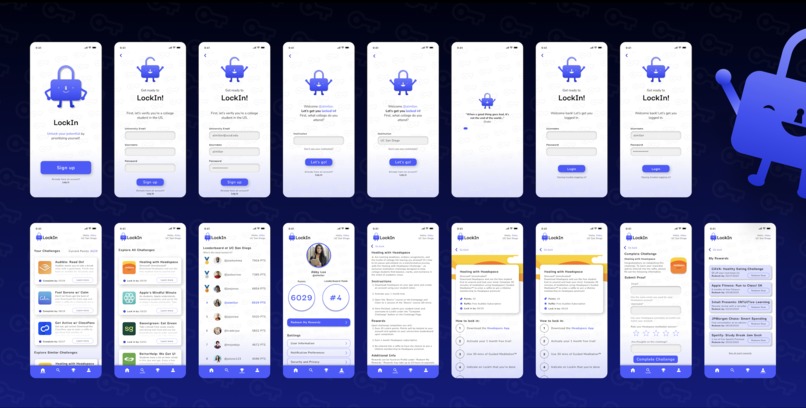
High fidelity frames


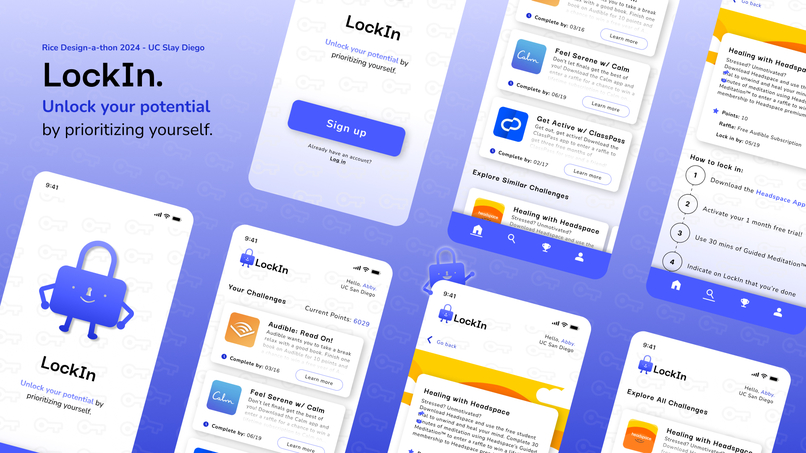
LockIn: Unlock your potential by prioritizing yourself.
A new mobile app made by students, for students.
Official LockIn Prototype:
Click here for our prototype (Figma)
Describe your project:
LockIn: Unlock your potential by prioritizing yourself. College students are broke, busy, and in need of a break. How can we get students’ heads out of their laptops, and help them “lock in” and focus on their health and wellbeing?
LockIn fosters a mutually beneficial relationship between students and companies, by incentivizing students to achieve personal goals, and opening a new avenue of marketing for companies on college campuses. Companies can host challenges to promote their own products as well as increase overall downloads, transactions, and engagement on their apps. As students, we can enter these challenges to not only take advantage of the free or discounted product offers by our partners, but also enter a raffle to get an even bigger reward! Finally, undergraduate college students have an opportunity to take a break from their difficult studies and prioritize their health over all else.
Describe your research process and findings:
We conducted primary and secondary research simultaneously in order to understand what kind of goals undergraduate students set for themselves, the obstacles they face in setting and achieving their goals, and the effect of rewards and gamification on combating low motivation.
For our secondary research, we looked at a range of different research articles and papers found here and here. Here are some of our key research findings:
Within the school system, studies have shown that “allowing students to choose themes or topics enables new knowledge, skills and understandings to be made visible, as well as providing students with a sense of ownership over their work (Scott, 2010)” (Valerio). We found that if we were to entice undergraduates into partaking in health and well-being activities, those pursuits must be natural and personal to the user themself. For example, suggesting reading to someone who doesn’t fancy themself a bookworm would be counterintuitive and not a great use of free time, nor would help them mentally, emotionally, or physically.
Students also tend to use rewards as a strategy for increasing motivation, persistence, and belief that they can be successful, as explained by papers by Wilson and Corpus (2015) and Wolters (1998).
Additionally, gamification of technology has shown to increase student motivation, student achievement and overall student performance, as suggested by Lister who did a study on motivation in Canadian post-secondary college students (2015).
For our primary research, we sent out a questionnaire on Google Forms. 100% of our participants were undergraduate students.
One important research finding was that the majority of our participants (15/18) said that time constraints were the biggest obstacle stopping them from achieving their goals, followed by low motivation and stress (both mentioned by 13/18 participants). With our design solution and after this key finding, we wanted to ensure that our app was not inconvenient for students to use, but rather our app would provide additional benefits to completing tasks that students would already be doing. By gamifying these tasks and adding bonus incentives (free products, discounts, and even raffle prizes), students are invited to take a break from their studies and do something productive for themselves.
Another key finding from our research is that 16/18 participants already use a reward system to finish tasks or achieve goals, with 14/16 of the participants stating that using rewards helps them achieve their goals. This finding highlights that our solution would be helpful to undergraduate students as extrinsic motivation is shown to be useful in completing personal tasks that benefit their overall wellbeing.
Describe your most important design decisions. What research findings and/or user testing results led you to make these decisions?
One of our most important design decisions was regarding what kind of challenges undergraduate students were able to participate in, and the goals undergraduate students were able to achieve in our app. Initially, our team wanted to balance academic, mental health, and wellbeing activities within our application. Our main goal was to help students by rewarding them for their academic pursuits. After analyzing our data and conducting usability testing with our initial high-fidelity prototype, 4/5 users noted that nonacademic centered activities would provide greater mental health and wellbeing while also allowing undergraduate students to avoid academic burnout.
Another important consideration in our design process was to not only focus on seamless interface design, but also take a deeper look into how we might be able to explore innovative interactions. The term “Piggyback Prototyping,” highlights the process of leveraging pre-existing applications and building on top of them. This concept lets us take advantage of other softwares in a mutually beneficial way between LockIn and partnering companies. For example, rather than needing a separate team of people to check every user’s submission validity, LockIn merely syncs user bases of multiple apps to track activity directly on our partners’ app. Piggyback prototyping allowed our team to put more thought into accessibility features, information hierarchy, and functionality (Grevet & Gilbert, 2015).
As for our visual design decisions, LockIn utilizes an inclusive visual design guide that emphasizes clean lines, accessibility, and motivation. We utilized the font “Darker Grotesque,” which has a distinct “feet” on the “I” to help differentiate and increase readability for the app name “LockIn.”
Built With
- figma
- google-form
- miro


Log in or sign up for Devpost to join the conversation.