-
-

Ribeye the Pacifist
-
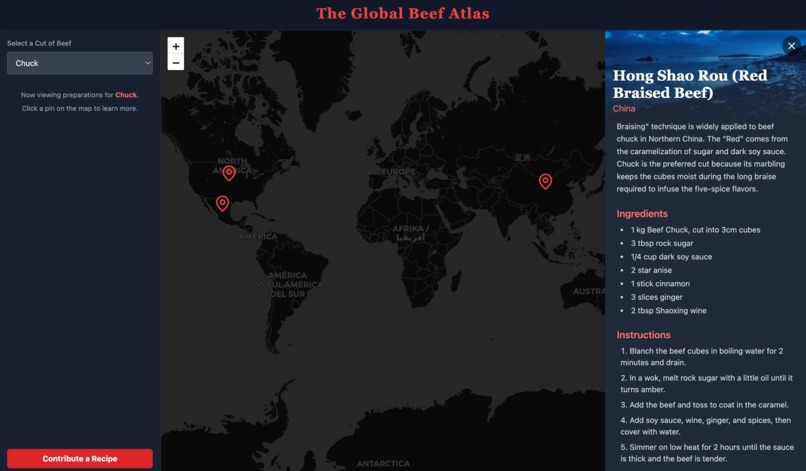
The Global Beef Atlas

Inspiration
From the postwar scarcity of sukiyaki in Japan to the rise of Western steak culture as a hallmark of prosperity, beef has historically represented more than just nutrition—it has been a totem of industrial progress and social divide."Ribeye the Savory Man" seeks to recontextualize this "symbol of power" into a symbol of shared heritage. By tracing the journey of a single animal’s cuts across global borders, we aim to prove that despite our political boundaries, humanity has always sat at a remarkably similar table.
What it does
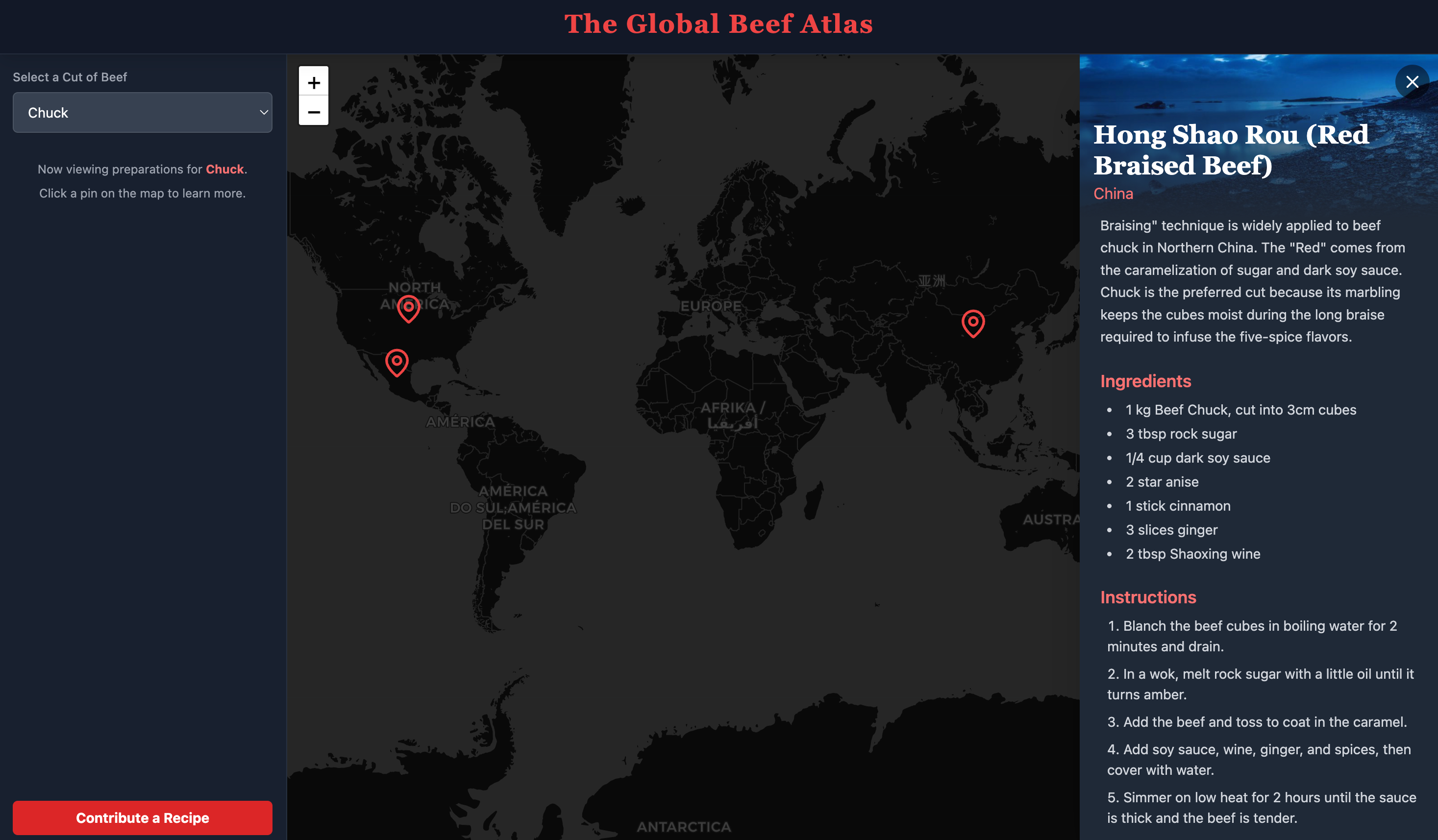
Ribeye the Savory Man is an interactive Global Beef Atlas that bridges the gap between anatomy and culture.
- Anatomy-to-Geography Linkage: Users interact with a high-fidelity diagram of the animal. Selecting a primal cut (such as the Shank, Brisket, or Flank) instantly illuminates a world map with corresponding regional traditions.
- Immersive Cultural Exploration: Whether it is a bowl of Vietnamese Bò Kho or a plate of Italian Ossobuco, the app provides not just ingredients, but the cultural history and local soul behind every dish, proving that every civilization has found its own unique way to cherish the same universal resource.
How we built it
We pioneered a high-precision "Chain-of-Tools" pipeline, leveraging the unique strengths of three distinct AI environments:
- Opal (The Architect): Used to anchor the initial application logic. While it doesn't produce code, its flowcharts served as our "North Star," ensuring a seamless user journey before development began.
- Gemini 3 Thinking (The Strategist): Utilized for deep-reasoning prompt engineering. It established the strict JSON schemas and data constraints required to guide the builder model.
- Google AI Studio / Gemini 2.5 Pro (The Builder): Acted as our primary engine to generate the interactive UI prototype and the initial global datasets with high-speed execution.
- Gemini 3 (The Refiner): Performed the final pass for deep-dive fact-checking, professional English polishing, and narrative consistency.
Challenges we ran into
- The Verification Gap: Initially, Google AI Studio provided limited data points per cut, and verifying the cultural authenticity of these "hallucination-prone" details was difficult.
- The "Serendipitous" Pivot: We turned a technical hurdle into a workflow breakthrough. When AI Studio suggested a "user submission form" UI, we repurposed that suggested structure as a Data Template. We fed this template to Gemini 3 (Thinking) to extract verified, high-fidelity information, which was then fed back into the project. This closed-loop system allowed us to iterate from "basic data" to "cultural authority."
Accomplishments that we're proud of
- Multi-Model Synergy: Orchestrated a seamless integration between Opal (Logic), Gemini 3 (Strategy), and AI Studio (Execution), proving that the sum of AI tools is greater than its parts.
- Closed-Loop Data Engineering: Inventively converted UI suggestions into data-harvesting templates, solving the problem of information scarcity.
- The Gastronomic Rosetta Stone: Successfully mapped 9 major beef primal cuts to authentic traditions across dozens of countries, transforming industrial data into a humanistic narrative.
What we learned
- Orchestration over Individualism: In 2026, the peak of AI development isn't finding one "all-in-one" model, but conducting a symphony of specialized tools.
- The Value of Logic Anchors: Tools like Opal are essential; they provide the logical guardrails that prevent AI from "drifting" during complex code generation.
- Mutualism between Systems: We learned that a suggestion from one system (like a form layout) can become the secret key to unlocking data accuracy in another.
What's next for Ribeye the Savory Man
- Interactive Visual Anatomy: We are integrating a clickable, high-fidelity Cow Cuts diagram to create a 1:1 interaction between the animal's anatomy and the global map.
- Reddit-Style Community Governance: To transform from an atlas to a living community, we will implement a decentralized approval mechanism where users can "vouch" for the authenticity of regional recipe submissions.
- Dynamic Map Badging: Once a recipe is verified, it will be reflected as a live counter on the map markers. This turns the atlas into a global leaderboard of culinary heritage, showcasing exactly how many ways humanity has found to share the same earth.


Log in or sign up for Devpost to join the conversation.