-
-
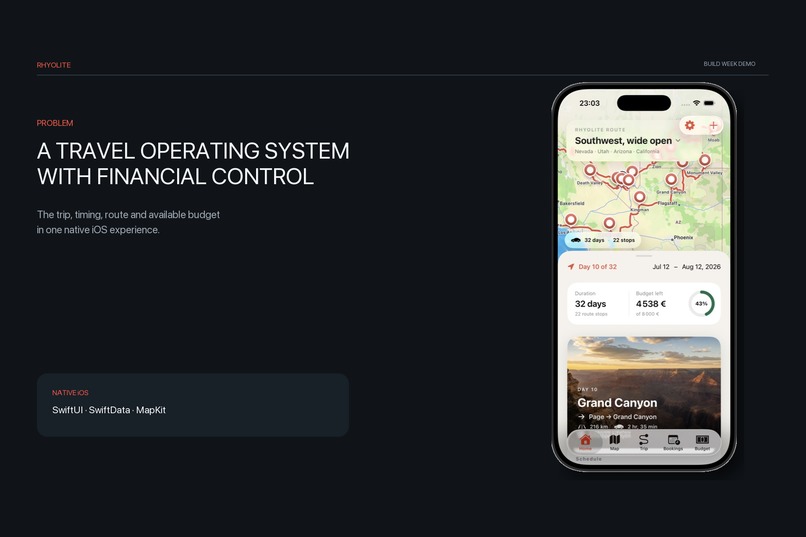
One trip, one operating system: route, current day and budget at a glance.
-
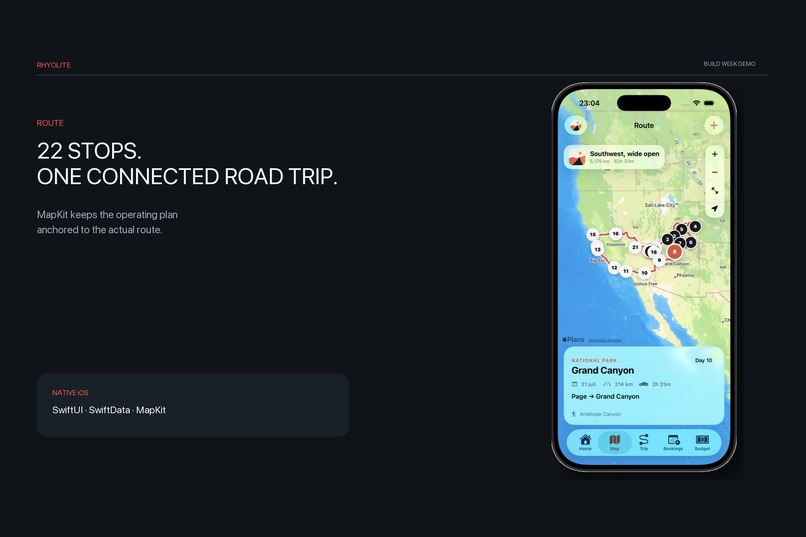
A 22-stop MapKit route anchored to the active Grand Canyon travel day.
-

Day 10 at Grand Canyon, with route leg, imagery and complete schedule.
-
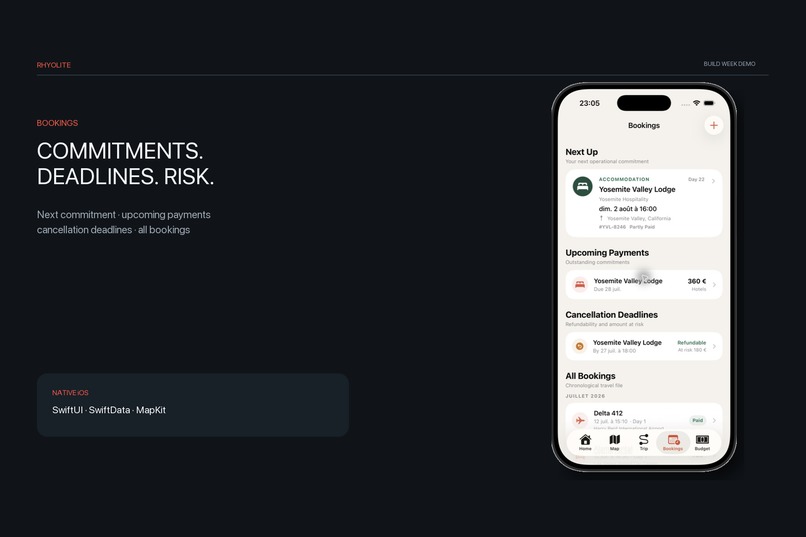
Bookings bring together commitments, payments and cancellation risk.
-
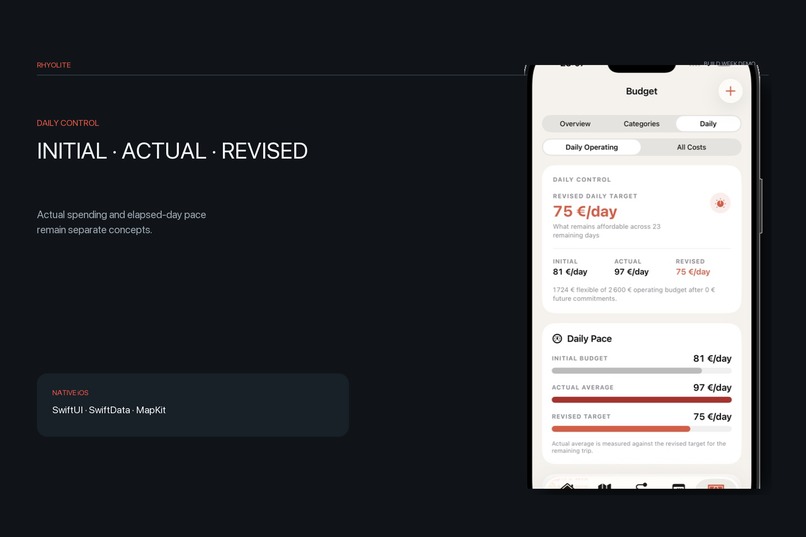
Daily control keeps initial, actual and revised pace clearly separated.
-
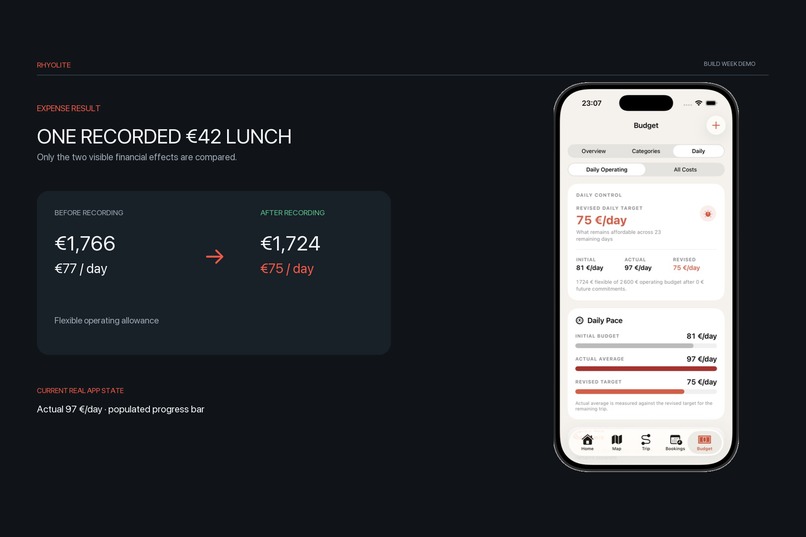
€42 lunch: allowance €1,766→€1,724; revised target €77/day→€75/day.


Inspiration
Most travel apps help users decide where to go. Rhyolite focuses on a harder problem: staying financially in control before and during the trip.
Flights, hotels, rental cars, reservations and daily expenses are usually scattered across booking apps, notes and spreadsheets. That makes it difficult to answer simple questions:
- How much of the trip budget is already committed?
- How much has actually been spent?
- What remains available for the rest of the trip?
- What is the realistic daily spending target from today onward?
Rhyolite was inspired by my own travel planning needs and by my background in finance and controlling. I wanted to bring itinerary planning and real-time budget steering into one clear native iOS experience.
What Rhyolite does
Rhyolite is a native iOS travel operating system built around a financial cockpit.
Its core value is not only showing a total budget. It continuously reconciles:
- planned budget
- committed costs
- actual expenses
- completed travel days
- remaining travel days
- revised daily spending capacity
The app separates major trip costs such as accommodation, flights and rental cars from daily operating categories such as food, fuel, leisure and miscellaneous expenses.
Recorded spending and actual daily pace remain separate concepts. Expenses contribute immediately to their relevant categories, while actual daily pace is calculated from elapsed travel days.
As the trip progresses, Rhyolite recalculates the realistic daily target for the remaining days, helping the traveller understand whether current spending is sustainable.
Alongside this financial control, Rhyolite brings together:
- trip overview and route
- day-by-day itinerary
- destinations and maps
- bookings and key travel information
- planned, committed and actual spending
- category-level forecasts and revised daily targets
Most travel apps tell you where you are going. Rhyolite tells you whether your trip is still financially on track.
How I built it
Rhyolite was built as a native iOS application using Swift, SwiftUI, SwiftData, MapKit and Xcode.
GPT-5.6 was used as a product and financial sparring partner: to structure the product requirements, challenge the financial model and business rules, refine the user experience, and improve the product narrative.
Codex handled the implementation workflow. It inspected the Xcode codebase, translated those requirements into SwiftUI and SwiftData features, diagnosed issues, tested the implementation, and supported repeated build-and-refinement cycles.
The development process was iterative:
- define the expected behaviour and financial rules
- challenge those assumptions with GPT-5.6
- let Codex inspect the relevant architecture
- implement and test the feature in Xcode
- review the displayed values and refine the result
This separation was especially valuable for the financial cockpit, where planned costs, commitments, actual expenses, elapsed days and remaining days had to remain distinct while producing a coherent revised daily target.
Challenges
The main challenges were:
- keeping itinerary, booking and budget data consistent
- separating committed costs from actual expenses
- distinguishing recorded spending from daily pace based on elapsed days
- separating accommodation and major trip costs from daily operating spending
- calculating a revised daily target from the remaining budget and remaining days
- making controller-style financial logic understandable to non-finance users
- maintaining stability while iterating quickly across interconnected SwiftUI views
What I learned
This project showed me how far a domain expert can go by combining strong business judgement with AI-assisted product development.
GPT-5.6 was most valuable for challenging assumptions, structuring requirements and improving the financial and product narrative.
Codex was most effective when the expected outcome, business rules, constraints and proof of completion were clearly defined. The best results came from focused implementation cycles followed by direct testing and correction.
What's next
The next steps include receipt scanning, richer booking management, localisation, additional currencies, collaborative trip planning and a more complete trip-end budget variance analysis.

Log in or sign up for Devpost to join the conversation.