Inspiration
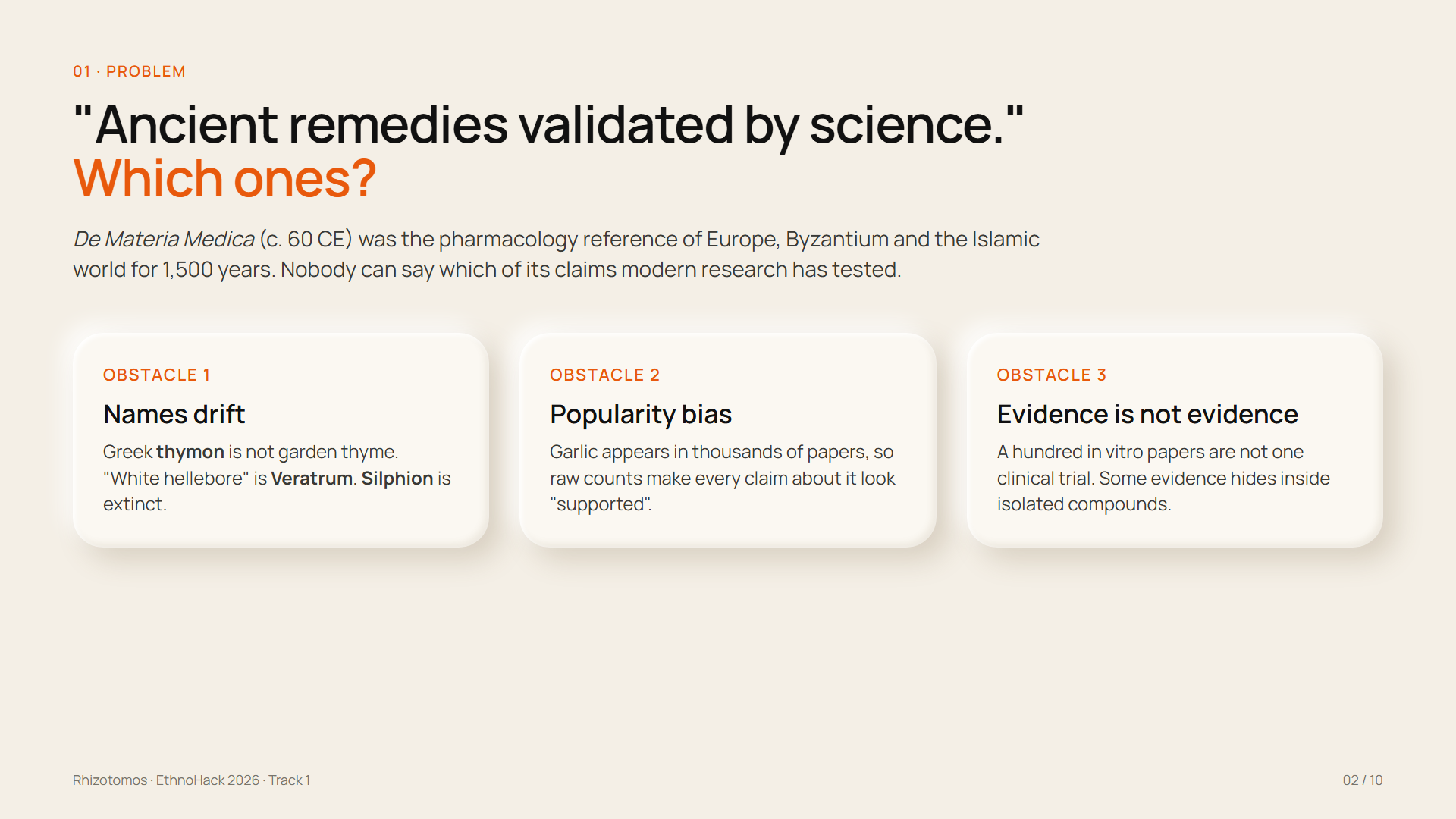
De Materia Medica (c. 60 CE) was the pharmacology reference of Europe, Byzantium and the Islamic world for about 1,500 years. People often say that "ancient remedies are being validated by science", but nobody can say which ones. We wanted to replace that anecdote with a measurement. The name comes from the rhizotomoi (ῥιζοτόμοι), the Greek root-cutters whose field knowledge Dioscorides recorded.
Problem statement
Linking historical claims to modern evidence fails for three reasons:
- Names drift. Greek thymon is not garden thyme, "white hellebore" is Veratrum, and silphion is extinct.
- Popularity bias. Famous plants appear in thousands of papers, so naive searches make every claim about them look "supported".
- Evidence quality. Many in-vitro papers are not one clinical trial, and some evidence moved into isolated compounds.
What it does
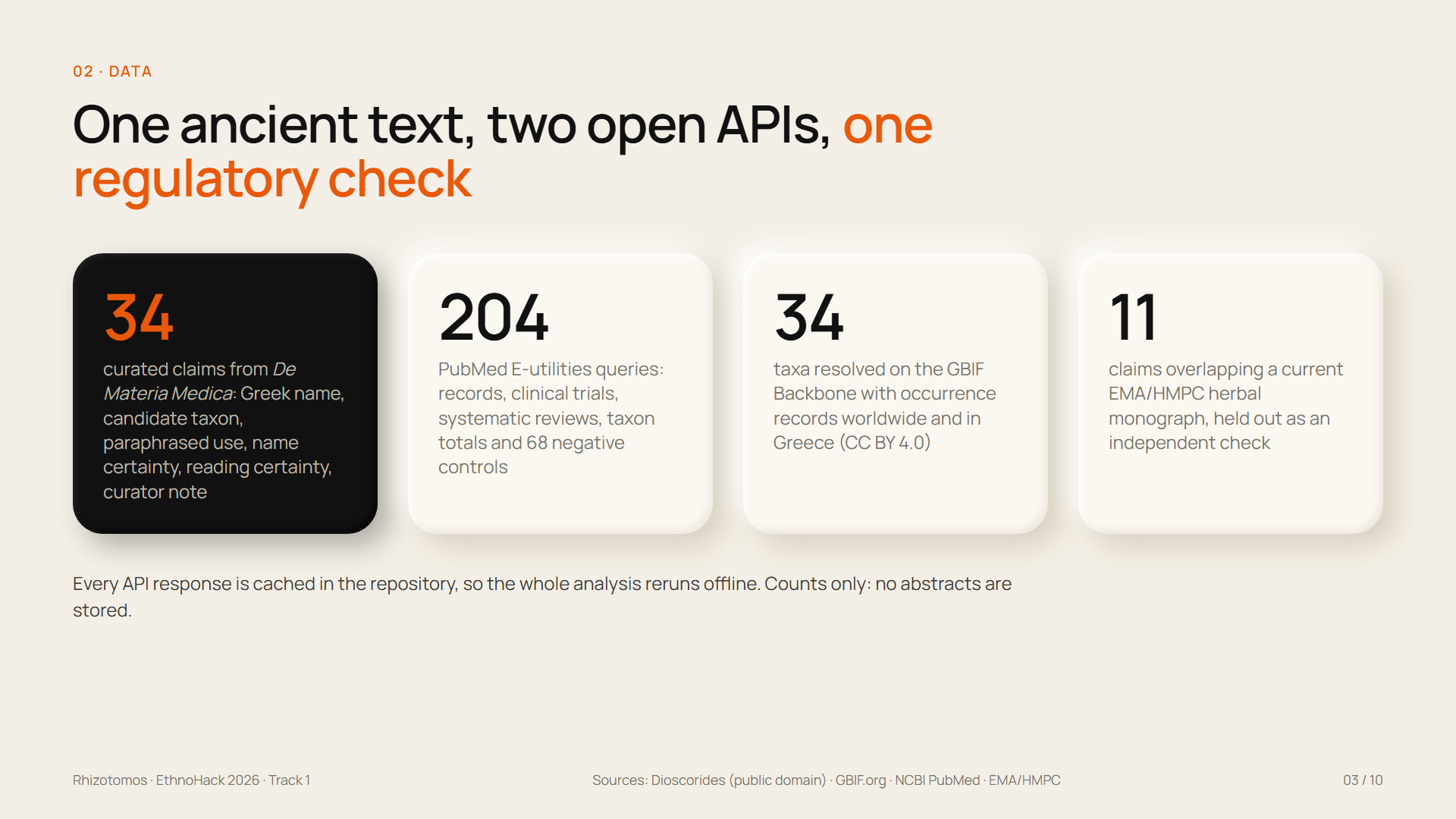
For each of 34 curated claims from De Materia Medica, Rhizotomos:
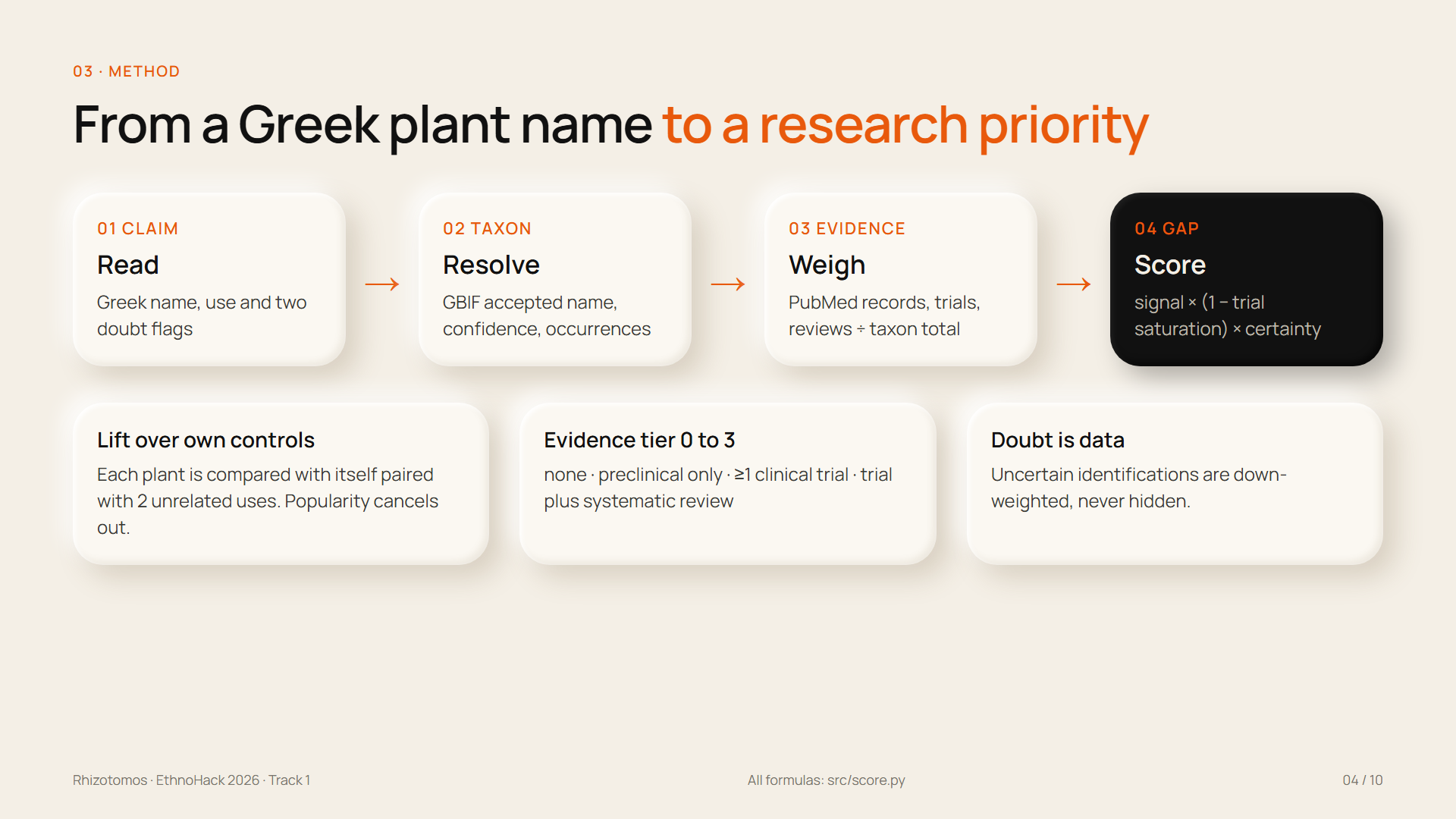
- records the Greek name, a candidate modern taxon, the paraphrased use, and two explicit doubt flags (identification certainty, reading certainty);
- resolves the taxon on the GBIF Backbone (accepted name, family, match confidence, occurrences worldwide and in Greece);
- queries PubMed for records, clinical trials/RCTs, and systematic reviews/meta-analyses, plus the taxon's total literature;
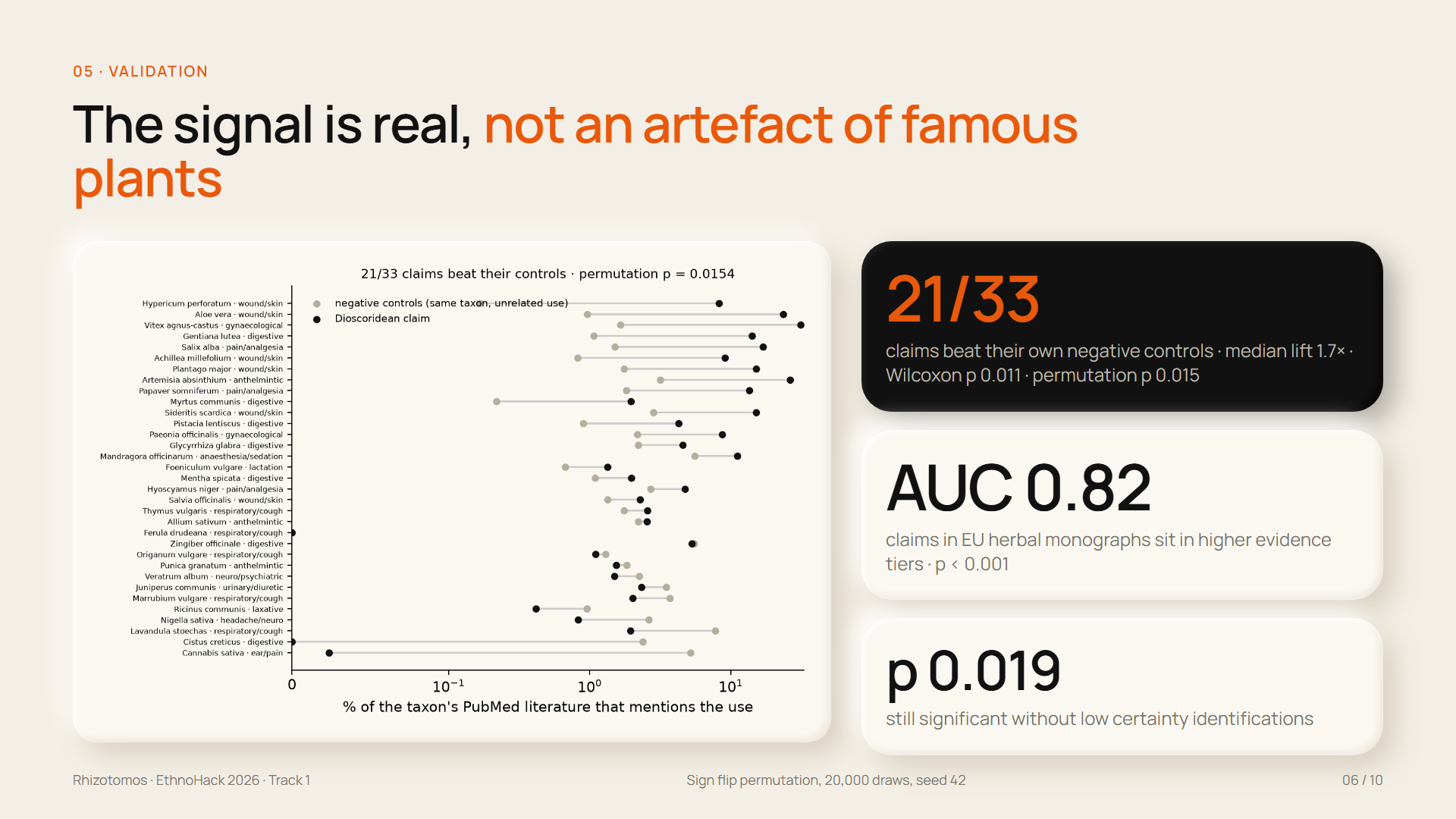
- compares each claim with the same plant paired with two unrelated uses (negative controls), which cancels popularity bias;
- assigns an evidence tier (0–3) and a translational-gap score = preclinical signal × (1 − trial saturation) × certainty;
- shows everything in an interactive atlas where every number links to the exact PubMed query.
How we built it
Python (pandas, NumPy, SciPy, requests) for the pipeline and statistics. NCBI E-utilities and GBIF REST APIs, with all responses cached for offline reproducibility. A static HTML/JS atlas (no framework, no server) deployed on Vercel and GitHub Pages. The deck is generated from the result files with Playwright, so no number is typed by hand. The narrated video was made with Kokoro TTS and ffmpeg.
Results
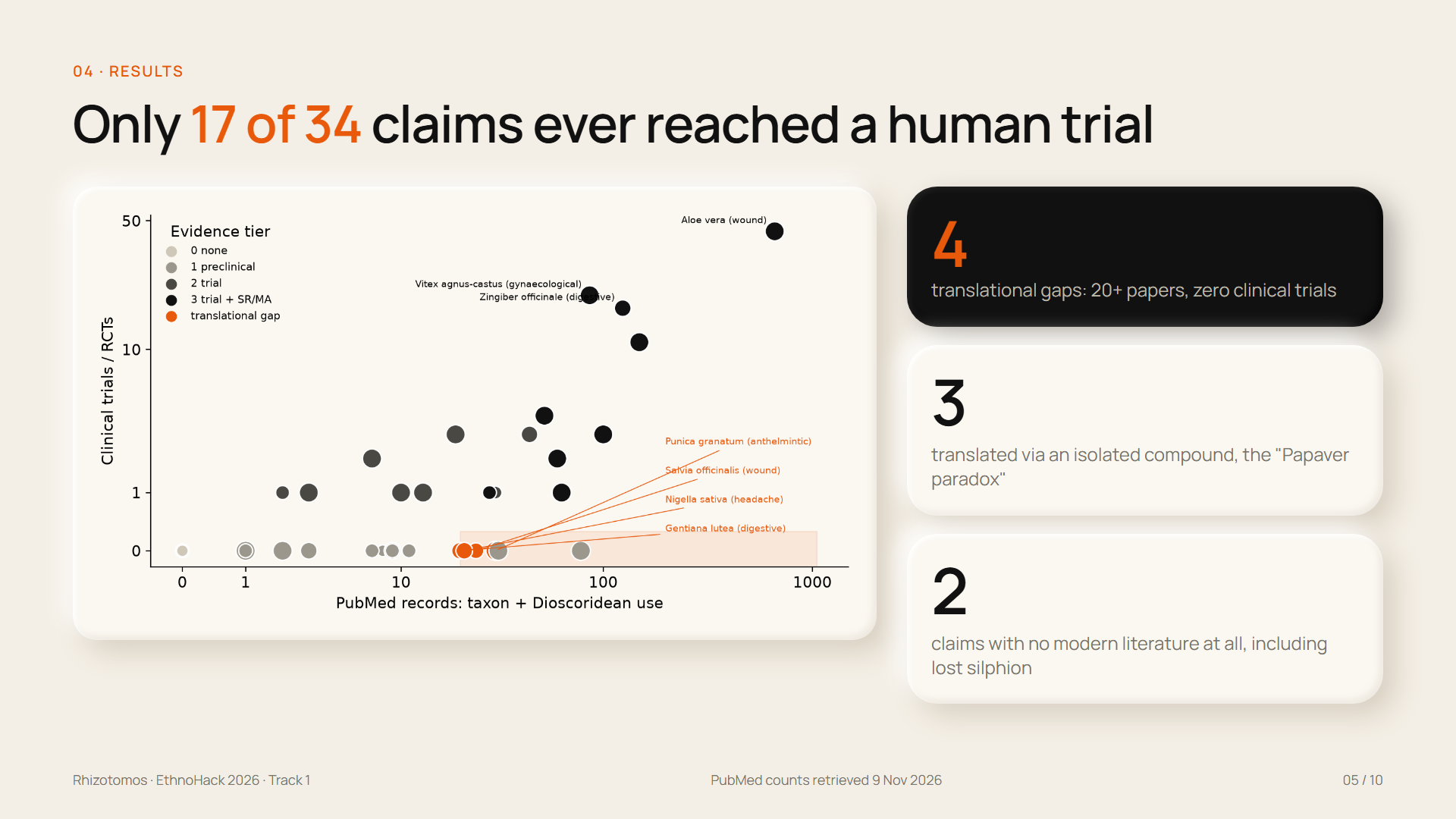
- Only 17 / 34 claims ever reached a human clinical trial.
- 4 translational gaps (≥ 20 papers, 0 trials): gentian root for the stomach, pomegranate root against worms, black cumin for headache, sage for wounds.
- Headline: gentian "for the stomach" is 12× more specific than gentian's unrelated uses, with 20 papers and 0 trials.
- Validation: 21 / 33 claims are more specific than their own negative controls (median lift 1.7×; Wilcoxon p = 0.011; sign-flip permutation p = 0.015, 20,000 draws). The result holds without low-certainty identifications (p = 0.019). Claims overlapping current EMA/HMPC monograph indications sit in higher evidence tiers (AUC = 0.82, p < 0.001).
- Two unexpected insights:
- The taxonomy blind spot. GBIF matched all names with 99–100 % confidence, even disputed ones. Databases are confident; history is not.
- The Papaver paradox. Opium + pain shows 0 plant-level trials, because evidence migrated into morphine. Such claims are labelled "translated via compound" rather than called gaps.
Data sources and licences
Dioscorides, De Materia Medica (public domain; claims paraphrased by the team) · GBIF Backbone Taxonomy and occurrence API (CC BY 4.0) · NCBI PubMed E-utilities (counts only, no abstracts stored) · EMA/HMPC herbal monographs (public; binary overlap flag). Code under the MIT licence.
Challenges
- Separating historical identification doubt from taxonomic matching confidence. These are different things, and the tools only measure the second.
- Avoiding the "famous plant" artefact. We solved it with within-taxon negative controls instead of raw counts.
- Honest framing: co-occurrence measures attention, not efficacy.
Accomplishments
A fully reproducible pipeline, statistically validated with negative controls and an independent regulatory reference, that turns a 1st-century text into a ranked list of testable hypotheses.
What we learned
Historical uncertainty has to be modelled explicitly. Evidence often leaves the plant name behind. And a well-designed control matters more than a bigger model.
Responsible research
No output is medical advice, and several plants are highly toxic. The seed table needs line-by-line expert verification against the Wellmann edition. Because the source is a public-domain text, no living community's knowledge was taken. Extending the method to community knowledge requires prior informed consent and Nagoya benefit-sharing.
What's next
- Greek NLP over all ~800 chapters.
- Name mapping through Byzantine, Arabic and Latin translations.
- Trial-outcome grading from ClinicalTrials.gov.
- Compound-aware queries (closing the Papaver paradox).
- LOTUS/Wikidata compound links for Track 2.
- IUCN conservation status.
