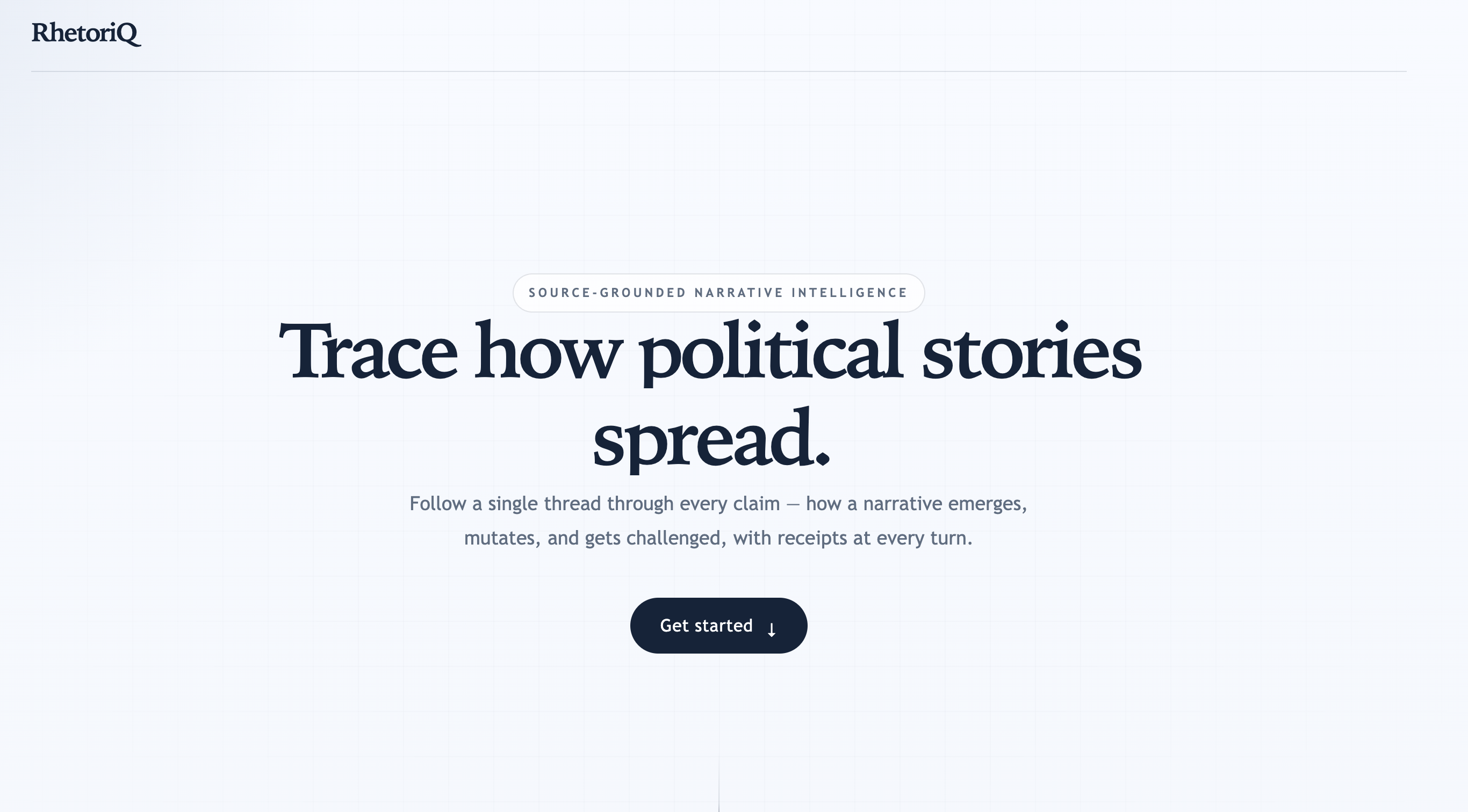
What inspired us Political narratives now spread faster than most people can investigate them. A phrase can start in one corner of the internet, get reframed by different communities, show up in news coverage, and eventually shape public opinion before anyone has time to trace where it came from or how it changed. We built RhetoriQ because we wanted a better way to investigate that process. Not a “truth engine,” and not a tool that assigns ideology or morality to sources. We wanted a system that helps people follow the narrative itself: where it first appears in the dataset, how it mutates, who amplifies it, what counter-narratives emerge, and what evidence actually supports the claims being made. Our goal was to make civic and political information easier to inspect with transparency, context, and receipts. What it does RhetoriQ is an AI-powered narrative investigation platform for civic and political stories. A user can ask a natural-language question like: “Where did the ‘hidden energy tax’ narrative come from, and how has it spread?”
RhetoriQ then builds a structured investigation that can include: a timeline of how the narrative appeared and evolved phrase mutations and related framing source diversity across outlets and content types counter-narratives and corrective framing evidence receipts tied to specific claims investigation gaps and recommended human follow-up Instead of saying “this is true” or “this is false,” the platform shows how a narrative moves through an information ecosystem and gives the user the evidence trail to inspect it themselves. How we built it We built RhetoriQ as a staged investigation system with a React frontend and a FastAPI backend. On the frontend, we used: React + TypeScript + Vite animated investigation views and flowchart-style narrative exploration dashboard and prompt-driven investigation flows On the backend, we built a multi-stage pipeline in FastAPI that breaks an investigation into explicit artifacts instead of relying on one giant model response. The backend includes agents and builders for: investigation planning retrieval and source gathering source diversity analysis timeline construction counter-narrative detection narrative family / mutation tracing analyst synthesis claim-vs-counterpoint matching receipts generation skeptic and gap-analysis passes For storage and infrastructure, the project uses: SQLite for persisted investigations Redis for caching and vector-style retrieval support model client support for Gemini, Groq, and Ollama hooks for live source verification and evaluation workflows We also designed the system with a clear safety boundary: the platform uses language like “first observed in our dataset” rather than making absolute origin claims, and it avoids truth scores or bias scores. Challenges we ran into The hardest challenge was resisting the temptation to make the product sound more certain than it should be. Narrative investigation is messy. Sources are incomplete, phrasing changes over time, duplicate reporting can create false signals, and the “origin” of a phrase is often impossible to prove from a limited corpus. We had to build the product so it stays useful without overstating certainty. Another challenge was making the agent pipeline interpretable. It is easy to generate a polished summary with an LLM, but much harder to show the user: what evidence was found which claims are well supported where the gaps are when the system should defer to human judgment We also had to balance hackathon realism with product ambition. That meant supporting live integrations and agent workflows while still maintaining deterministic demo paths that let us reliably show the experience end to end. What we learned We learned that transparency is a product feature, not just an ethics note. We also learned that multi-step AI systems become much more trustworthy when they produce intermediate artifacts that users can inspect. A timeline, a source diversity panel, a counter-narrative cluster, and a receipts layer together are far more useful than a single confident paragraph. On the technical side, we learned how important it is to combine: structured backend stages grounded retrieval careful uncertainty language frontend storytelling that makes complex investigations understandable Most importantly, we learned that building AI for civic information requires discipline. The interface and the language both need to encourage investigation, not blind trust. What's next We want to expand RhetoriQ with broader live data ingestion, stronger source verification, better cross-platform narrative tracking, and richer collaboration tools for journalists, researchers, and civic organizations. The long-term vision is to make it easier for anyone to investigate how public narratives spread, evolve, and influence discourse, with evidence always visible and human judgment always in the loop. I can also turn this into a tighter, more polished Devpost-winning version with a stronger hook and better pacing.

Log in or sign up for Devpost to join the conversation.