-
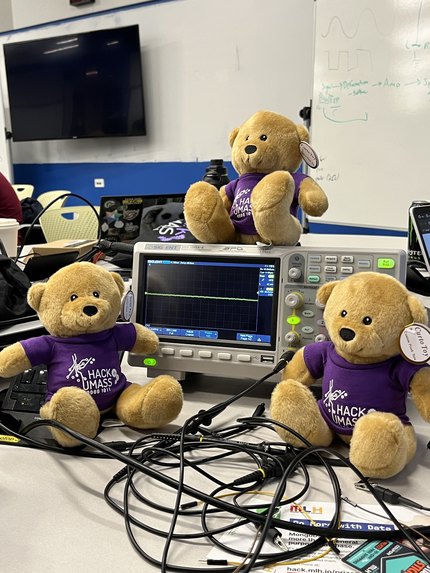
Plushies next to an oscilloscope
-
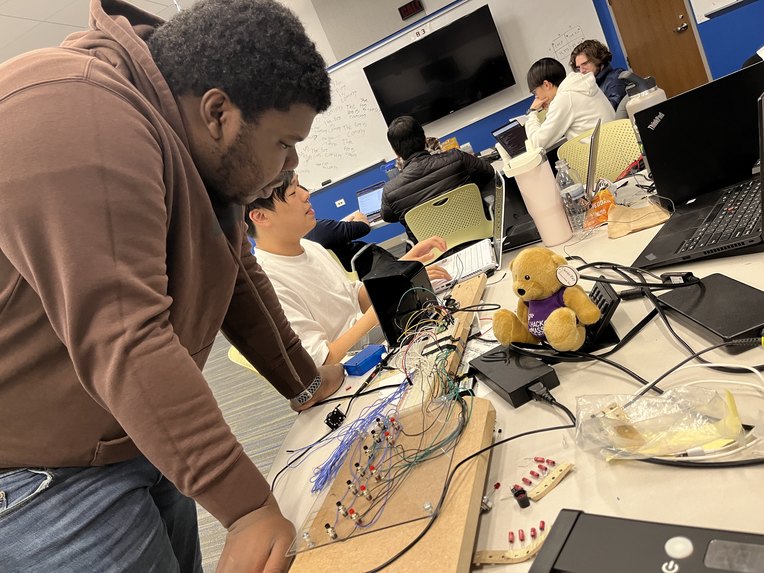
Teammember Ibrahima examining the keytar.
-
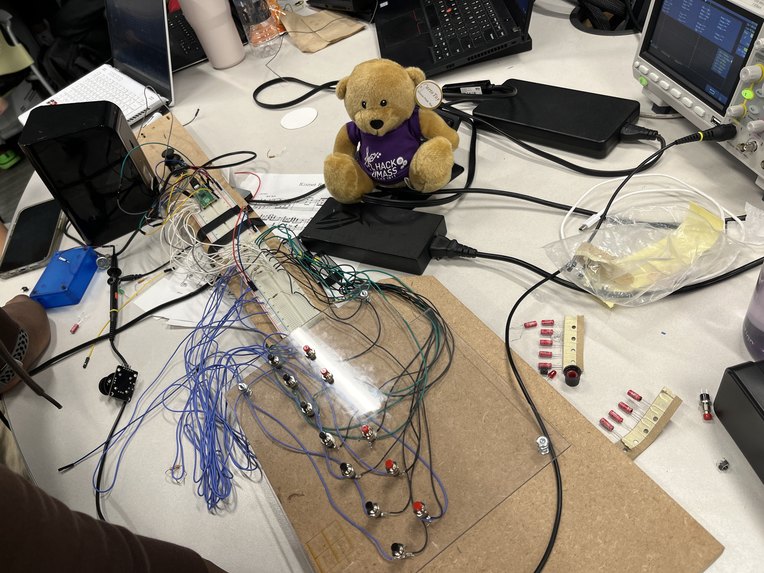
View of the keytar with a plushie.
-
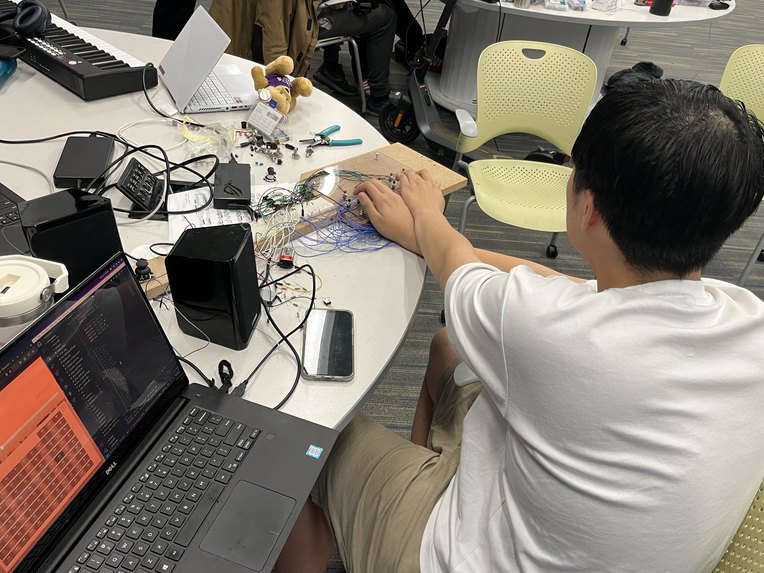
Team member Minh connecting wires in the Pi Pico


Inspiration
On our team, we are invested in Innovation that Excites. All of us were very enthusiastic about music and music production, and we wanted to make a project that combined our passions for music production and hardware. The idea of making an audio synthesizer came up at some point, and along the line we decided to make it hardware based.
What it does
Our project generates waves with digital output. In effect, we have a "keytar" with 12 keys (representing the full chromatic scale), and each button/key plays a tone (a waveform) with a frequency corresponding to a certain note (e.g. C, C#, D...). Additionally, we have functionality to transpose our keys up and down an octave and change the type of wave generated.
How we built it
We used a Raspberry Pi Pico and copious amounts of wires and buttons. We also build the body of our "keytar" with MDF wood. We also used an premade speaker.
Challenges we ran into
One difficulty that we ran into consistently throughout the Hackathon was our Amplifier. We were not able to get an amplifier working to boost our synthesizer's volume, as it didn't work for a number of reasons, from simply getting the circuit wrong to having a speaker with too low a wattage and no alternative equipment. In addition, we had struggled for a while with the pitches our synthesizer outputted being inconsistent. We found out that our raspberry pi couldn't keep up with a fixed sampled rate for the outputs, which disrupted the waves generated. We removed the fixed sampling rate, which made the waves much more consistent.
Accomplishments that we're proud of
We were proud of being able to fix the sampling rate issue, as the issue had been plaguing us for some time after many iterations of attempted fixes. Additionally, although we were not able to create our amplifier, we were proud of having learned so much about amplifier circuits and related tooling such as mosfet transistors trying to implement them. And of course, we're very happy with how our keytar turned out. The build was pretty solid and we were abled to implement a full 12 notes with extra features.
What we learned
We learned a ton about working with arduinos and how sound works during this project. We also learned a ton about cirtcuits, having been lucky enough to learn about amplifiers and circuits in general from qualified people specialized in electrical engineering.
What's next for Rhapsody in CS Major
Going on tour.


Log in or sign up for Devpost to join the conversation.