-
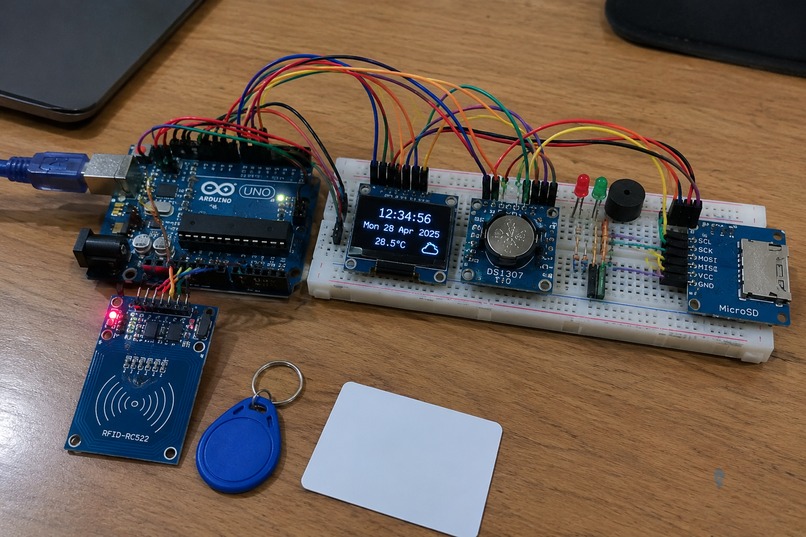
“Realistic Offline RFID Attendance System – Arduino UNO, RC522 RFID, OLED Display, DS1307 RTC & MicroSD Module”
-
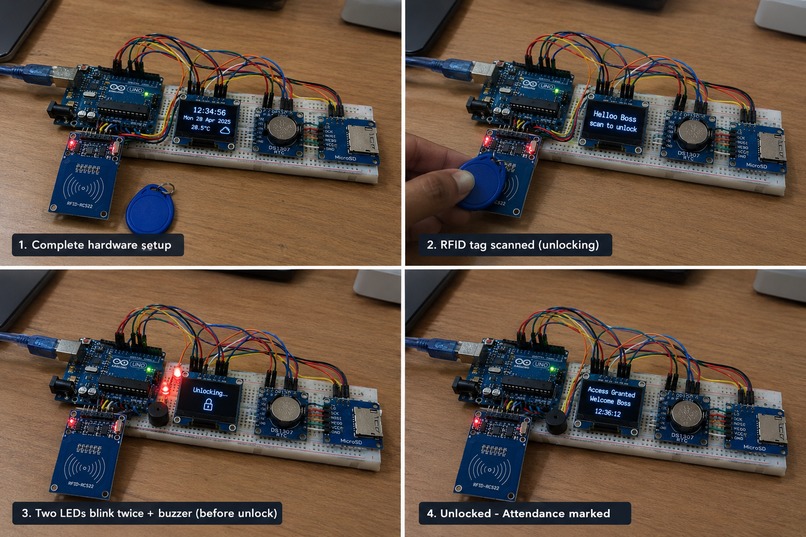
“Realistic Offline RFID Attendance System – Arduino UNO, RC522 RFID, OLED Display, DS1307 RTC & MicroSD Module”
## Inspiration
Taking manual attendance in classrooms and workshops is slow, error-prone, and prone to proxy marking. Existing digital solutions often rely on continuous Wi-Fi connections, cloud server subscriptions, or expensive proprietary hardware. We were inspired to build a low-cost, 100% offline "tap-and-go" attendance logger that instantly verifies identities, updates a display, and saves structured log files locally—all for under $20 in hardware.
What it does
The RFID Attendance System is a standalone device that:
- Reads 13.56 MHz RFID cards or key fobs using an MFRC522 reader.
- Queries a battery-backed DS1307 Real-Time Clock (RTC) for precise timestamps.
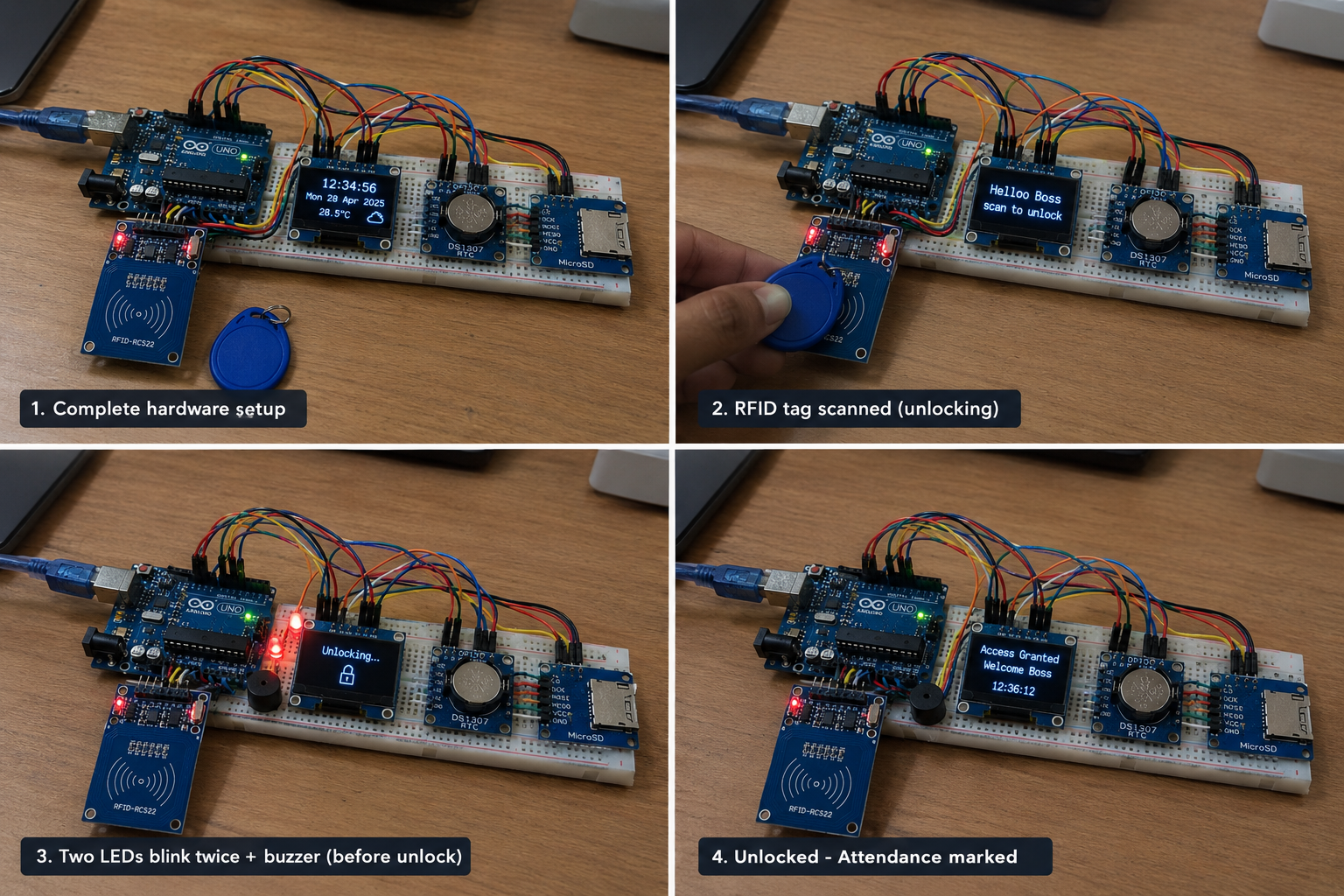
- Displays real-time scan feedback ("Access Granted" + UID) on a high-density 0.96" SSD1306 OLED screen.
- Appends structured records (
Date,Time,UID,Status) toATTEND.CSVon a MicroSD card. - Operates completely offline with sub-second processing latency per scan (T_total ≈ 150 ms).
How we built it
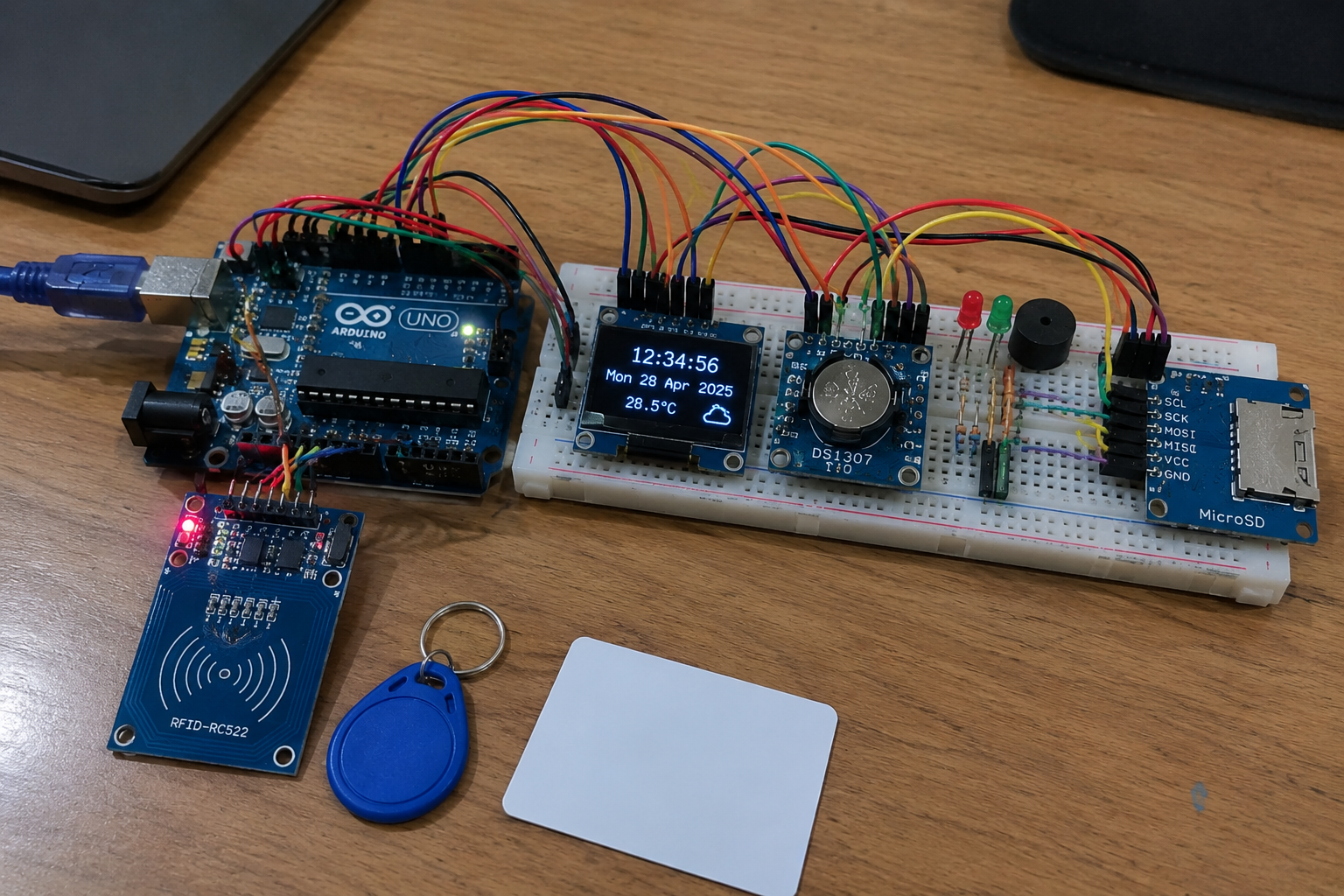
- Hardware Core: Arduino Uno (ATmega328P microcontroller).
- Peripherals: MFRC522 RFID reader (SPI), MicroSD Card Module (SPI), 0.96" SSD1306 OLED (I2C), and DS1307 RTC (I2C).
- System Metrics:
- Processing Latency Equation:
T_total = T_read + T_rtc + T_sd_write + T_display ≈ 150 ms - Attendance Percentage Calculation:
Attendance % = (N_present / N_total) × 100%
- Processing Latency Equation:
- Software Stack: Developed in C++ on the Arduino framework, utilizing
MFRC522.h,RTClib.h,Adafruit_SSD1306.h, andSD.h.
Challenges we ran into
- Severe SRAM Bottlenecks: Including libraries for four hardware modules consumed over 80% of the ATmega328P's 2 KB SRAM, causing random memory crashes. We resolved this by wrapping static strings in the
F()macro (e.g.,Serial.println(F("Ready"));), forcing UI text to store in 32 KB Flash memory instead of dynamic RAM. - SPI Bus Flooding: The RFID reader and MicroSD card module share the same hardware SPI lines (Pins 11, 12, 13). Concurrent access caused SD file system corruption. We solved this by implementing explicit Chip Select toggling (
digitalWrite(SS_RFID_PIN, LOW)/digitalWrite(SD_CS_PIN, HIGH)) before initiating data transfers.
Accomplishments that we're proud of
- Built a reliable offline data logging device that boots in under 1 second.
- Squeezed full I2C OLED graphics and SPI CSV file logging into a resource-constrained 8-bit microcontroller.
- Designed a standard CSV format that allows direct data import into Excel or Google Sheets without data transformation.
What we learned
- Hands-on hardware bus management involving simultaneous I2C and SPI communication protocols.
- Advanced C++ memory optimization strategies for microcontrollers with limited SRAM.
- Fail-safe offline embedded system design techniques.
What's next for RFID-based Attendance System with Integrated OLED
- Cloud Sync via ESP32: Transitioning from Arduino Uno to an ESP32 board to auto-sync offline CSV logs to Google Sheets when Wi-Fi is detected.
- Portable Hardware Enclosure: Designing a 3D-printed enclosure with a TP4056 lithium battery charger module for complete wire-free mobility.
- Multi-Factor Biometrics: Adding an optical fingerprint scanner to combine RFID cards with biometric verification for enhanced security.
