-
-
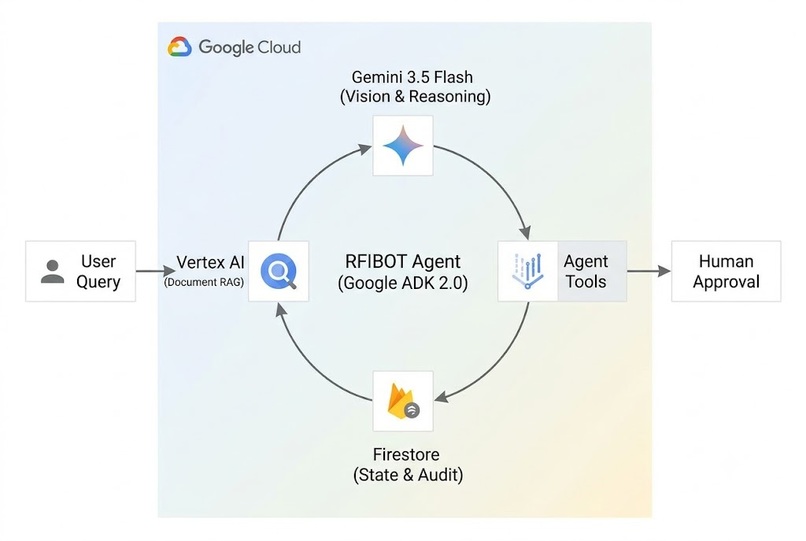
The Architecture: Google-Powered Agentic Loop
-
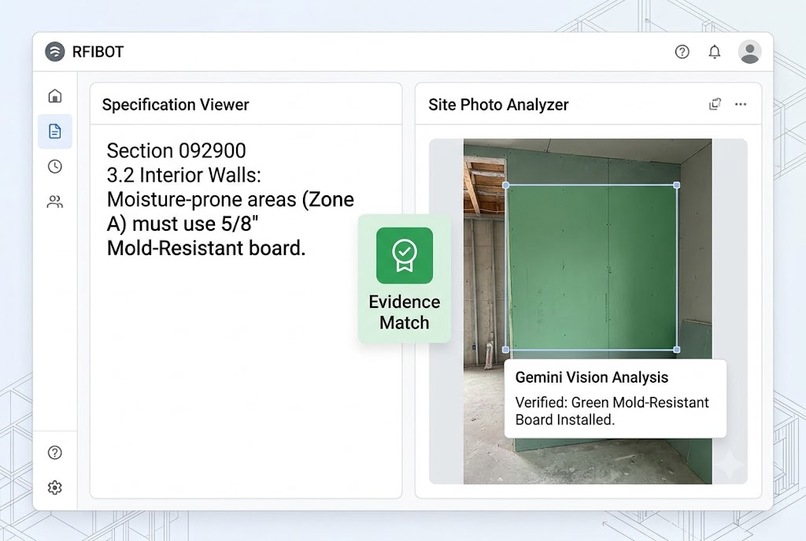
Multimodal Grounding: Specs vs. Site Photo
Inspiration
The construction industry loses over $31 Billion annually due to delays, rework, and communication bottlenecks stemming from the Request for Information (RFI) workflow. On a typical commercial project, answering a single RFI requires a human project manager or engineer to spend hours or days cross-referencing dense written specifications, architectural CAD drawings, past project decisions, and physical site photographs. A single missed detail can halt a job site, delay trades, or lead to multi-million dollar structural errors. i set out to ask: What if an AI agent could autonomously investigate an RFI across specs, blueprints, and site photos, synthesizing a verified, auditable response in under 40 seconds?
What it does
RFIBOT is an autonomous AI construction engineer designed to automate the complete RFI investigation lifecycle. When a construction manager submits a field question such as "What material should be used for interior walls in Zone A according to Section 3.2, and does our current installation match?" RFIBOT executes a multi-step investigation loop: Decomposes Query Intent: Breaks the RFI into required verification targets across specifications, CAD details, field images, and historical logs. Executes Multi-Modal Search: Queries project specifications, searches architectural drawing sheets, and pulls active site photographs. Computer Vision Verification: Analyses field photographs using multimodal vision to verify whether physical installations match project drawings. Precedent Cross-Checking: Audits past project RFIs to check if a prior design variance or exception was granted. Confidence & Risk Evaluation: Calculates an aggregate evidence score to determine if human intervention is required. Automated State Execution: Drafts an auditable answer with exact source citations, routes the package to the designated Lead Architect for sign-off, and updates the project RFI tracker.
How I built it
RFIBOT is built on a Google-first architecture, utilising the latest Google Cloud and AI ecosystem to demonstrate a true, multi-step agentic workflow rather than a simple chatbot: Google Agent Development Kit (ADK): Drives the core decision loop, tool routing, dynamic goal decomposition, and asynchronous state management. Gemini 3.5 Flash: Serves as the intelligence engine, executing high-speed function calling and multi-modal vision analysis on site photographs. Vertex AI Search (Agent Builder): Ingests and performs layout parsing across unstructured architectural drawings, specifications, and historical RFI logs. Firebase & Cloud Storage: Manages real-time application state streaming, session history, audit trail logging, and secure image/document hosting. Cloud Run: Hosts our Python ADK FastAPI backend API server container.Next.js 14 & Tailwind CSS: Powers a real-time terminal dashboard visualizing the agent's thought stream, retrieved citations, confidence score, and human-in-the-loop approval routing. The Math Behind Evidence Confidence To prevent dangerous construction hallucinations, RFIBOT computes an Aggregate Confidence Score ($C_{\text{RFI}}$) across $N$ retrieved evidence sources using a weighted alignment function:$$C_{\text{RFI}} = \sum_{i=1}^{N} w_i \cdot S(E_i, Q) \cdot (1 - \Delta_{\text{conflict}})$$Where:$w_i$ is the authoritative weight of the source type (e.g., $w_{\text{spec}} = 0.4$, $w_{\text{drawing}} = 0.3$, $w_{\text{photo}} = 0.2$, $w_{\text{history}} = 0.1$).$S(E_i, Q) \in [0, 1]$ represents the semantic and visual alignment function between retrieved evidence $E_i$ and query $Q$.$\Delta_{\text{conflict}} \in [0, 1]$ represents a penalty factor triggered if tool outputs contradict one another (e.g., spec requires mold-resistant board, but site photo reveals standard drywall).If $C_{\text{RFI}} < 0.85$, RFIBOT flags the response as High Uncertainty and automatically escalates the ticket directly to the Lead Architect for manual review.
Challenges I ran into:
Cross-Modal Grounding: Teaching the agent to correlate a written requirement (e.g., "Section 3.2: 5/8-inch Mold-Resistant Board") with a spatial visual (Detail A-2.1) and a real-world photo (identifying green-faced drywall) required fine-tuning tool prompts and visual input framing. Deterministic Safety vs. Autonomy: Construction decisions carry real legal liability. I had to design strict safeguards to ensure the agent never invents specifications when document evidence is missing or ambiguous. Real-time Latency: Demonstrating multi-step execution (Spec Search $\rightarrow$ Drawing Lookup $\rightarrow$ Vision Analysis $\rightarrow$ Precedent Audit) within a crisp 30–60 second demo required optimizing asynchronous tool calls and leveraging the inference speed of Gemini 3.5 Flash. ##Accomplishments that am proud of: True Agentic Orchestration: I avoided simple prompt-chaining and built a dynamic graph agent that selects tools, handles evidence dependencies, and executes database side-effects autonomously. Multimodal Verification Engine: Successfully pairing computer vision on job-site photos with PDF specification text retrieval to confirm physical construction compliance in real time. Auditable Human-in-the-Loop Model: Creating a trust-first framework where architects receive full evidence chains with one-click approval workflows rather than trusting a black-box AI.
3What I have learnt:
Agents need structured bounds: Unrestricted LLMs hallucinate tolerances, but an agent constrained by strict tool execution contracts and confidence math provides enterprise-grade safety. Multimodal cross-referencing is a superpower: Combining visual field photos with text spec retrieval yields a level of verification that neither medium can achieve on its own. Human-in-the-Loop builds trust: Positioning AI as an autonomous investigator that proposes rather than blindly approves makes the technology immediately adoptable for conservative industries like construction.
What's next for RFIBot
I envision RFIBOT becoming the standard intelligence layer for global construction management. Next steps include: Deep Enterprise Integrations: Building native API plugins for Procore, Autodesk Construction Cloud (ACC), and Oracle Aconex to process RFIs directly within current construction inboxes.3D BIM Integration: Expanding vision capabilities from 2D photos and drawings to full 3D Building Information Models (IFC/Revit files).Multi-Agent Collaboration Networks: Deploying specialized sub-agents (e.g., Structural Agent, MEP Agent, Code Compliance Agent) that debate and cross-examine complex engineering changes before human sign-off.
Built With
- cloud-run
- fastapi
- firebase
- gemini
- google-agent-development-kit
- google-cloud
- next.js
- python
- react
- tailwind-css
- vertex-ai

Log in or sign up for Devpost to join the conversation.