Inspiration
We take notes while we study and work, and we lose most of them. Research by Gloria Mark at UC Irvine found people now spend about 47 seconds on one screen before switching. Screen recorders make this worse because they treat a 10-second Discord reply the same as an hour of real work. We wanted notes that write themselves and ignore the glances. Additionally, during the first few hours into this hackathon we found ourselves re-googling something twice so we came up with this.
What it does
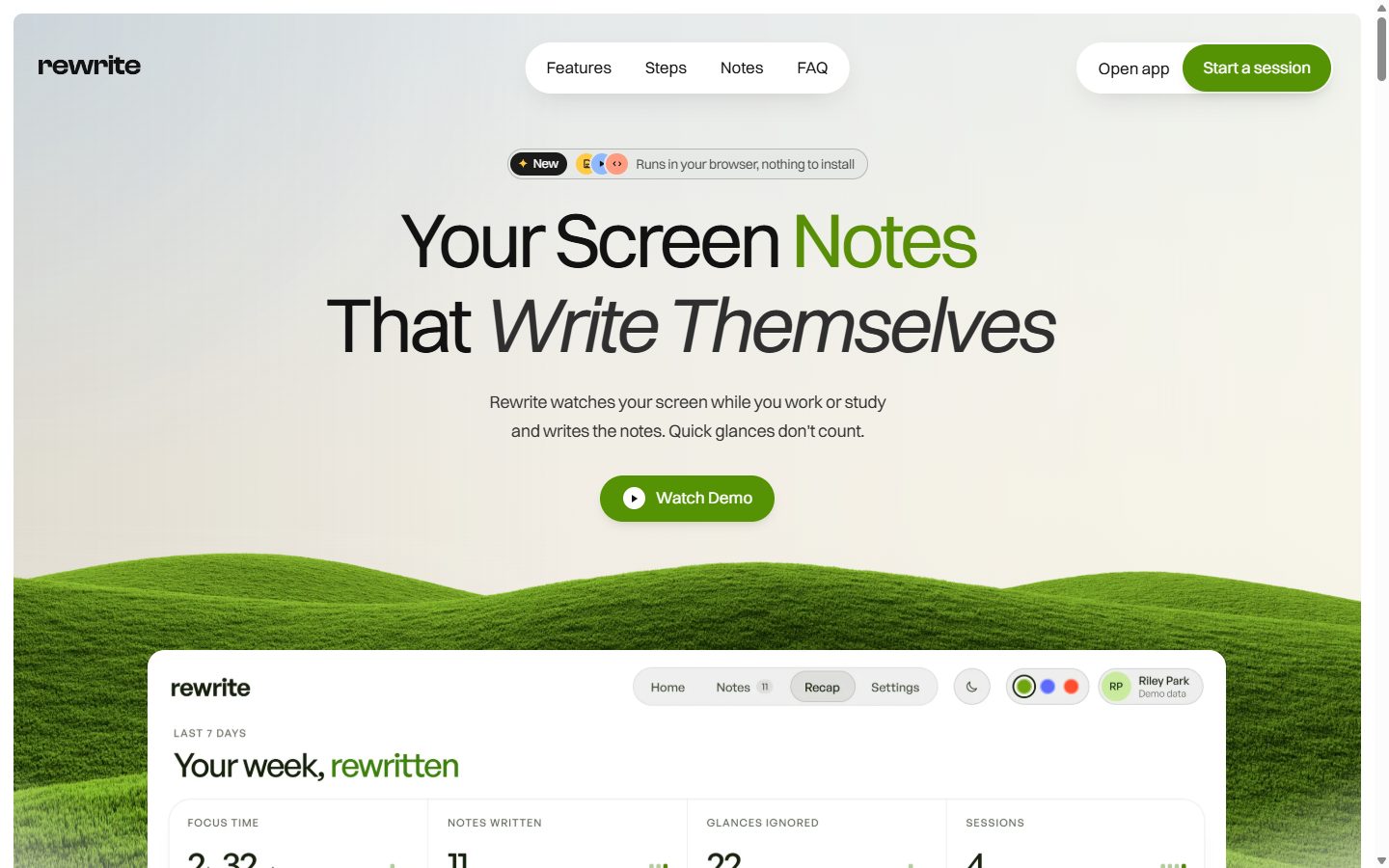
Rewrite watches your screen while you work and writes the notes for you. It is not only for studying; it works for anything you do on a screen.
- It looks at your screen about once a second and writes a first note after 10 seconds, then a new one about every 40 seconds.
- Short detours to a chat, music, social, video or game app (20 seconds by default) are marked as glances and left out of the notes.
- A small floating window shows that it is running while you work in other tabs.
- When you finish, you get a timeline of the session, the notes, the key terms and the glances it left out.
- The home screen has a field that starts as bare sand and grows grass and flowers as your focus time for the day goes up.
How we built it
Rewrite is one HTML file of about 1,500 lines with no framework and no build step. We built it with Claude Code as our coding partner, and we directed the idea, the design and the testing.
- Capture: the browser's Screen Capture API, at about one frame per second.
- Glance filter: frames are compared to spot a switch. On-device text reading (Tesseract.js) checks the new screen against a list of 30 apps.
- Notes: two writers. Claude, with your own API key, or an on-device reader that needs no key.
- Floating window: Document Picture-in-Picture.
- The field: WebGL, drawn live and tied to your real focus minutes.
- Storage: the browser's local storage. There are no accounts and no server.
- Hosting: GitHub Pages, with more than 20 releases during the hackathon.
Challenges we ran into
- Telling a glance from real work. Dropping every short visit also dropped useful things, like a quick search. We changed the rule so a detour only counts as a glance when it lands on a known chat, music, social, video or game app.
- A browser cannot see window titles. We read the tab and address bar from the captured frame on the laptop to work out where you are.
- Building from the venue. The code ran on a home PC that we steered from a laptop, so we could not open local previews. We published early and tested on the live link.
- Design. Our first versions looked generic. We rebuilt the interface several times until it was flat, simple and built around one living thing, the field.
Accomplishments that we're proud of
- It is live and anyone can try it, with a sample session that needs no setup.
- In our test run it kept the work on an AI assistant and dropped Discord and a music app.
- The on-device mode writes notes without sending your screen anywhere.
- The whole app is one file with zero frameworks.
- The field makes focus something you can see grow.
What we learned
- The hard part is not capturing the screen. It is deciding what counts.
- Browsers can now do a lot on their own: screen capture, a floating window, text reading and WebGL.
- Privacy has to be a design decision from the first hour, not a feature added later.
- Shipping a live link early made every later test faster.
What's next for Rewrite
- A desktop version that reads window titles directly.
- Export to Google Docs, Notion and Markdown.
- Review questions and flashcards made from your notes.
- Testing on more laptops and with more real apps.


