Who we are
William Lin - Computer Engineering, 2nd year.
John Azer - Computer Science, 2nd year.
Abid Panahie - Computer Science, 2nd year.
Inspiration
Our inspiration came from needing a better way to study. Knowing you got a question wrong is obvious but knowing how you got it wrong sometimes isn't. These types of situations often results in AI chatbots explaining it to us, which more than not, creates an illusion of learning and skips the “productive struggle”. On the other hand, trying to productively learn by using course material means sorting through countless modules, lecture slides, and lecture videos. The content is always available but accessing them takes time that makes official resources a discarded option more likely than not. We wanted a solution to that and here it is, an AI integration that finds the information you need straight from your canvas course.
What it does
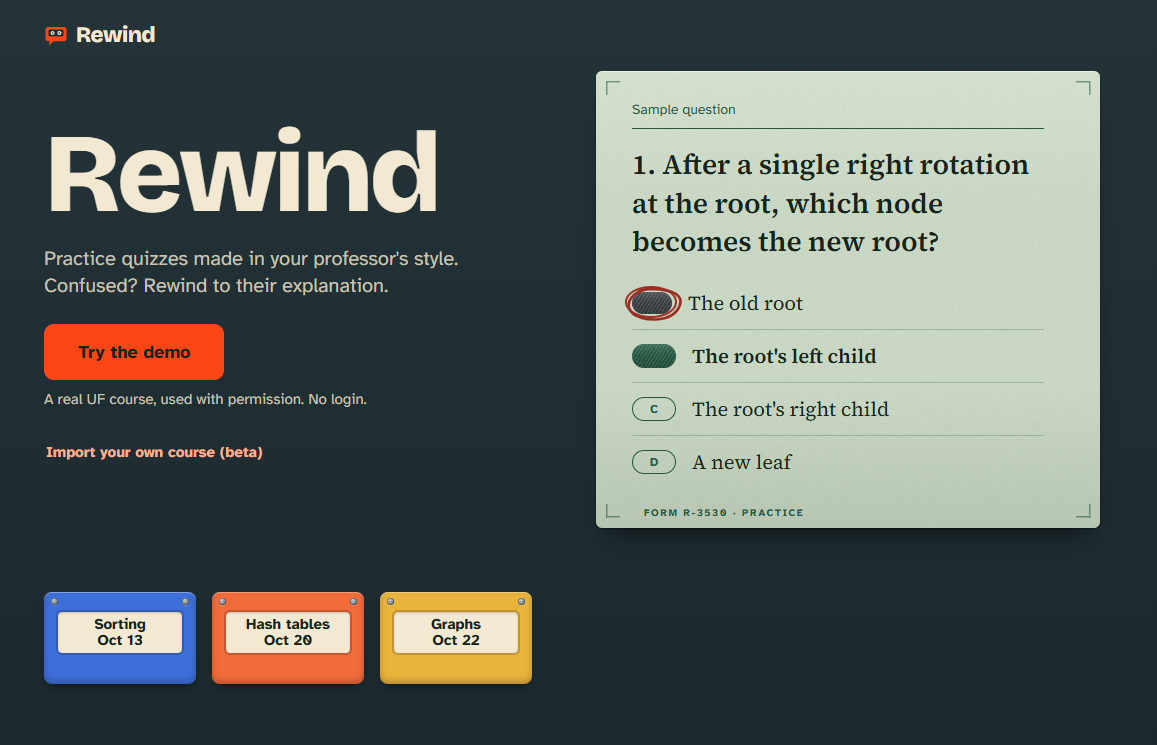
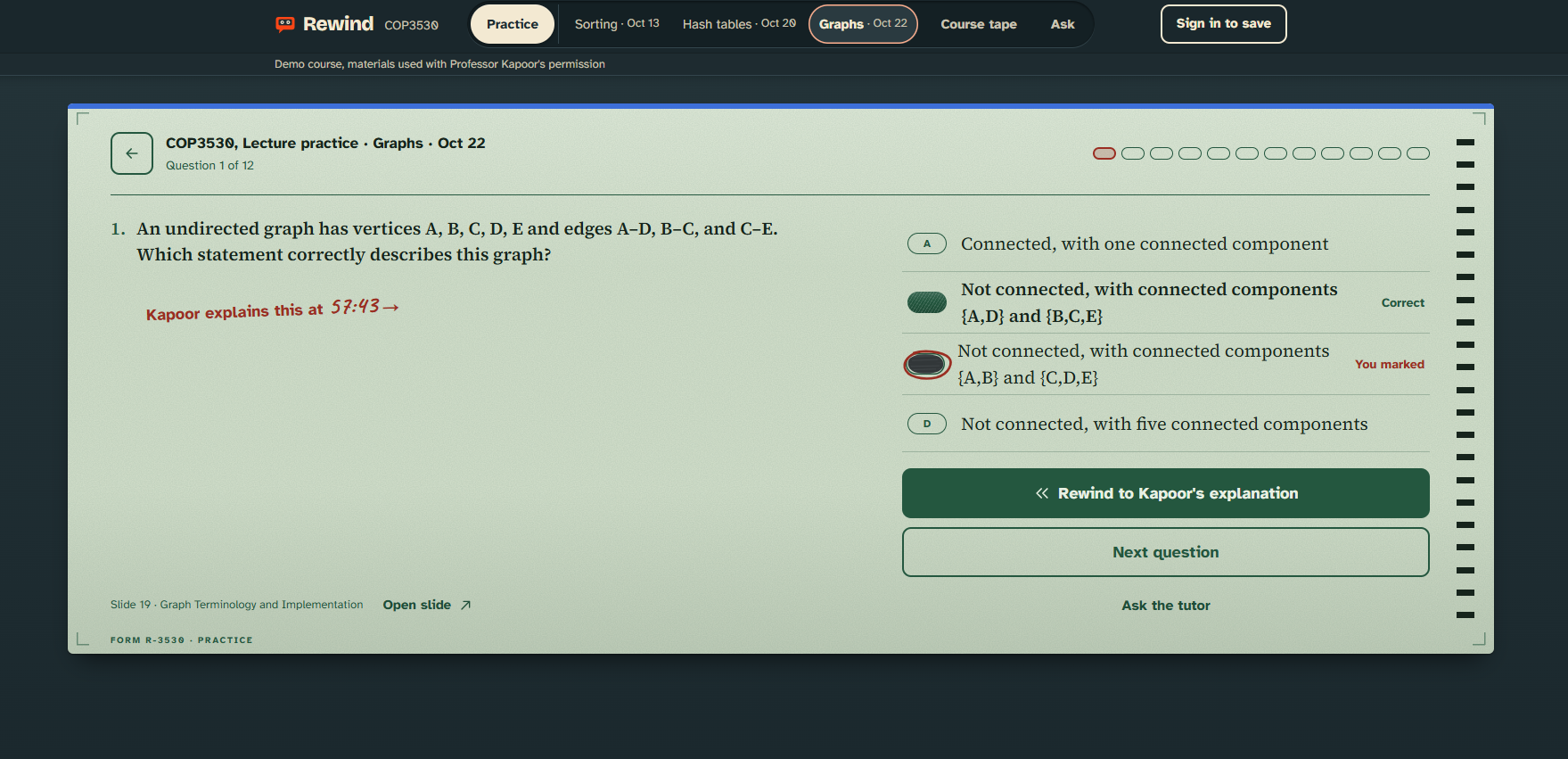
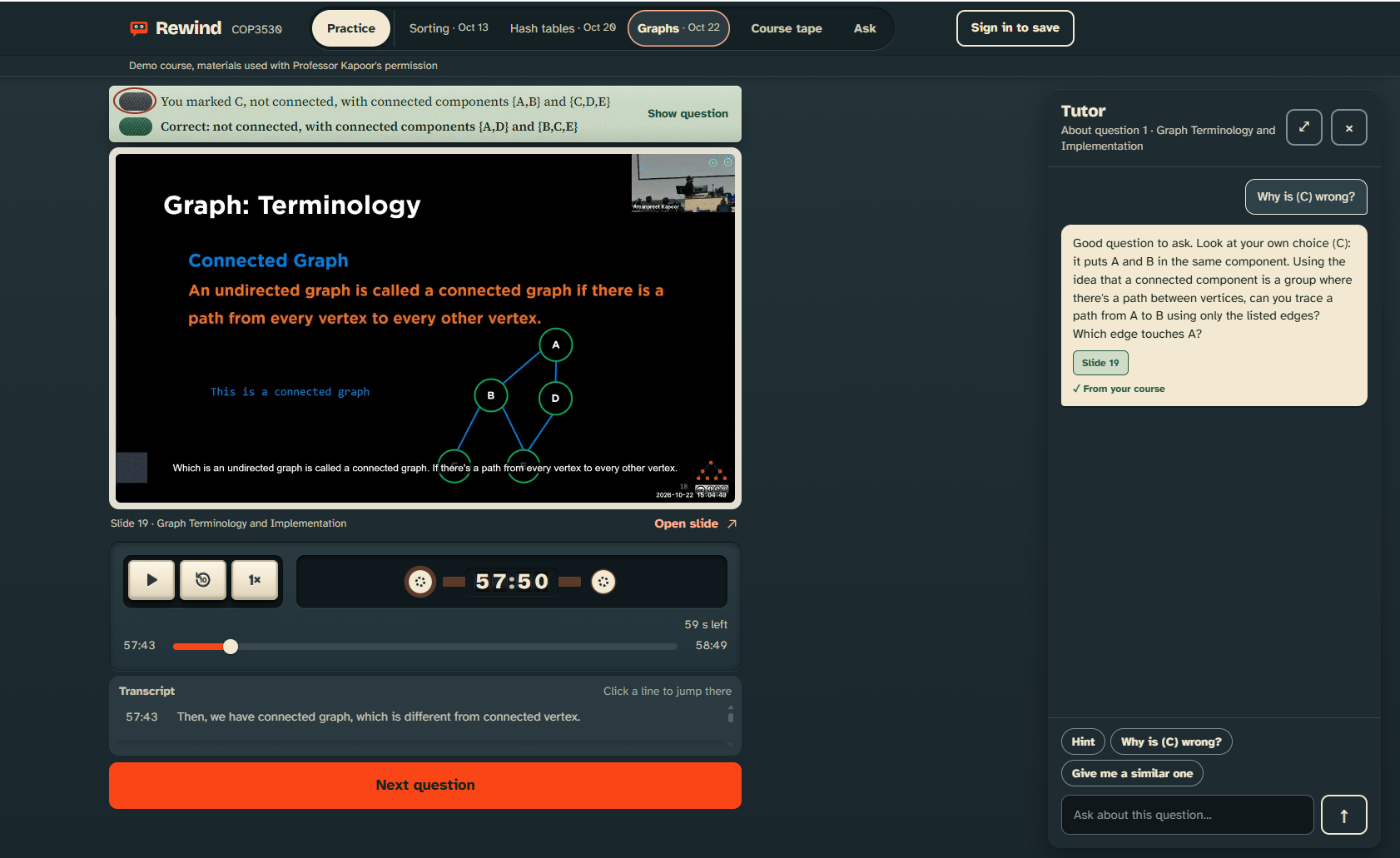
Rewind turns your canvas course into practice you might see from your professor with the actual recording (if available). Using our import feature utilizing the chrome extension tool, it will read your course from what you can access and make custom practice quizzes that’s different for each course and each professor.
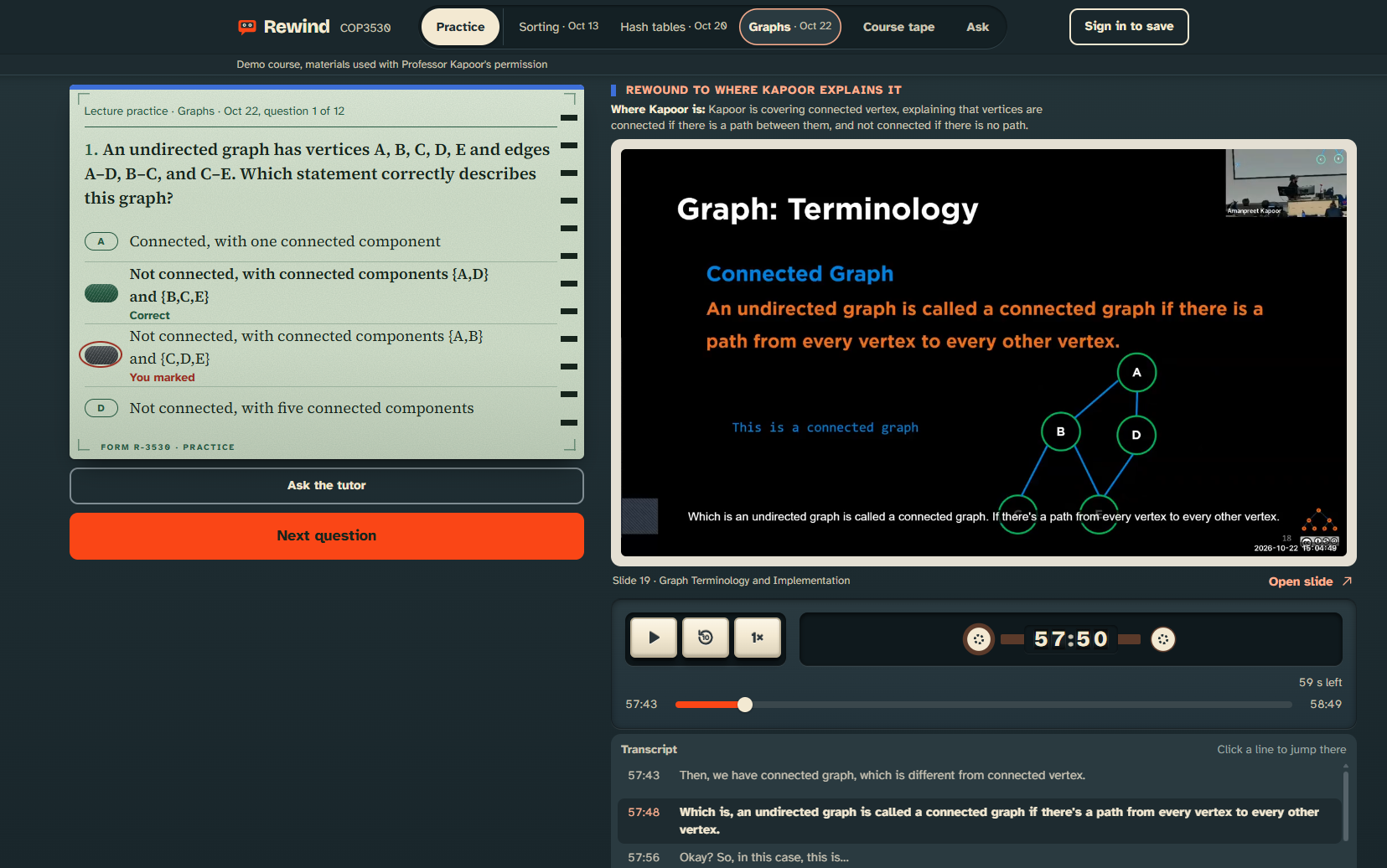
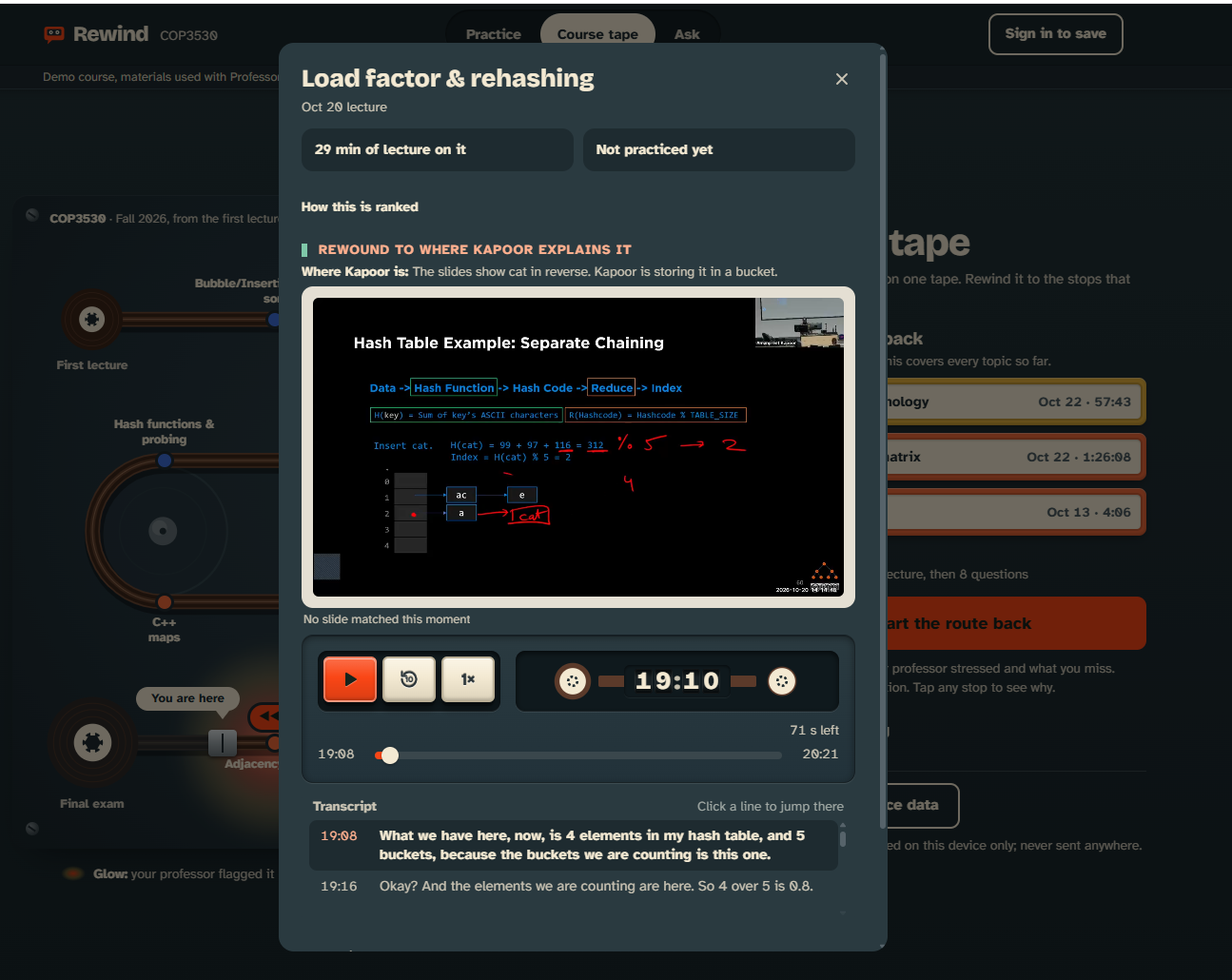
What Rewind does uniquely is that when you get something wrong, it rewinds back right to the moment your professor explained it from official zoom meetings or slides. We have a built-in tutor, made on the data from your course. It’s not made to just give out answers, instead it’s made to guide.
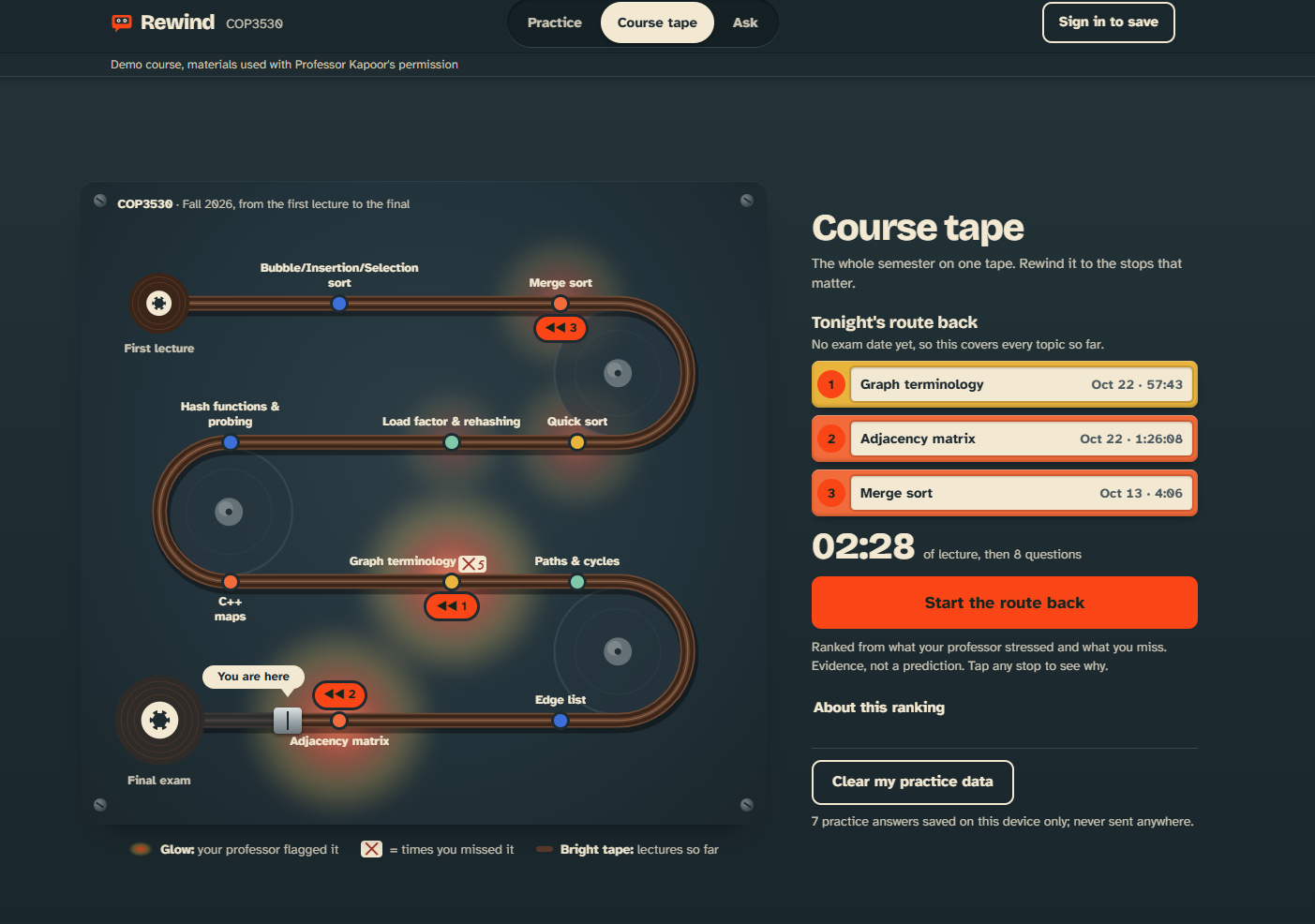
Study session: our maximum study mode for those last-minute crams on exam nights. More than just an AI overview of your course, it catches the moments your professor says a topic will be on the exam and ranks it based on that.
Course Tape: Look through your semester like a cassette tape with quick summaries of each one readily available.
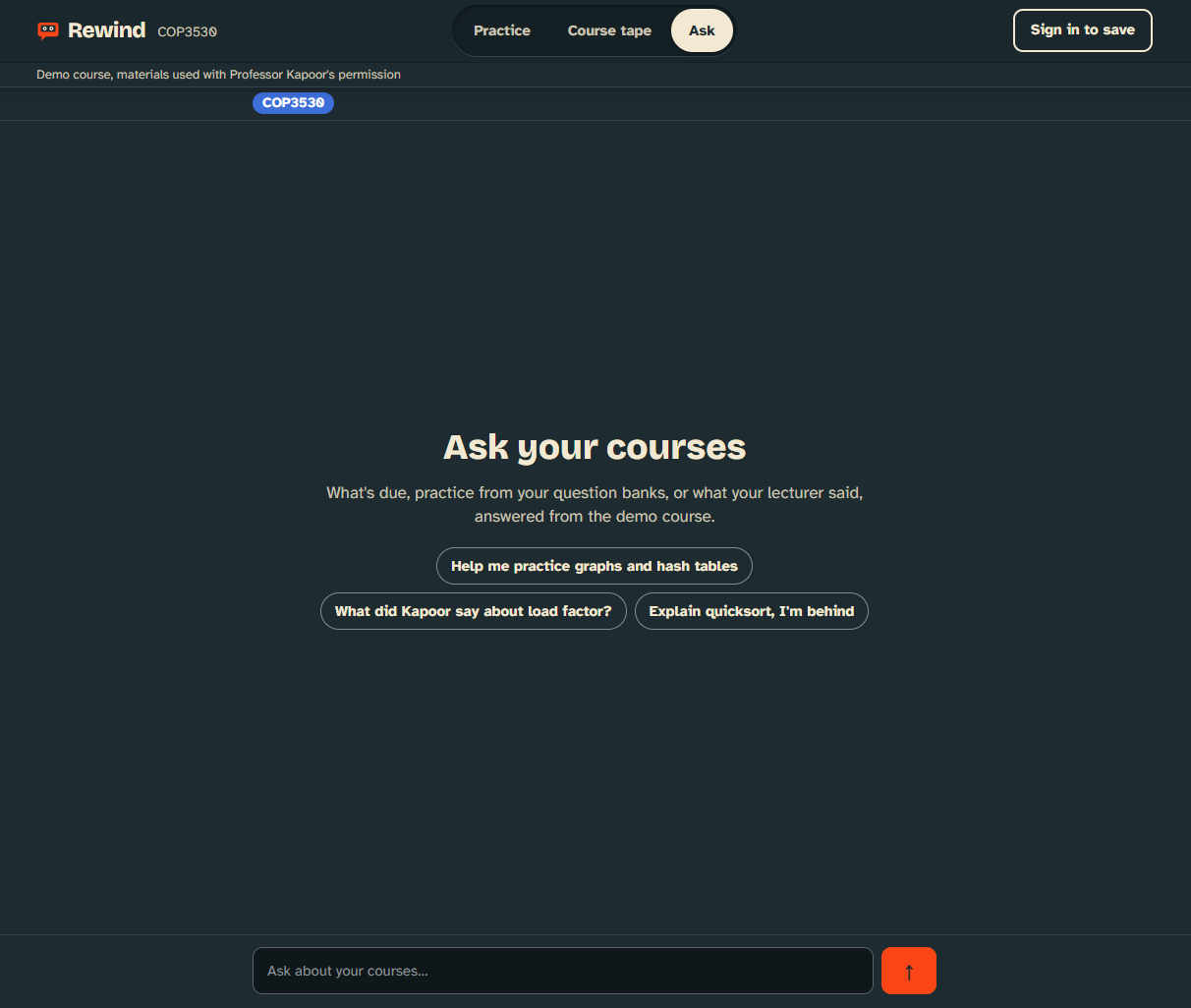
Ask: Every course, every syllabus, every topic, every due date, all in one place. Cites lectures and slides for information.
How we built it
Chrome extension: Built on Manifest V3 to export student courses.
Pipeline: Gemini Embedding 2 is used to match questions to its lecture moments. Gemini Flash 3.8 is used to pick each clip, write the moment summary and spots when a professor flags something as important. Gemini Flash Lite sorts canvas files. Finally Claude Opus 5.5 writes questions in your professor's style, tied to verbatim quotes.
App: Our app is built on Next.js, React, Typescript, and Tailwind on Vercel. Our Tutor and Ask features run on Claude Sonnet 5.5. Quality: over 900 unit tests and a few hundred Playwright end-to-end tests, including contrast checks, answer-leak checks on every question, and tests that no request carries data it shouldn't.
Challenges we ran into
We 100% got overly ambitious with all the features we wanted to implement out of the gate. Due to this, we spread ourselves very thin which led to us scrapping features and lots of bug fixing on Sunday.
For our practice problems, we realized that it had started to ask questions on syllabus information due to it simply being in the modules, we didn’t want to test on that, unless asked for, so we had to implement algorithms to avoid syllabus questions.
We struggled with getting the demo up, seeing as we needed to get the zoom recordings downloaded/accessible, so we had to use screen recordings instead.
Zoom recordings also included chat messages/students who turned on their microphone mid lecture, which caused issues for transcription and finding important moments using the zoom recordings.
Accomplishments that we're proud of
AI has made it so much easier to simply grab the answers for your assignments or learn how to solve problems through methods your professor doesn’t want you to use/isn’t beneficial. However, using official resources has practically stagnated in development, so we are glad to make something that can make using official resources easier.
We’re also proud to make something that has a use outside of a challenge/class. This would be our first project we’ve made that isn’t based on a direct prompt, but instead it's something that we all had problems with.
What we learned
Making a working demo is a lot more important than trying to pack more features. We spent much too long trying to make features that don’t mean anything for the overall project, whilst running out of time to make the demo itself work.
Parsing course data is very messy. There’s many different types of information spread out across many different formats coming from different people. We had to sort through all of that before we could begin working with it to make the program itself, which heavily delayed a lot of our program.
What's next for Rewind
- Make the work less manual, currently, pdfs/powerpoints would have to be picked out by hand to be considered in our briefings.
- The extension will become more than just a tool to format the necessary information, where it could hopefully build everything right there so this process is much easier. -Support for more learning platforms than Canvas, such as mediasite. -An instructor opt in, so professors can share their own materials
Built With
- claude
- css
- geminiapi
- html
- javascript
- python
- shell
- typescript


Log in or sign up for Devpost to join the conversation.