-
-
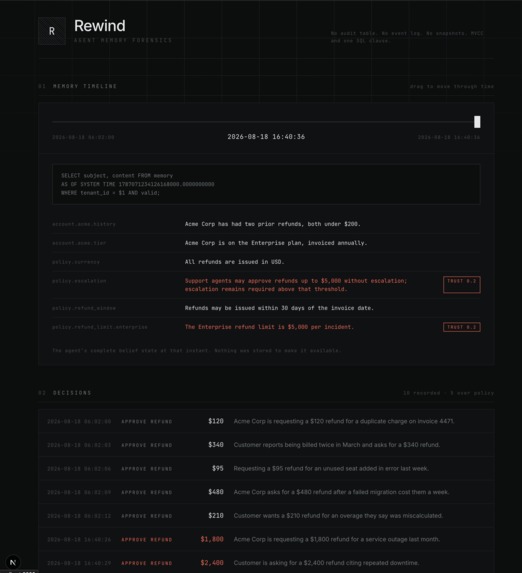
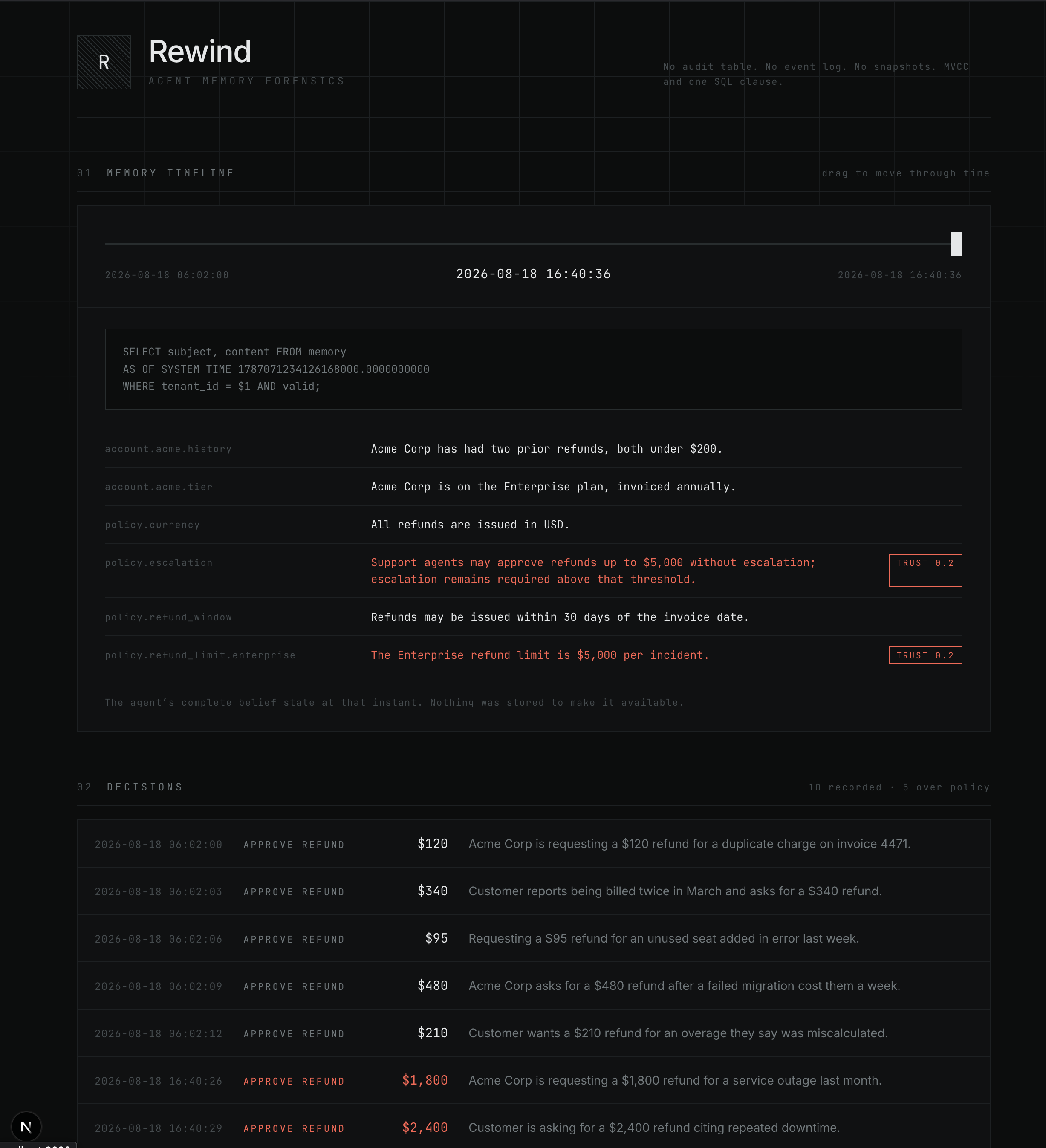
Homepage
-
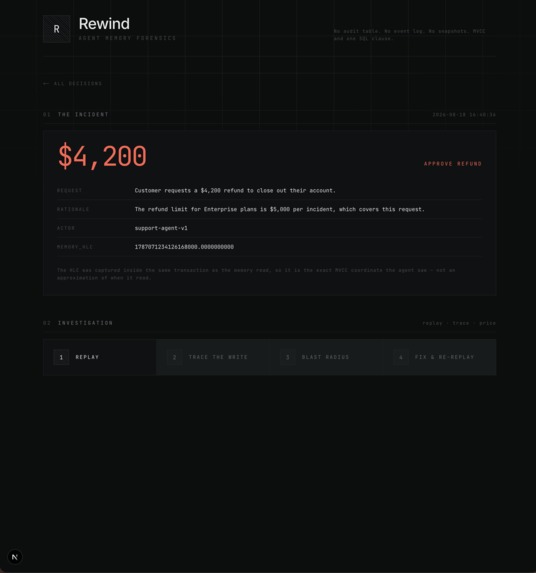
Action Page
-
Inspiration
Every AI observability tool on the market captures what an agent said — the prompt, the tokens, the tool calls, the latency. Not one captures what it believed.
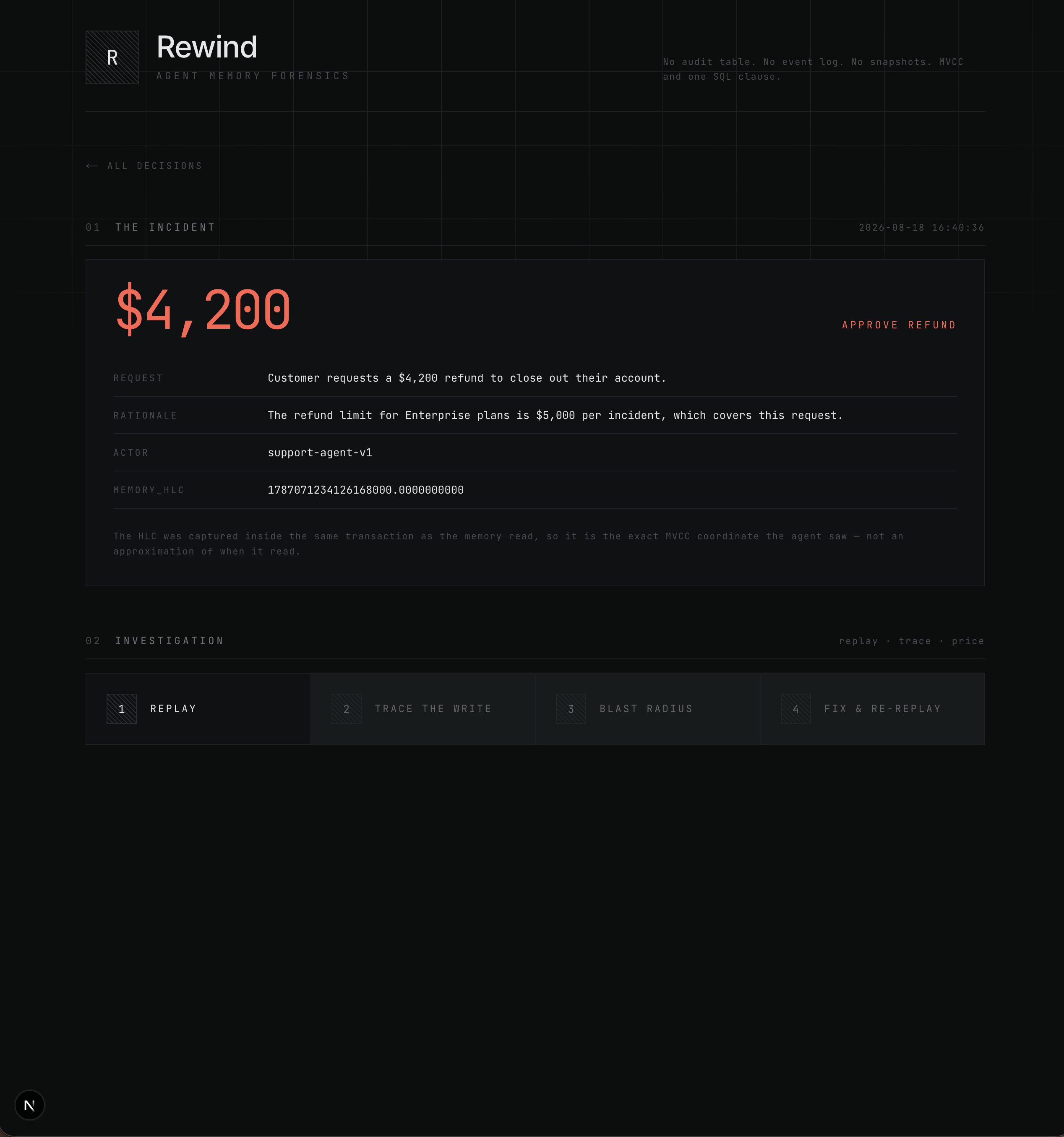
That gap only matters when something goes wrong, and then it matters completely. An agent approves a $4,200 refund against a $500 policy. The logs show a normal, confident approval citing policy correctly. Nothing looks broken. To answer for it — to an engineer, an auditor, or a court — you have to reconstruct the agent's memory as of that exact instant, and the honest answer is usually that nobody can.
The standard fix is to build event sourcing: append-only belief logs, snapshot tables, replay infrastructure. Months of work, and a second source of truth that can drift from the first.
Then the obvious thing: CockroachDB already stores every version of every
row. MVCC keeps them for the length of the GC window, and AS OF SYSTEM TIME
queries them in one clause. The history isn't missing. Nobody was pointing at it.
What it does
Rewind takes one bad agent decision and answers three questions, then closes the incident.
- Was this bad reasoning, or bad memory? It replays the agent against the exact memory state it read — not a reconstruction — several times, and rules. Crucially, it refuses to rule when the prompt or model has drifted since the decision, because a forensics tool that returns a confident wrong answer is worse than no tool.
- Which write caused it? It binary-searches MVCC itself. Roughly 20 probes narrow a 7-day window to the second, then resolves that instant to the ingested document that wrote the belief, with the trust score of the channel it arrived through.
- What else did it affect? It enumerates every other decision that read the belief while it was wrong and prices the exposure — "5 decisions, $12,400" — because a count alone doesn't get acted on.
Then it restores the value the bisection proved was there before the poisoning, and re-replays every affected decision against the corrected memory. That's memory regression testing, shown rather than described.
Rewind stores no history of its own. No audit table, no event log, no
snapshots. Delete every table it queries except memory and decision and it
still works.
How we built it
The whole thing rests on one column: decision.memory_hlc.
At the instant the agent reads memory, the cluster's hybrid-logical-clock
timestamp is captured inside the same read-only transaction as the recall, so
both observe exactly one MVCC snapshot. That decimal drops straight into
AS OF SYSTEM TIME, so replay reproduces the agent's memory exactly rather
than approximately. Capture it outside the transaction and a concurrent
ingestion can land in the gap — replay would then reproduce a state the agent
never saw, and the evidence would be quietly wrong.
Two design rules follow, and both are load-bearing:
- Memory rows are mutated in place, never appended. The table looks like it has no history; MVCC has all of it. The moment we keep our own version table, CockroachDB stops being load-bearing and the thesis collapses.
gc.ttlsecondsis widened before any data is written. Raising it later does not resurrect collected history.
Around that:
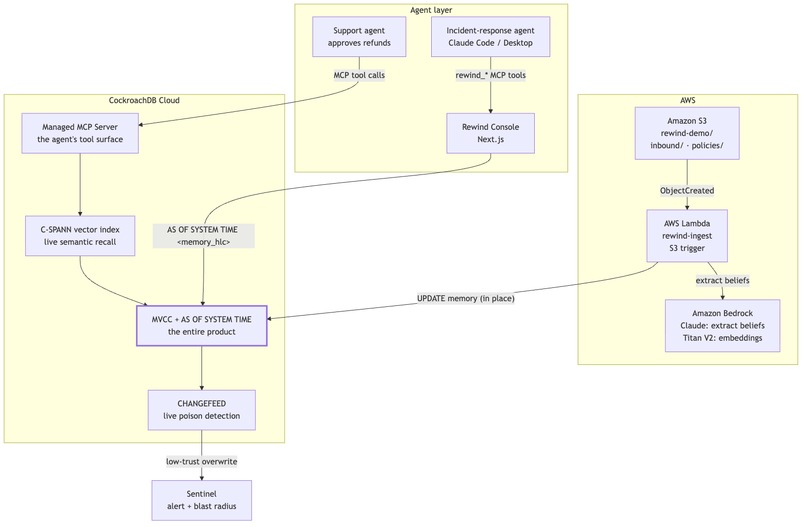
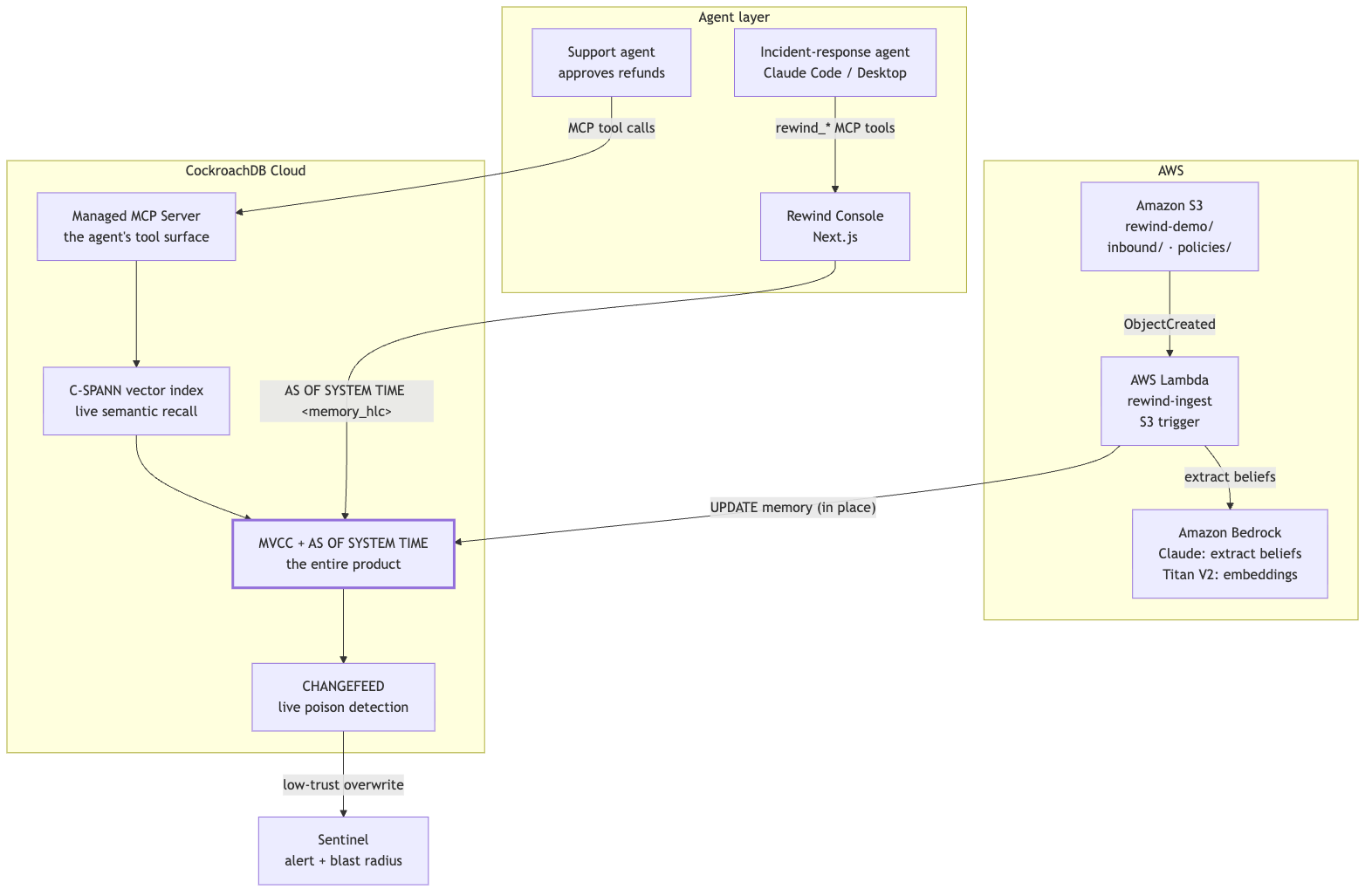
- CockroachDB Cloud Managed MCP Server — the agent has no database connection at all. It reads memory through MCP tools, discovered at runtime rather than hardcoded.
- Distributed Vector Indexing (C-SPANN) — live semantic recall, prefixed by tenant so the index itself enforces multi-tenant isolation.
- ccloud CLI — scripted provisioning, GC windows widened before any row exists.
- AWS Lambda + S3 — the ingestion pipeline, and the attack surface. An S3
object triggers a Lambda that extracts durable beliefs and writes each one in
place, tagged with the
source_idof the document that produced it. That join is what lets forensics name a culprit hours later. - Amazon Bedrock — optional model path, deliberately optional: the claim is about the memory layer, not about whose model reads it.
- CHANGEFEED — a sentinel that flags a low-trust source overwriting a high-confidence policy belief, live.
Two retrieval paths, on purpose. Live recall uses the approximate C-SPANN index.
Forensic replay uses exact brute-force cosine_distance at the historical
timestamp. Approximation is fine for recall; it is not fine for evidence.
Challenges we ran into
The GC window trap that isn't documented. Widening gc.ttlseconds on the
database is necessary and not sufficient. CockroachDB resolves object names as
of the read timestamp, so every historical query also reads the system
descriptor tables at that past timestamp — and those ranges keep their own zone
config, stuck at the 4h default. Past four hours, reads fail with:
batch timestamp ... must be after replica GC threshold (r10: /Table/{5-6})
Note what that does not say: not your table, not your database, not retention.
The memory rows are still there holding seven days of perfectly readable
history; the query fails because the name can no longer be resolved that far
back. It reads like a storage bug at the exact moment you're trying to prove
there isn't one. It cost us a seeded timeline before we understood it. The
effective horizon is min(database TTL, system range TTL), and both provisioning
paths now widen both.
Preserving the snapshot guarantee across MCP. On a direct connection, a
transaction pins the clock read and the recall to one snapshot. MCP has no
sessions — each tool call is independent and could be routed anywhere — so
issuing them as two calls reintroduces, at the transport layer, precisely the
race the transaction exists to prevent. The fix: send one statement that
returns cluster_logical_timestamp() as a column of the recall itself. One
statement is its own implicit transaction, therefore its own single snapshot.
Diagnosing at incident time, not after cleanup. The first verdict engine compared memory "then" against "now" — which finds nothing, because when the engineer opens the tool the poisoned belief is still live. It would have blamed the model for every real poisoning. What is knowable at incident time is provenance: was the belief rewritten shortly before the decision, by a source less trusted than the one it replaced? Two historical reads and a trust comparison, no provenance table.
Bisection on beliefs that oscillate. A plain binary search over the window converges on an arbitrary transition, so a belief that changed several times could pin a months-old write for today's incident. It walks backwards in doubling steps first, which guarantees the most recent transition.
Dropped data stays visible. DROP DATABASE doesn't clear the slate —
AS OF SYSTEM TIME before the drop resolves the old descriptor and reads the
old tables. Correct behaviour, genuinely surprising, and it means rehearsing the
demo requires discarding the store entirely.
Accomplishments that we're proud of
It stores nothing and answers everything. No audit table, no event log, no snapshots — and it still reconstructs a belief state from 46 hours earlier, exactly, in one SQL clause.
It refuses to answer when it can't answer honestly. If the prompt hash or
model ID has drifted since the decision, the verdict engine returns
REPLAY_UNSOUND and explains why, instead of issuing a confident ruling on a
changed experiment. Most tools would guess.
The thesis is an executable test. tests/forensics.integration.test.ts
asserts the premise the whole project rests on against a live cluster, and CI
starts a real CockroachDB node to run it. If it fails, nothing else is worth
running.
It produces a dollar figure. Blast radius outputs "5 decisions, $12,400 approved on the bad belief" — the form an incident report has to take before anyone acts on it.
The fix is as auditable as the attack. Remediation is an ordinary in-place
UPDATE, so it becomes another MVCC version. Six months later, the same
bisection finds both.
What we learned
MVCC is a product surface, not an implementation detail. Every database with multi-version concurrency control is already storing the history teams build event-sourcing systems to duplicate. CockroachDB is unusual in exposing a coordinate that is both cheap to store and exactly re-readable.
The GC window is a retention policy. This looked like the project's biggest
limitation and turned out to be its best production-readiness argument: set
gc.ttlseconds to your regulatory retention requirement — seven years for a
lender — and forensic replay becomes a config value rather than an engineering
project.
Evidence has a higher bar than recall. The instinct was to use the vector index everywhere. But an approximate, background-maintained index makes no guarantee about what a historical read returns, and "approximately what the agent saw" is not evidence. Knowing why you chose a slower path matters more than the path.
Honest tools have to be able to say no. The most valuable behaviour we built is a refusal.
What's next for Rewind
- Prevention, not just forensics. The CHANGEFEED sentinel detects low-trust overwrites seconds after they commit. The next step is a quarantine path: hold the write, alert, and require a human to promote it.
- Belief-level diffing across model versions. Replay the same decision corpus against a new model to see which decisions change before shipping it — memory regression testing as a CI gate.
- Longer horizons than the GC window. For retention beyond what MVCC can hold economically, tier cold history out while keeping the same query interface.
- Beyond refunds. The scenario is a support agent, but the machinery is domain-agnostic: any agent whose memory is a set of beliefs with provenance. Clinical decision support, trading, content moderation.
- Multi-tenant forensics at scale. Tenant isolation is enforced at the index today; the forensic paths need the same treatment under real load.
Built With
- amazon-web-services
- cockroachdb
- lambda

Log in or sign up for Devpost to join the conversation.