-
-
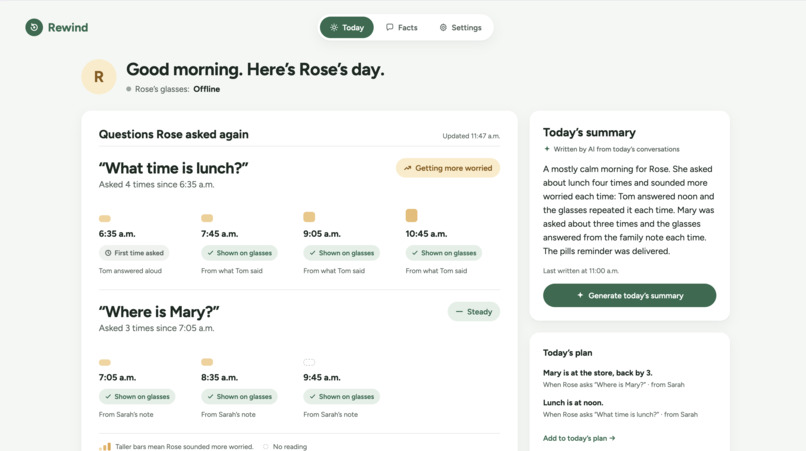
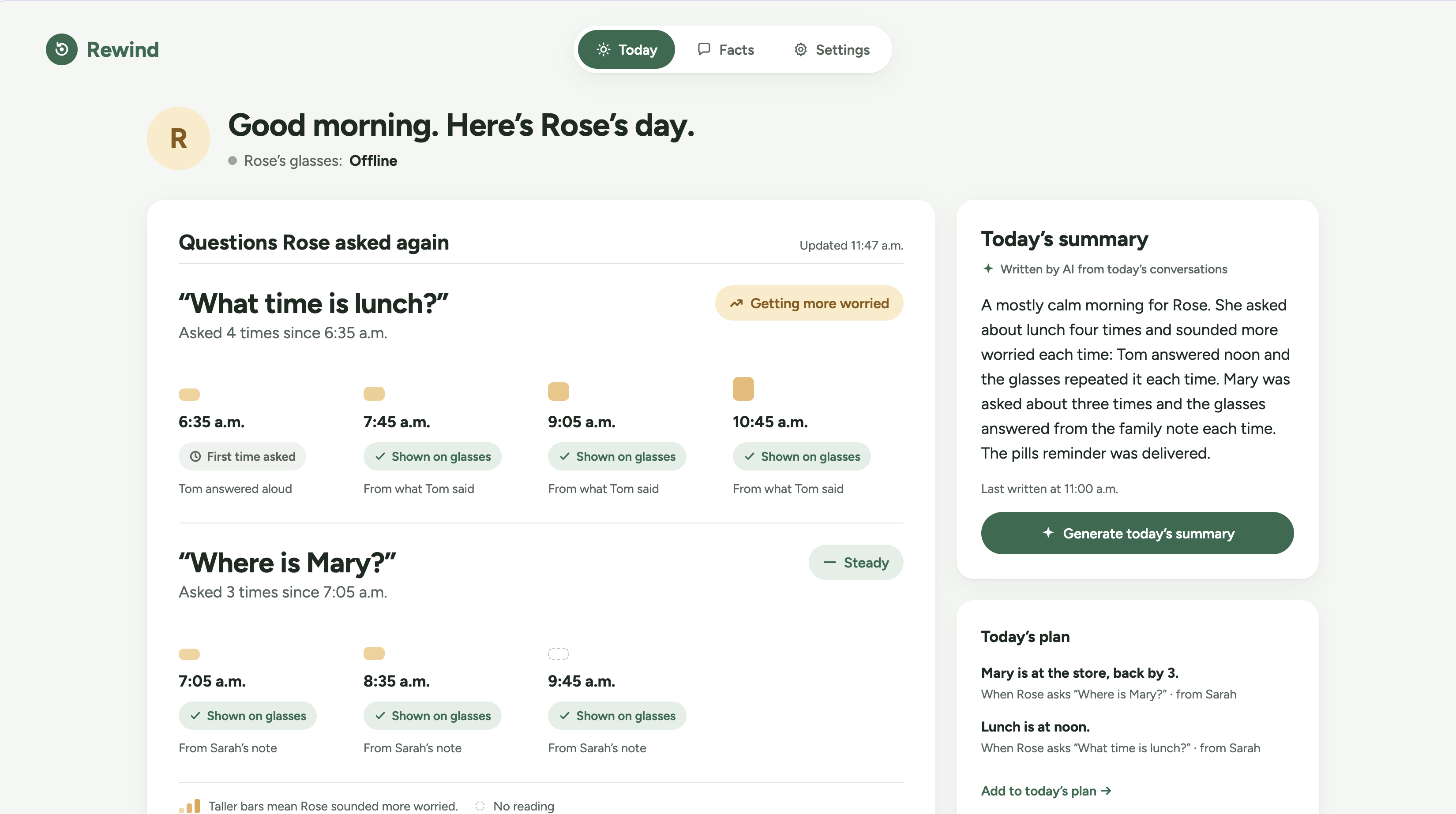
Front page
-
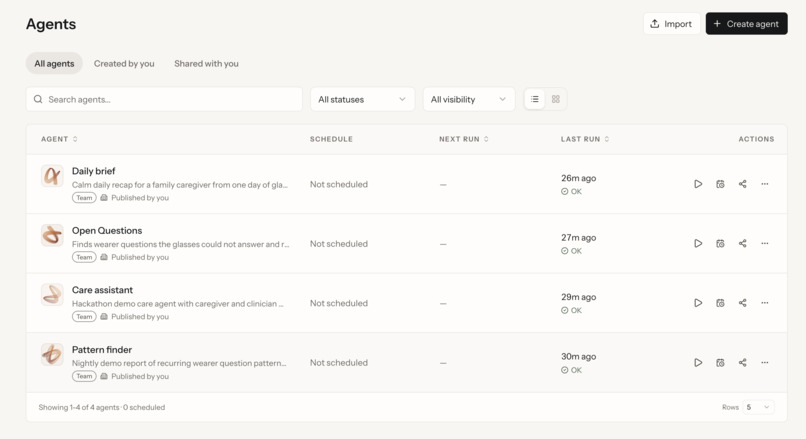
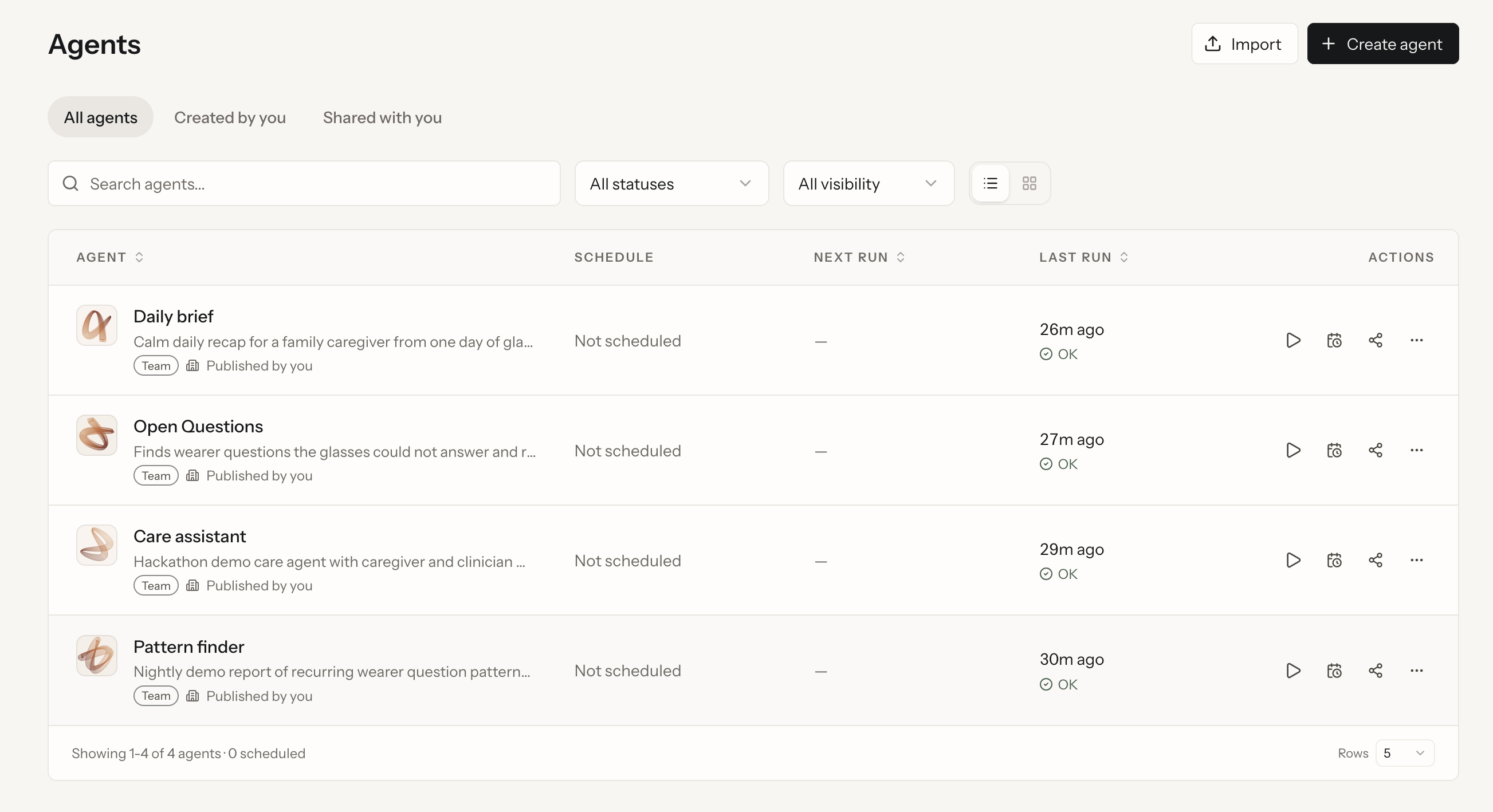
Agents page
-
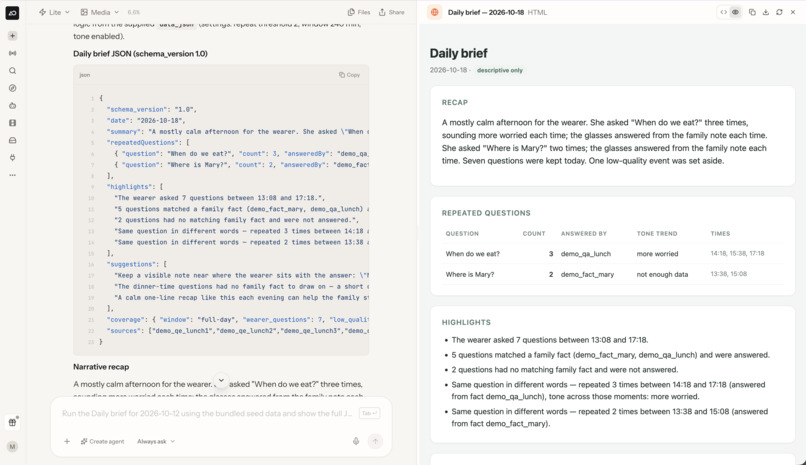
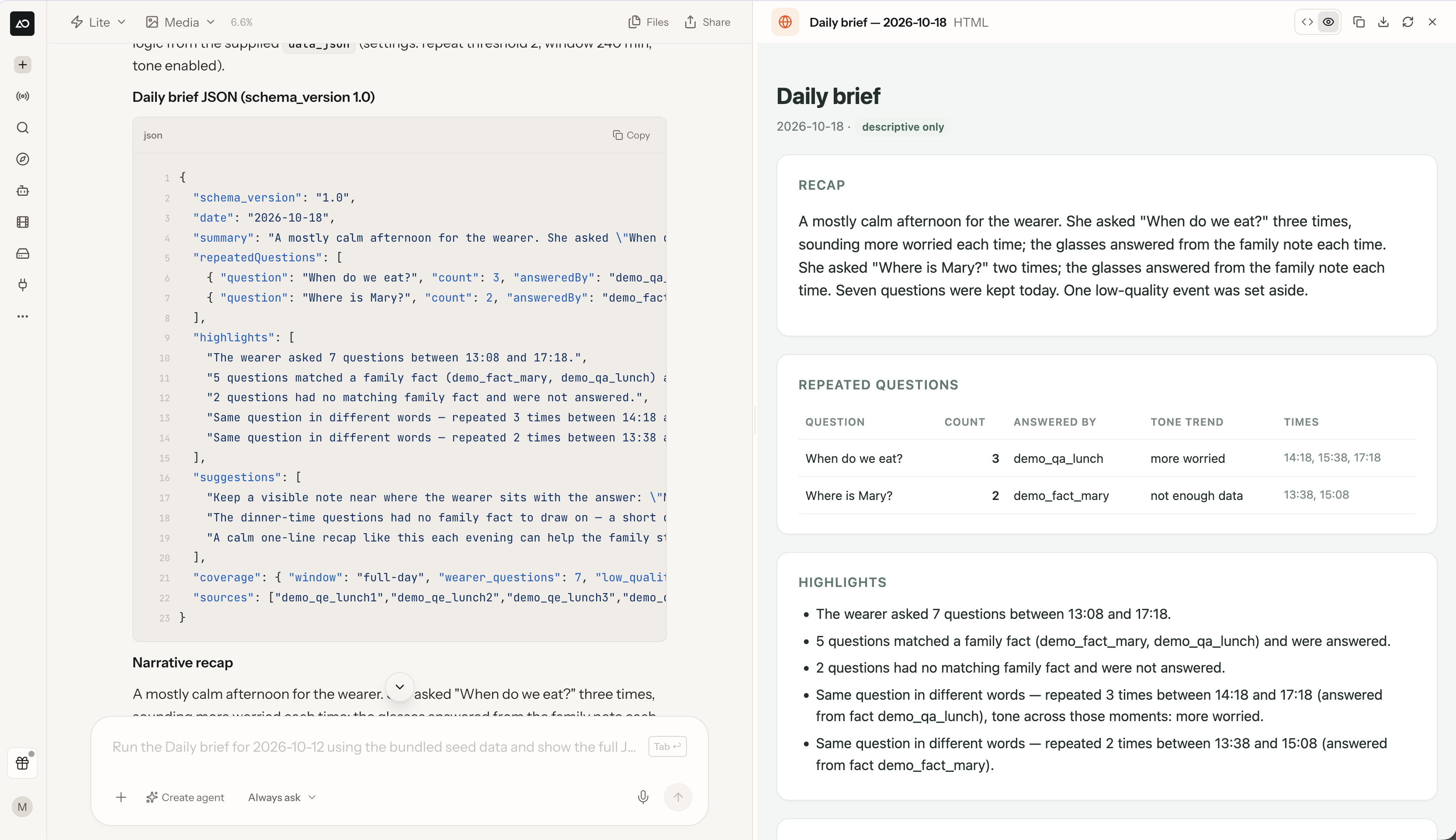
Daily briefs agent run
-
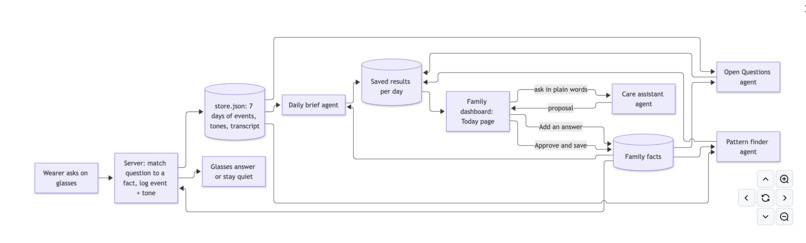
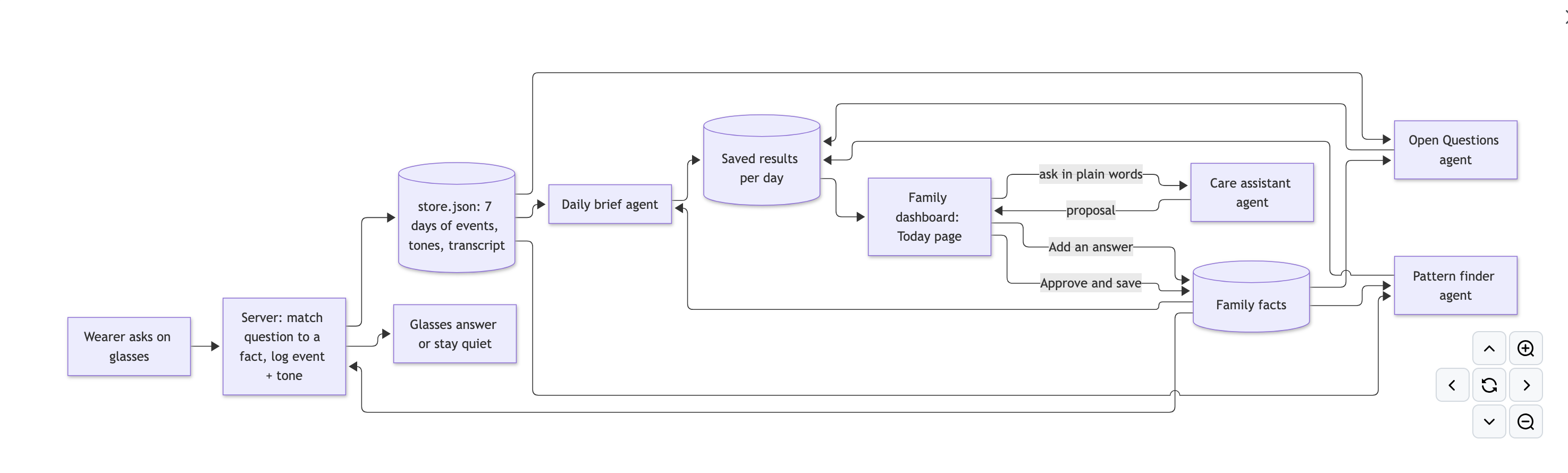
System diagram
Inspiration
Repetition is one of the hardest parts of early memory loss. The person asks when lunch is, or when their daughter is visiting, and gets a patient answer. Twenty minutes later they ask again. Each repeat is a small distress for them and a small drain on the family, and families often feel they cannot say "I just told you."
We wanted the answer to be there without anyone having to repeat themselves, and without the person reaching for a phone. We also set one firm rule early: a wrong answer for someone with dementia is worse than no answer, so no AI is ever allowed to write what the wearer reads.
What it does
Asked & Answered is a pair of smart glasses that quietly answers the questions a person with early dementia keeps repeating, using answers their family already gave.
For the wearer. The display stays blank until it is needed. When they ask a question they already asked, the glasses show the earlier answer in one line, with who said it and when: "Lunch is at 12. Sarah, 10:40 AM." If nobody answered aloud, it falls back to a fact the family entered ahead of time. If there is nothing reliable, it shows nothing. Answers that are too long for the display are never cut, because a cut can drop a "not", so the glasses point to the phone for the full text.
For the family and clinicians. A team of four AI agents works in the background and supports the family without replacing anyone:
- Daily brief: which questions repeated, how often, and what was answered.
- Pattern finder: questions repeated across several days and the time of day they cluster in, as counts only. Never a diagnosis.
- Open Questions: questions the glasses could not answer that keep coming up. It asks the family to answer them, and it filters out one-offs and noise.
- Care assistant: a caregiver can say "I'm visiting Thursday at 3" and the plan updates. A clinician can tune measurement settings. Each role can only do its own job.
Rules we built in.
- The AI never writes answers. It only decides whether a question matches an earlier one.
- Every answer shows who said it and when, so the wearer can judge if it is out of date.
- When unsure, show nothing. A missed repeat costs little, and a wrong answer costs trust.
- Old answers expire unless the family marked them as standing facts.
- Tone of voice is shown to the family only, as a trend, and described as an estimate of expression, not of feeling.
How we built it
The live answer path is fast and deterministic. Glasses audio is transcribed, the system works out who is speaking, saves a question and the reply that follows it, and matches new questions against earlier ones with a second check that the two really mean the same thing. Any failure returns nothing. The AI agents run separately in the background on CREAO and never sit in the live path, so answers still reach the glasses if they are slow or down. Every claim an agent makes traces back to a logged event.
Install the agents
| Agent | Agent ID | Install link |
|---|---|---|
| Daily brief | cc26aad8-308e-4bba-9d1a-164dfed81be5 |
https://agent.creao.ai/install/cc26aad8-308e-4bba-9d1a-164dfed81be5?version=42aa0b71-6e2c-4bd1-b52e-cbb2afcfac83 |
| Pattern finder (v1.2.0) | 1dd9ddd9-a2a2-491a-a4aa-89f165fd277f |
https://agent.creao.ai/install/1dd9ddd9-a2a2-491a-a4aa-89f165fd277f?version=6ef2776b-d217-48af-aae7-fb8d9de47753 |
| Open Questions (v1.1.0) | 44b1a649-026f-4b4f-84f5-1142ba9a2c63 |
https://agent.creao.ai/install/44b1a649-026f-4b4f-84f5-1142ba9a2c63?version=d89164a7-10bd-4d61-84aa-734ff5e558cb |
| Care assistant (v1.2.0) | ff8a0dd2-4b8a-454f-a3c5-e231d5c5edd2 |
https://agent.creao.ai/install/ff8a0dd2-4b8a-454f-a3c5-e231d5c5edd2?version=41df3983-d1d6-4bb3-81be-e0fdf35d8cb1 |
How we set the agents up
Shared rules in every agent
- Every number is computed by code in the agent's sandbox, and the narrative is written afterwards.
- Every claim cites event or fact ids under
sources; claims we cannot cite are dropped. - Banned words: confused, confusion, declining, worsening, deteriorating, progression, symptom, symptoms, diagnosis, diagnose, impairment, disoriented.
- Tone is reported only as a trend across at least 3 observations, for the wearer only, skipping low-quality readings. It is never a single score.
- Sparse data gives "not enough data" instead of an invented pattern.
- Output is JSON with
schema_version "1.0"plus a short plain-language summary. - Agents only propose. They never write, publish, share, connect an app or send anything.
Settings and defaults
| Agent | Inputs | Defaults |
|---|---|---|
| Daily brief | date, settings_json, data_json |
repeat threshold 2 asks, 240 minute window, tone on |
| Pattern finder | end_date, window_days, data_json |
7 days; needs 3 or more days with 2 or more asks each |
| Open Questions | end_date, settings_json, dismissed_clusters, data_json |
raised only at 3 or more asks across 2 or more times of day, at most 3 a day; it never invents an answer |
| Care assistant | role, request, today, data_json |
caregiver proposes fact changes only; clinician previews setting changes only |
Clinician setting ranges: repeat threshold 2 to 10, repeat window 15 to 240 minutes, at most 1 to 5 open questions a day, tone on or off.
Fine-tuning we did
- Pattern finder tone is now one label (more worried, less worried, steady, not enough data), with no raw counts.
- The Care assistant clinician preview now shows before and after repeated-question groups per day plus a total, and says "This setting is a preference, not validated clinical logic."
- The Care assistant refuses cross-role requests. A caregiver cannot change settings, and a clinician cannot edit facts.
- A caregiver request replaces the existing fact on the same topic and never adds a duplicate. It resolves relative dates ("Thursday") against today and sets an expiry of the event time plus 3 hours.
- Added an optional
data_jsoninput to Pattern finder, Open Questions and Care assistant so the server can send live data. Seed-data behavior is unchanged and was verified byte for byte.
How the agents are used
The server collects the wearer's questions, answers and tone, and starts each agent through its own CREAO trigger API with data_json. It saves each result, and the family dashboard shows it.
| Agent | Triggered by |
|---|---|
| Daily brief | 8 PM, or the Generate button |
| Pattern finder | 11:30 PM, or the Update now button |
| Open Questions | Every 30 minutes when new questions arrive, or the Check now button |
| Care assistant | A person, from the dashboard |
A person approves any proposed fact. Approval is the only thing that changes what the glasses say.
How the agents work together
Start here
Pipeline (what triggers what, how a run works, where to improve): https://github.com/nam-m/la-ai-hackathon-2026/blob/main/care-agents/PIPELINE.md
Explains the agents
Exact agent specs, rules, output JSON and test cases: https://github.com/nam-m/la-ai-hackathon-2026/blob/main/care-agents/AGENT_SPECS.md
Handoff with test results (PASS/FAIL per agent), known issues and next steps: https://github.com/nam-m/la-ai-hackathon-2026/blob/main/care-agents/HANDOFF.md
The seeded data the agents were tested on, plus expected results: https://github.com/nam-m/la-ai-hackathon-2026/tree/main/care-agents/seed
Demo runbook (the order to present in): https://github.com/nam-m/la-ai-hackathon-2026/blob/main/care-agents/DEMO_RUNBOOK.md
The data_json input edit and the check we used: https://github.com/nam-m/la-ai-hackathon-2026/blob/main/care-agents/DATA_JSON_EDIT.md
A sample Care assistant proposal: https://github.com/nam-m/la-ai-hackathon-2026/blob/main/care-agents/examples/caregiver-proposal.json
Challenges we ran into
- Working out who is talking from wearable audio, so we let the system say "unknown" instead of guessing.
- Look-alike questions that should not match, which we handled with a verification step and a high bar for matching.
- Fitting an answer on a tiny display without changing its meaning.
- Keeping caregivers from drowning in noise: the agents only raise a question after it repeats at different times of day.
- Sensitive output: early agent runs reported alarming tone trends from very little data, so we tightened the rules to require several observations.
Accomplishments that we're proud of
- A full loop from a spoken question to a sourced line on the glasses, working on real hardware.
- A design where the AI cannot hallucinate to the wearer.
- Four care-side agents that pass all 11 of our seeded test cases, including the refusals: a caregiver cannot turn tone tracking off, and a clinician cannot add a fact.
- Honest handling of uncertainty: the pattern finder says "not enough data" when it has less than 3 days of questions.
What we learned
- For people with memory loss, showing nothing is a feature. Restraint mattered more than recall.
- Keep the fast, predictable path separate from the slow, judgment-heavy one.
- Permissions belong in code, not in an agent's instructions.
- Wearable audio is messy, and attribution has to be allowed to say "I don't know."
What's next
- Let the family confirm an agent's proposed answer so it reaches the glasses automatically.
- Real consent and data controls before any real user.
- More support for daily life, such as reminders, routines and reminiscence, described as support rather than treatment.
- Clinical review of the thresholds we chose.
Tracks and challenges
- CREAO, Best Team Empowerment: four agents connect the wearer, family and clinician without replacing anyone.
- Even Realities, Smart Glasses Building Challenge: built for the G2's quiet display, with one private line shown only when needed.
- Applied Intelligence: applied AI for a daily problem, with strict rules about when it stays silent.
- MLH Best Use of ElevenLabs: ElevenLabs transcribes the live speech behind every answer.
Built With
- claude
- creao
- elevenlabs
- even


Log in or sign up for Devpost to join the conversation.