Inspiration
It's 8:40, the bus is at 8:45, and the glasses aren't where they always are. Pockets, coat, bathroom, kitchen, back to the coat. Most of us have lived some version of this morning. Now imagine it happening ten times a day.
That's daily life for a lot of people living with dementia, and for many people with ADHD. While reading around the problem, one detail stuck with us. The real damage isn't the lost item: it's the stress and the slow loss of confidence in your own memory.
Almost every existing fix asks the person to do something: stick on a tracker, keep "a place for everything", write it down. Those are exactly the habits memory problems make hard.
So instead of asking people to remember better, what if the room remembered for them?
What it does
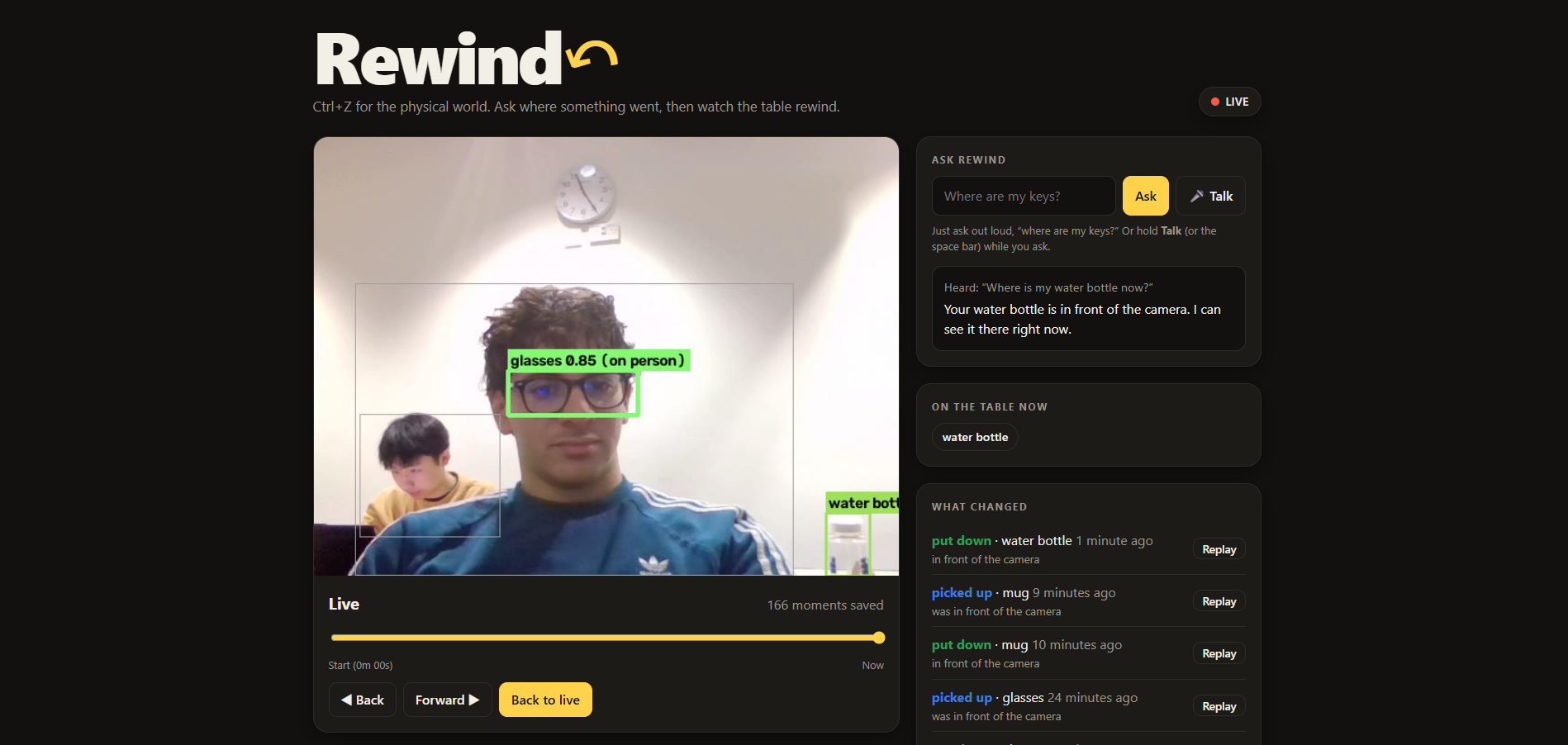
A camera watches the places people put things down. When you ask "Where are my glasses?", out loud or by typing, Rewind answers "The glasses are on the table, next to the mug." The web page then jumps back to the moment they were last seen, so you can see it for yourself. A slider lets you scrub back through the table's history.
How we built it
Rewind has two brains. The fast one is YOLO running on the laptop: it watches the table live, but only bothers re-running when the picture actually changes (tables are boring, so that's rarely). When something moves and then goes still, Rewind knows an item was just put down and takes a snapshot.
That snapshot goes to the smart one, Gemini, with every person blurred out first. Gemini lists what's on the table and double-checks anything YOLO isn't sure about ("is that really a pen?").
Ask "where are my keys?" by voice (ElevenLabs) and Rewind answers out loud, "on the table, next to the mug", then rewinds the screen to the moment you put them there.
Challenges we ran into
- Detectors blink. missed frame tricked the detector into thinking your keys left. An item only counts as gone after it's missing from two keyframes in a row, and Rewind asks for that confirming look itself instead of waiting for more movement.
- Wrong names. YOLO kept calling water bottles "remote controls", and sometimes put wallet and phone on the same box. We now keep one label per object, stopped YOLO looking for remotes, and let Gemini check anything YOLO isn't sure of.
- Held or on the table? From a side-on camera, a phone on the table behind someone looks like it's in their hand. An item only counts as held if it sits mostly inside a person's box, in the top 60% of it (face, chest, raised hand).
- Free-tier limits. Every Gemini look costs quota. Rewind only looks when the scene settles, rate-limits itself, and falls back to YOLO automatically if the quota runs out, so the demo never dies.
- Two versions, one product. We built two pipelines in parallel overnight, one with stronger detection and one with a better answer and voice experience, and had to merge the best of both late in the hackathon.
Accomplishments that we're proud of
We're very proud that we were able to accomplish our goal and provide an actual functioning system that could be used in a real house.
What we learned
- Measure, don't guess. Testing on labelled photos showed us the bigger, slower model was worth it, which is the opposite of what our gut said.
- Fast and dumb plus slow and smart beats either alone. YOLO keeps up with the room; Gemini makes sure it's right.
- Privacy is easy if you start with it. Blurring people before anything leaves the laptop took a few lines of code.
- Wording matters as much as detection. "Next to the mug" helps someone find their keys; coordinates don't.
What's next for Rewind
- Every room, not just one table: several cameras, so Rewind knows your keys are in the hallway, not just "on a table".
- Fully offline: run the smart checks on the device too, so no image ever leaves the home.
- Built with the people it's for: test with people living with dementia and their carers, and let carers check in remotely.


Log in or sign up for Devpost to join the conversation.