-
-
ReWeb Logo
-
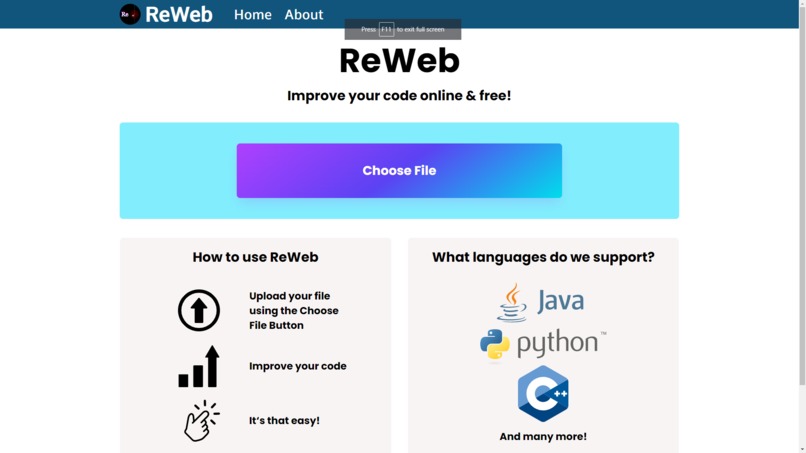
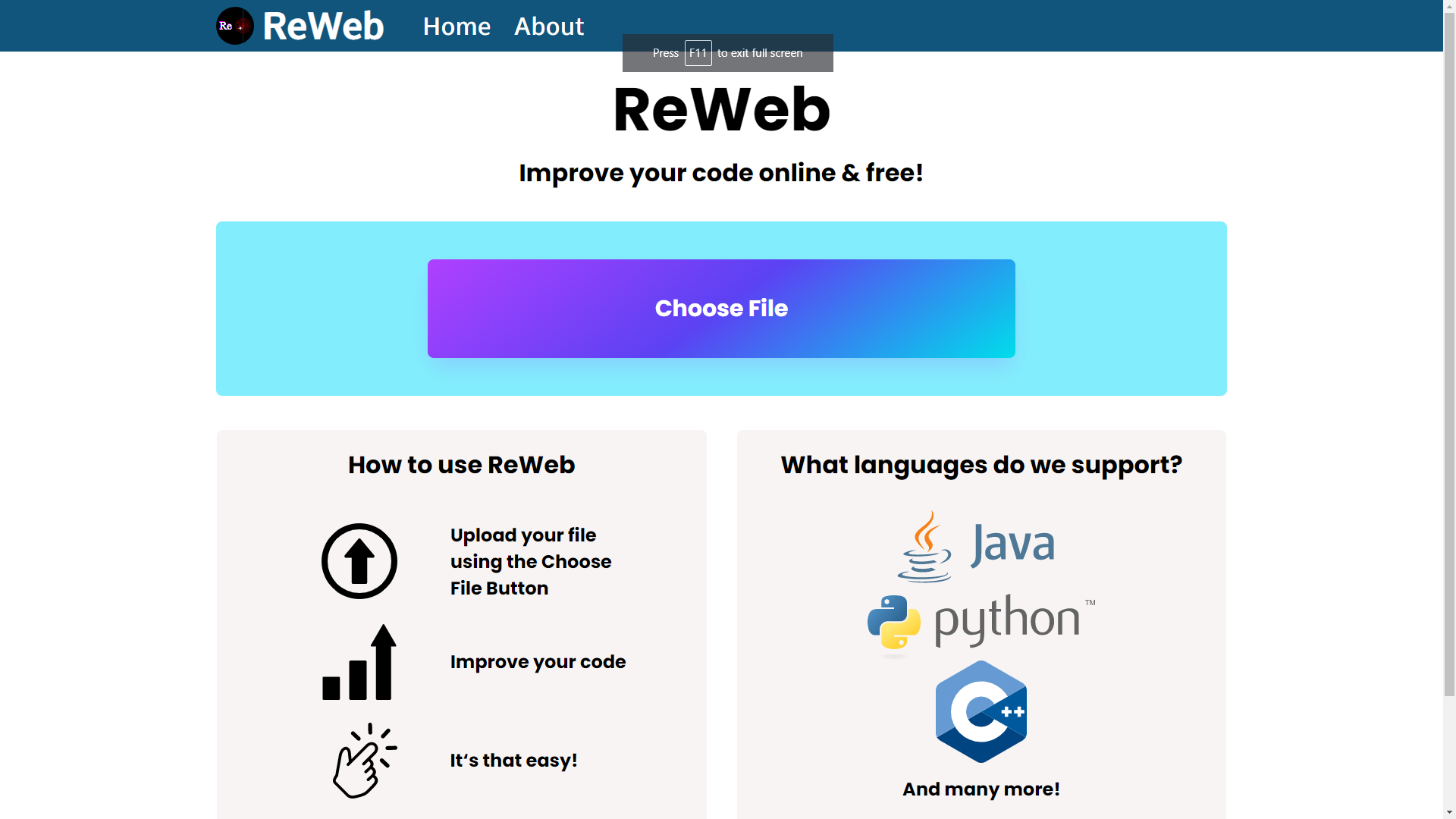
Home Page
-
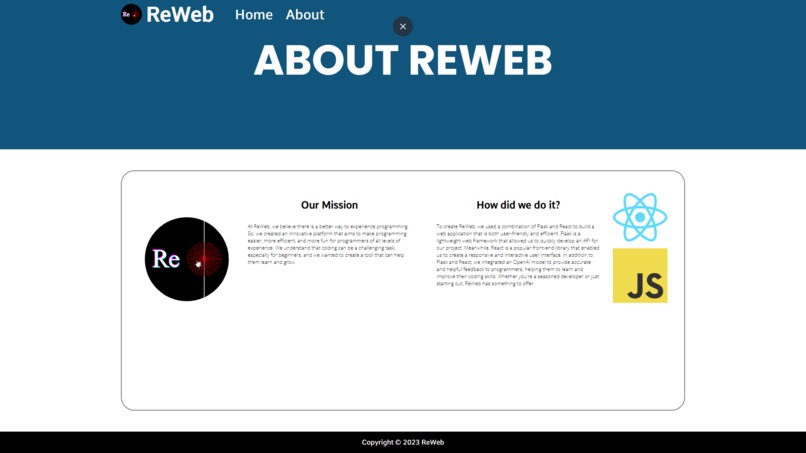
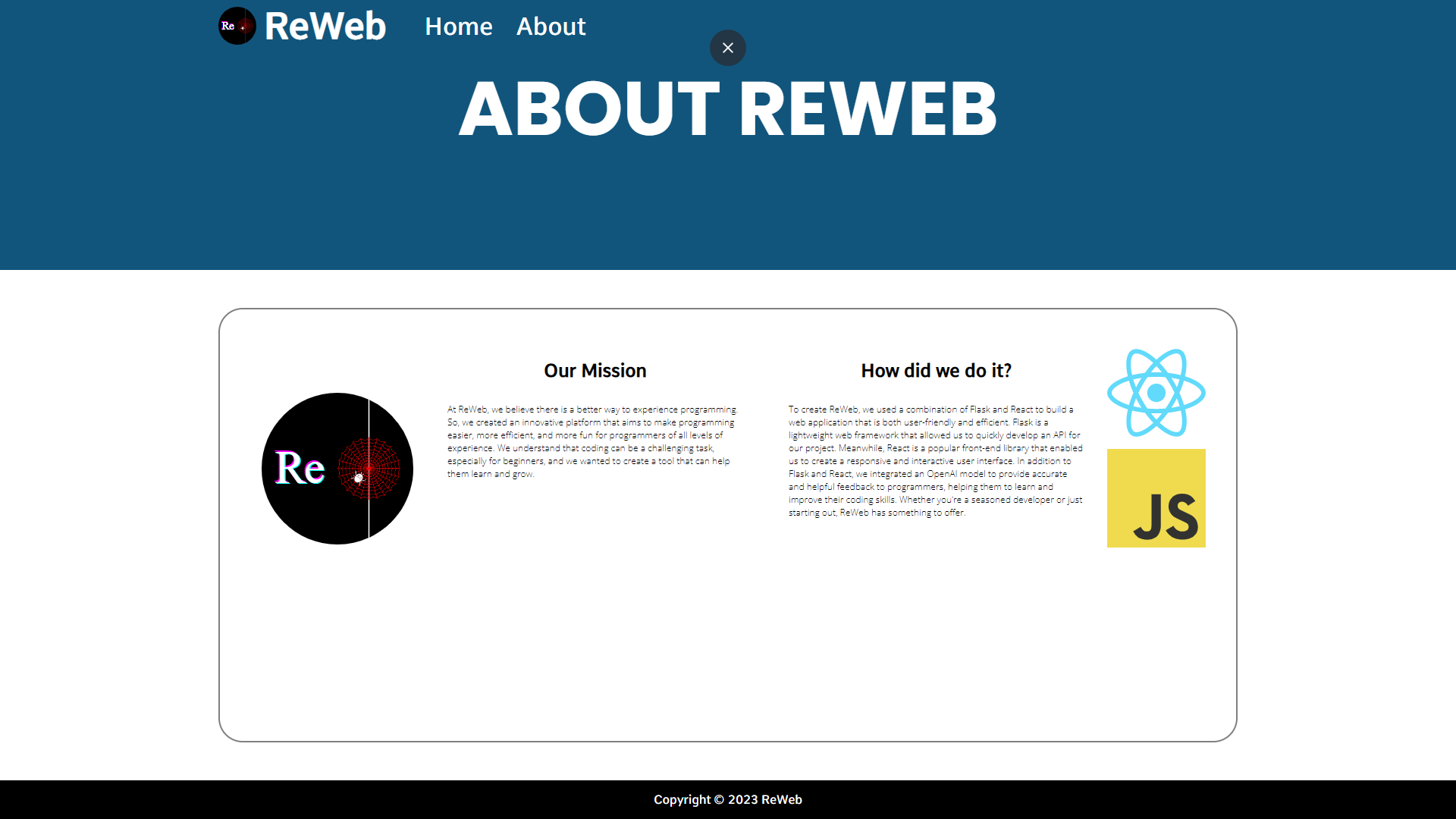
About Page
-
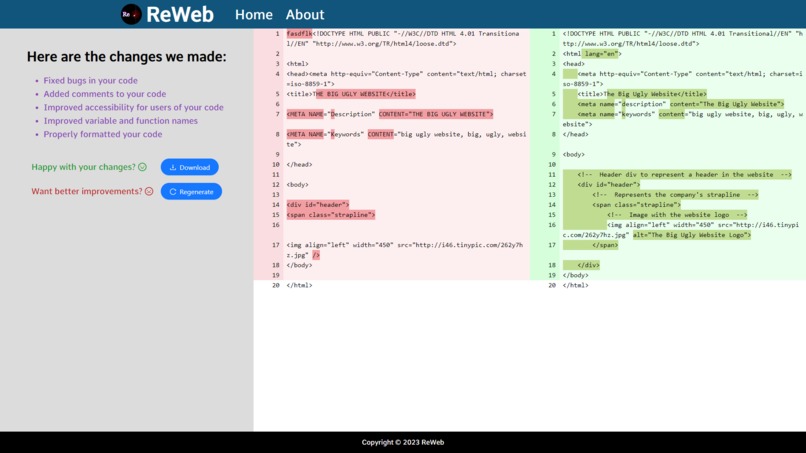
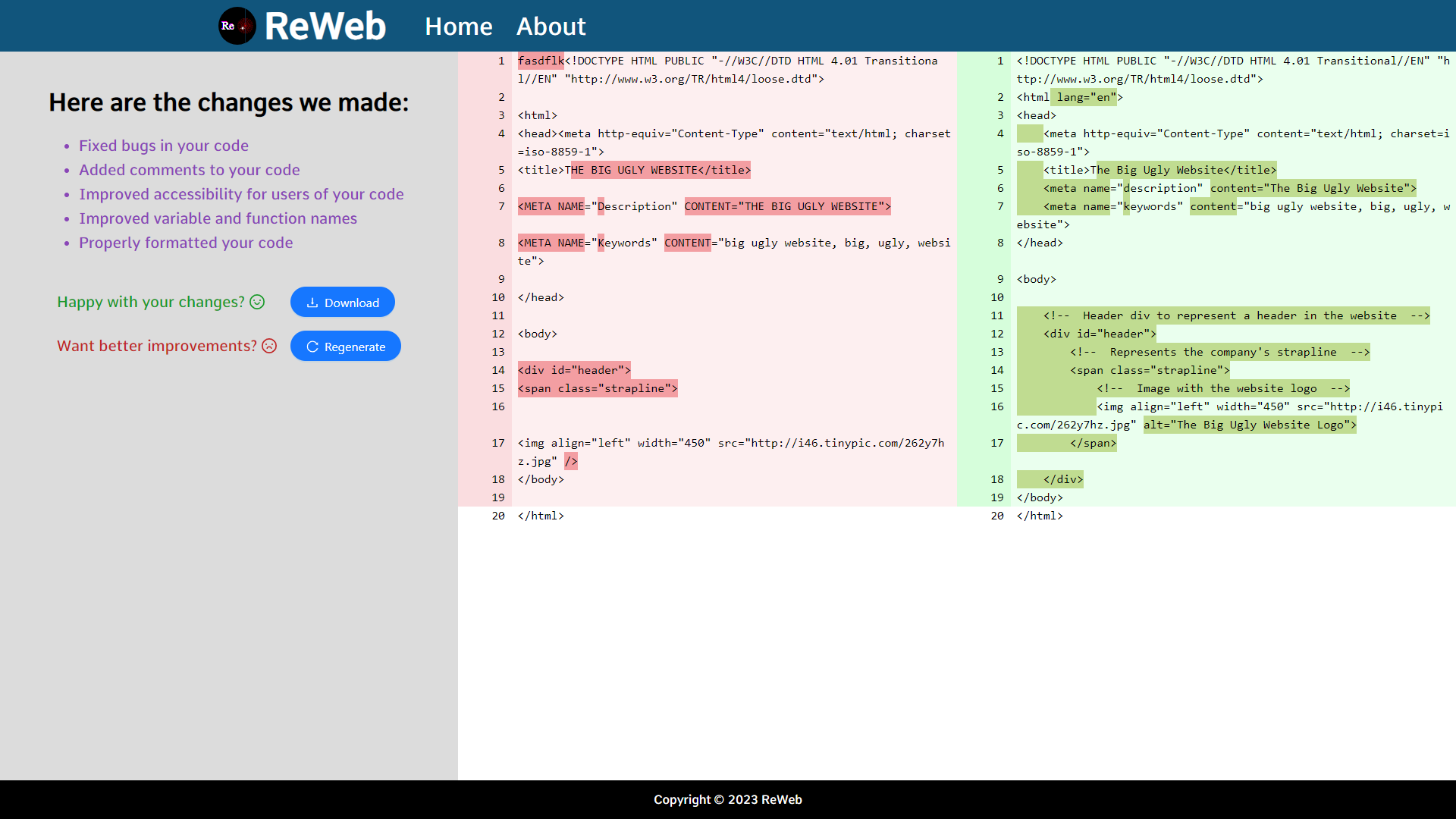
Improvements Page
ReWeb
A web application to improve your code. The application fixes bugs, improves style (reformats code, renames bad variable/function names, adds comments etc.), and improves user accessibility.
Inspiration
As we grow older, our parents and those of old age begin to exhibit health issues that deter them from using websites effectively. As programmers and designers, it becomes evermore important to make websites more accessible to those who need it in order to function in a society progressing towards advanced technology becoming the backbone of our world. We've spent countless hours trying to debug or improve code that was all too simple once we figured out the solution. We hoped to create an application that was free, easy to use, and could help other programmers save time during their programming endeavors. In hopes of that our application is aimed towards refactoring code in order to add more comments for developers to easily understand what is written, add accessibility features for those who need it, and improving small bits here and there to produce clean code!
What it does
Our application allows users to upload a file containing code in any language (although generally for now its HTML). The application then parses the code and fixes bugs, improves style (reformats code, renames bad variable/function names, adds comments etc.), and improves user accessibility using Generative AI from EdenAI. The application then shows the new code side-by-side in a GitHub style diff view. The user can continuously regenerate new files in order to find changes they think is most appropriate based on whatever is output by the Generative AI model.
Our project uses an OpenAI model behind the scenes to generate the code improvements. We use the OpenAI model through the Eden AI API.
How we built it
We built the application using the Flask and React frameworks. The frontend of the application is built using React and various Ant Design components. We used Flask to create our custom REST API, which is used to communicate with the Eden AI. While Flask handles the logic and generates the necessary prompts using our API, React is calling our REST API in order to format the code in a pretty manner, while also making use of dynamic components in order to ensure it seems as seamless as possible. Throughout the code we have added bits of accessibility using our program, which demonstrates real applicability of our application! Specific improvements may involve the css in order to make it more responsive, and color suggestions in order to help contrast for people who are colorblind.
Challenges we ran into
We ran into a lot of challenges while building this application. The first challenge was to find a suitable API to use for our project. We tried to avoid the OpenAI API due to it being a paid API, and because of that, we ended up spending hours trying to find an alternate API. We eventually found the EDEN AI API which allowed us to use OpenAI models for free. From there we had to learn how to combine React and Flask in order to communicate effectively, eventually deciding to have backend only act as the intermediary for connecting to Eden, while React handles most of the frontend components. One of our members was completely new and had to learn CSS/HTML from scratch, which was a challenge in of itself as they had to learn the slight differences between how React works with HTML. Similarly, our other members had to focus on developing with unknown frameworks as they have mostly worked in individual projects using CLI components.
Accomplishments that we're proud of
Building the application was no easy feat, and we had to constantly iterate on the design of the application. Getting the color scheme to a satisfactory level was the hardest part of our design process, along with additional components in getting the css appropriately fixed. However, we feel like the biggest accomplishment was getting the diff-view working on our react frontend. We believe that showcases effectively the dynamic aspect of our application, and allows it to be more seamless. Along with that we are proud of the integration between our frontend and backend in order to make use of Generative AI to display newly refactored code. The model we use seems to work well, and we hope that in future iterations it would be best to make use of something like Copilot to get more effective changes.
What we learned
The whole process of creating the application was a journey for our team. We learned technical skills like web design and handling OpenAI API calls within our web application. We learned how to effectively manage our time (given we we're on such a strict time constraint), and learned how to collaborate manage our tasks. A majority of our members were in college and we're still doing finals, which proved that we didn't have as much time as we wanted to work on the project, but we persevered. One member learned essentially all of CSS and HTML within a single night in order to create the design of our entire application. The other two learned how to seamlessly integrate frontend and backend together by communicating effectively.
What's next for ReWeb
In the future, we'd like to improve our UX as well as add more functionality to our website so that we can better help aspiring coders. We hope to create our own model similar to Copilot from Github which will make our code a lot more applicable to users, and provide actual benefits that may be used in the industry. Furthermore, when we design our own model, we want it to be more specifically targeting ways in how to improve accessibility. By making our model emphasize clean code, accessibility, and improvements, we can have more targeted results. Similarly, we hope to expand towards allowing multiple files to be uploaded which will allow more complex projects to be integrated and made more accessible!


Log in or sign up for Devpost to join the conversation.