-
-
Main Page
-
Chat page
-
Analysis page
-
Analysis page
-
Quiz page
Inspiration
The inspiration for RevTutor started with a common struggle: the illusion of competence. We often read an article or watch a tutorial and walk away feeling like experts. But when asked to explain it to someone else, we stumble, use too much jargon, and realize there are massive gaps in our understanding.
This is where the Feynman Technique comes in; the idea that you don't truly understand a concept until you can explain it simply to a beginner. We wanted to take this profound pedagogical insight and supercharge it with AI. Instead of using AI as a tutor that spoon-feeds information (which can encourage passive learning), we flipped the script. What if the AI was the student, and you were the teacher?
What it does
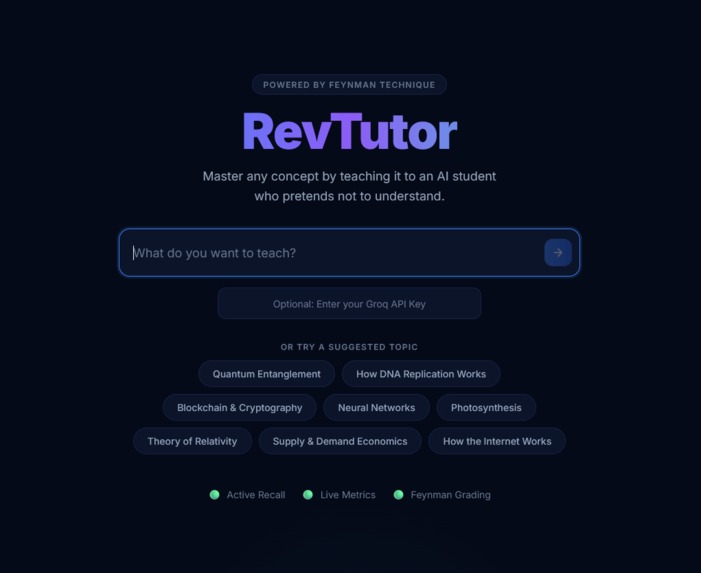
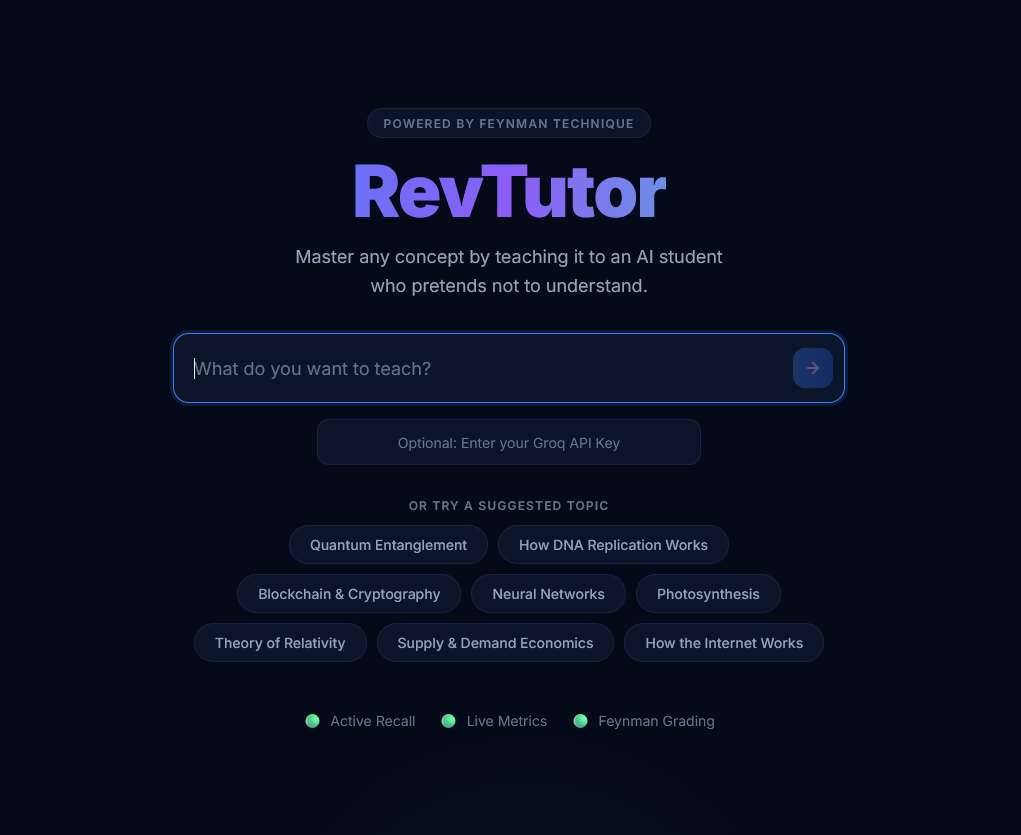
RevTutor is an AI-powered learning assessment platform that flips the traditional tutoring model. Instead of an AI teaching you, you teach the AI.
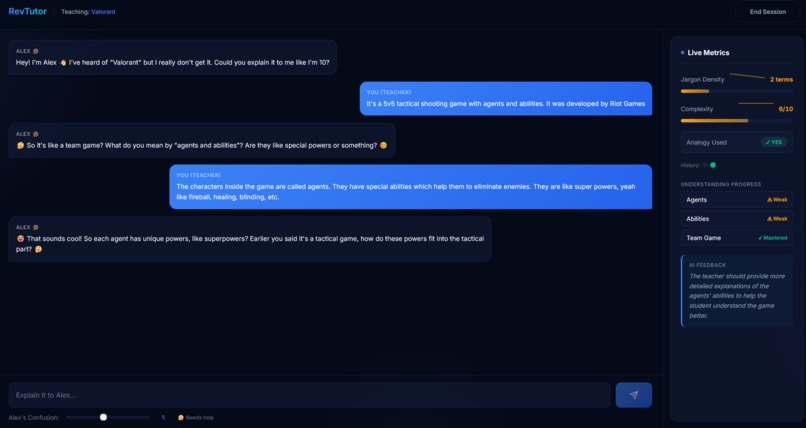
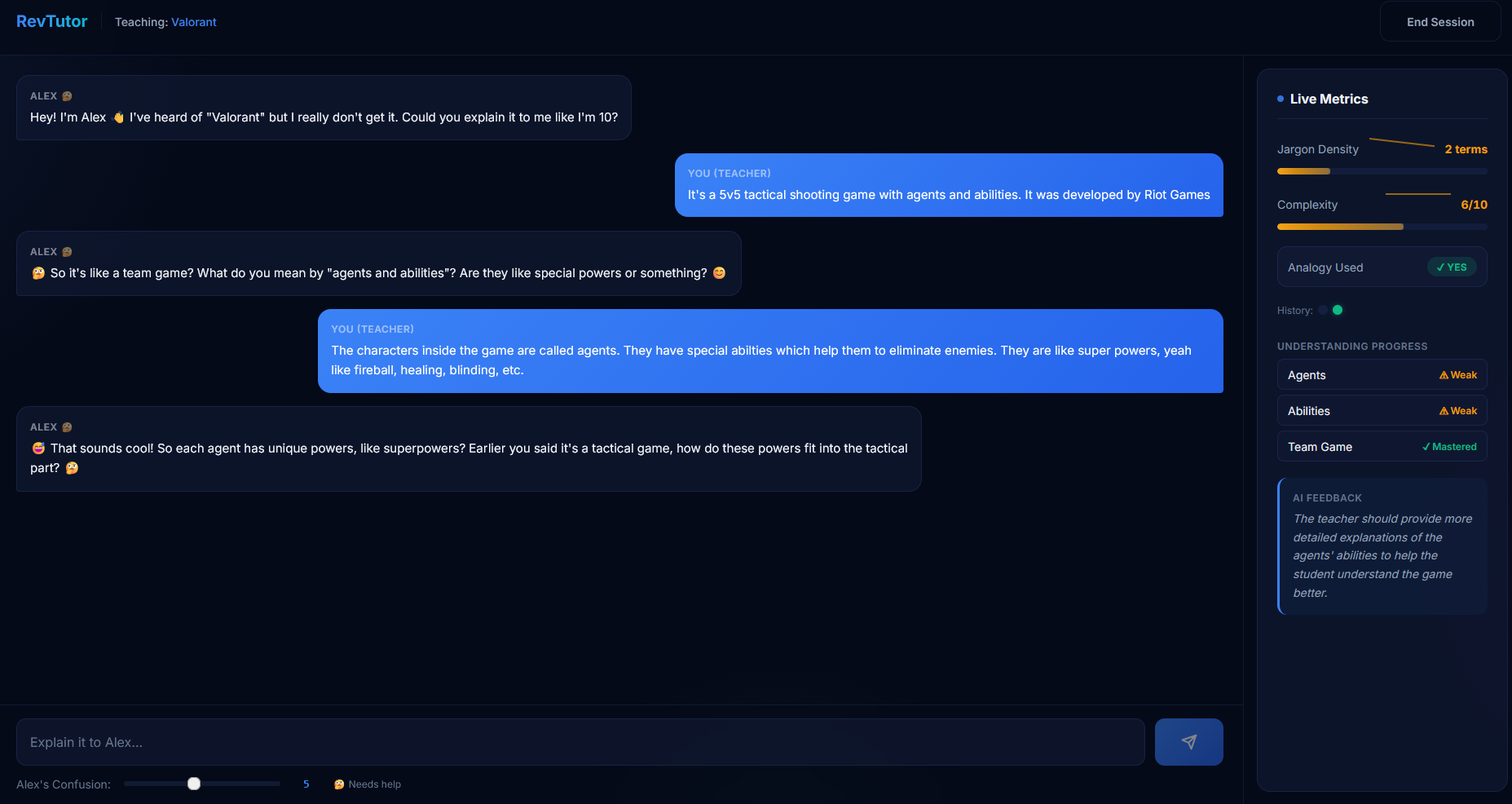
You start by picking a topic you want to master. Then, you enter a chat session with "Alex," our AI student persona. Alex is curious but easily confused. As you explain the concept, Alex actively tries to follow along, asks naive questions, misinterprets your points, and pushes you to simplify.
Crucially, Alex has Intelligent Memory. He remembers what you taught him earlier in the session, connects different parts of the discussion, and politely challenges you if you say something factually incorrect or contradict yourself.
While you teach, a live dashboard evaluates your explanations in real-time, providing feedback on:
- Understanding Progress: A live tracker showing which specific concepts you've mastered, which are weak, and which you've completely missed or gotten wrong.
- Misconception Alerts: Immediate flags if you state a factual inaccuracy, allowing you to self-correct.
- Communication Metrics: Real-time scoring of your jargon density, language complexity, and use of analogies.
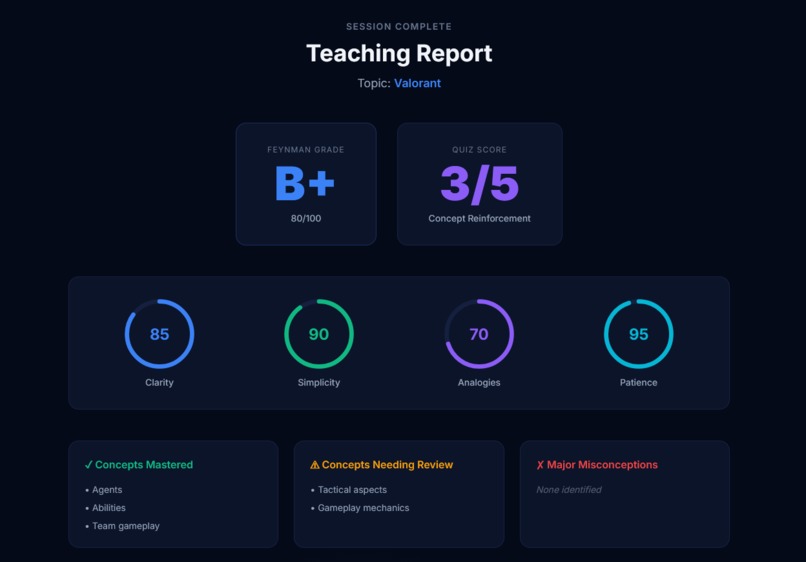
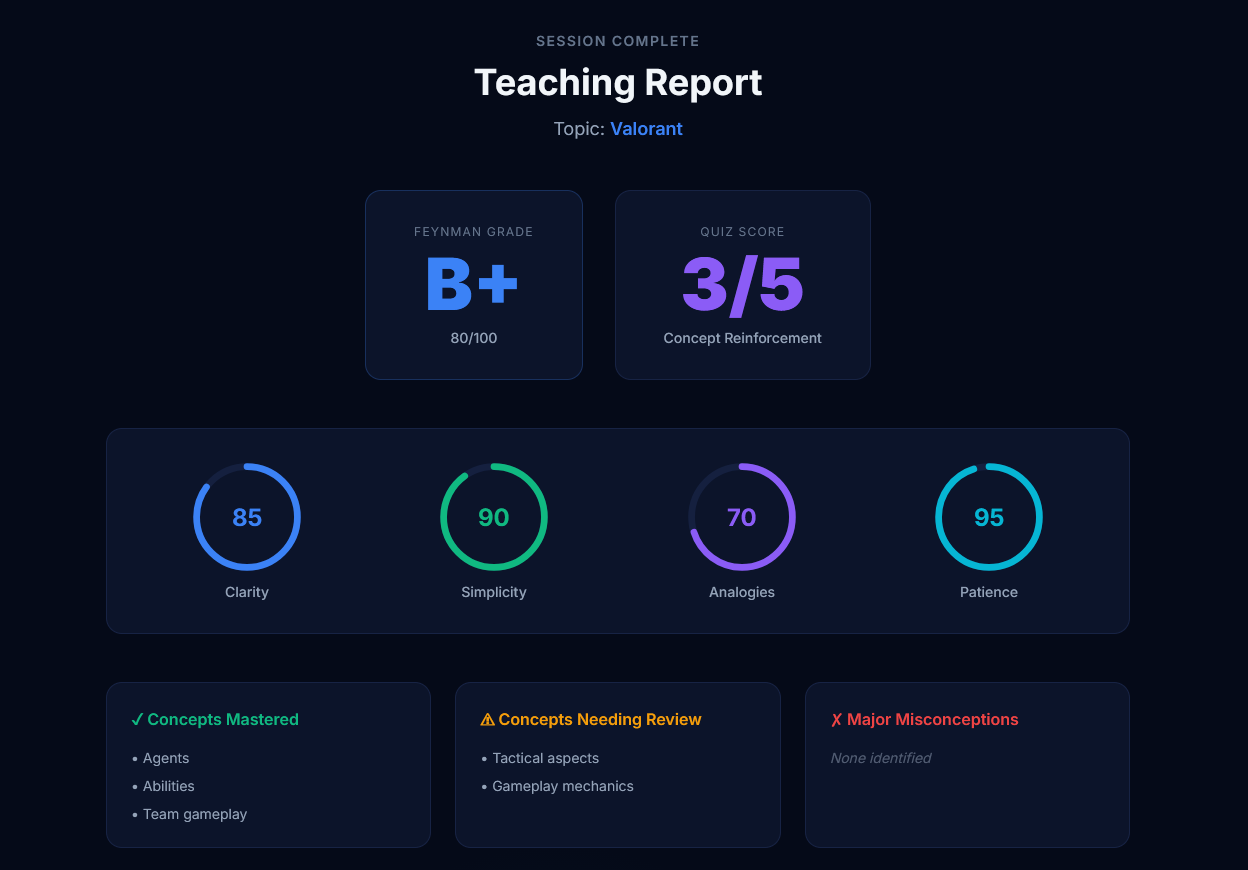
When you end the session, RevTutor generates a comprehensive Feynman Grade and a final report. This includes:
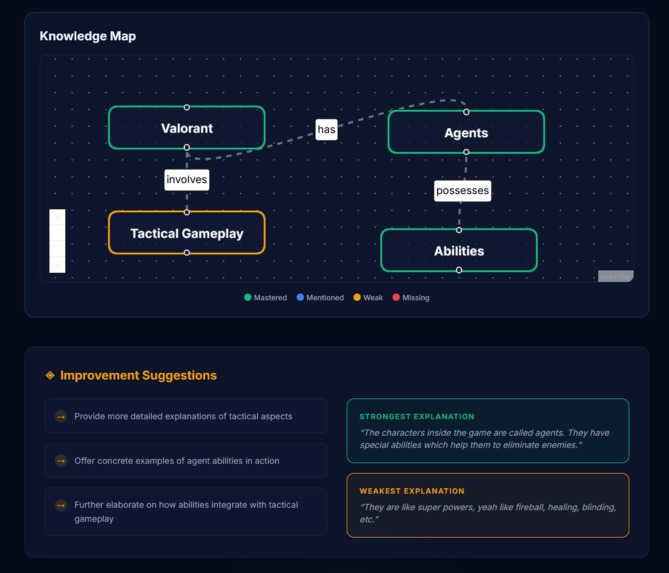
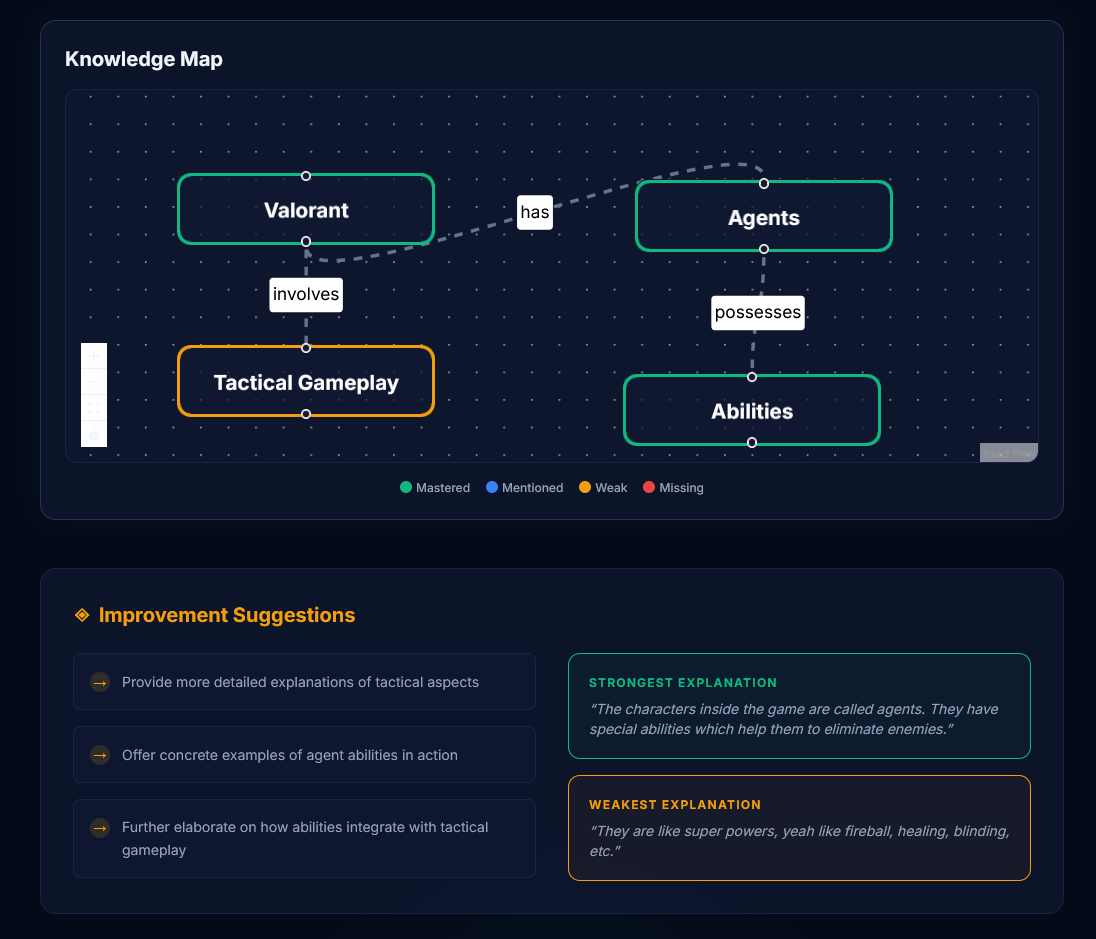
- An Interactive Knowledge Map visualizing how well you explained and connected various sub-concepts.
- Actionable Improvement Suggestions highlighting quotes of your strongest and weakest explanations.
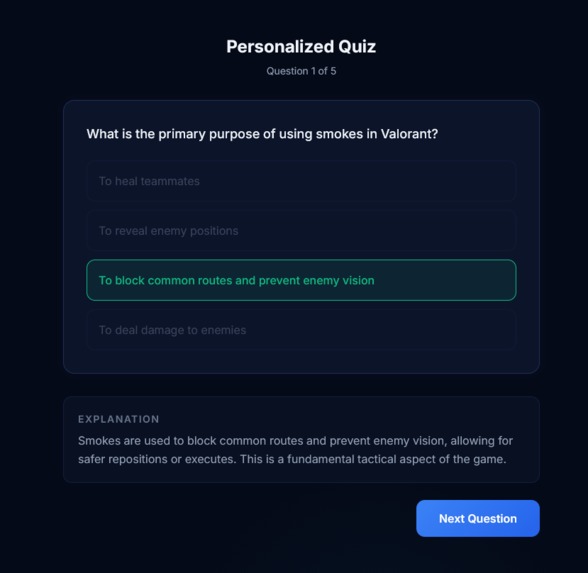
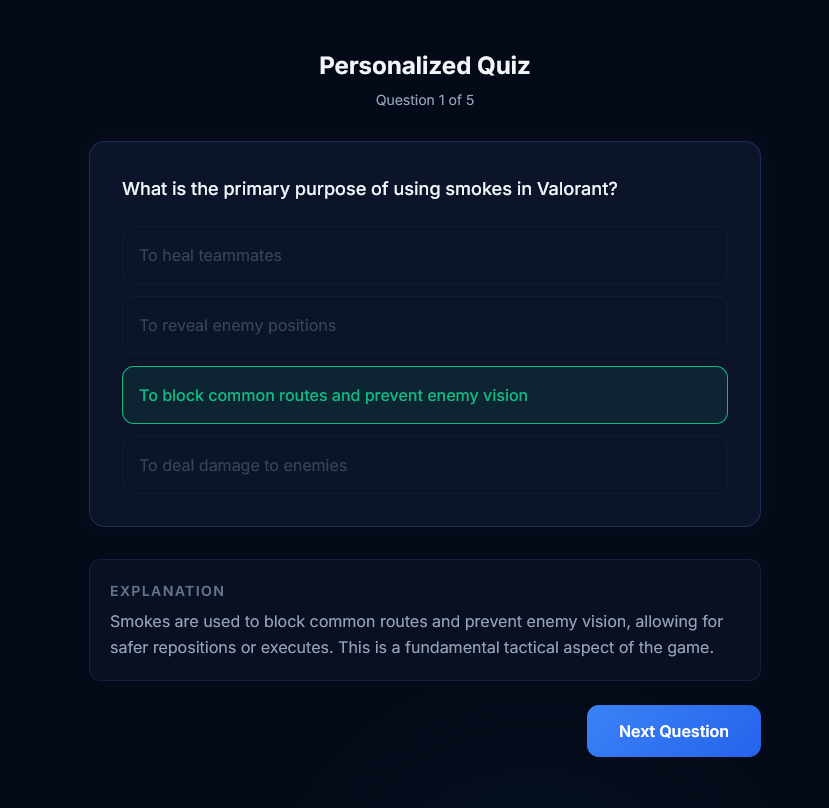
- A Personalized Quiz, generated on the fly, specifically targeting the exact concepts you struggled with most during your teaching session.
How we built it
RevTutor is a full-stack web application designed to be fast, responsive, and visually engaging.
- Frontend: We built the user interface using Next.js and React. We used Tailwind CSS to craft a premium, glassmorphic dark theme with fluid CSS animations. For the interactive Knowledge Map, we integrated React Flow (
@xyflow/react) to render the dynamic concept graphs. - Backend: The server is powered by Python and FastAPI, chosen for its speed and asynchronous capabilities.
- AI Integration: The core intelligence is driven by the Llama 3.3 70B model, accessed via the Groq API for incredibly fast, near-instant inference.
- Complex Prompt Engineering: We designed highly structured prompts for multiple endpoints. The
/chatendpoint gives Alex his distinct, memory-driven personality. Simultaneously, the/analyzeand/summaryendpoints act as strict educational evaluators, processing the entire conversation history on the fly to extract JSON data representing mastered concepts, misconceptions, and graph nodes.
Challenges we ran into
Transforming RevTutor from a simple chatbot into a comprehensive learning assessment platform presented several unique challenges:
- Prompt Engineering the "Anti-Tutor": LLMs are overwhelmingly trained to be helpful, knowledgeable assistants. It was incredibly difficult to force the AI to not explain things. We had to heavily iterate on the system prompt to ensure Alex remained in character, asking naive questions and making plausible mistakes, without accidentally slipping into "tutor mode" and giving away the answer.
- Real-Time Contextual Evaluation: To accurately track a user's understanding and detect misconceptions, the
/analyzeendpoint needed to evaluate the entire conversation history on every single message. Doing this quickly enough to update the live UI without lagging the chat experience required highly optimized API calls and careful React state management using debouncing andAbortController. - Extracting Graph Data from Conversation: Generating a reliable, accurate Knowledge Map from unstructured natural language conversation was complex. We had to carefully craft the LLM prompt to reliably output structured graph data (nodes, edges, and mastery statuses) that could be parsed and rendered perfectly by React Flow.
Accomplishments that we're proud of
- Creating a Believable Persona with Memory: We are incredibly proud of how "Alex" turned out. By tying his behavior to a dynamic UI slider (controlling the LLM temperature $T$) and giving him explicit instructions to remember and connect past statements, the teaching experience feels organic and genuinely challenging.
- The Live Understanding Tracker: Building a system that can extract concepts from natural language in real-time and categorize them as "Mastered," "Weak," or "Incorrect" feels like a massive leap forward for educational tools.
- Personalized, Context-Aware Quizzing: The ability to automatically generate a multiple-choice quiz that specifically targets a user's weak points immediately after they finish teaching is an incredibly powerful way to close the learning loop.
What we learned
Building RevTutor was a massive learning experience:
- The Power of Constraints: We learned how deeply you can shape an LLM's behavior with the right constraints. Forcing the AI to only output structured JSON for analytics while simultaneously running a conversational persona taught us a lot about advanced prompt design.
- UI/UX for Learning: We discovered that visual, immediate feedback—like a concept turning yellow in the Understanding Tracker, or a sudden Misconception alert popping up—is a powerful motivator.
- Active Learning > Passive Learning: Above all, testing our own app reinforced the core concept. The struggle of trying to explain a complex topic to a stubborn, confused AI is hard work, but it cements the knowledge in your brain far better than passively reading any textbook.
What's next for RevTutor
We have big plans for the future of RevTutor:
- Session History Storage: Implementing persistent storage for past teaching sessions. This will allow users to review their previous Feynman Grades, track their improvement over time, and revisit complex topics they previously struggled with.
- Voice Integration: Allowing users to actually speak their explanations to Alex (and having Alex speak back) would make the experience even more natural and challenging.
- Long-Term Knowledge Graphs: Tracking a user's mastery over time across interconnected concepts and multiple sessions (e.g., mastering "Atoms" before unlocking "Molecules").
- Multiplayer Mode: Allowing two human users to take turns being the teacher and the student, with the AI acting as a moderator, evaluator, and fact-checker.
- Curated Curriculums: Creating structured learning paths for specific subjects like Computer Science or Biology, where Alex expects you to teach him specific core concepts in a specific order to "pass."
Built With
- fastapi
- groq
- next.js
- python
- react
- typescript


Log in or sign up for Devpost to join the conversation.