
What Inspired Us
Most AI memory tools remember facts. They can store that your granddaughter's name is Lily, but they don't remember how you found your way back to that name. For someone with aphasia or dementia, that recovery process is exactly what matters.
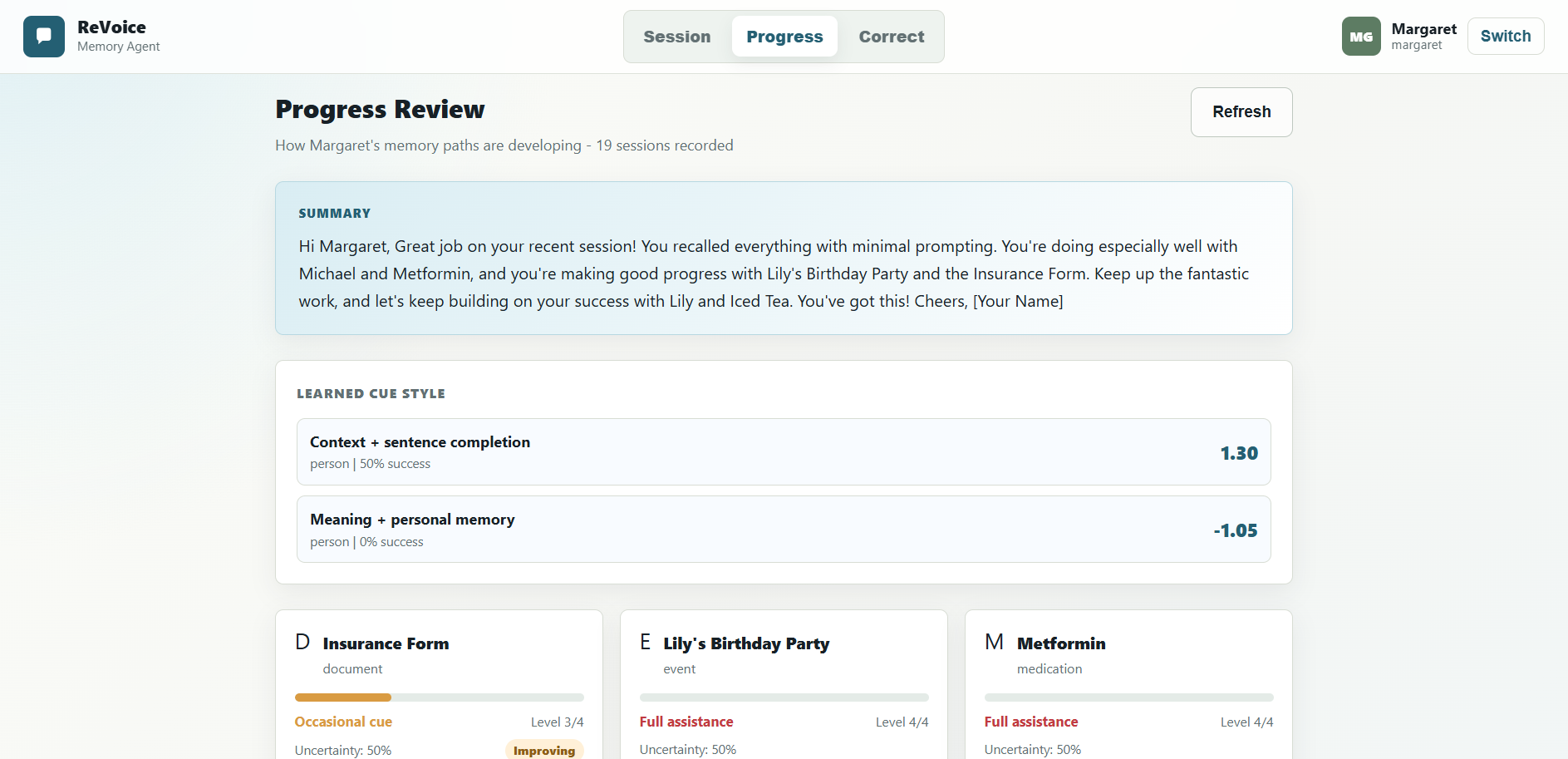
That insight inspired ReVoice, an AI agent that remembers not just what someone forgot, but which cues helped them successfully retrieve the word, enabling more personalized and effective rehabilitation.
What We Built
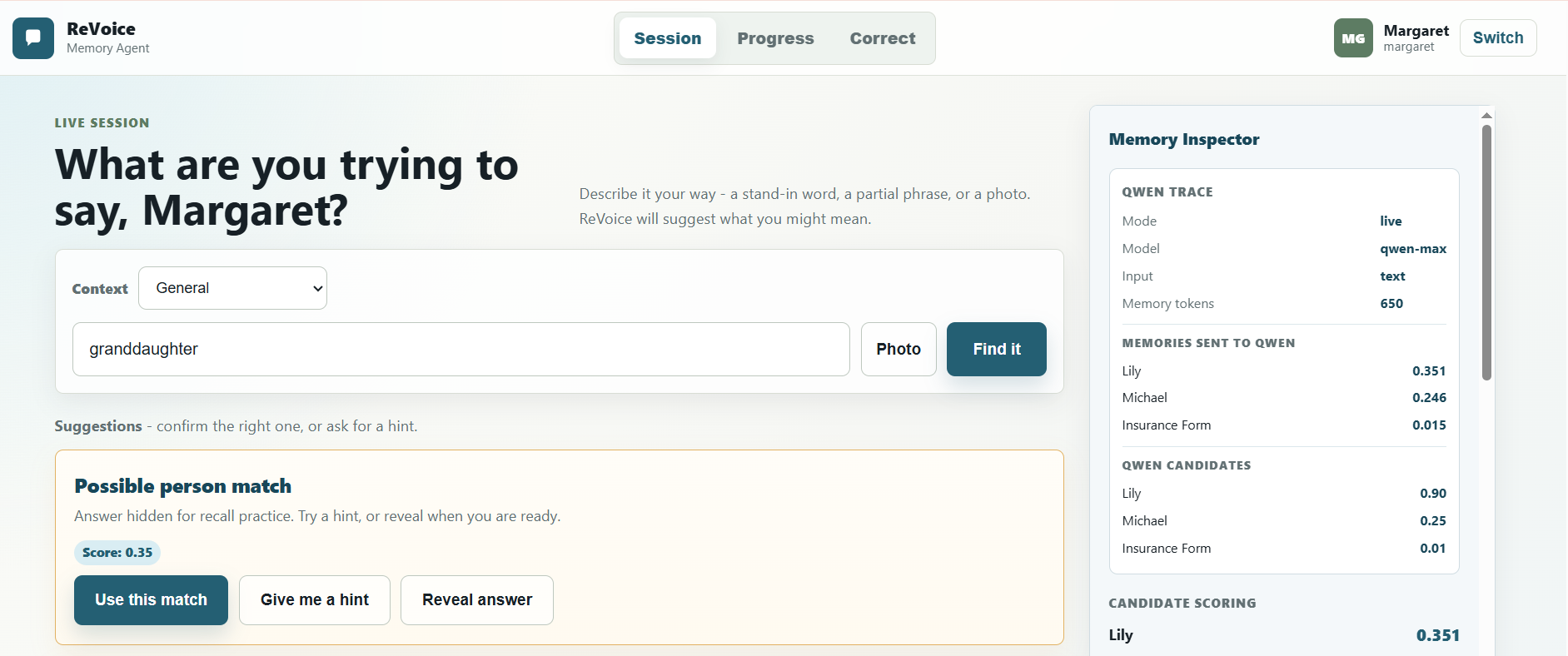
ReVoice is a Qwen-powered adaptive memory agent for people with aphasia and other word-finding disorders.
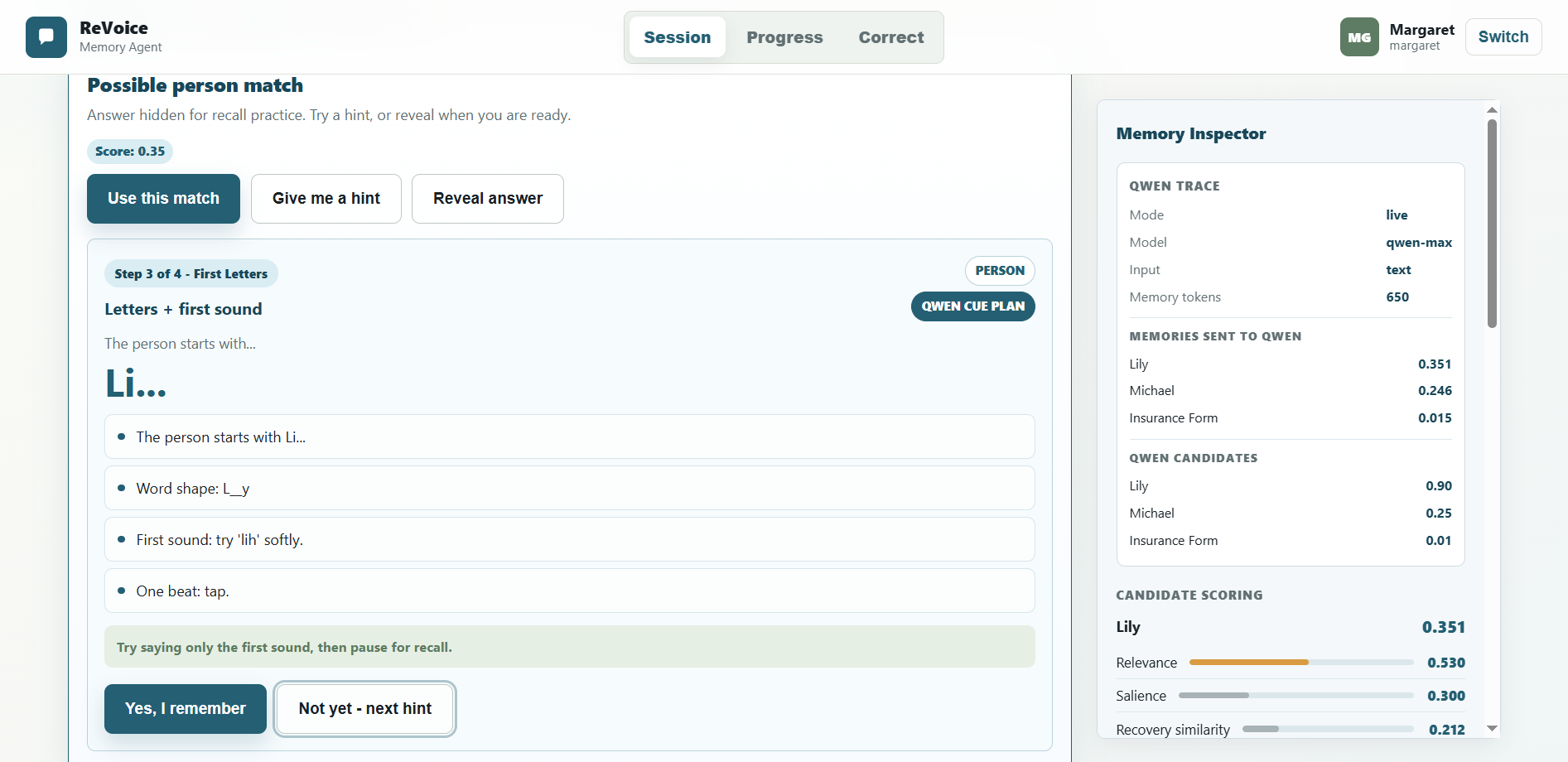
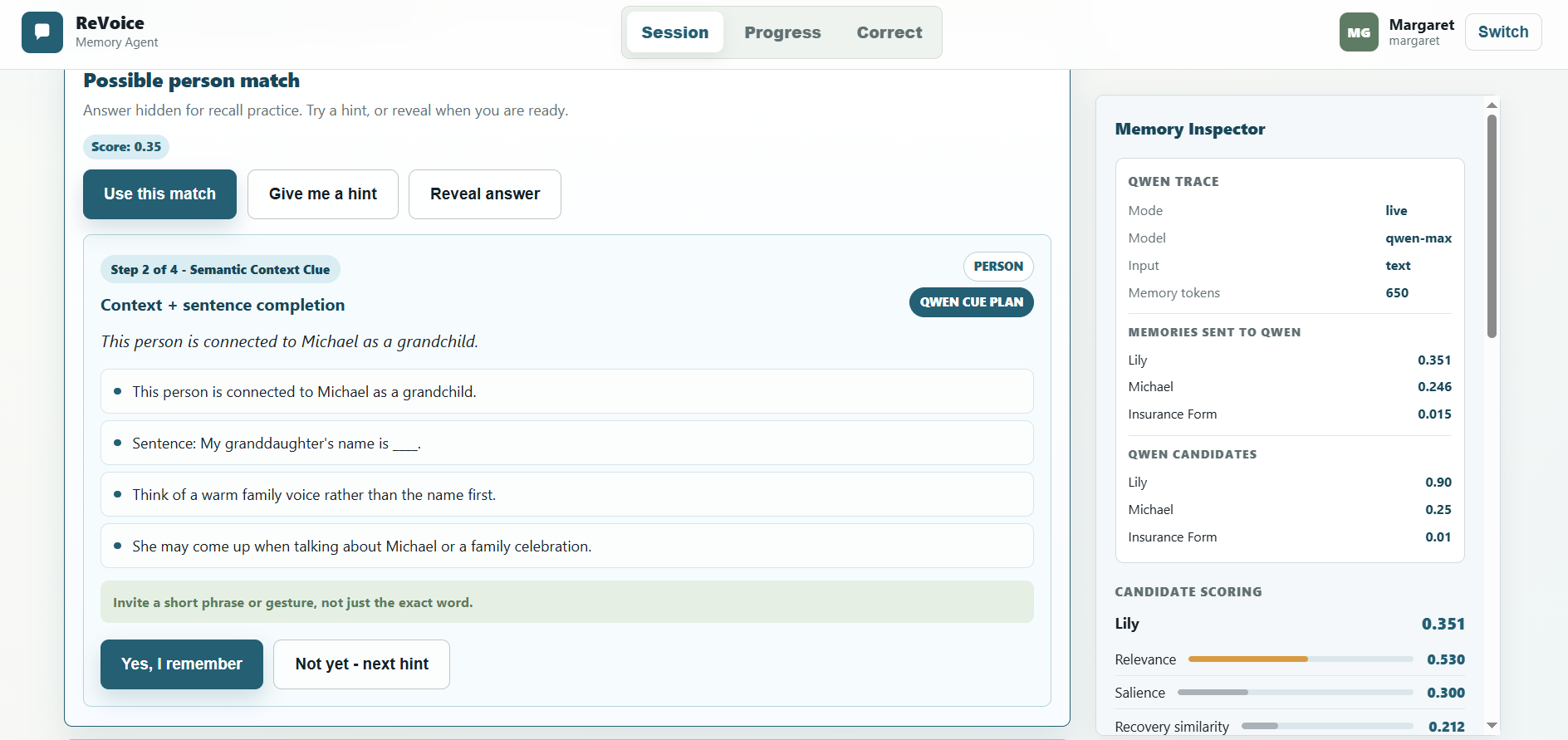
Instead of immediately revealing forgotten words, it guides users through an evidence-based cue ladder, adapting to each person's recovery history. Every interaction teaches the system which cueing strategies work best, creating a personalized recovery profile that improves over time rather than acting like a static memory database.
How We Built It
ReVoice combines three Qwen models in an agentic pipeline:
Qwen-Max for reasoning, memory retrieval, tool orchestration, and progress summarization. Qwen-VL-Max for understanding uploaded family photos and extracting contextual relationships. Qwen-Turbo for fast generation of personalized retrieval cues.
Before information reaches the LLM, memories are ranked using a hybrid scoring function that combines semantic relevance, importance, recovery history, uncertainty, recency, and token cost. A relevance gate ensures unrelated memories can never outrank the correct concept simply because they were practiced more often.
The selected memory is then transformed into an adaptive four-level cue hierarchy:
Semantic or personal cue Sentence completion cue First letter or phonological cue Answer reveal only when necessary
Rather than always starting from the easiest hint, ReVoice begins at the assistance level that has historically worked best for that individual.
The project is hosted on Qwen Cloud Elastic Compute Service (ECS) instance.
Challenges We Faced
Our biggest challenge was balancing memory with relevance. Early versions overemphasized memories with extensive practice histories, even when they were unrelated to the current query. The relevance gate solved this by ensuring semantic similarity always remains the primary retrieval criterion.
Another challenge was preventing accidental answer leakage. LLM-generated hints occasionally contained the target word, so we introduced deterministic post-processing that removes answer leakage before cues reach the user, making concealment reliable and auditable.
Finally, fitting rich personal memories—including relationships, images, and cue histories—within the model's context window required careful memory ranking and compression.
Additionally, we also had problem with activating functional compute service as our accounts were not validated in time. So, eventually we had to host on ECS instance using docker containerization.
What We Learned
We learned that the strongest AI systems combine deterministic logic with LLM reasoning.
Qwen excels at reasoning, contextual understanding, and generating natural therapeutic cues, while deterministic components enforce relevance filtering, answer hiding, safety constraints, and retrieval policies.
Most importantly, we discovered that memory becomes far more valuable when it stores how someone succeeds, not simply what they know. That shift—from remembering facts to remembering recovery—is what makes ReVoice different.
Built With
- alibaba-cloud
- alibaba-cloud-oss
- fastapi
- mcp-(model-context-protocol)
- openai-sdk
- pydantic
- python
- qwen-cloud
- react
- restapi
- sqlalchemy
- sqlite
- typescript
- uvicorn
- vite
- wordnet


Log in or sign up for Devpost to join the conversation.