-
-

StayFi helps seasonal hotels turn future revenue evidence into a clear, human-reviewed financing workflow.
-
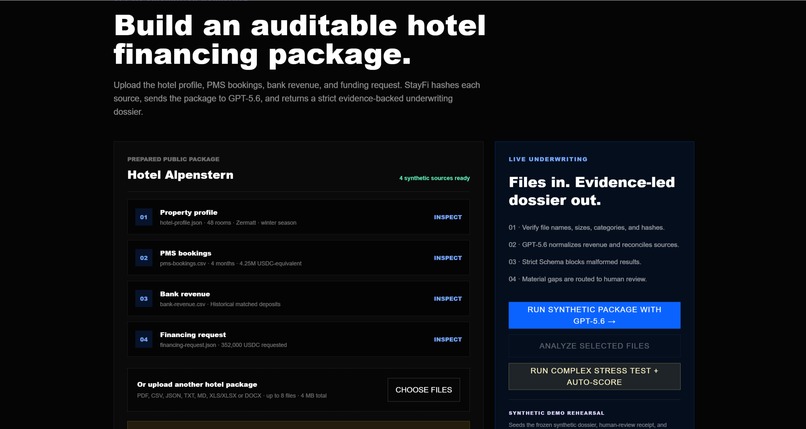
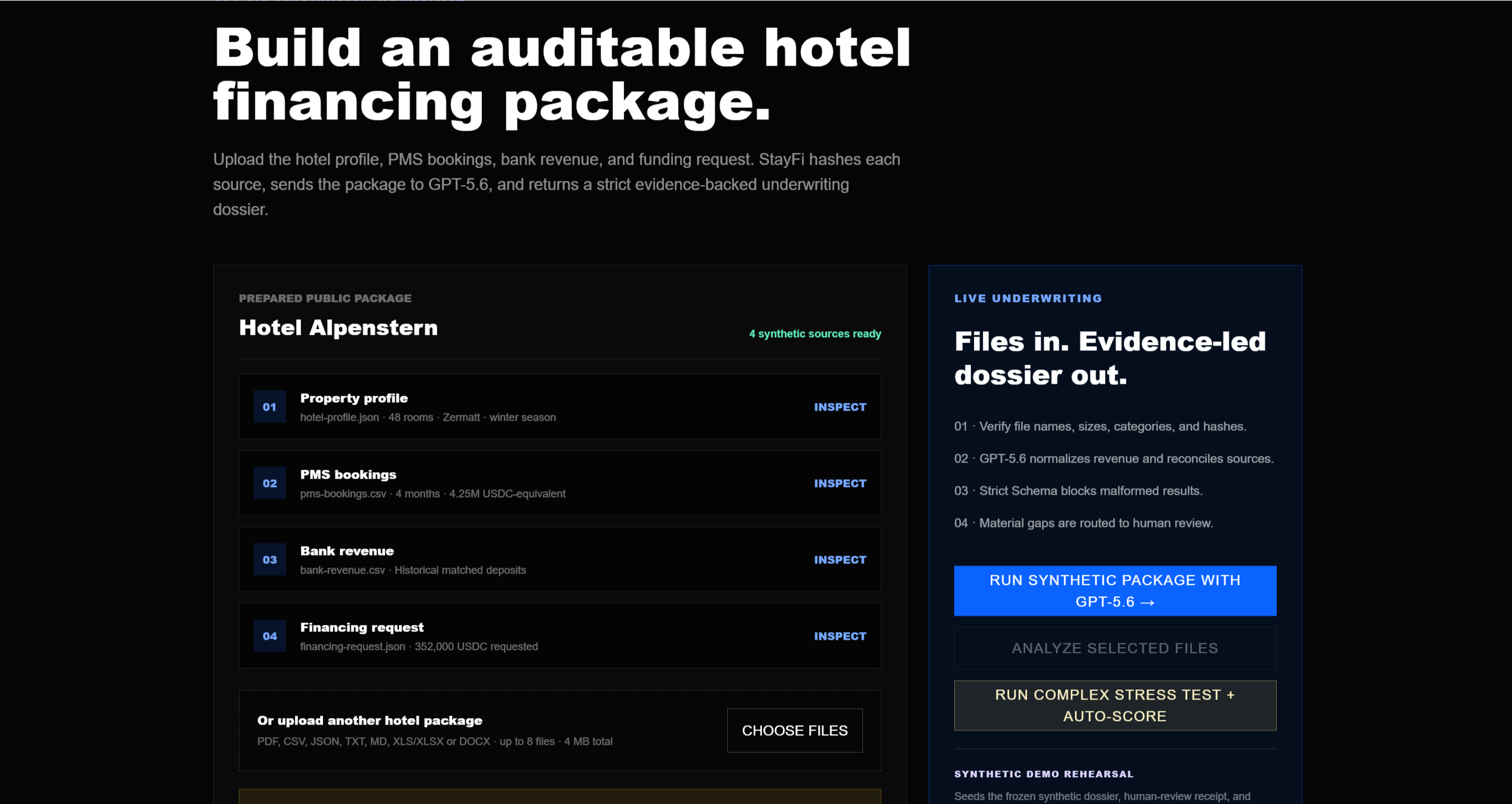
Hotels submit their profile, PMS bookings, bank revenue, and funding request for GPT-5.6 evidence-backed underwriting.
-
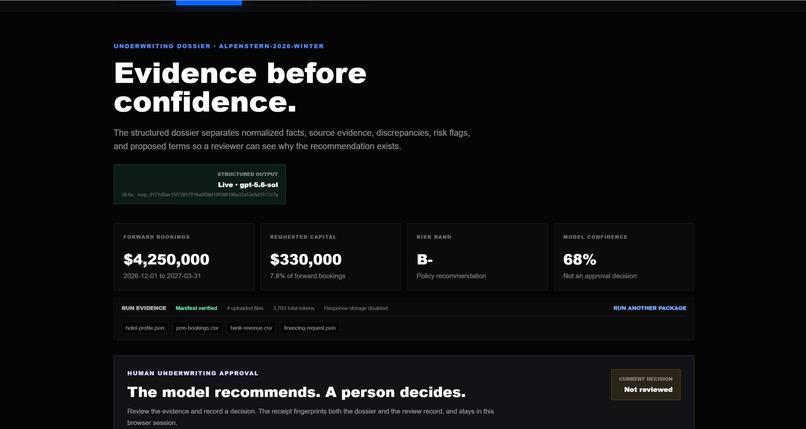
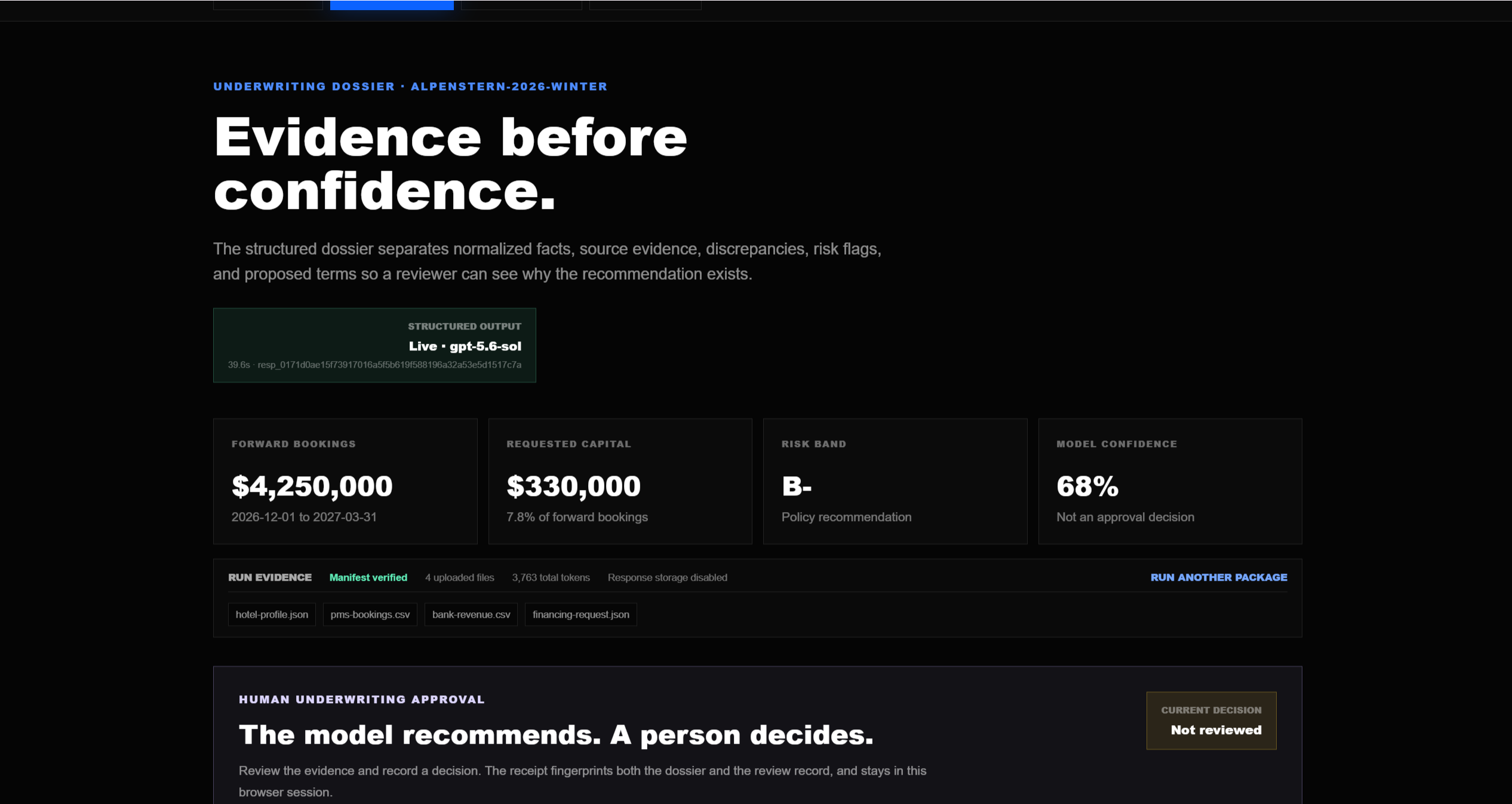
GPT-5.6 produces a structured dossier with source-linked metrics, visible risk, and model confidence—not an approval decision.
-
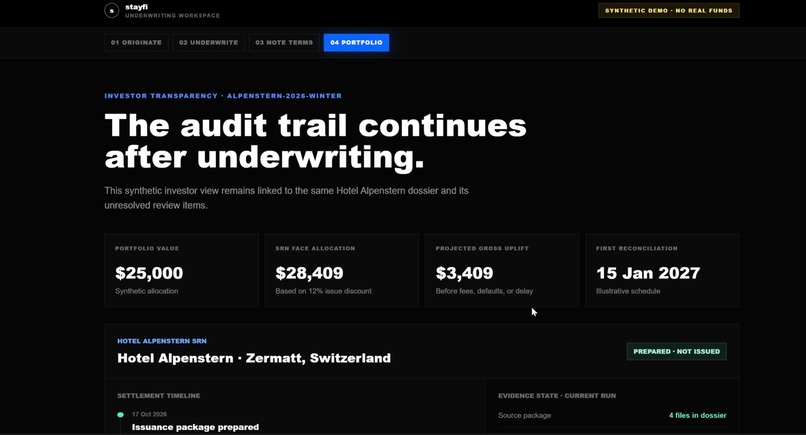
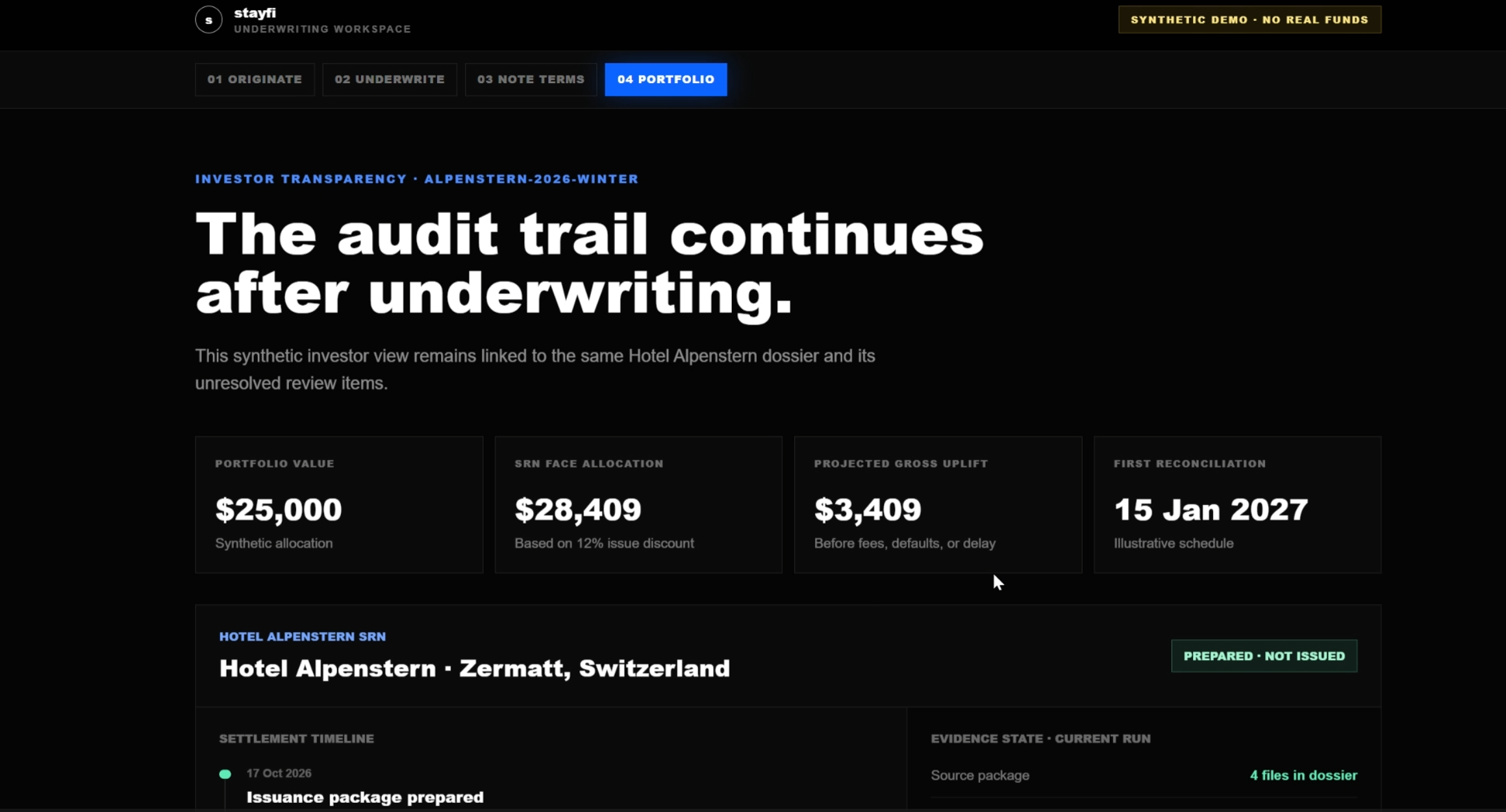
The investor view remains linked to the same evidence, human decision, and synthetic SRN package—prepared, not issued.
-
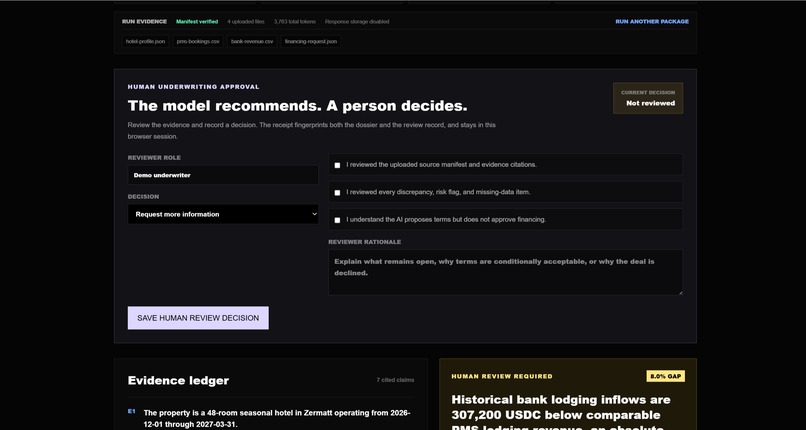
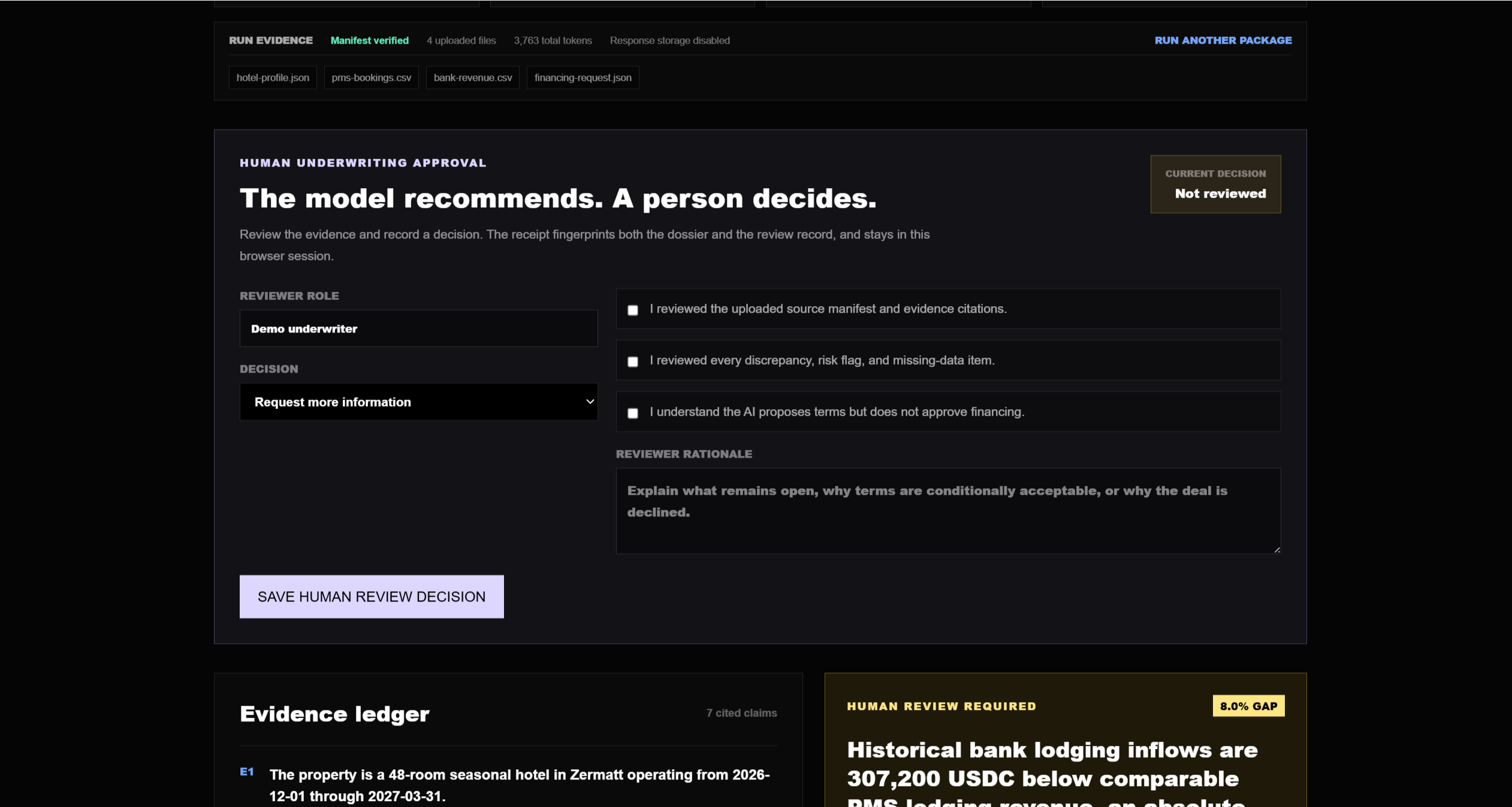
A reviewer verifies the evidence, discrepancies, and risk flags, records a rationale, and makes the final financing decision.

Inspiration
Hi, I am Jessie Zhao. My background is in finance rather than computer science, and English is not my first language.
The idea for StayFi came to me while I was staying at a seasonal hotel. Even when a hotel expects a strong peak season, it still needs to pay staff, maintenance, inventory, and suppliers before most guest revenue arrives.
That made me ask a simple question: Could future hotel revenue help solve today's working-capital gap without hiding the risks from investors?
StayFi is my answer: an evidence-first workflow that turns seasonal hotel operating data into an auditable financing proposal while keeping a human responsible for the final decision.
What it does
StayFi converts a hotel financing package into a structured and reviewable Seasonal Revenue Note workflow.
A hotel can provide:
- a hotel profile;
- PMS and booking information;
- bank and revenue records;
- spreadsheets, PDFs, CSVs, and DOCX files;
- a financing request.
GPT-5.6 reads the submitted files and produces a strict underwriting dossier containing:
- normalized hotel and revenue metrics;
- source-linked evidence;
- missing information;
- conflicting data;
- risk flags;
- model confidence;
- proposed financing terms.
The model does not approve the financing. A human reviewer must inspect the evidence, record a rationale, complete the required attestations, and make an explicit decision.
After approval, StayFi can prepare a synthetic Seasonal Revenue Note package containing proposed settlement rules, investor restrictions, a deal SPV, a revenue lockbox, and a revenue waterfall.
The package is deliberately marked prepared, not issued. The prototype does not connect a wallet, deploy a contract, mint a token, perform KYC, transfer funds, or create a legal security.
The investor view remains linked to the same evidence dossier, human-review receipt, and issuance manifest. If the underlying evidence or approval changes, the previous preparation package becomes stale.
How we built it
StayFi was built with:
- Next.js, React, and TypeScript;
- the OpenAI Responses API and GPT-5.6;
- strict JSON Schema structured outputs;
- SHA-256 source, review, and issuance fingerprints;
- browser-session storage for the synthetic demonstration;
- Vercel for deployment;
- Codex for implementation, debugging, testing, and documentation.
GPT-5.6 performs the multi-file underwriting analysis. Its output must conform to a strict schema instead of returning an unrestricted paragraph. This makes the result easier for a human to inspect, challenge, and audit.
I also created a complex synthetic evaluation package with mixed PDF, scanned-document, spreadsheet, CSV, and DOCX evidence, together with a human gold-standard answer and automated scoring.
How I used Codex
The original StayFi concept and protocol website existed before OpenAI Build Week.
After July 13, 2026, I gave Codex my whitepaper and explained the product in Chinese using normal financial and business language. Codex helped me turn the concept into a working end-to-end application.
During Build Week, Codex helped:
- inspect and preserve the original website;
- design the four-stage product workflow;
- integrate GPT-5.6;
- define the underwriting JSON Schema;
- build file uploading and structured analysis;
- create the human-review gate;
- add issuance-preparation safeguards;
- create the investor audit trail;
- write evaluation and regression checks;
- debug uploaded-data handling;
- prepare the deployed demonstration and submission materials.
I retained the important product and risk decisions. Codex did not replace my judgment—it helped turn my financial knowledge into software that I could test and improve.
Challenges we ran into
The most important problem appeared when I tested the product with a different hotel package. Some downstream pages were still displaying values from the original sample case.
Because I tested the product from the perspectives of the hotel, reviewer, and investor, I noticed that the result was wrong. I challenged the output and worked with Codex to repair the data flow so that every downstream page uses the current underwriting run and refuses to silently substitute another dossier.
Other challenges included:
- comparing evidence across different file formats;
- keeping contradictions visible instead of smoothing them into confident prose;
- connecting human decisions to the exact dossier that was reviewed;
- invalidating issuance preparation when evidence changes;
- clearly separating a financing proposal from a real securities issuance.
Accomplishments that I am proud of
- A real multi-file GPT-5.6 workflow rather than a text-only chatbot.
- Evidence citations and visible uncertainty for financial conclusions.
- A human-review gate that prevents AI from making the final decision.
- SHA-256 fingerprints linking evidence, review, and issuance preparation.
- Automatic stale-state detection when evidence or approval changes.
- A downloadable synthetic SRN preparation package.
- An investor view connected to the same audit trail.
- A complete working prototype that does not require an account or wallet.
What I learned
For financial workflows, the most useful AI output is not a persuasive paragraph. It is a constrained and inspectable intermediate artifact that a person can verify and challenge.
I also learned that auditability is an end-to-end property. Source files, normalized facts, model recommendations, human decisions, financing terms, and preparation records must all refer to the same version of the evidence.
Most importantly, I learned that someone without a traditional computer-science background can use Codex to turn domain knowledge into working software while still retaining responsibility for product decisions and testing.
What's next for StayFi
The next steps would include:
- authenticated hotel and reviewer identities;
- hotel PMS and bank integrations;
- signed server-side audit records;
- jurisdiction-specific legal review;
- regulated KYC and AML controls;
- qualified-investor whitelisting;
- a real SPV and revenue-participation agreement workflow;
- a regulated escrow and revenue-lockbox provider;
- independent revenue reconciliation;
- only then, a permissioned blockchain deployment.
These production controls are not claimed by the current hackathon prototype.
Try it out
Live demo:
https://stayfi-website-zma4.vercel.app/
Source code:
https://github.com/OrangQ7/stayfi-website
- Open the live demo and select Launch underwriting demo.
- Load the synthetic example or upload a synthetic hotel package.
- Start GPT-5.6 underwriting.
- Review the evidence, discrepancies, missing information, risks, and proposed terms.
- Complete the human-review controls and save a conditional approval.
- Continue to the note page and prepare the synthetic issuance package.
- Open the investor view and compare the audit fingerprints.
No login, wallet, payment, or real hotel data is required.
Built With
- codex
- css
- gpt-5.6
- json
- next.js
- openai
- react
- responses
- schema
- sha-256
- tailwind
- typescript
- vercel


Log in or sign up for Devpost to join the conversation.