-
-
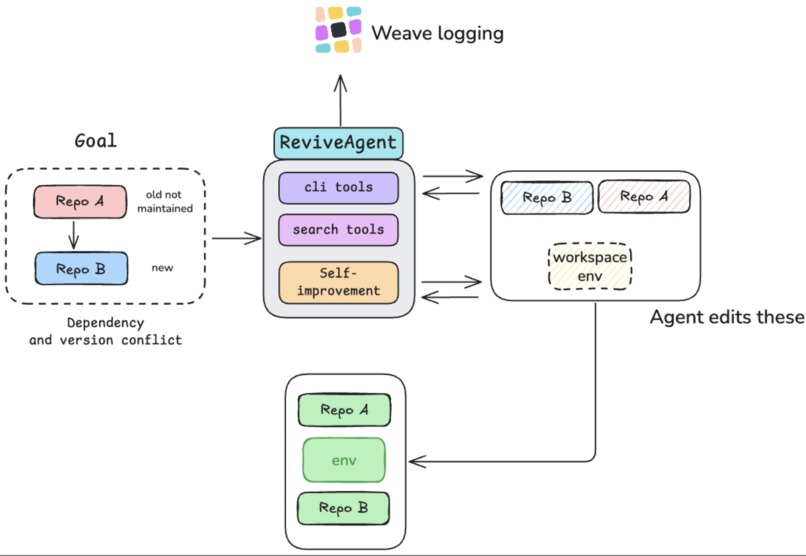
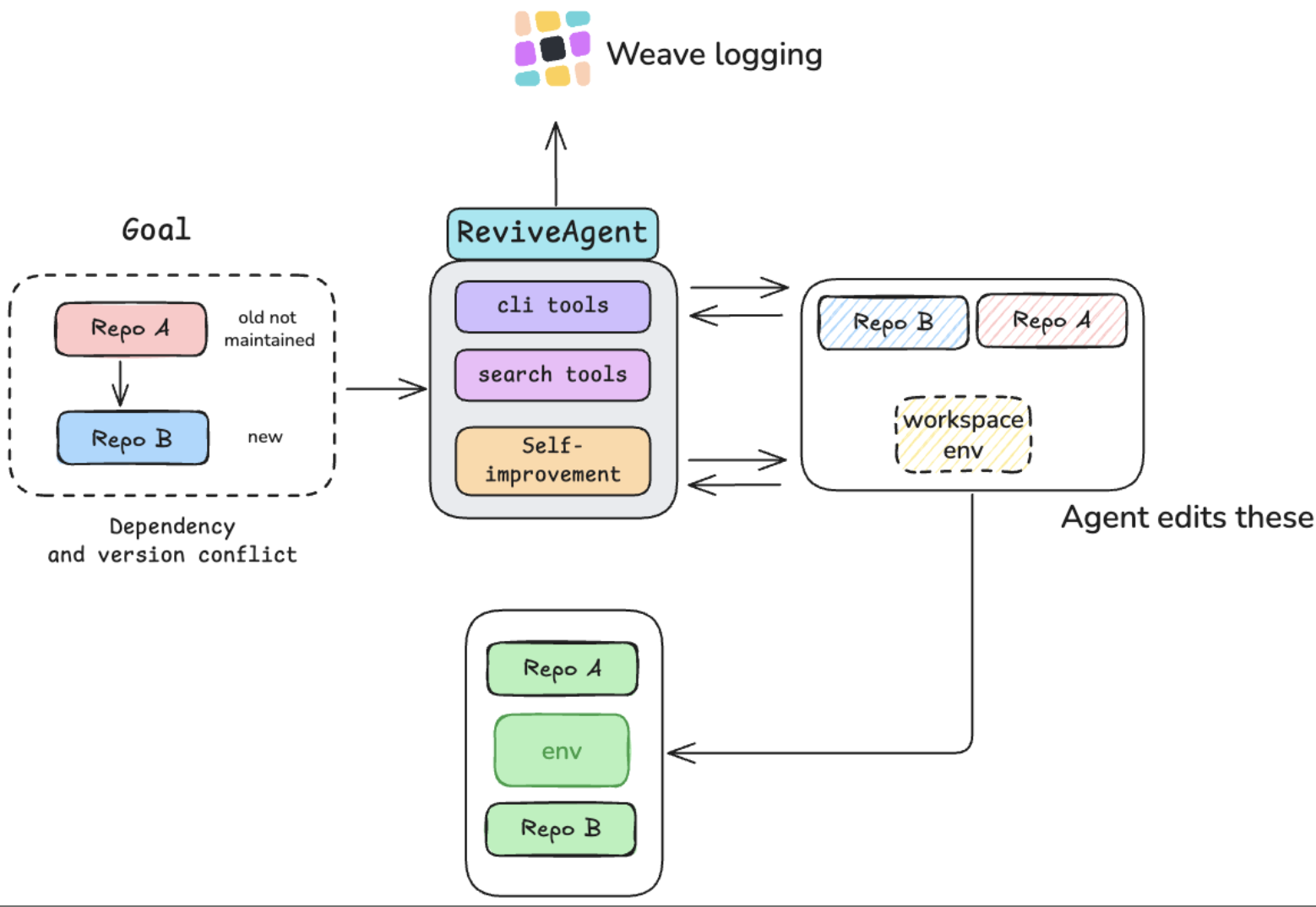
framework architecture
Inspiration
The inspiration for ReviveAgent came directly from the most common, awful developer friction points. We recognized that developers are spending up a bunch of their time in non-value-add maintenance loops: manually untangling complex dependency graphs, resolving merge conflicts, and being careful around fragile legacy code. We asked ourselves: What if we could automate the maintenance layer entirely? Our goal was to build a framework that doesn't just suggest code, but acts as a dedicated, self-improving engineer whose sole task is to eliminate technical debt and free human developers to focus 100% on tasks which matter.
What it does
ReviveAgent is an end-to-end, autonomous agent designed to manage and resolve the chronic issues of large codebases.
- Autonomous Dependency Resolution: The agent tries to setup a new environment and then run, test and resolve dependencies When an update or conflict arises, the agent predicts the necessary changes, selects the optimal version, and executes the fix across all affected files, often without human intervention.
- Self-Improving Refactoring: It employs a 'Reflect and self-improve' loop. After every code execution teacher agent logs the mistakes and how to improve, it analyzes bottlenecks and technical debt patterns, then generates and tests necessary.
How we built it
We built ReviveAgent around a powerful, modular architecture, leveraging agentic code tools while focusing our engineering on the critical components that ensure autonomy and self-improvement:
Core Intelligence Engine: We utilized Claude/Cursor as the foundational intelligence engine. Instead of building from scratch, we integrated these code CLI systems to handle the core task reasoning and code generation for a head-start.
Optimized Tool-Use Prompts: We crafted optimized Meta-Prompts that explicitly instruct the LLM on tool usage. These prompts transform high-level goals (like "resolve dependency X") into structured, atomic steps that utilize our custom tools, rather than relying on pure generation.
Self-Reflection & Improvement Framework: Our custom framework is the true differentiator. It analyzes the results of every task execution—logging successes, failures, and code quality metrics. When a task fails, the agent enters a Reflection Loop where it analyzes the failure logs and automatically adjusts its internal prompt (or tool selection strategy) for future, similar tasks, ensuring it is constantly improving its success rate and logic.
Challenges we ran into
Massive Context Management: Providing the AI with the necessary multi-file, multi-repository context (dependency graphs, configuration files, source code) to make an accurate change without overwhelming its context window proved extremely difficult. We tried to build our own framework, but we settled with cursor-cli for the POC.
Unpredictable Environment Setup: Achieving reliable execution required overcoming major friction in environment initialization. Specifically, automating the installation and resolution of complex, often brittle, Conda dependencies was a significant challenge for autonomous agents.
Accomplishments that we're proud of
Our proudest moment was validating ReviveAgent's ability to solve a real-world problem that had previously blocked our human team:
Solving a Complex Legacy Migration: We successfully used the agent to fix and fully update the dependencies for the 5-year-old multi_car_racing RL environment. This included the difficult process of migrating its internal APIs to the modern Gymnasium repository standards.
Massive Time Savings: This particular migration was a complex and brittle task that had previously taken our developers 2 to 3 days of dedicated, focused effort to manually resolve. The agent was able to complete the necessary dependency resolution, code patching, and compatibility fixes autonomously, validating its potential for massive time savings.
Proof of Self-Improvement: This complex fix provided critical data for our self-improvement loop, as the successful execution informed the agent's internal logic, making it significantly better at handling similar deep dependency and API migration tasks in the future.
What we learned
Glimpses of Success Validate the Vision: The ability of ReviveAgent to successfully migrate the complex, 5-year-old multi_car_racing environment to Gymnasium confirmed that our tool-using, self-reflecting agent architecture is fundamentally sound.
Tooling Orchestration is Key: We learned that the secret to autonomy isn't the LLM's ability to write code, but its ability to reliably plan, diagnose, and execute specialized actions via external tools.
Context is King: The true scaling barrier lies not in code generation, but in overcoming the difficulty of context management and achieving robust, language-agnostic environment initialization (like resolving complex Conda setups).
What's next for ReviveAgent
- We really want to integrate it with sandbox environments, and it can passively run itself and resolve conflicts.
- The dream would be to get rid of third party dependencies, build our own context management framework with better tools and more user control.
- As the tool is used more and more we create a knowledge base of dependency resolution, which our agent can refer to and resolve similar conflicts faster.
- Big opportunity to train a smaller model on the traces of this agent as well.


Log in or sign up for Devpost to join the conversation.