Inspiration
370,000 out-of-hospital cardiac arrests happen in the US every year. Only 40% receive bystander CPR — not because people don't care, but because they've never practiced. The most common reason for inaction is fear of doing it wrong. Existing CPR training costs $200, takes four hours, uses a $50,000 mannequin, and happens once a year. The skill decays in under a month. We built PulseHero to break that barrier.
What it does
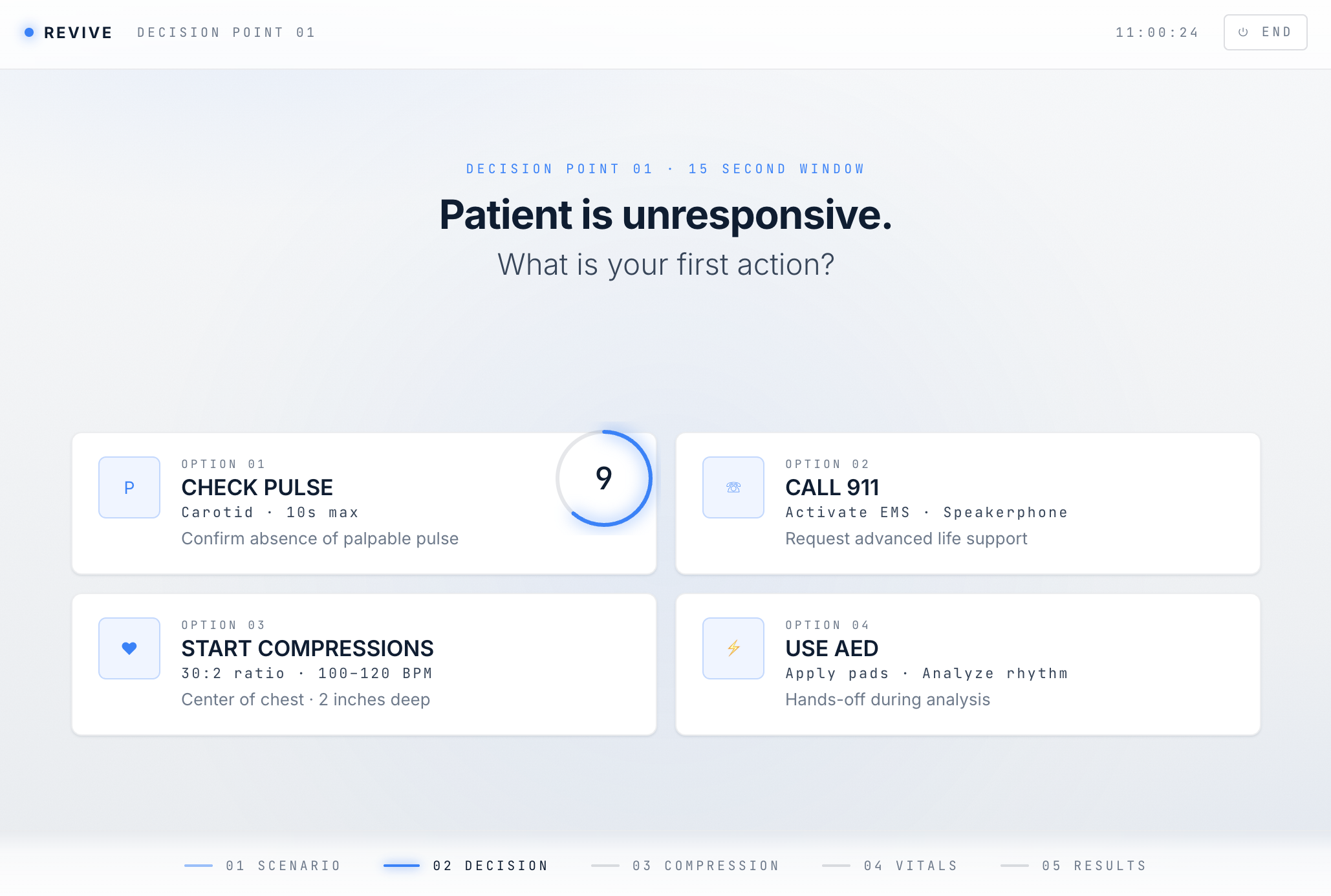
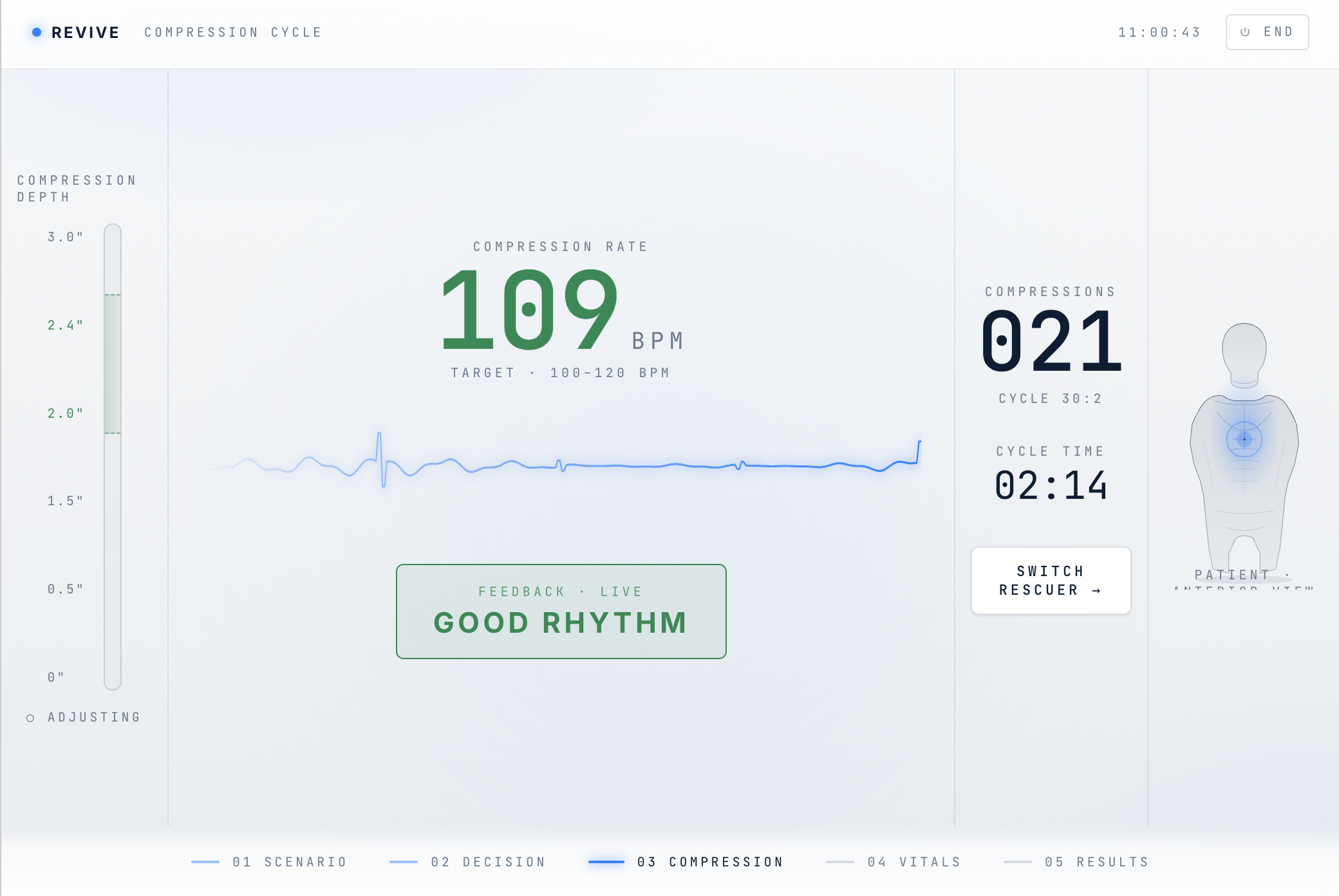
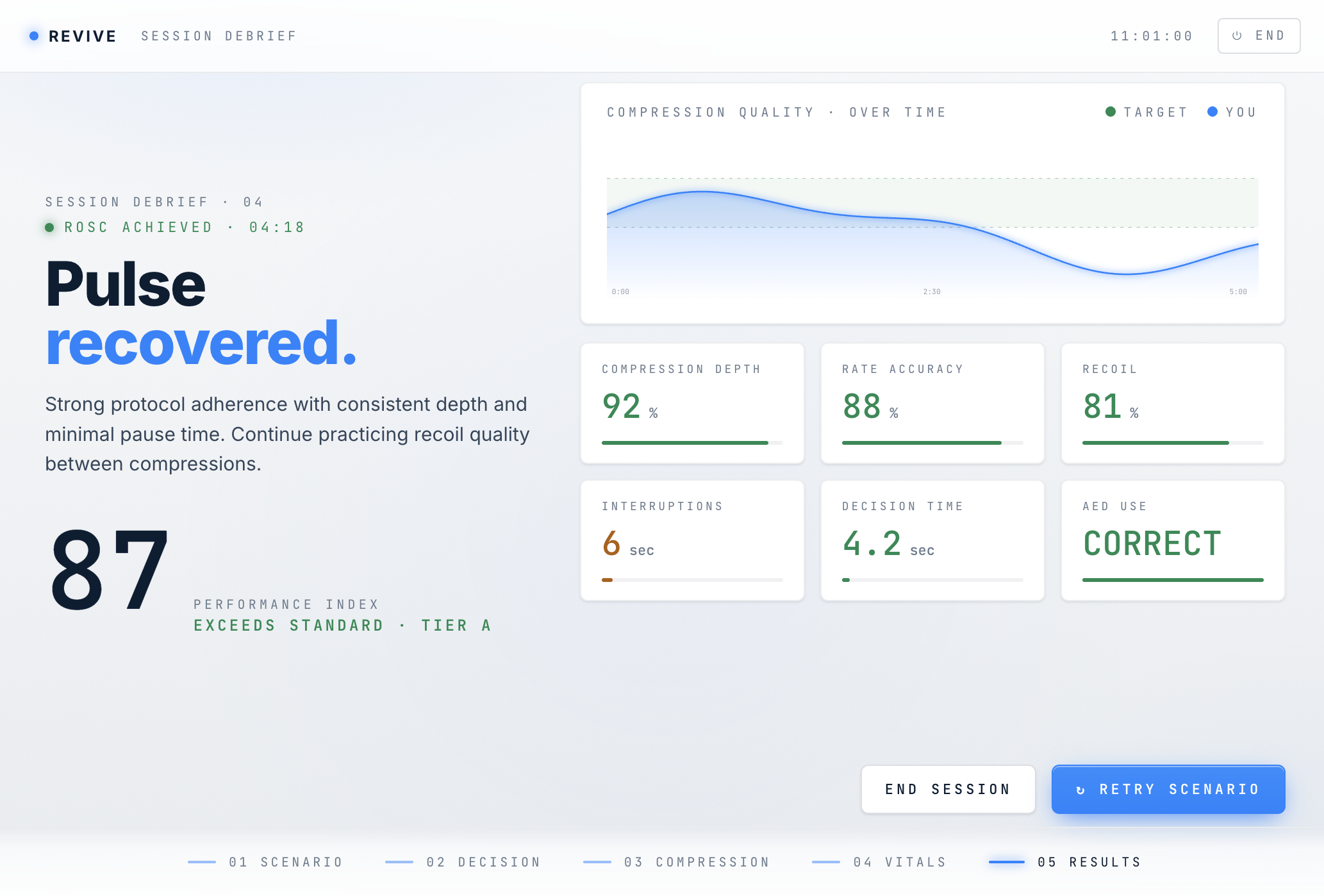
PulseHero is a closed-loop CPR training simulator. A force-sensing foam pad measures compression depth and rate at 200 Hz over USB serial. A web app drives a simulated patient with live vitals. Three Gemini agents handle physiology simulation, technique evaluation (scored against AHA targets: 2" depth, 100–120 BPM, full chest recoil), and scenario progression. ElevenLabs speaks corrective coaching within two seconds of a bad compression. At the end of every session, a full after-action report is written to a local JSON file for review.
The loop is: hand → pad → app → voice → hand.
The pad fits in a backpack, costs ~$97 in parts, and works on any flat surface — kitchen counter, break room, daycare classroom, college dorm. It teaches rate, force calibration, and emergency decision-making. It does not replace an in-person Red Cross class for hand placement or rescue breaths — it's the flight simulator that keeps your muscle memory alive between certifications.
How we built it
Hardware: A foam compression pad built around a force-sensing resistor (FSR) and an Arduino, reporting raw sensor values over USB serial at 200 Hz. A JC Toys 16" baby doll serves as a tactile demo prop on top of the pad.
Firmware: Arduino sketch reads the FSR, applies dual-threshold hysteresis (start compression at FSR > 400, end at FSR < 200) to suppress signal flap, and streams depth/rate over serial.
Web App: Next.js frontend with a single smoothed compression stream consumed by all agents. One vitals strip, one coaching line, one decision card visible at any moment — designed for a judge with three minutes, not a power user.
AI Agents (Gemini):
- PatientAgent — updates a patient state JSON every 2 seconds based on compression quality
- CoachAgent — evaluates each compression cycle and selects a correction phrase
- ScenarioAgent — drives the scenario state machine through 10 labeled states
Voice (ElevenLabs): Pre-cached audio for the 5 most common coaching phrases keeps the demo within the free tier. A full streaming fallback fires for dynamic corrections.
Persistence: Session records written to local JSON at scenario end for after-action review.
Challenges we ran into
- Sensor noise and flap: Raw FSR values flap at threshold boundaries. We solved this with dual-threshold hysteresis and a rolling smoothing window in firmware.
- Sub-2-second coaching: Coordinating three live Gemini agents and a TTS stream fast enough to fire before the next compression cycle required careful agent bus design and audio pre-caching.
- Cold start reliability: The demo environment (fresh browser tab, cold Gemini API, locked audio context) behaves differently than warm. We built an explicit pre-warm ritual: audio context unlock, serial port open, agent ping — all before the judge presses Start.
- Cognitive load: Keeping one metric, one coaching line, and one decision card visible at all times while five data streams ran underneath was a real UI discipline challenge.
What we learned
That the hardware moat is real — a $97 pad that closes the feedback loop is a different product category than a $50,000 mannequin. And that sub-2-second voice coaching requires treating latency as a first-class invariant, not an afterthought.
What's next
Bilingual EN/ES coaching, persistence to cloud for longitudinal skill tracking, and partnerships with daycares and EMS recertification programs to get pads into the places where the skill decays fastest.
Built With
- arduino
- css
- elevenlabs
- fastapi
- fsr
- googlegemini
- html
- json
- next.js
- node.js
- pyserial
- python
- react
- tailwind
- typescript
- websockets


Log in or sign up for Devpost to join the conversation.