-
-
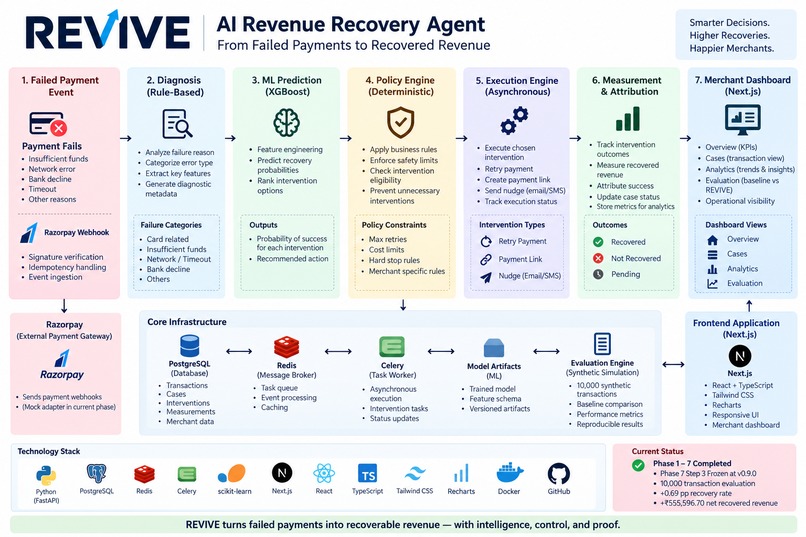
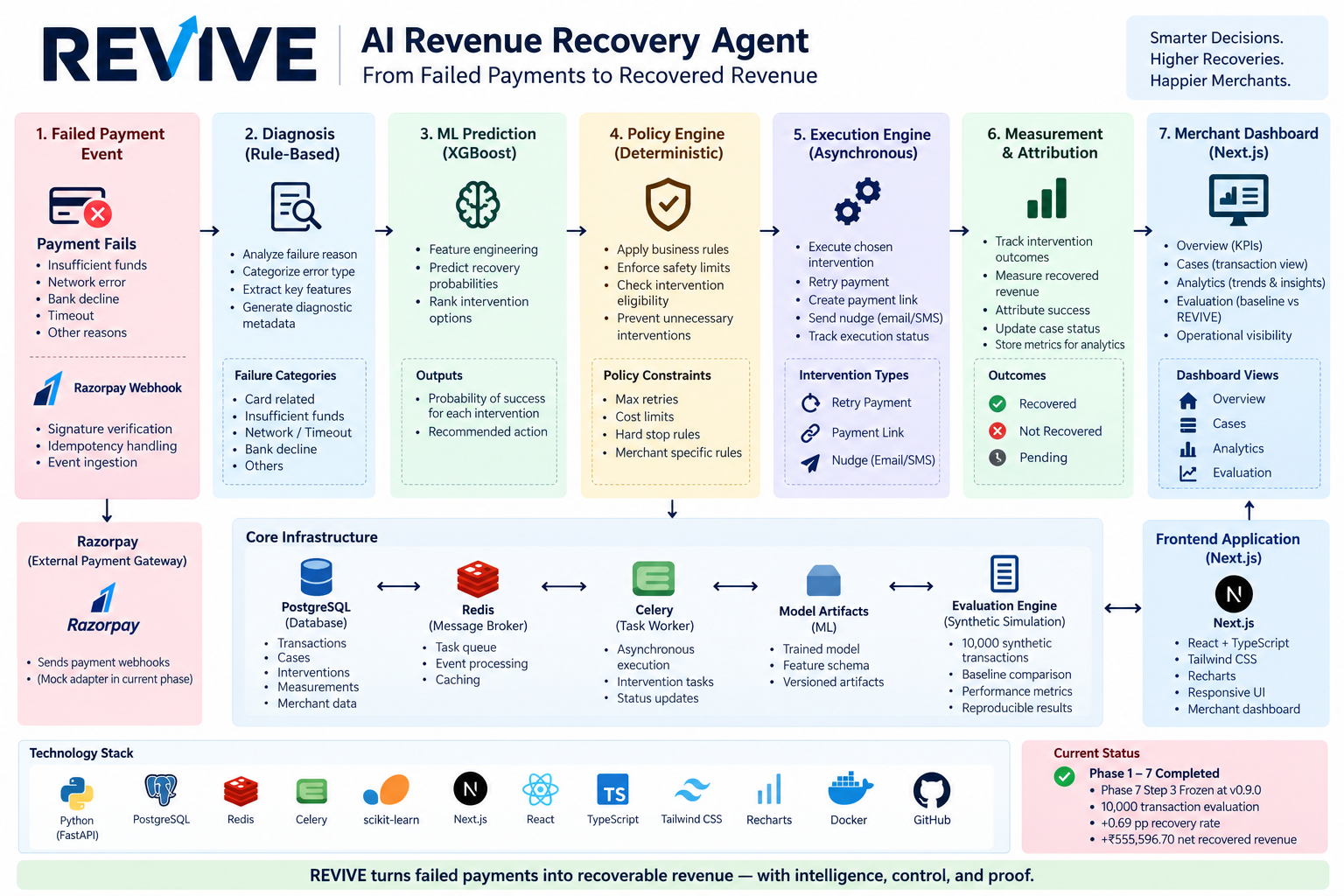
REVIVE Architecture — From failed payment to intelligent, measured revenue recovery
-
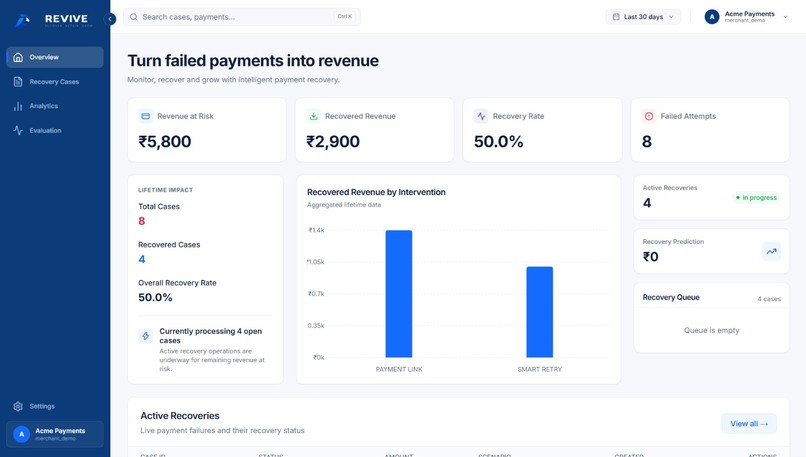
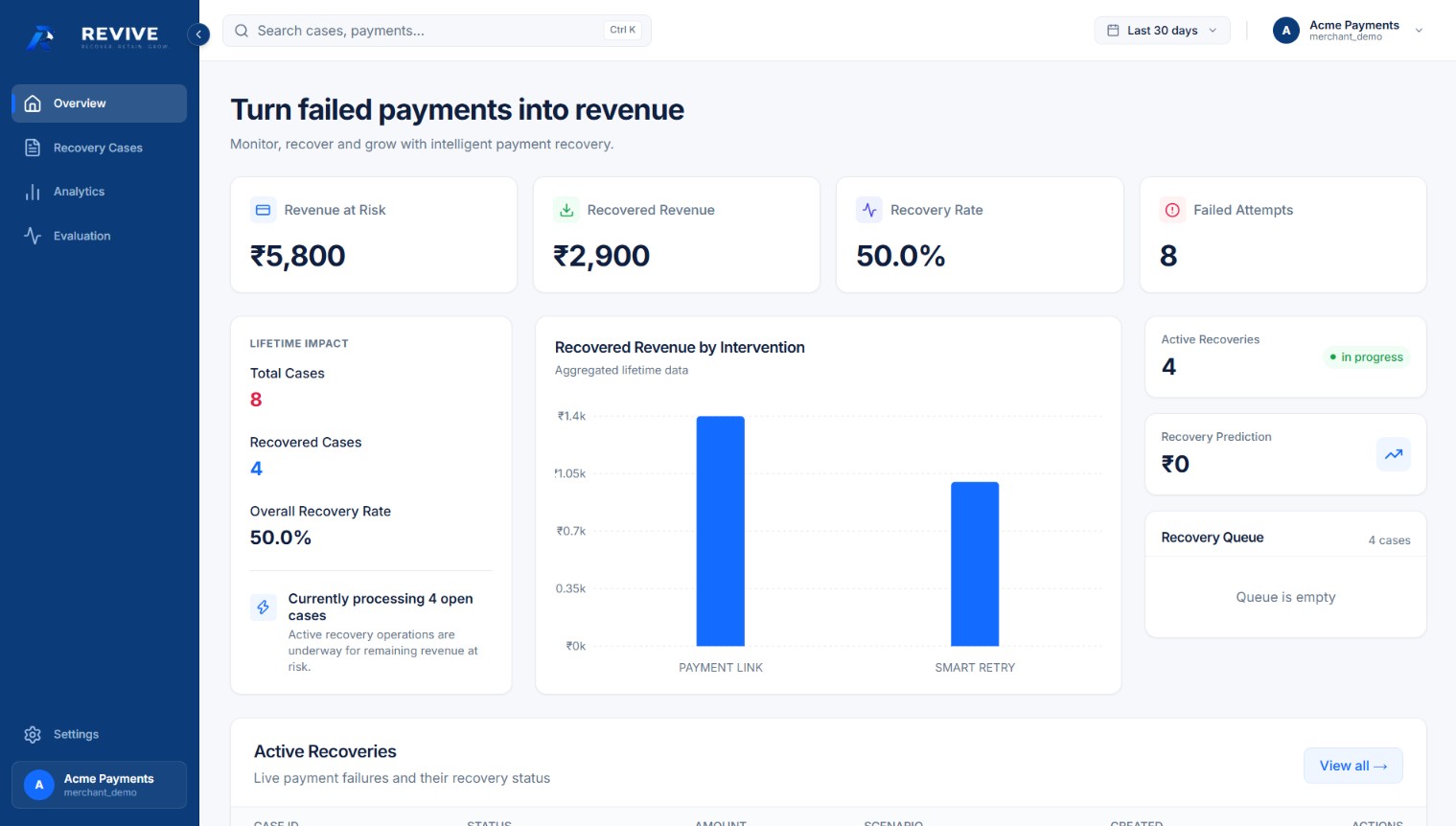
Merchant Overview — Real-time recovery KPIs and operational performance
-
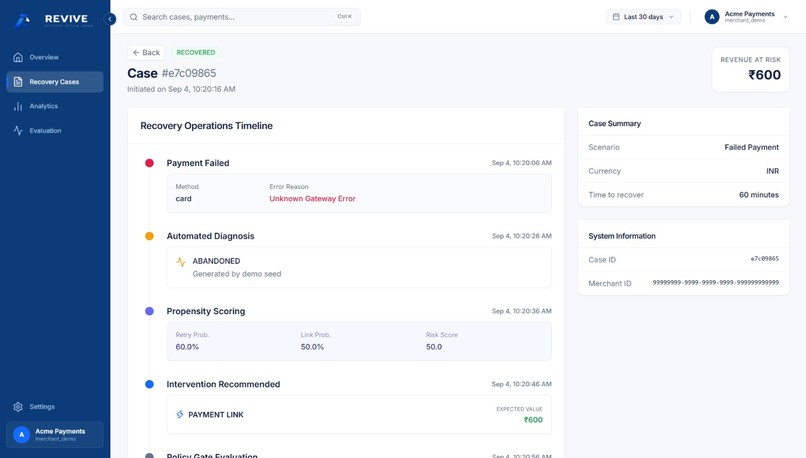
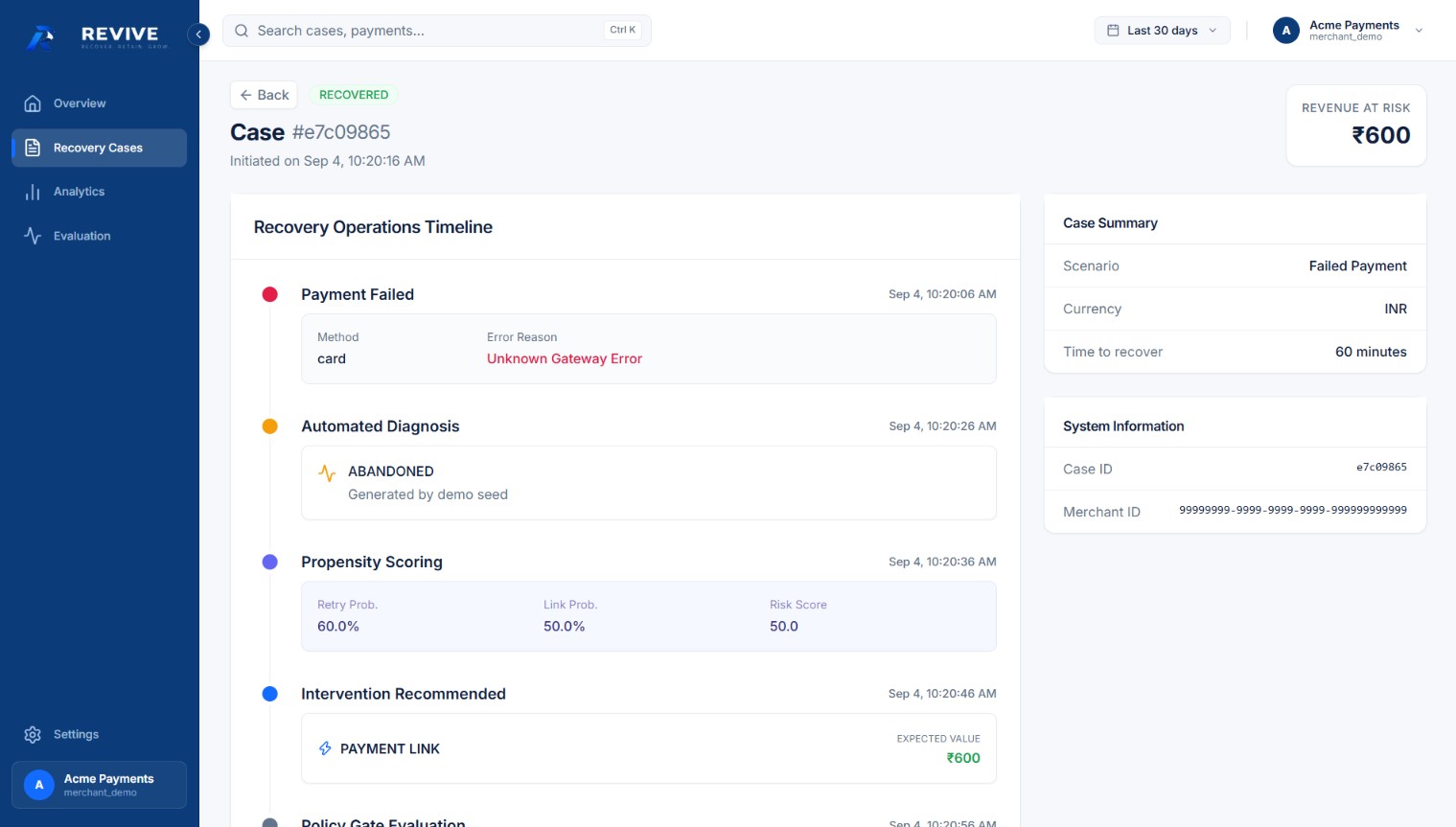
Case Intelligence — Diagnosis, recommended intervention, policy decision, and execution state
-
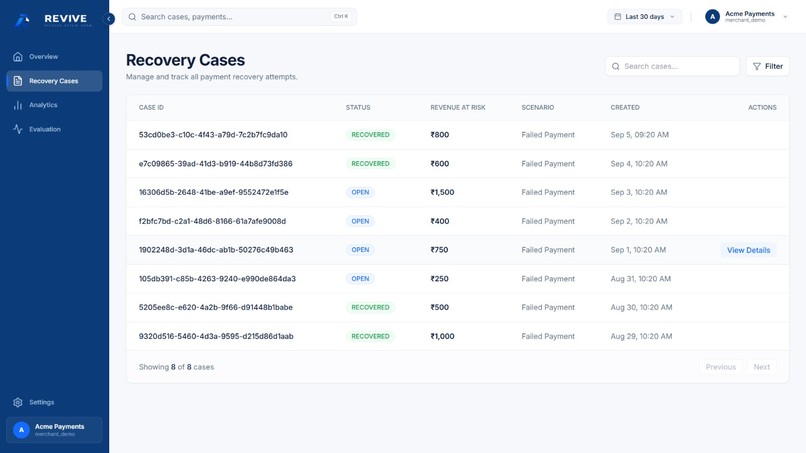
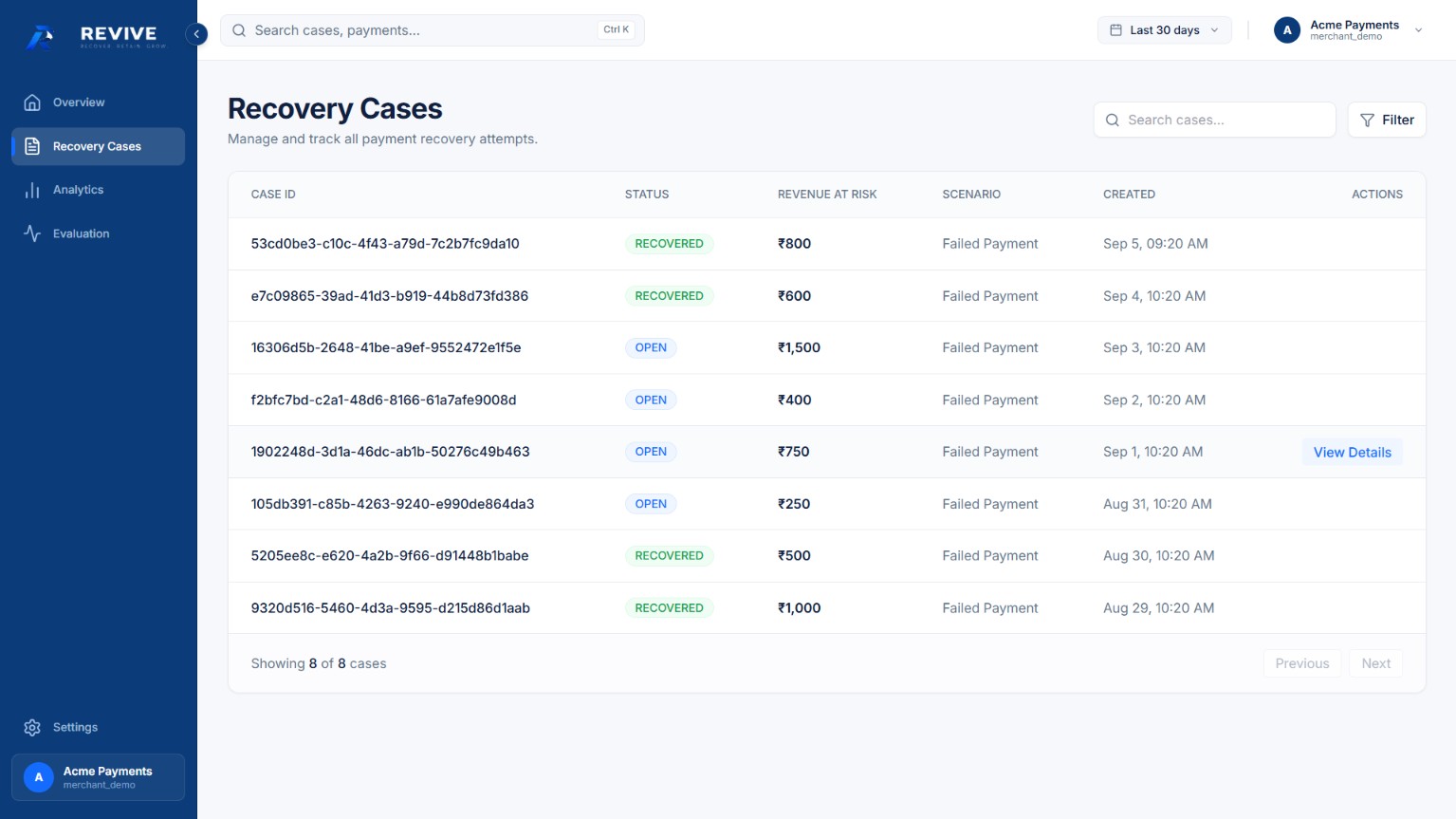
Recovery Cases — Transaction-level visibility into failed payments and interventions
-
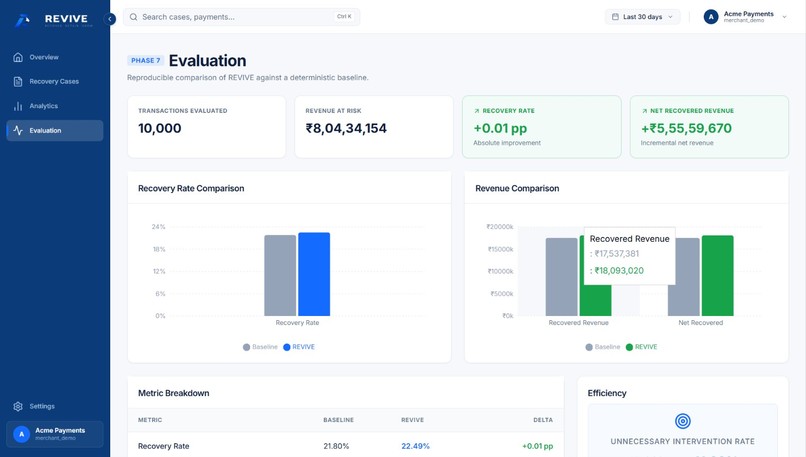
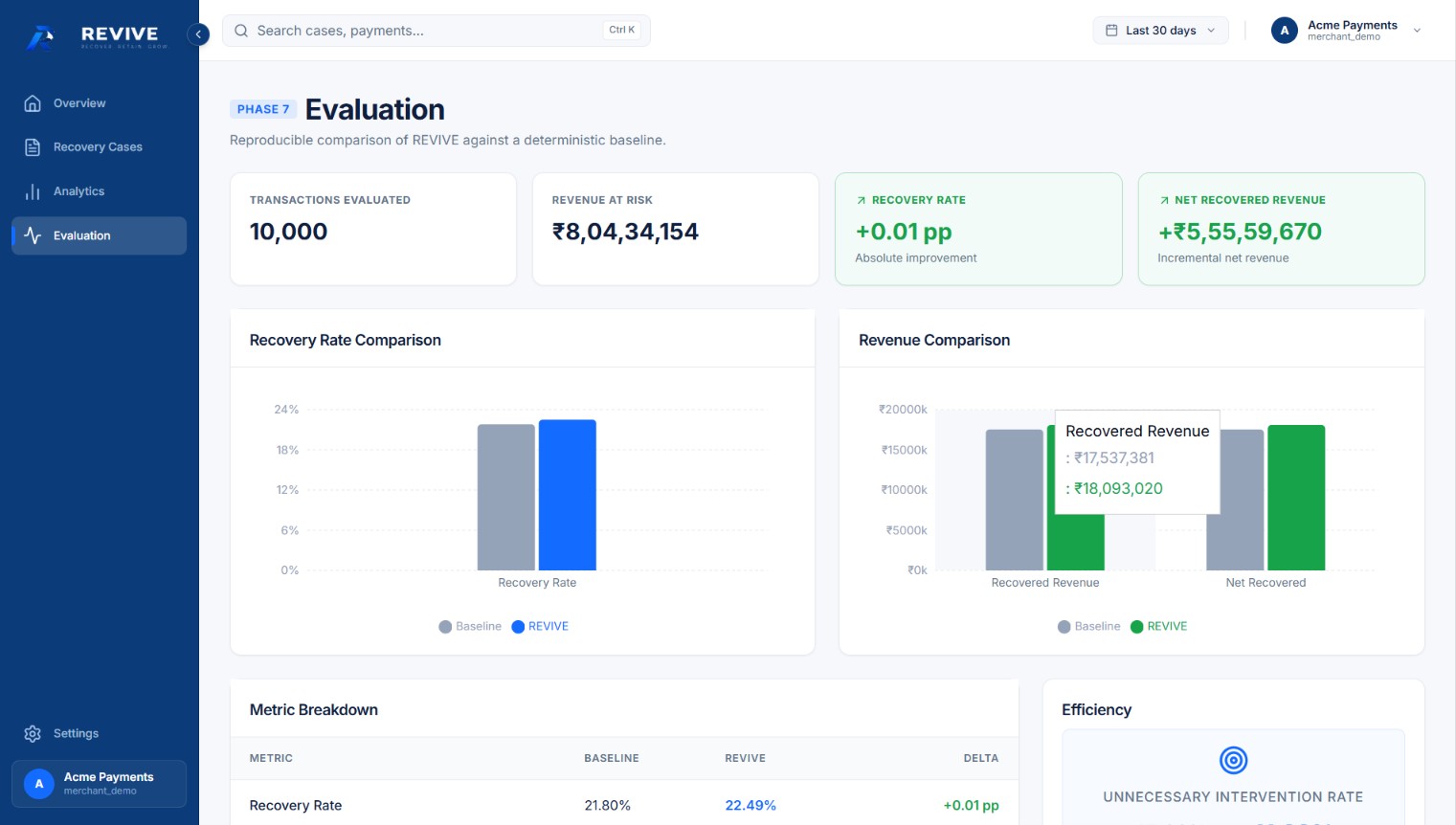
Evaluation Dashboard — REVIVE vs. Always Retry across 10,000 synthetic transactions
-
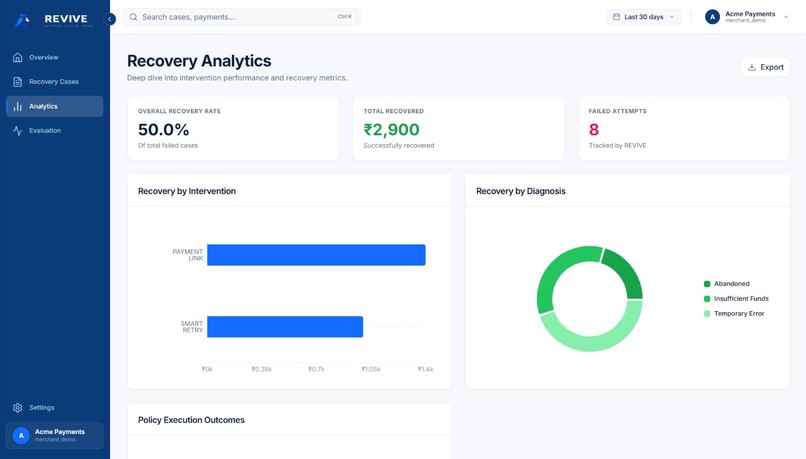
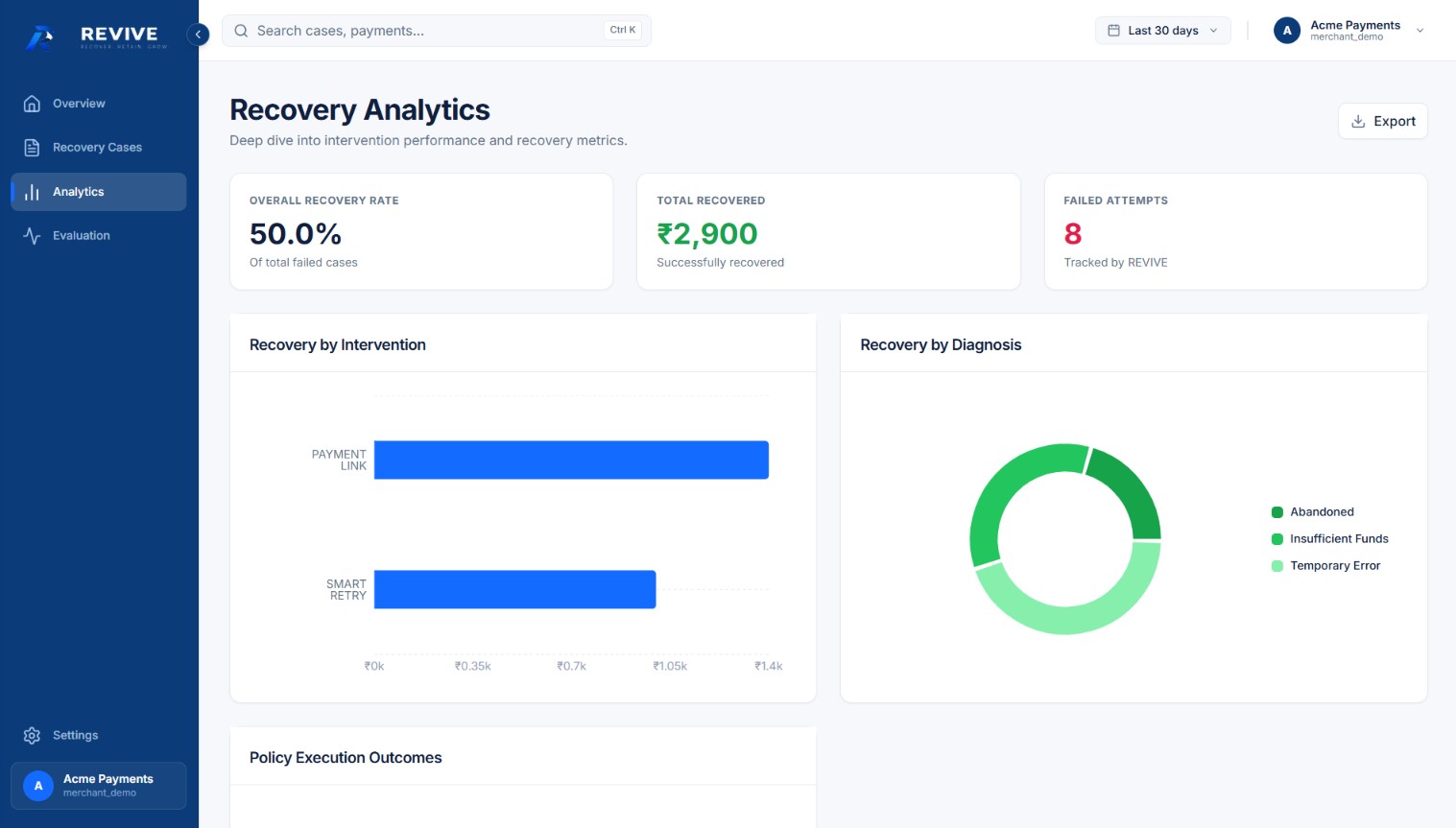
Recovery Analytics — Trends and intervention performance across payment failures
REVIVE — AI Revenue Recovery Agent
Inspiration
Failed payments are not always lost revenue.
A payment can fail because of insufficient funds, authentication issues, card problems, bank declines, network failures, or temporary gateway problems. Treating every failure the same way — especially by blindly retrying — can waste recovery opportunities and create unnecessary interventions.
I wanted to build a system that answers a more useful question:
"Given why this payment failed, what is the best next action?"
That became REVIVE.
What REVIVE Does
REVIVE is an AI-powered revenue recovery agent that transforms failed payment events into intelligent, measurable recovery decisions.
Instead of simply retrying a failed payment, REVIVE moves each transaction through a complete decision pipeline:
Failed Payment → Diagnosis → ML Prediction → Policy → Execution → Measurement
The system first diagnoses the failure using deterministic rules. An XGBoost model then predicts the probability of success for different recovery interventions:
- Retry the payment
- Generate a payment link
- Send a customer nudge
The recommendation then passes through a deterministic Policy Engine. The ML model can recommend an action, but it cannot bypass safety rules.
If the action is allowed, the Execution Engine processes it asynchronously. The Measurement layer then tracks the outcome and attributes recovered revenue.
This creates a closed loop:
AI recommends → Policy controls → Execution acts → Measurement proves
Architecture
REVIVE is built as a modular pipeline rather than a single prediction model.
Event Ingestion
- Receives payment failure events
- Verifies webhook signatures
- Handles idempotency
Diagnosis
- Classifies failure reasons
- Produces deterministic diagnostic metadata
ML Prediction
- Extracts transactional features
- Uses an XGBoost model
- Predicts recovery probabilities for multiple interventions
- Selects the highest-probability intervention
Policy Engine
- Applies deterministic business rules
- Enforces retry limits
- Checks intervention eligibility
- Prevents unsafe or unnecessary actions
Execution Engine
- Runs interventions asynchronously
- Tracks execution state
- Supports retry, payment-link, and nudge workflows
Measurement & Attribution
- Tracks intervention outcomes
- Measures recovered revenue
- Maintains recovery status
- Provides data for analytics
Merchant Dashboard
- Overview KPIs
- Transaction cases
- Analytics
- Evaluation dashboard
Evaluation
To determine whether the AI strategy actually improves recovery, I built a reproducible evaluation framework using 10,000 synthetic payment scenarios.
REVIVE was compared against an Always Retry baseline using the same transactions, ground truth, policy constraints, intervention costs, and evaluation methodology.
Results
| Metric | Always Retry | REVIVE |
|---|---|---|
| Recovery Rate | 21.80% | 22.49% |
| Recovered Revenue | ₹17,537,381 | ₹18,093,020 |
| Net Recovered Revenue | ₹17,537,381 | ₹18,092,977.70 |
| Unnecessary Interventions | 45.08% | 41.82% |
REVIVE produced:
- +0.69 percentage points recovery-rate improvement
- +₹555,596.70 additional net recovered revenue
- -3.26 percentage points unnecessary interventions
These results are based on synthetic data and simulated intervention latency. They are not production performance claims.
The evaluation framework is isolated from operational database tables, making repeated evaluations deterministic and reproducible.
Engineering Challenges
One of the biggest challenges was making an AI system that remained controllable.
A prediction alone is not enough for a financial workflow. I deliberately separated probabilistic ML decisions from deterministic business constraints so that the model could recommend an intervention without having unrestricted authority to execute it.
Another challenge was evaluation integrity. Running thousands of transactions through the existing ML pipeline could have polluted operational tables, so the evaluation framework uses isolated in-memory simulation and a generated evaluation artifact.
The 10,000-row evaluation also exposed a sequential inference performance bottleneck. Instead of coupling the dashboard to a long-running simulation, the final system generates a deterministic JSON evaluation artifact that the API serves to the frontend.
I also encountered a Windows console encoding issue when printing currency symbols during evaluation. This was resolved without changing the underlying numerical calculations or ML behavior.
Technology
REVIVE uses:
- Python
- FastAPI
- SQLAlchemy
- PostgreSQL
- Redis
- Celery
- Scikit-learn
- XGBoost
- Next.js
- React
- TypeScript
- Tailwind CSS
- Recharts
- Docker
- Docker Compose
Why REVIVE
REVIVE is not just an ML model that predicts whether a payment might recover.
It is an end-to-end decision system designed around a simple principle:
Intelligence without control is risky. Control without intelligence is rigid. REVIVE combines both.
The result is a system where AI makes the recommendation, deterministic policies provide the guardrails, asynchronous execution performs the intervention, and measurement proves whether it actually recovered revenue.
REVIVE turns failed payments into recoverable revenue — with intelligence, control, and proof.
Built With
- artificial-intelligence
- celery
- docker
- fastapi
- fintech
- machine-learning
- next.js
- postgresql
- python
- react
- recharts
- redis
- scikit-learn
- typescript
- xgboost


Log in or sign up for Devpost to join the conversation.