-
-
Logo
-
Main Screen
-
Graphed Data
-
User Data
Revival
From wearables to warnings: your liver’s silent signals, visualized.
🧠 Inspiration
Liver disease is often called a “silent killer” — symptoms don’t appear until damage is advanced. Yet many early risk factors (BPM, inactivity, sleep, blood markers) are already passively tracked by devices like the Apple Watch.
We wanted to create a tool that interprets and simulates that data to create a more accessible version of the digital twin model — helping people catch issues early and make lifestyle changes that actually matter.
🚀 What It Does
Revival is an intelligent liver health companion that:
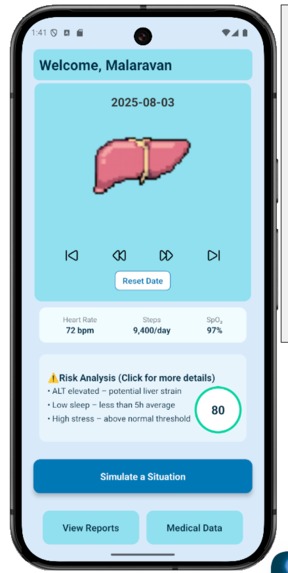
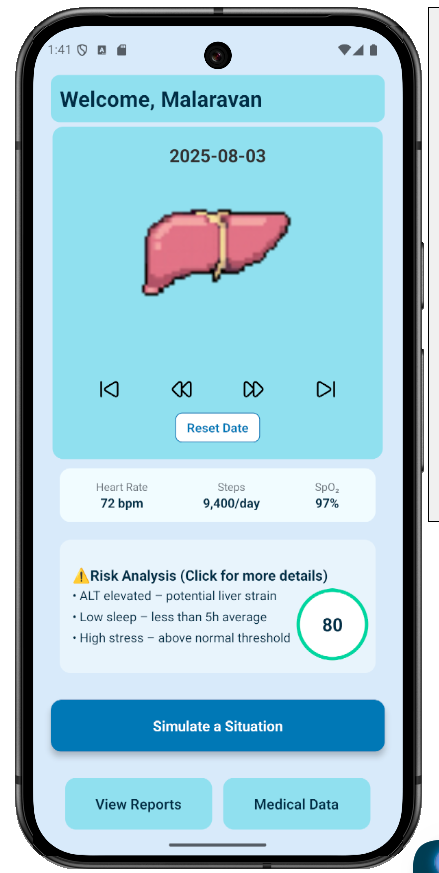
- Computes a daily Organ Risk Index (0–100) from wearable and blood test data, and predicts common at-risk problems (such as ASL, Fibrosis, inflammation, and many more).
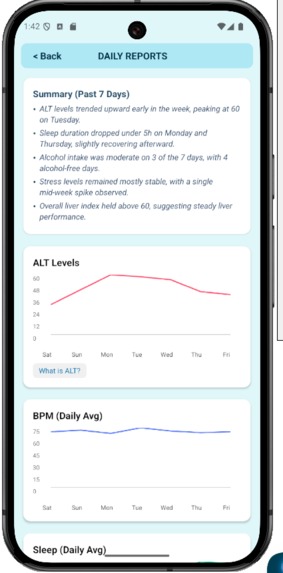
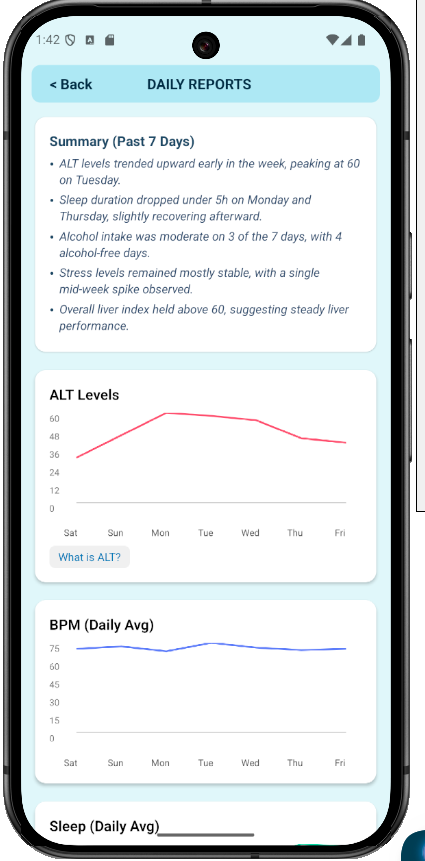
- Visualizes and recognizes trends in metrics like ALT, heart rate, and respiratory rate
- Animates a friendly liver sprite that reacts in real-time to your health score
- Lets you simulate lifestyle changes (e.g. "What if I sleep more?") using natural language prompts that feed into a custom-built neural network
🛠️ How We Built It
Frontend: React Native with Expo for mobile UI, animation, screen routing, and charts
Backend: FastAPI with MongoDB to store user data, pre-generate relevant data, fetch reports, and manage simulation prompts. Dockerized and deployed on Azure to serve data across the internet to the mobile frontend securely.
AI Core: Two neural networks built in PyTorch, built on millions of lines of public-sourced health data both partially-generated & labelled with the help of varying Gemini agents. Trained and hosted locally.
- First model processes and down-samples 24-hour smartwatch time series (steps, BPM, respiration) into relevant blood values, such as C-reative Protein (CRP).
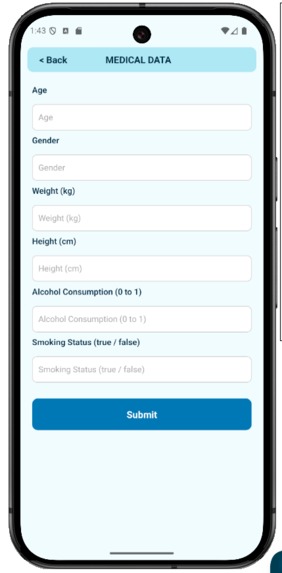
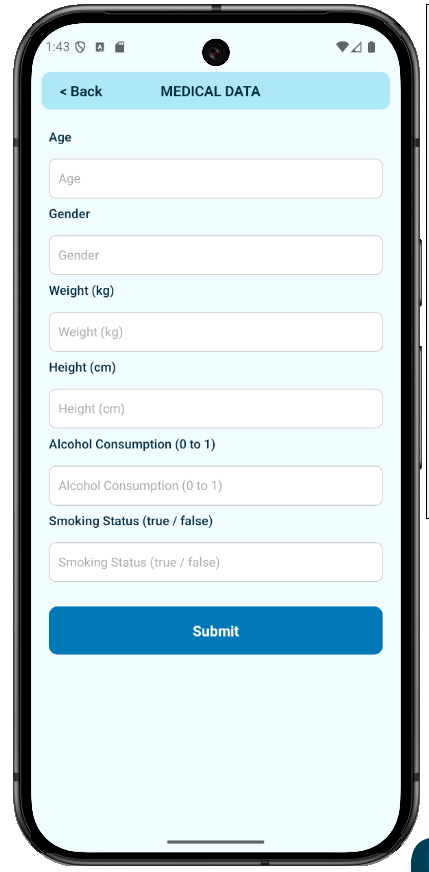
- Second model ingests static lifestyle and blood data (e.g. ALT, weight, alcohol use) to generate a Organ Risk Index and identify common risks & concerns.
Data is displayed across animated timelines, charts, summary reports, and simulation responses
⚠️ Challenges We Ran Into
- Obtaining extreme amounts of varied, labelled data without compromising on outliers
- Mapping minimal Apple Watch data into something medically meaningful
- Working & storing with user-dependant time-series and static data to estimate blood data
- Balancing between clinical accuracy and friendly, non-intimidating UI
🏆 Accomplishments We're Proud Of
- A working full-stack app that calculates personalized liver health scores
- Integrated a real dual-branch (conv1d + dense) NN model directly into a mobile interface
- Developed a natural language simulation feature for lifestyle planning
- Delivered a smooth, animation-driven health experience
📚 What We Learned
- Good, ethically-sourced data is extremely hard to obtain and hard to generate without a multi-agent system
- Even small, focused data inputs can power meaningful neural network predictions:Loss changes compared between 90k to 1 million rows of raw JSON was less significant than expected
- Mobile health apps are more effective when they feel alive and personal
- You don’t need full EMR data to start helping people make better decisions
- Expo + FastAPI is a fast, scalable combo for mobile-first health apps
🔮 What's Next for Revival
- Reduce MSE loss and build a far more advanced pattern-recognition model to calculate blood statistics
- Integrate with Apple HealthKit for real-time data syncing
- Host the PyTorch model in production using TorchServe
- Expand ML capabilities to include more biomarkers and longitudinal (trending) predictions
- Build out a clinician-facing dashboard for monitoring patient trends
- Let users export PDF liver health reports for doctor visits or records


Log in or sign up for Devpost to join the conversation.