-
-
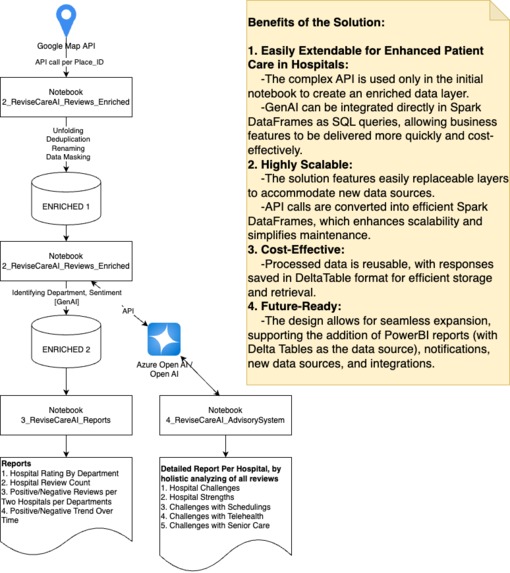
Data Flow Diagram of the ReviseCareAI
-
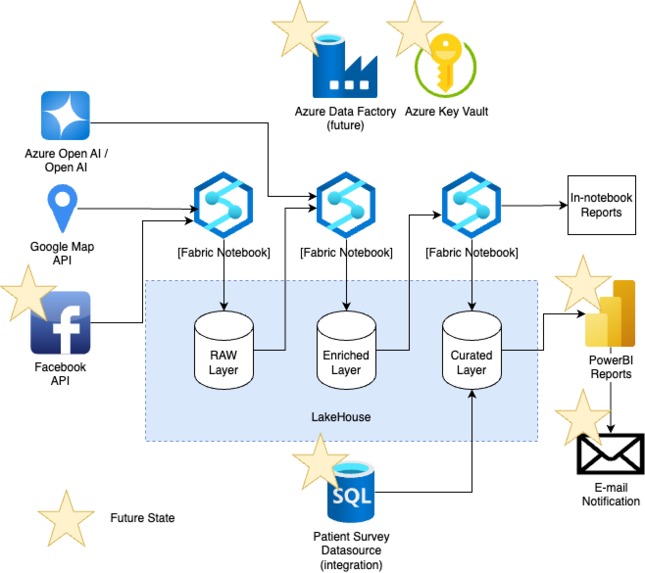
Component Diagram of the ReviseCareAI

What is the essence of the solution?
For Healthcare, ReviseCareAI+ delivers on-demand business insights into patient opinions about the Hospital, with a delay starting from 30 minutes. It connects review platforms such as Google Maps, with Azure OpenAI and leverages the comprehensive data processing capabilities of Azure Fabric to set up an environment for Power BI reports and notifications, enabling further business utilization.
The essence of the business is reflected in the name of our project - ReviseCareAI+:
- Revise = Reconsideration.
- Care = The main priority for the hospital.
- AI = Building a smart ecosystem to deliver the best care for patients.
- "+" = it is a platform, growing platform.
What does the ReviseCareAI solution do?
Iurii Iurchenko: Our primary goal was to build a highly scalable low-cost platform, prioritizing the data processes over a flashy UI. We invested 80% of our time in making the data process scalable, secure, and easy to maintain.
From an engineering standpoint, ReviseCareAI+ offers three main functionalities:
- AUTOMATES the gathering and processing of information from GOOGLE MAPS (with plans to include other sources in the future)
- EXTRACTS additional INSIGHTS from reviews using Generative AI, consolidating the information at various levels of granularity (e.g., review level, hospital level)
- PROVIDES CLARITY on the data, enabling the creation of detailed reports, notifications, and integrations with other platforms, such as OHDSI or internal systems
Oleh Buchynskyi: From the clinical perspective, ReviseCareAI translates various and numerous reviews provided by patients in Google Maps into the language, that can be understood by the clinics. It provides the capability for the clinic to evaluate its performance and build an actionable patient care improvement plan.
How to Install the Solution?
It is described in README.md in a GitHub repo
What Is the Current Process Flow Architecture?
The Data/Processing Flow involves the following:

The SOURCE CODE may be found in our Public Github here.
The INSTRUCTION HOW TO INSTALL may be found here.
What about the Economy, Following Policies?
Economy
For approximately 20 iterations over 20 hospitals, using the OpenAI and Google Maps APIs, our costs without discounts were:
- OpenAI insight extraction: $0.08
- Google Maps API: $11.26
This is relatively inexpensive when considering the potential ROI (Return on Investment) for the business.
Following Policies
We carefully reviewed the policies from Azure, OpenAI, and the Google Maps API SDK. As a result, we implemented a masking function to hide certain information that could potentially impact the business reputation of the hospitals we were analyzing using public Google reviews. Therefore, in the demo reports, you will see masked data.
What was Our Inspiration?
Iurii Iurchenko: Since childhood, I have loved smart competitions. Also, I’m passionate about the healthcare sector and inspired by Generative AI and High Load Data Engineering. The intersection of these fields motivated me to join this hackathon, as I see it as a valuable opportunity to contribute to healthcare and data engineering by creating a promising and scalable platform that could enhance feedback loops in healthcare and other domains. Also, after submission, I plan to share the insights, and code snippets, and experience from that hackathon with others to demonstrate that Generative AI is not a black box but a technology that can be used effectively. Inspiring others is the greatest inspiration for me.
Oleh Buchynskyi: As a former MD currently working as a Business Analyst and Project Manager supporting the development of software products for the Healthcare and Biotechnology industries, I am passionate about solving real issues the patients experience by utilizing both technological and medical expertise.
How did we build it?
Iurii Iurchenko: We started by brainstorming several ideas. Our initial concept was a real-time application to help patients track their medication progress. We then shifted our focus to our current business idea: gathering reviews for each hospital, consolidating them, using generative AI to extract additional insights (e.g., identifying problematic departments), and visualizing the results. From there, we entered a cycle of coding, brainstorming, and refining. That’s how we built it.
Oleh Buchynskyi: At first, we wanted to work on a solution that helps patients achieve medical adherence during their treatment. Due to the possible legal issues and complications with sensitive patients' data we decided to shift our efforts into improving the quality of services patients receive while using the clinic.
What challenges we've encountered?
Iurii Iurchenko: The main challenge was time, as both of us have full-time jobs. The final demo was recorded close to midnight on Friday. :)
Oleh Buchynskyi:
- Time
- Understanding how to build the bridge between the data provided by the patients and customers after using the clinic and the value it will bring them after the data was processed.
What are the Accomplishments We are Proud of?
Iurii Iurchenko: 1) We wrapped OpenAI into a SQL Spark UDF function. With our solution, Business Analysts can extract insights from OpenAI using a simple command like this:
SELECT
    *
    ,openai_udf(
        "Below, you will see the recent reviews on Google Map for Hospitals."
        ,"Give concise and structured answer with 3-5 points which problems were detected in that hospital"
        ,gen_ai_context) as hospital_challenges
2) We built a scalable platform designed for the future, incorporating best practices from Microsoft and utilizing layer separation. For example, if we process data using GenAI in the Enriched Layer, we can reuse the results without incurring additional queries or costs.
Oleh Buchynskyi: As a former clinician, I see the main achievement of ReviseCareAI in the focus on the REAL issues patients run into daily. Patients cannot always (and actually do not have to) understand the complexity of the clinic organization and therefore can express their opinions in a manner that can be unclear for the clinic to understand (and hard to process as there are usually a lot of reviews). ReviseCareAI bridges this gap.
What we've learned?
Iurii Iurchenko: I learned how to create business value at the intersection of (a) Microsoft Fabric Data Processing, (b) GenAI, and (c) the Healthcare Business Domain. It was a great journey.
Oleh Buchynskyi: Understood how to transform unstructured patient feedback into valuable insights.
What others may Learn from the Solution?
There is plenty of room to learn how to:
- Use GenAI for Healthcare Reputational Strategy (CEOs, marketing teams, BAs).
- Integrate GenAI directly into a SQL query (BAs).
- Connect to review providers, such as Google Maps, via API (Data Engineers).
- Convert complex API data into a Spark DataFrame and Delta Table (Data Engineers).
- Work with varying levels of contextual detail for GenAI, such as moving from analyzing a single review to generating a comprehensive report using all reviews per hospital. Technically, we implemented hospital-level column concatenation using concat_ws in Spark (Data Engineers).
- Utilize Azure Fabric's capabilities for the full-cycle development of a Business Application, from idea to Alpha version (Data Team Leads, Data Managers, Data Engineers, Architects).
- Save money by properly architecting data processing layers and reducing repetitive GenAI queries in Enriched Layers (Data Engineers, Data Architects).
What Is Next for ReviseCareAI?
Iurii Iurchenko:
- Enhancing Power BI reports to replace Python visualizations—a must-have.
- Adding fine-tuning to the model to improve the accuracy of attribute extraction from reviews.
- Developing more comprehensive reports that analyze healthcare business challenges and patient pain points.
- Implementing cost monitoring.
- Integrating with other systems, such as OHDSI data warehouses and patient survey systems.
Oleh Buchynskyi:
- Build benchmarks against top-performing clinics to drive better care
- Leverage Generative AI to provide more insights to the clinics
- Build a new feature tracking system that will allow clinics to keep on track with their competitors
- Create top areas that are most valuable for the users and establish a patient care baseline.
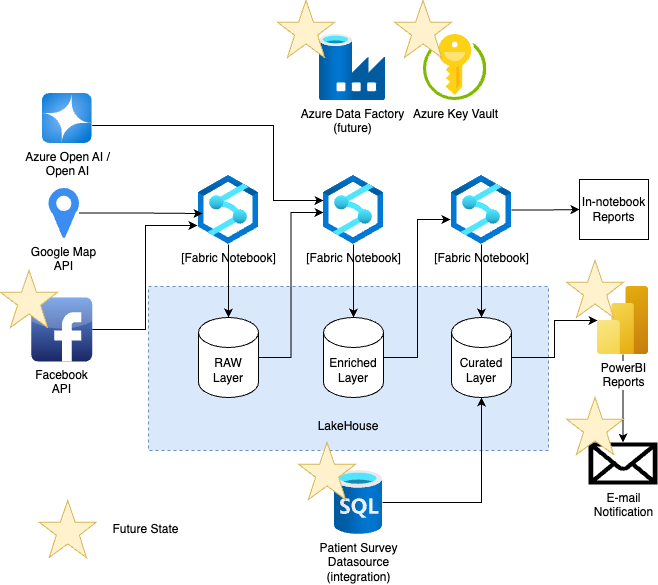
The Current/Future Statement Diagram:

Words of Appreciation
Big shout-out to Microsoft for the opportunity to compete in such an event and for providing the great SaaS platform, Azure Fabric. A huge thank you to DevPost for orchestrating this event—I love your platform. Much respect for the judges for your time and attention. Thank you to all the engineers who are learning, growing, and sharing their knowledge with others. Together, we are a force. Let's make our engineering field better together.
Find us on LinkedIn: Iurii Iurchenko, Oleh Buchynskyi


Log in or sign up for Devpost to join the conversation.