-
-
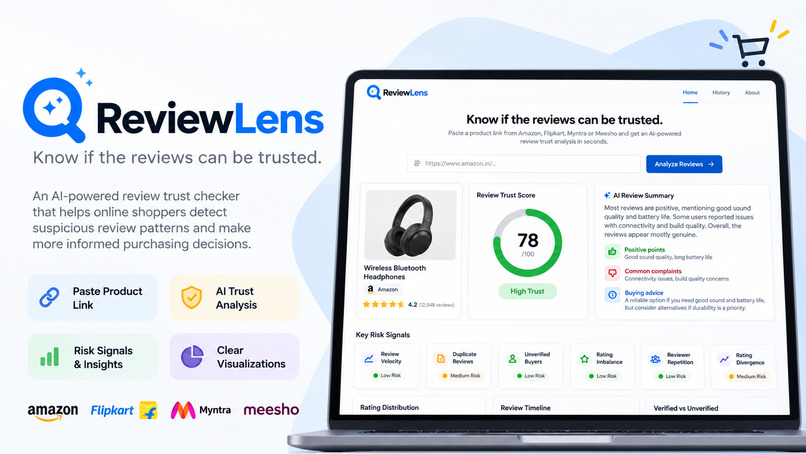
ReviewLens: AI-powered product review trust checker for smarter shopping.
Inspiration
Online shopping has become a part of our everyday lives, and we often depend on customer reviews and star ratings before buying a product. But can we always trust them? A product with a 4.6-star rating might look like a great choice, yet some reviews could be repetitive, unverified, or posted in unusual patterns.
Most shoppers don't have the time to go through hundreds of reviews to figure out what's genuine and what's suspicious. We wanted to make this process easier. That's how ReviewLens came to life — a tool designed to help people understand review patterns and make more confident purchasing decisions.
What It Does
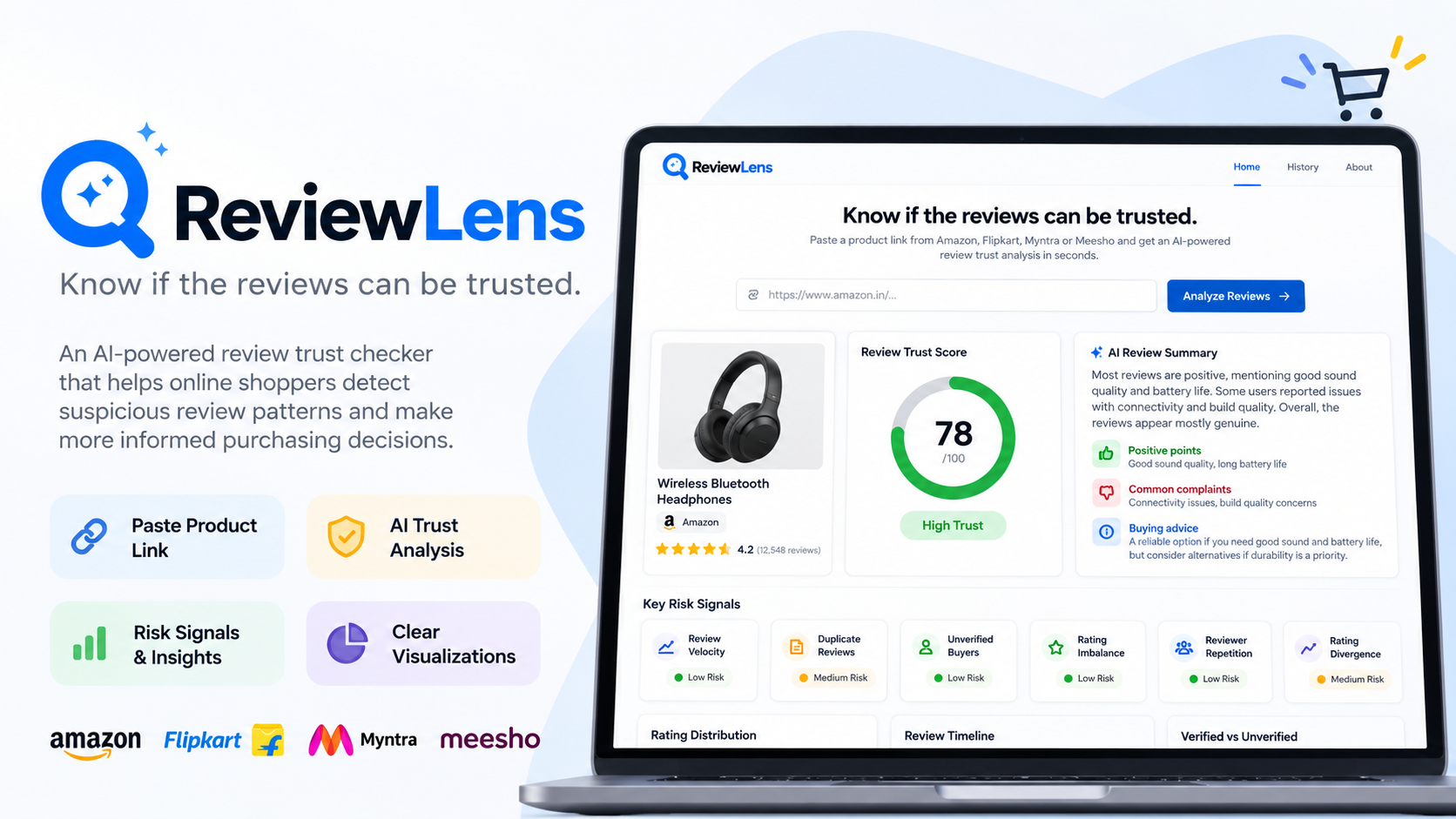
ReviewLens is an AI-powered review trust checker that helps shoppers look beyond star ratings and understand potential warning signs in product reviews.
- Product URL Analysis: Users can paste a product link from supported e-commerce websites, including Amazon India, Flipkart, Myntra, and Meesho.
- Product Image Extraction: The application attempts to retrieve the actual product image from page metadata and uses fallback images when necessary.
- Review Trust Score: ReviewLens calculates a score between 0 and 100 using six rule-based checks:
- Unusual increases in review activity over short periods.
- Repeated or very similar review text.
- A high proportion of unverified purchases.
- Unbalanced or unusual rating distributions.
- Repeated reviewer identities.
- Differences between verified and unverified review ratings.
- AI-Powered Insights: Google Gemini 2.5 Flash helps turn the available analysis into an understandable summary, highlighting positive feedback, potential concerns, and useful buying considerations.
- Interactive Dashboard: The interface includes a visual trust score, review data charts, and a Recent Analyses section for revisiting previous results.
Our scoring approach is designed to make potential warning signs easier to understand rather than simply giving shoppers another number to trust blindly.
How We Built It
We developed ReviewLens as a two-member team, combining our efforts to build a full-stack application and explore how AI can support better online shopping decisions.
Our technology stack includes:
- Frontend and framework: Next.js 14, React 18, and TypeScript.
- UI and styling: Tailwind CSS, with a clean, light-mode design focused on readability.
- AI integration: Google's Generative AI SDK with Gemini 2.5 Flash, structured output validation, and rule-based fallbacks.
- Database: Prisma ORM and MySQL for data persistence, with an in-memory fallback where supported.
- Data visualization: Recharts for displaying rating distributions, review timelines, and verified-purchase ratios.
- Product metadata: Server-side extraction of product images and metadata from supported page formats.
We separated the scoring logic from the AI-generated explanations so that calculated risk indicators can guide the final report instead of relying entirely on an AI model to make the assessment.
Challenges We Ran Into
Building ReviewLens came with a few challenges that helped us learn more about full-stack development.
1. Handling MySQL index limitations
We encountered issues with MySQL indexes on longer strings using utf8mb4 encoding. We addressed this by adjusting relevant Prisma schema fields to use @db.VarChar(191) where appropriate.
2. Working with different shopping websites
E-commerce websites don't all structure their product pages in the same way. We developed a fallback approach that checks OpenGraph metadata, Twitter image metadata, JSON-LD, and other available image sources.
3. Making AI responses more reliable
We wanted the AI report to explain findings without inventing statistics. To address this, we designed the scoring engine to calculate risk indicators first and then provide those findings as context for Gemini's explanation.
4. Resolving development and build issues
Running development servers and production builds sometimes caused Webpack cache conflicts. We investigated these issues and worked on keeping the build process clean and isolated.
Accomplishments We're Proud Of
We're proud of bringing our idea into a full-stack application and exploring how explainable rules and generative AI can work together.
Some highlights include:
- Building a dashboard that brings review analysis and AI-generated explanations together.
- Designing six rule-based risk checks to make potential review manipulation patterns easier to examine.
- Implementing product metadata and image extraction with fallback options.
- Creating interactive visualizations and a Recent Analyses interface.
- Using structured AI outputs and fallback logic to make the application more resilient.
Most importantly, this project gave us an opportunity to turn an everyday online shopping concern into a practical software solution.
What We Learned
While developing ReviewLens, we learned how to combine deterministic algorithms with generative AI instead of relying on an LLM for every decision.
We also gained experience with Next.js, TypeScript, Prisma, MySQL, API integration, structured AI responses, and debugging full-stack applications.
Working through the Devpost Learn Skill Pack helped us approach the project in stages, from understanding the problem and defining requirements to implementation and preparing the final submission.
As a team of two, we also learned the importance of coordinating development work, integrating different parts of an application, and solving problems together.
What's Next for ReviewLens
We see several ways ReviewLens could become more useful in the future:
- Browser extension: Let shoppers check product reviews while browsing supported shopping websites.
- Seller and platform integrations: Explore direct integrations for more reliable access to product and review data.
- Review history tracking: Compare review patterns over time to identify unusual changes.
- Regional language support: Explore review analysis in Indian languages such as Kannada, Hindi, and Tamil.
Our long-term goal is to make online shopping decisions more transparent by helping people understand the evidence behind product reviews.


Log in or sign up for Devpost to join the conversation.