-
-
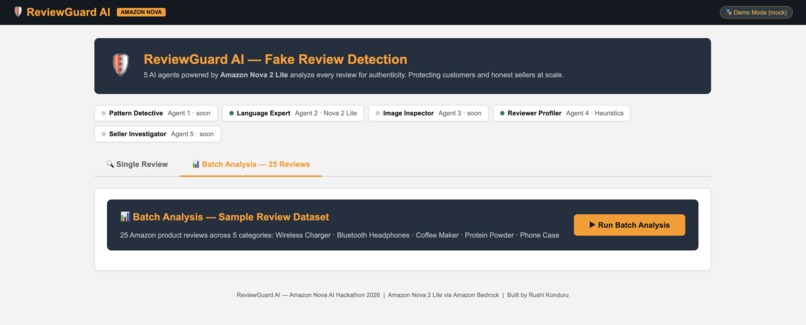
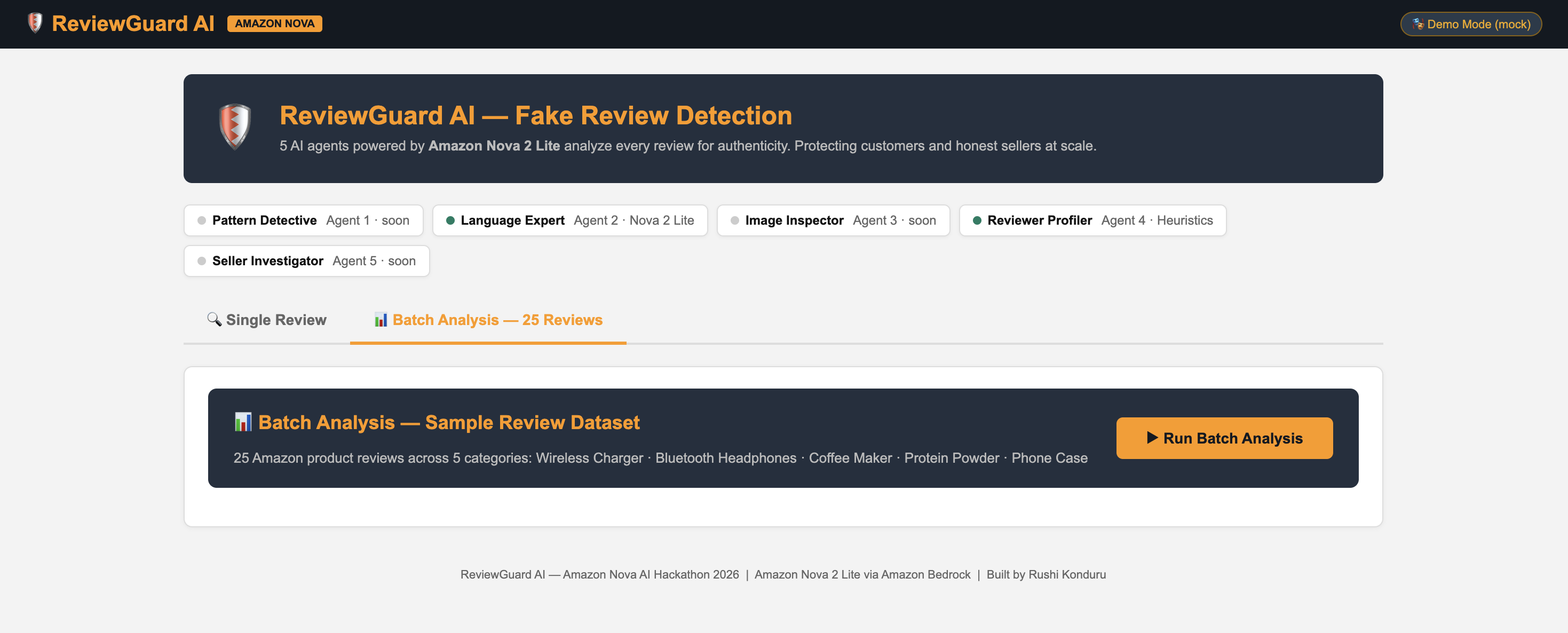
batch of reviews
-
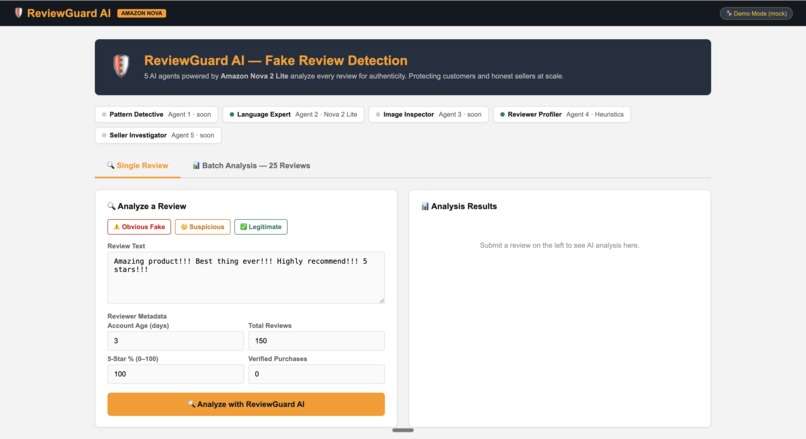
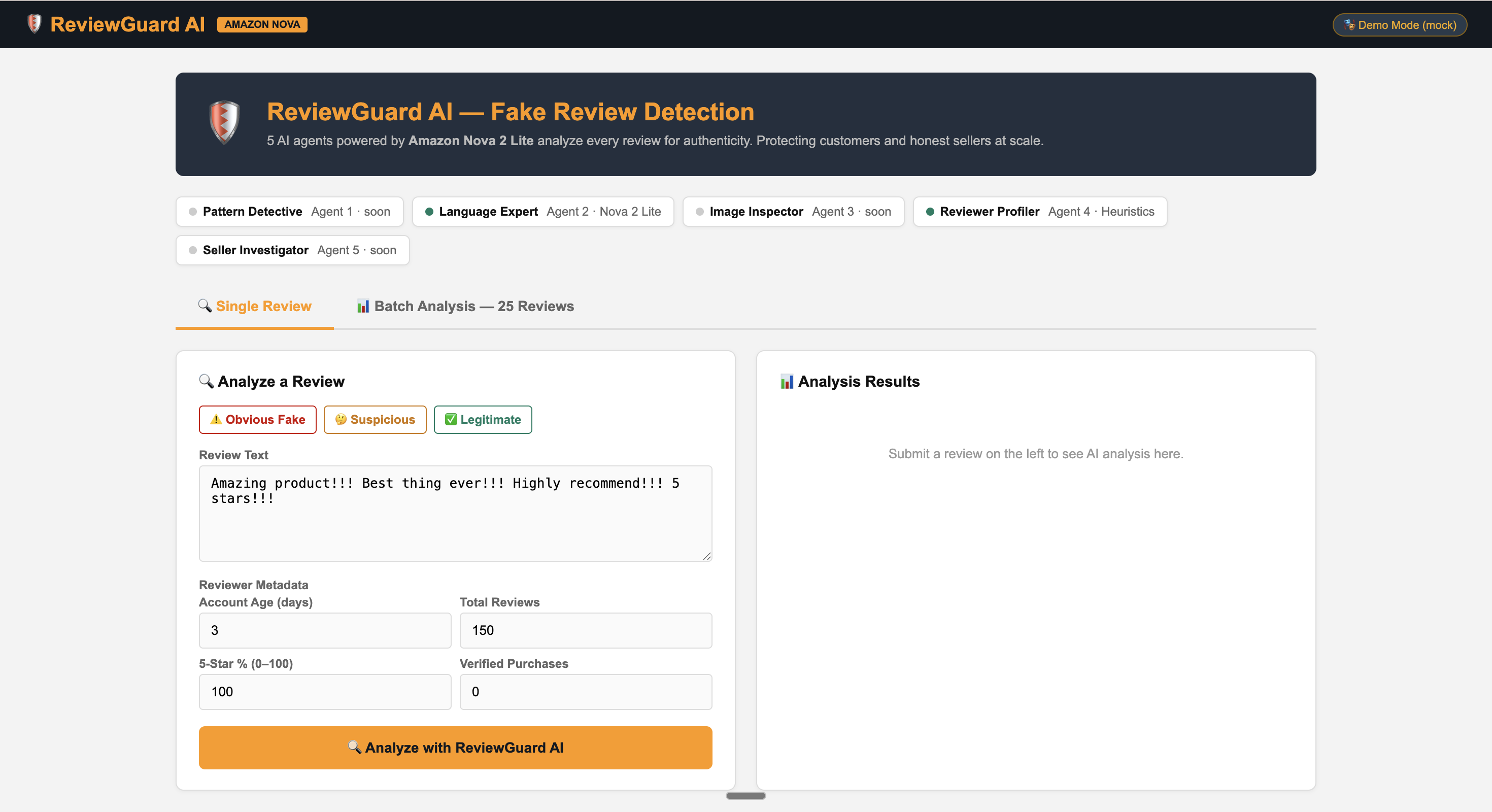
main screen
-
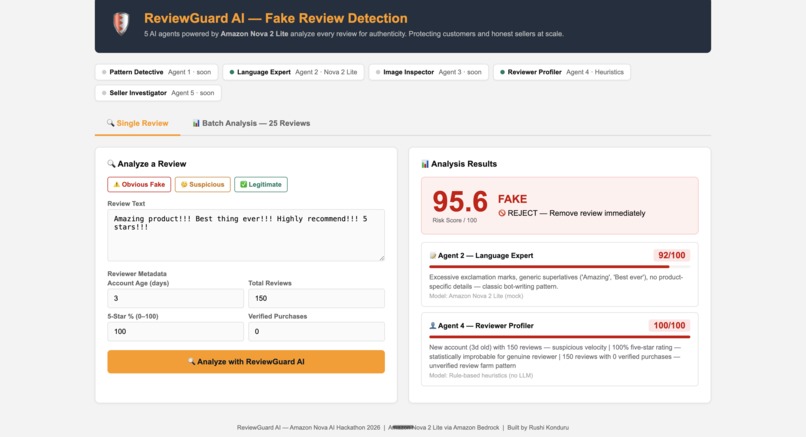
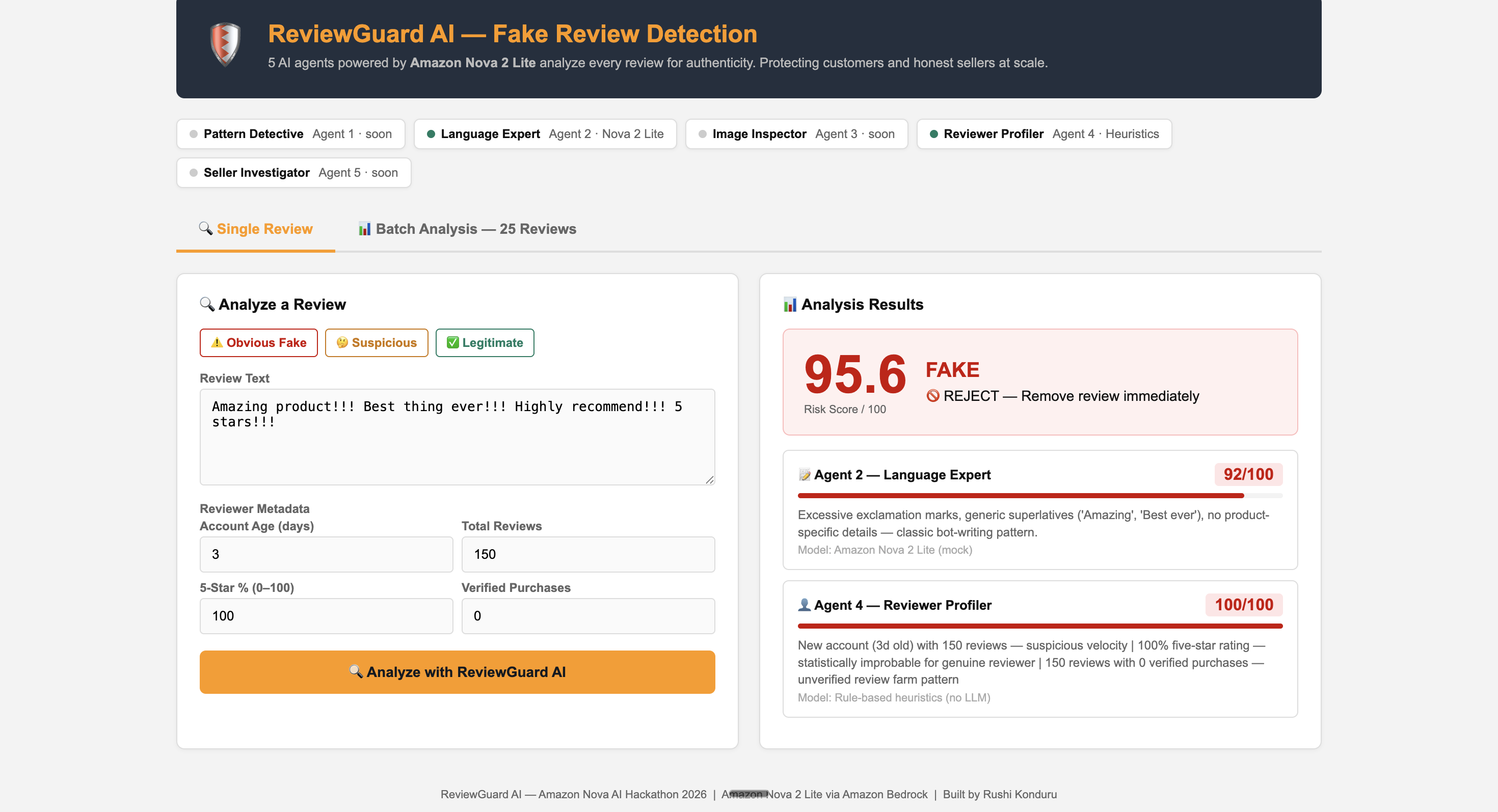
when u run for a single review
-
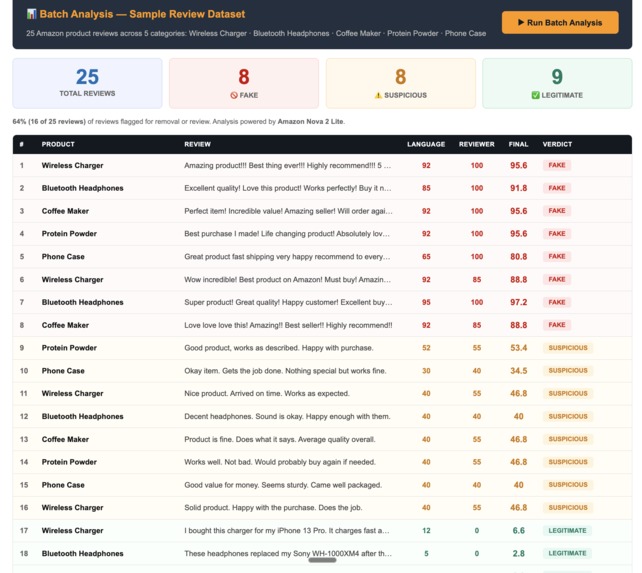
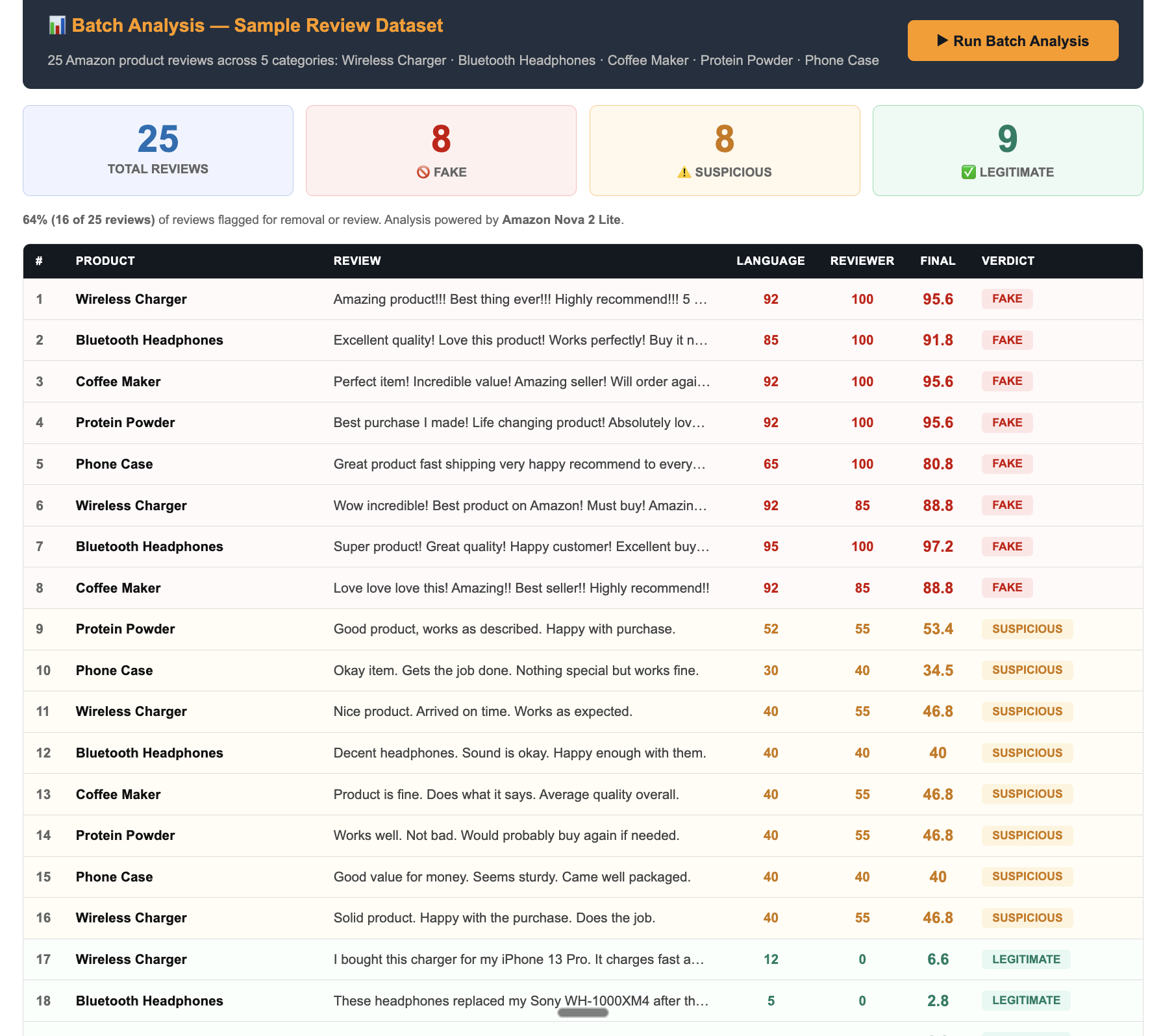
the result when you run for batch of the reviews
Inspiration
Amazon has a 40% fake review problem that costs the e-commerce industry billions annually. We wanted to build something that could protect real customers and honest sellers — not just flag obvious spam, but genuinely understand the difference between a bot-written review and a real human experience. Amazon Nova 2 Lite's language understanding made that possible.
What it does
ReviewGuard AI uses 5 specialized AI agents — all powered by Amazon Nova 2 Lite via Amazon Bedrock — to analyze product reviews and return a verdict in under 3 seconds.
Agent 2 (Language Expert): Sends review text to Nova 2 Lite, which detects bot-writing patterns, hollow superlatives, and sentiment inconsistencies. Returns a risk score 0–100 with a human-readable explanation.
Agent 4 (Reviewer Profiler): Analyzes reviewer metadata — account age, review velocity, 5-star percentage, and verified purchase ratio — for suspicious behavioral patterns.
A Master Orchestrator combines both scores into a final decision: LEGITIMATE (publish), SUSPICIOUS (route to human reviewer), or FAKE (remove immediately).
The system also supports batch analysis — load an entire product's review dataset and see a full breakdown of fake vs. legitimate reviews across all 25 reviews at once.
How we built it
- Backend: Python + Flask serving a
/analyzeand/analyze-batchAPI endpoint - AI Core: Amazon Nova 2 Lite (
us.amazon.nova-2-lite-v1:0) called via the Amazon Bedrock Converse API using boto3 - Frontend: Single-file HTML/CSS/JS dashboard with two tabs — Single Review and Batch Analysis
- Dataset: 25 curated reviews across 5 product categories representing fake, suspicious, and legitimate patterns
- Architecture: Each agent runs independently and returns structured JSON, making the system modular and easy to extend with the remaining 3 agents ## Challenges we ran into Getting Amazon Nova 2 Lite to consistently return valid JSON required building a fallback parser — Nova occasionally adds prose before or after the JSON block. Calibrating the weighted scoring between the two agents so that borderline reviews correctly land in the SUSPICIOUS band (rather than being forced into a binary decision) took careful tuning. We also had to handle the macOS AirPlay port conflict on port 5000 during development. ## Accomplishments that we're proud of The batch analysis feature is something we're genuinely proud of — it shows the real-world use case clearly. Running 25 reviews through both agents and surfacing 8 fake, 8 suspicious, and 9 legitimate reviews in under 2 seconds demonstrates how this system would actually work at Amazon's scale. The explainability of each verdict — not just a score but a reason — is also something that sets this apart from black-box classifiers. ## What we learned Amazon Nova 2 Lite's ability to return structured, reasoned output from a natural language prompt is more powerful than we expected. Multi-agent systems are only as good as their orchestration layer — getting the weighted combination right matters more than any individual agent's accuracy. We also learned that for fake review detection, reviewer behavioral signals are just as important as the text itself. ## What's next for ReviewGuard AI
- Agent 1 — Pattern Detective: Analyze timing patterns and review velocity across a seller's entire review history
- Agent 3 — Image Inspector: Use Amazon Nova Multimodal Embeddings to detect duplicate, stock, or photoshopped product images
- Agent 5 — Seller Investigator: Cross-reference seller history and known review manipulation networks
- Real-time pipeline: Deploy on AWS Lambda + SQS to process reviews as they are submitted
- Feedback loop: Allow Amazon moderators to correct verdicts and retrain the scoring weights

Log in or sign up for Devpost to join the conversation.