-
-

Logo/Splash screen
-
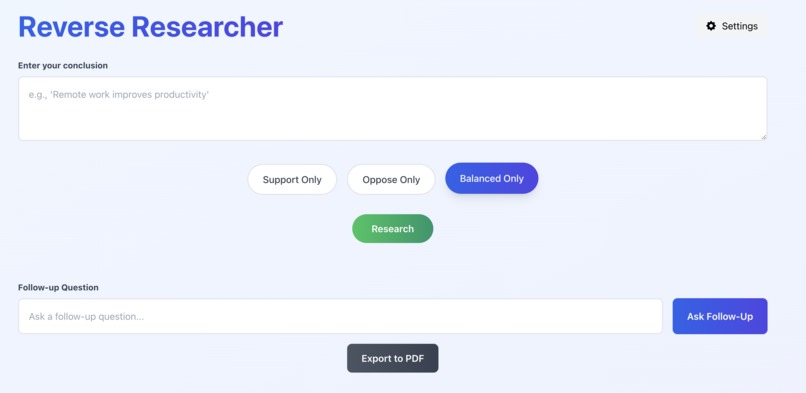
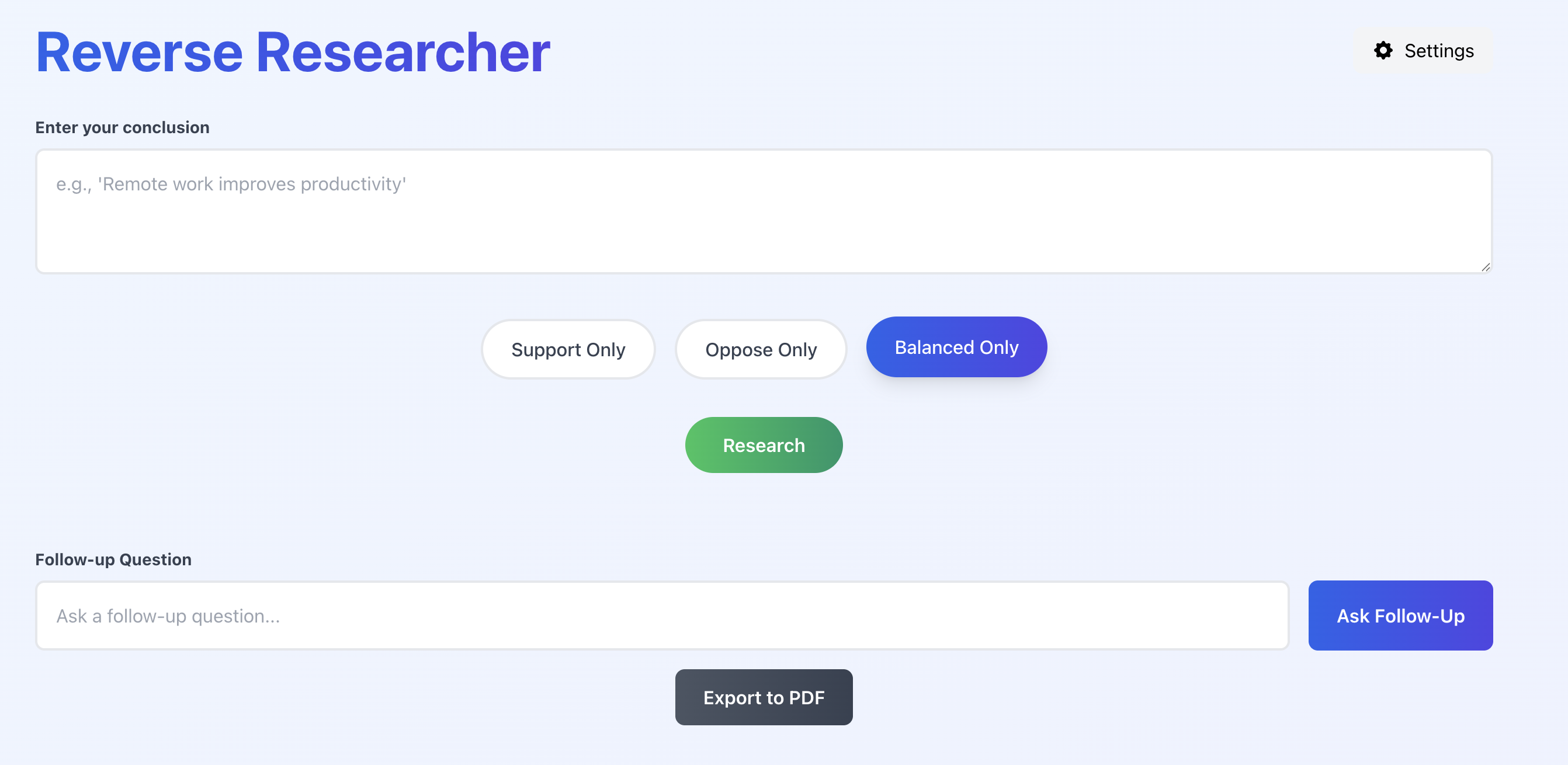
Fresh load
-
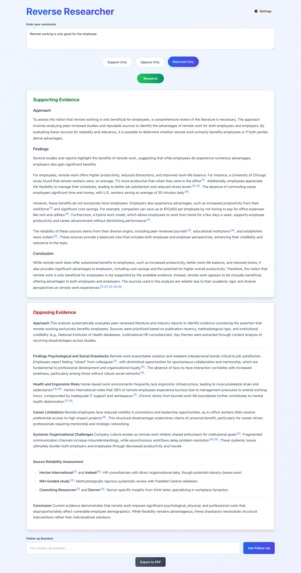
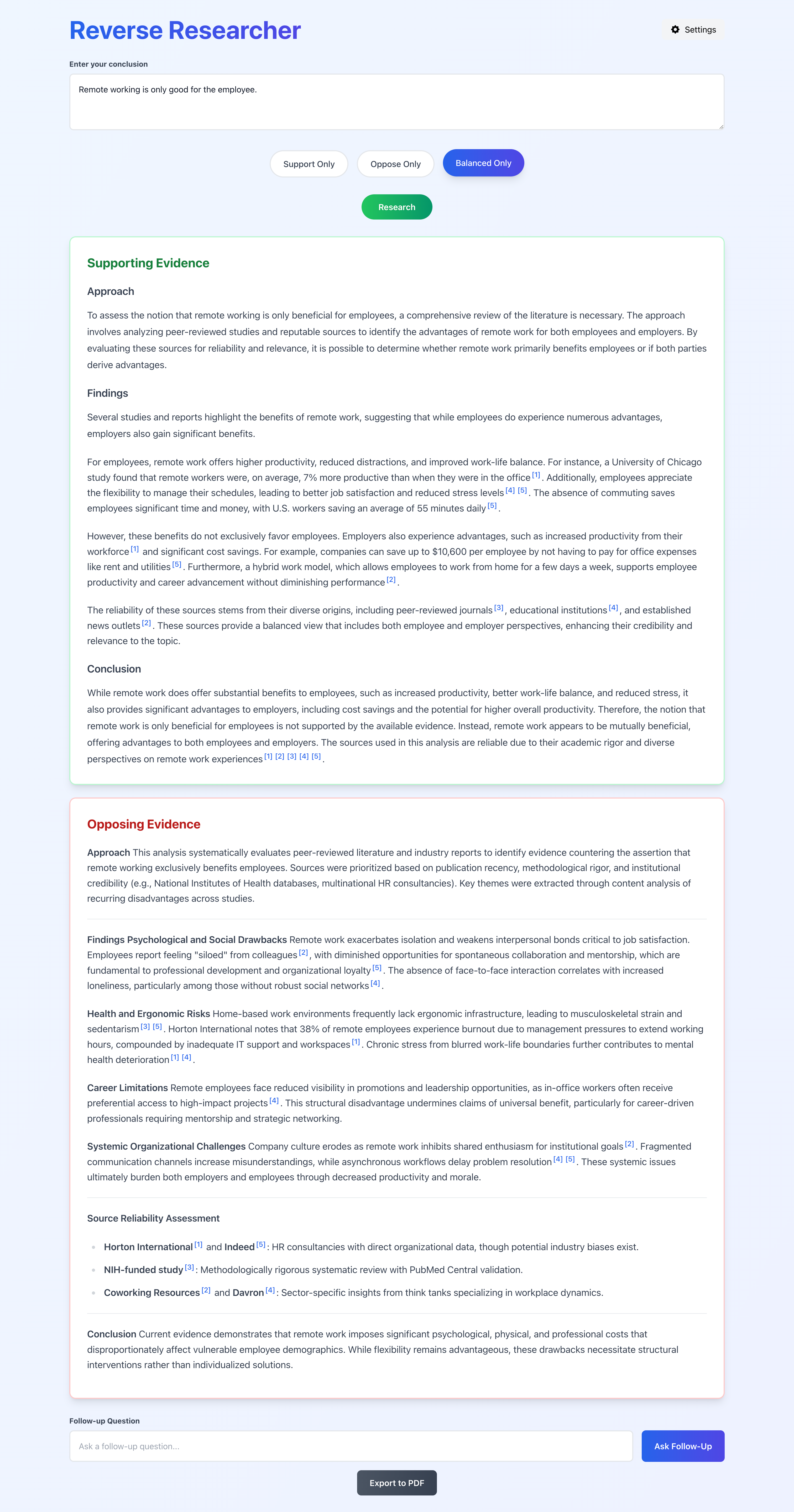
Full response

Inspiration
📖 About the Project
🔥 Inspiration
We’re surrounded by more content than ever—but that doesn’t mean we’re better informed. In classrooms, boardrooms, and online discussions, we often start with a conclusion and scramble for evidence. That got me thinking:
What if research could work in reverse?
Instead of asking a question, what if we asked AI to evaluate a claim—critically, fairly, and with citations?
Enter Reverse Researcher: an AI tool that flips the research process. Fueled by Perplexity’s Sonar API, it empowers users to see both sides of any conclusion—backed by real-time sources.
🧠 What I Learned
This project was my crash course in:
- Real-time prompt engineering for factual accuracy and citation clarity
- Handling user ambiguity in natural language inputs
- Designing a research UI that balances simplicity and transparency
- Fine-tuning API interactions with Perplexity Sonar for follow-ups and reasoning
I also learned how important it is to guide models with strong system prompts and trust-building features like citation verification and chain-of-thought reasoning.
🛠️ How I Built It
Tech Stack
- Frontend: React + Vite
- Styling: TailwindCSS
- AI Backend: Perplexity’s Sonar API (
sonar-small-chat)
Core Features
- Takes any conclusion as input
- Returns supporting and opposing evidence, using Sonar's real-time web search and citation capabilities
- Users can select their research angle: Support Only, Oppose Only, or Balanced
- Evidence includes citations and source credibility explanations
- Supports follow-up questions for deeper exploration
- Allows export to PDF
🧗 Challenges Faced
- Model Access: I initially used an unsupported model (
sonar-research-pro) and hit API errors until I aligned withsonar-small-chat - Citations & Reliability: Getting citations to display cleanly while preserving chain-of-thought clarity required prompt tuning and layout iterations
- Design Simplicity: Creating a clean UX while keeping advanced features like follow-up, export, and multiple views was a balancing act
- Real-time Debugging: Handling API rate limits, 400s, and malformed responses gracefully was critical to build user trust
🚧 What’s Next
Reverse Researcher has strong potential for growth and impact. Some of the features I’d love to explore next:
- Citation Filtering: Let users choose academic-only, news-only, or mixed source types
- Bias Detection: Flag possible source or phrasing bias in support/opposition arguments
- Browser Extension: Enable one-click research on any sentence from a web article or tweet
- Team Mode: Support multi-user sessions for classroom debate prep or peer reviews
- Custom Agents: Let users tune tone or depth: academic, journalistic, legal, etc.
💡 Final Thoughts
Reverse Researcher isn't just a hackathon project—it's a small step toward AI-enhanced critical thinking. I’m proud to contribute a tool that doesn’t just give answers, but reveals complexity.
If you’re a student, teacher, debater, or just curious about the world—you deserve more than one side of the story. Reverse Researcher gives you both.
Built With
- ai
- api
- javascript
- perplexity
- tailwindcss
- vite


Log in or sign up for Devpost to join the conversation.