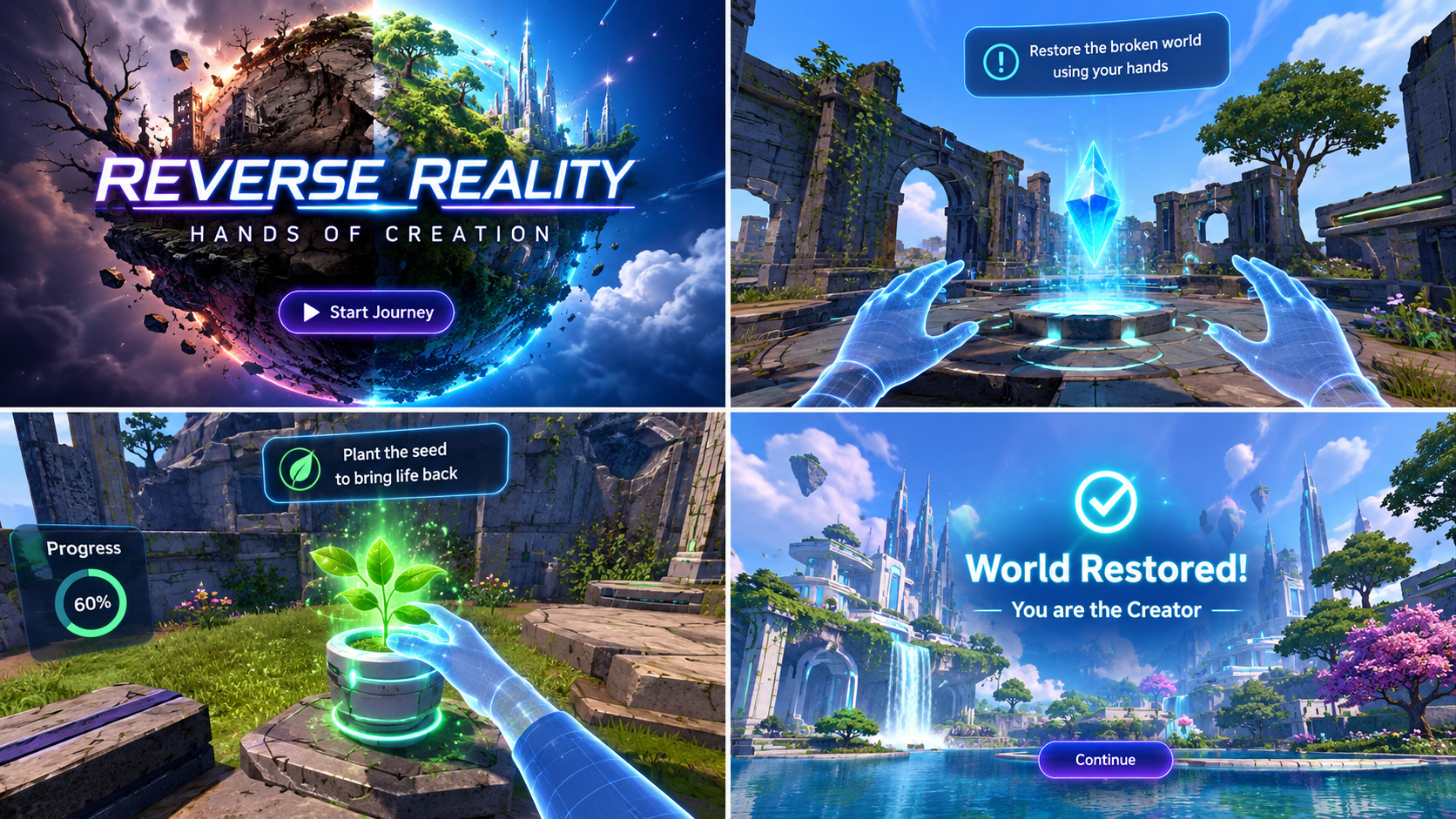
Inspiration
What if we could create beautiful 3D objects simply by moving our hands in the air?
This question inspired Reverse Reality — Hands of Creation. We wanted to explore a new way of interacting with digital environments where human gestures become tools for creativity.
Our inspiration came from the relationship between geometry and nature. Geometric shapes represent structure and precision, while organic forms represent imagination and natural beauty.
We imagined an experience where each hand controls a different creative world, and bringing both hands together transforms them into something entirely new.
Our vision is to make creation feel natural, magical and immersive.
What it does
Reverse Reality is an immersive WebXR creative experience where users explore 3D shape creation through two-hand gestures.
The experience revolves around three main interactions:
- Right Hand — Geometric World: Create and interact with geometric forms such as cubes, spheres, pyramids, crystals and abstract structures, represented with glowing cyan and blue effects.
- Left Hand — Organic World: Explore nature-inspired creations such as butterflies, flowers, hearts, leaves and other organic forms, represented with violet and purple effects.
- Two-Hand Fusion: Bring both hands together to trigger a magical transformation in which the two forms merge into a unique 3D masterpiece.
The experience also features an immersive landing page, a central 3D creation environment, visual interaction feedback and a final creation reveal with a congratulatory message and a generated masterpiece name.
The core idea is simple: Two Hands. Two Forms. One Creation.
How we built it
We developed Reverse Reality as a browser-based immersive experience using Meta Immersive Web SDK (IWSDK) and WebXR technologies.
Our development approach focuses on combining immersive 3D visuals with natural hand-based interaction.
The main components include:
- Immersive Interface: A futuristic landing page and dedicated gameplay interface designed to introduce users to the experience.
- 3D Environment: Interactive 3D objects, geometric forms, organic structures, lighting and visual effects.
- Hand Interaction: Camera-based hand tracking and gesture interpretation for independent left-hand and right-hand interactions.
- Shape Creation: Separate geometric and organic shape systems.
- Fusion Experience: A particle-based visual transformation concept that brings two independently created forms together.
- Final Reveal: A celebration screen featuring the completed creation, its name and replay functionality.
We use Vercel to host the web experience, making it accessible through a public HTTPS link.
Live Experience: https://reverse-reality.vercel.app/
Challenges we ran into
Building an immersive experience controlled by natural hand movements introduced several interesting challenges.
- Dual-Hand Recognition: Distinguishing left-hand and right-hand interactions and maintaining independent control.
- Tracking Accuracy: Reducing hand-tracking jitter and making interactions feel stable and responsive.
- 3D Coordinate Mapping: Translating real-world hand movements into meaningful positions and interactions inside a virtual environment.
- Shape Fusion: Creating a visually convincing transformation instead of simply placing two objects on top of each other.
- Performance: Maintaining smooth 3D rendering, animations and camera processing in a browser-based experience.
- User Experience: Making gesture controls intuitive enough that users can understand how to create, manipulate and combine shapes.
Each challenge encouraged us to think beyond traditional interfaces and explore more natural ways of interacting with virtual objects.
Accomplishments that we're proud of
We are proud of turning a creative idea into an immersive interactive WebXR project.
Some of our key accomplishments include:
- Developing a unique two-hand creation concept.
- Designing two distinct creative worlds: geometric and organic.
- Building a futuristic landing page and dedicated gameplay experience.
- Exploring gesture-controlled interaction with virtual 3D objects.
- Designing an organic-geometric fusion experience.
- Bringing the project online with a publicly accessible deployment.
Most importantly, we are proud of exploring a different approach to digital creativity, where users can express their imagination through movement rather than conventional input devices.
What we learned
Through this project, we explored immersive web development, WebXR, 3D interaction design, gesture-based interfaces and spatial computing concepts.
We learned how important it is to connect real-world movement with virtual environments in a way that feels natural.
We also gained a deeper understanding of the challenges involved in camera-based hand tracking, interaction design, 3D coordinate mapping, visual feedback and performance optimization.
This experience taught us that an immersive application is not just about beautiful graphics. The interactions, responsiveness and overall experience are equally important.
What's next for Reverse Reality — Hands of Creation
We see Reverse Reality as the beginning of a larger creative universe.
Our future plans include:
- Expanding the library with more geometric and organic shapes.
- Introducing more unique fusion combinations and procedurally generated masterpieces.
- Improving dual-hand tracking accuracy and gesture recognition.
- Adding more natural hand interactions, including object rotation, scaling and manipulation.
- Introducing immersive audio and spatial sound effects.
- Creating personalized galleries where users can save and revisit their creations.
- Further optimizing the experience for Meta Quest and other compatible immersive environments.
Our long-term vision is to make Reverse Reality a creative spatial playground where imagination has no boundaries.
Two Hands. Two Forms. Infinite Possibilities.
Welcome to Reverse Reality — Hands of Creation.
