Inspiration
Most decision systems prioritize the loudest voices, the most popular opinions, or the people with the most influence. We wanted to challenge that model by asking: what if problems competed instead of people? Reverse Democracy AI was inspired by the idea that urgent, high-impact issues should rise to the top based on evidence, risk, and consequences not popularity.
What it does
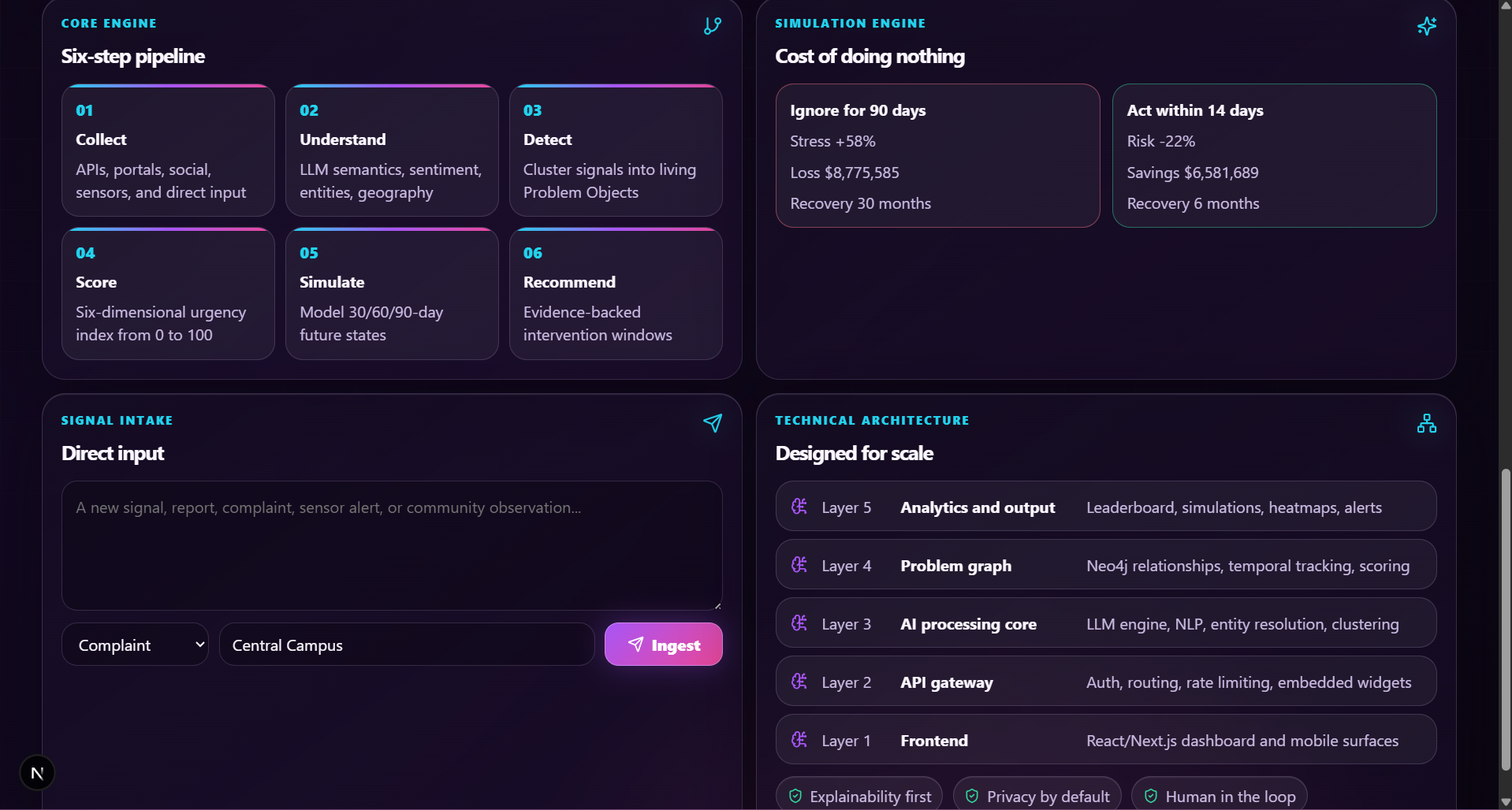
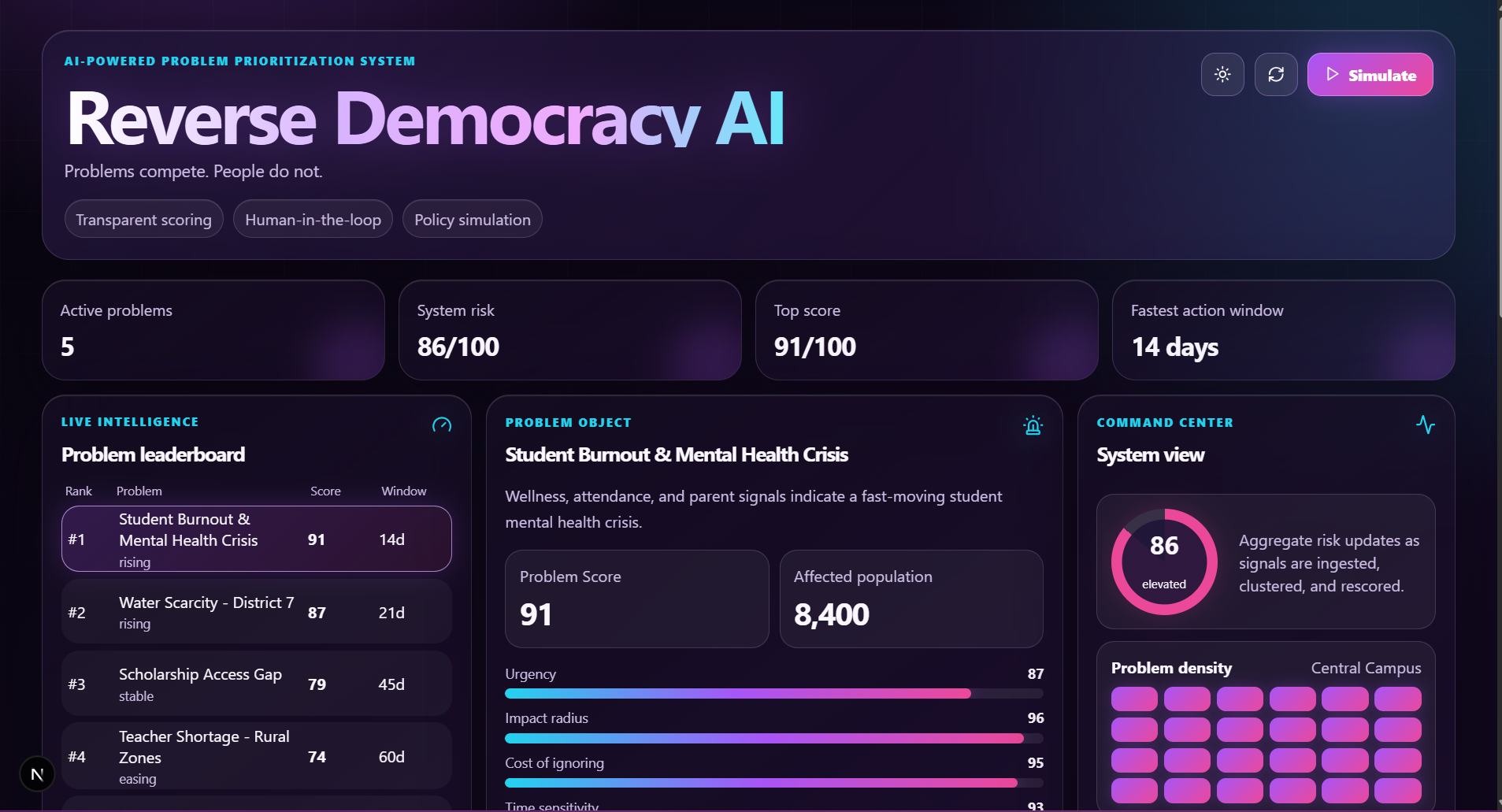
Reverse Democracy AI collects complaints, reports, and public signals, then converts them into structured Problem Objects. Each problem is scored and ranked using urgency, impact, severity, time sensitivity, affected population, and cost of ignoring it.
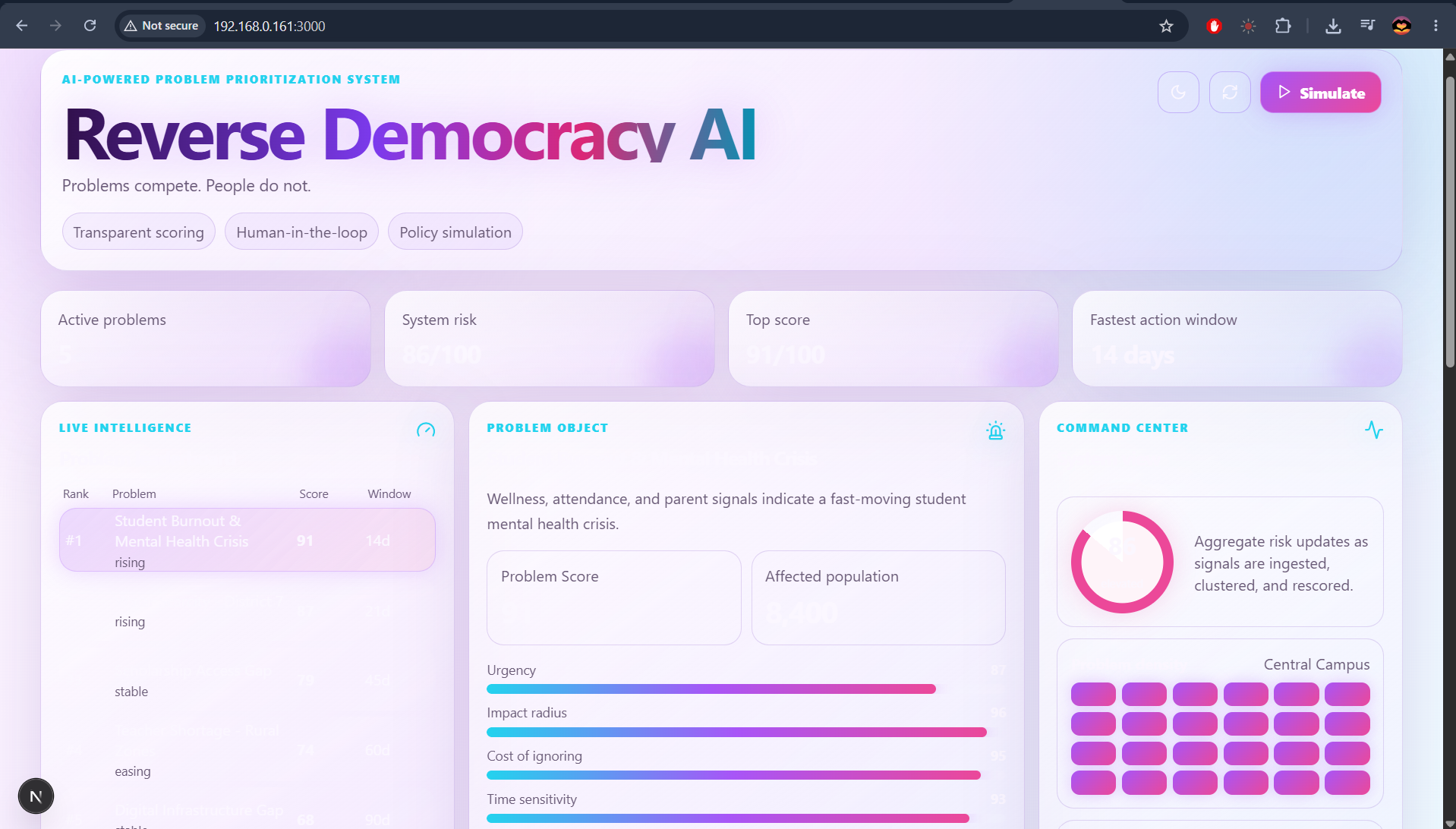
The system displays a live dashboard with a problem leaderboard, risk meter, heatmap, audit trail, and future simulation engine. It helps decision-makers understand which problems need attention first and what could happen if action is delayed
How we built it
We built the project as a runnable web application using a React/Next.js frontend, API routes, and an AI-assisted processing pipeline.
Raw signals are ingested through the app, analyzed by NLP logic, grouped into Problem Objects, scored using a six-dimension scoring engine, and displayed on a command-center dashboard. The system includes optional support for LLM APIs, Neo4j graph storage, PySpark scoring, Docker, and Kubernetes deployment.
Challenges we ran into
The biggest challenge was turning subjective complaints into measurable and explainable scores. We had to think carefully about fairness, bias, transparency, and how to prevent popularity from overpowering real urgency.
Another challenge was designing a system that could work both with advanced infrastructure like LLMs, Neo4j, and Spark, while still running locally without paid services.
Accomplishments that we're proud of
We are proud that we turned a concept from a slide deck into a working starter implementation. The project demonstrates a new decision-making model where problems are ranked by urgency and consequences instead of popularity.
We also built fallback logic so the app can run locally without external APIs, making it easier to test, demo, and expand.
What we learned
We learned how AI can support governance, public decision-making, and organizational prioritization when it is designed to be transparent and explainable.
We also learned that problem ranking is not just a technical challenge, it is also an ethical design challenge involving fairness, accountability, and trust.
What's next for Reverse democracy ai
We plan to improve simulation accuracy, integrate real-time data sources, and expand the platform for larger-scale decision environments. We also plan to improve the simulation engine, integrate real-time data sources, expand the scoring model, and add stronger explainability features.
Future versions could support city planning, student services, healthcare operations, disaster response, customer support, and enterprise risk management. The long-term vision is to help organizations respond to the problems that matter most before they become crises.
Built With
- ai
- dashboard-ui
- data-analytics
- fastapi
- graph-based-ranking
- json
- machine-learning
- natural-language-processing
- python
- react
- simulation



Log in or sign up for Devpost to join the conversation.