-
-
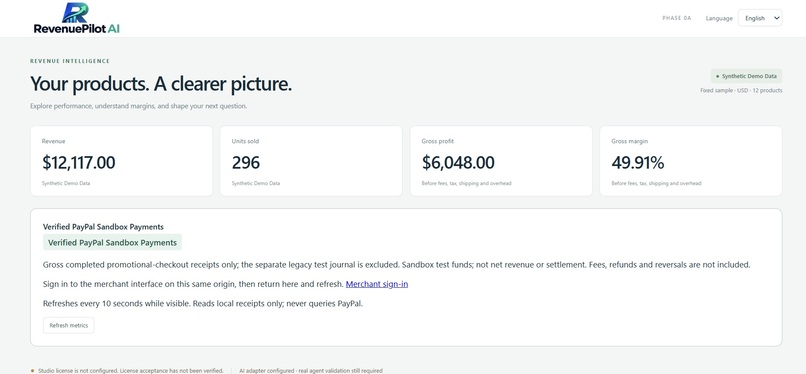
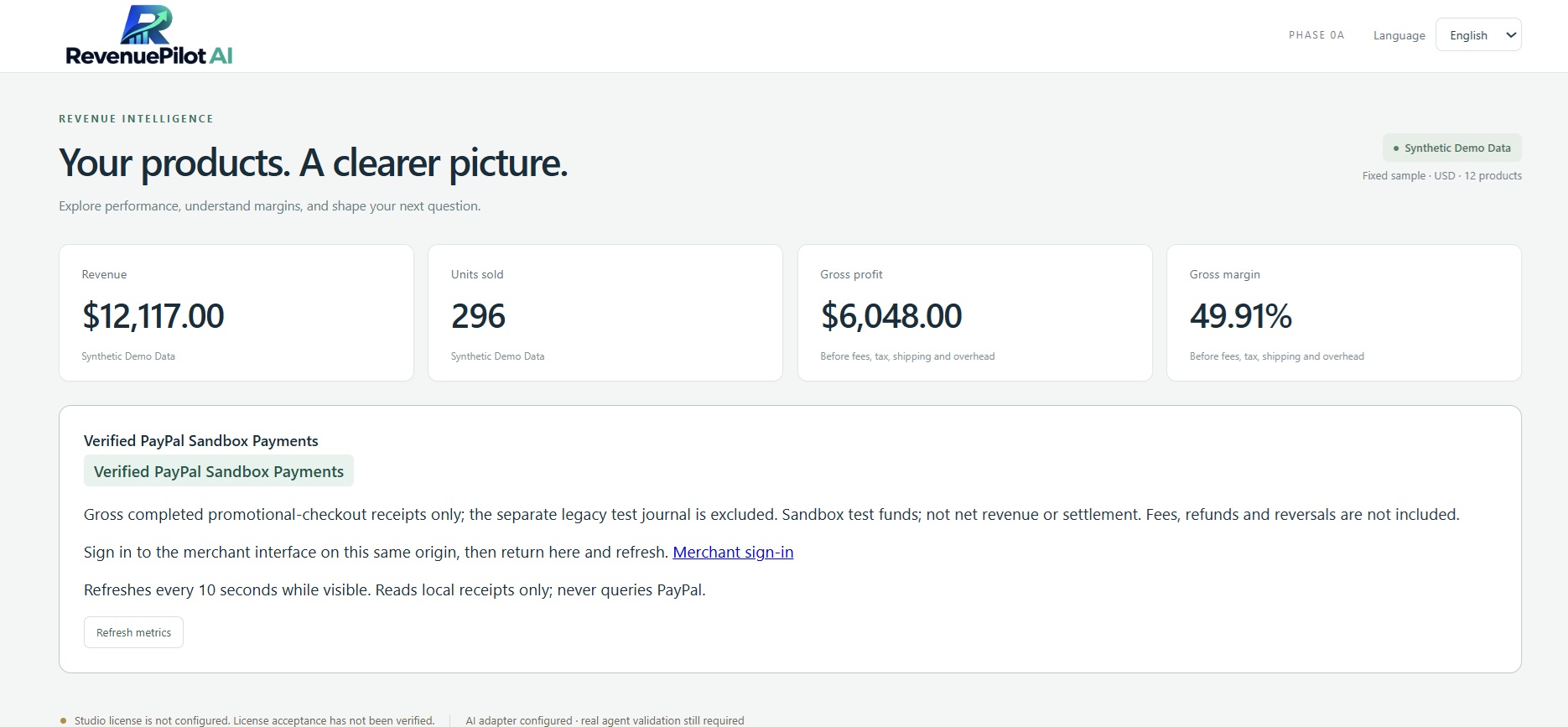
Dashboard principal
-
PayPal Sandbox
-
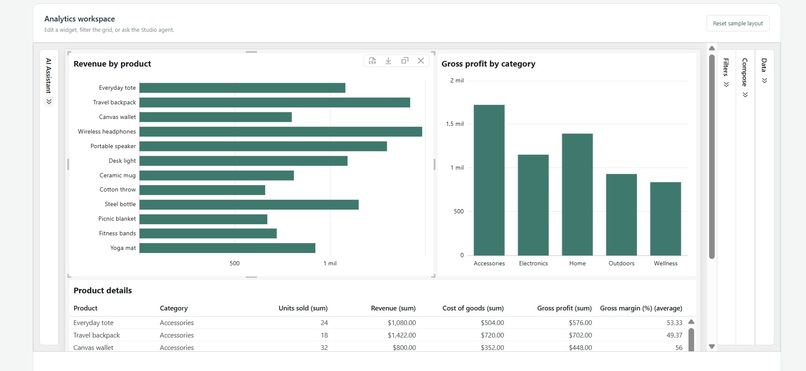
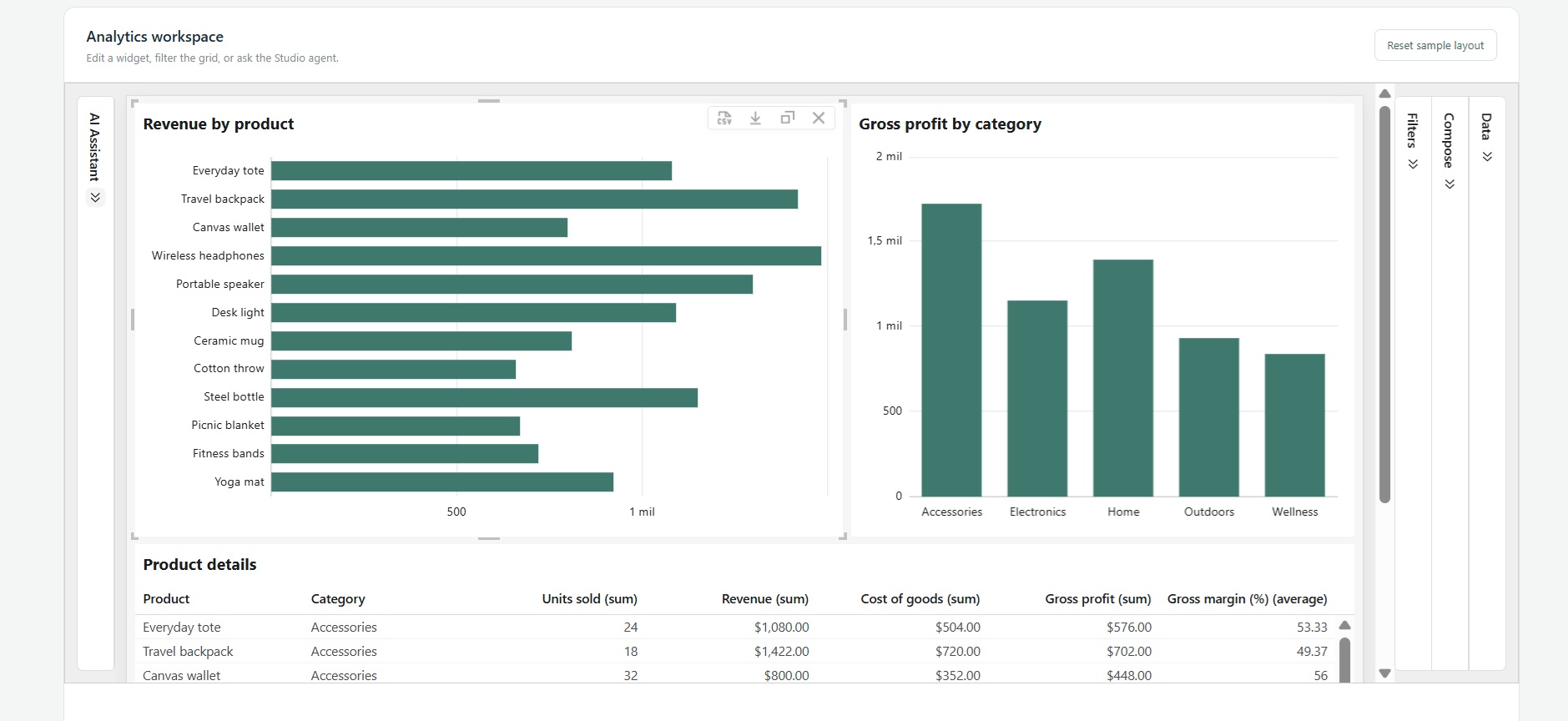
AI Assistant y AG Studio
-
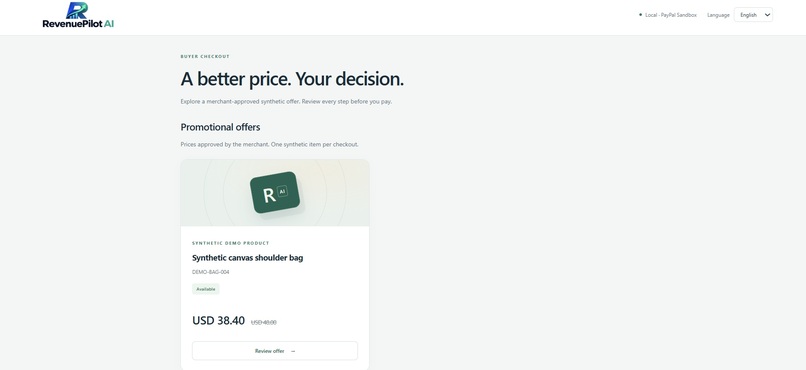
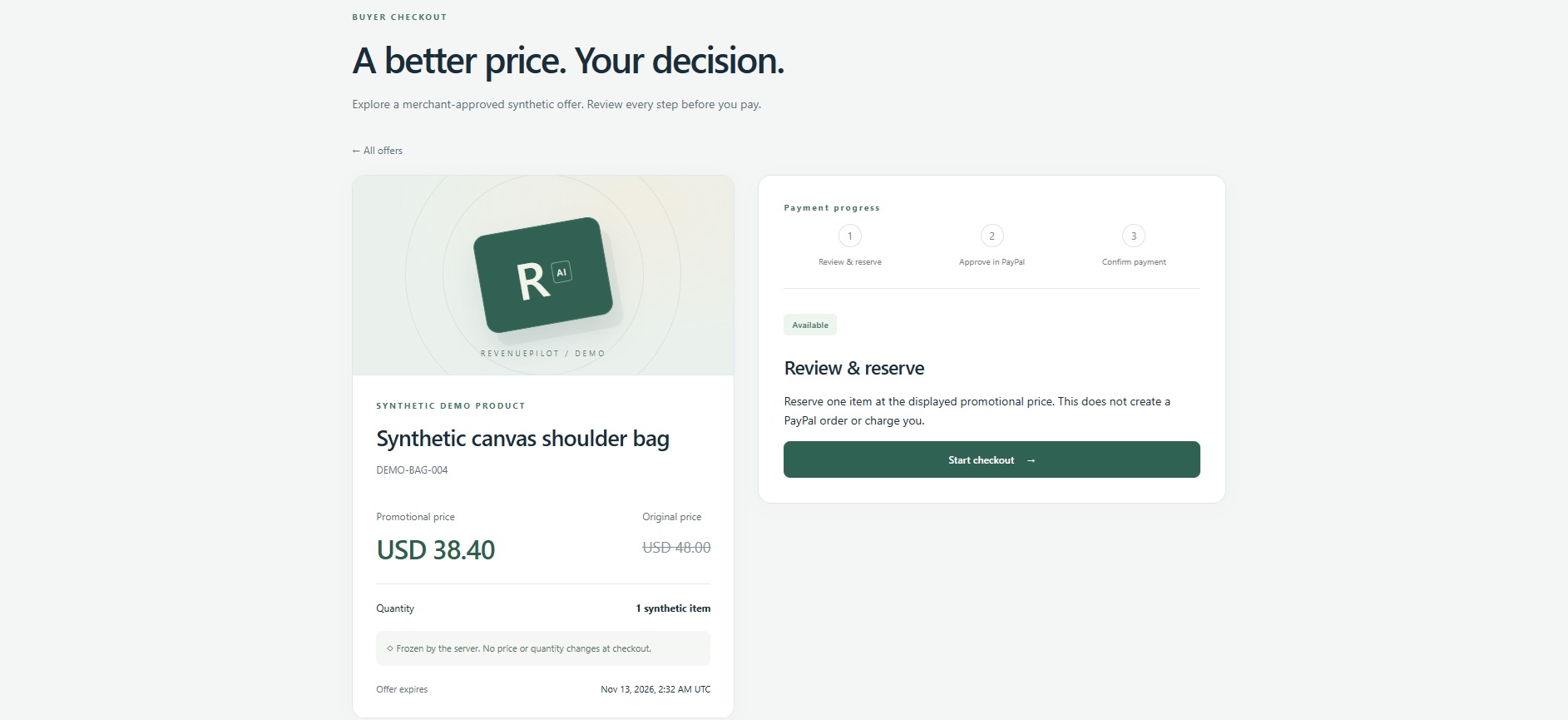
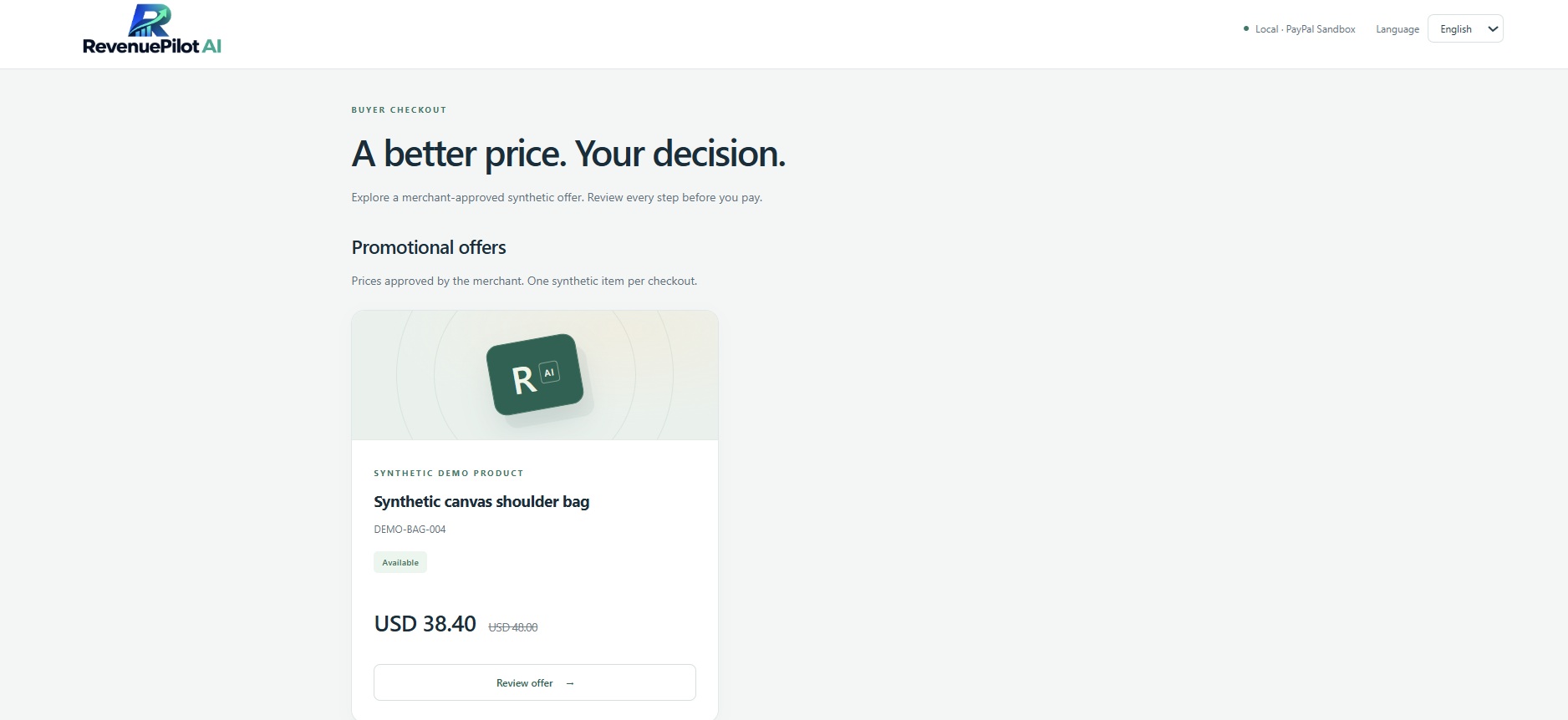
Buyer Checkout
RevenuePilot AI — Turn Data Into Revenue
Inspiration
Small businesses generate valuable sales data every day, but turning that information into better commercial decisions is not always easy.
Merchants often work with disconnected tools for analytics, promotions, inventory, and payments. Understanding which products perform best, identifying opportunities, and implementing promotional offers can require technical knowledge and considerable manual effort.
I created RevenuePilot AI to explore a simpler approach: what if merchants could understand their business through natural-language conversations and connect those insights to controlled commerce workflows?
My vision is to make AI-powered commerce intelligence more accessible while keeping merchants in control of important financial decisions.
What it does
RevenuePilot AI combines conversational analytics, interactive dashboards, merchant-controlled promotions, and PayPal Sandbox checkout workflows.
The current demonstration includes three connected experiences.
1. AI-Powered Commerce Analytics
Merchants can explore a synthetic product dataset through an interactive analytics dashboard.
Using an OpenAI-powered assistant integrated with AG Studio, users can ask questions such as:
- "Which three products have the highest units sold?"
- "Show me the sales performance of my products."
- "Change the revenue chart to display units sold instead."
The assistant can inspect the available data schema, execute structured queries, and update an existing visualization through natural-language instructions.
I successfully validated these capabilities using a real OpenAI model in the application deployed on Oracle Cloud Infrastructure.
2. Merchant-Controlled Promotions
The Merchant Workspace provides an interface for reviewing promotional offers and their financial details.
The approach maintains a clear separation between AI-assisted analysis and merchant authorization.
The demonstration includes an approved synthetic promotional quote, showing how merchant-controlled decisions can be connected to a buyer-facing offer.
3. Buyer Checkout with PayPal Sandbox
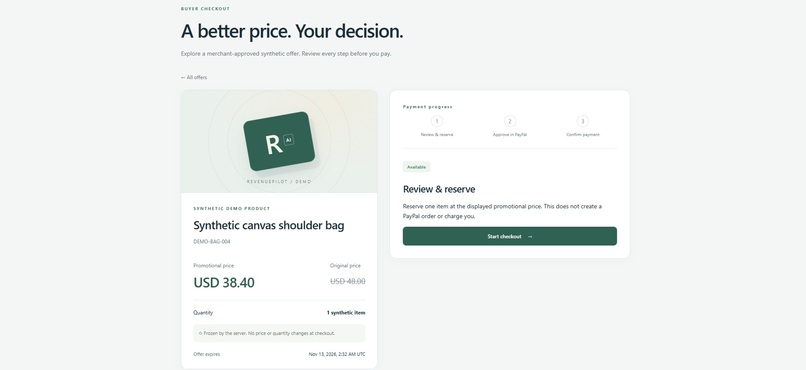
The Buyer Workspace displays merchant-approved promotional offers and provides a checkout workflow integrated with PayPal Sandbox.
The synthetic demonstration product, a canvas shoulder bag, has an original price of USD 48.00 and a promotional price of USD 38.40, representing a 20% discount.
The checkout workflow preserves server-controlled prices and quantities, supporting consistency between the merchant's approved offer and the buyer's experience.
During development, I validated a PayPal Sandbox order approval. However, the demonstration does not claim that a payment capture or real financial settlement has been completed.
How I built it
RevenuePilot AI uses a modular architecture combining modern web technologies, generative AI, structured data, and payment integrations.
Frontend: React, TypeScript, and Vite provide the dashboard and the Merchant and Buyer workspaces.
AI and analytics: OpenAI's Responses API powers the conversational assistant. AG Studio provides interactive visualizations and tools for inspecting schemas, querying data, and modifying charts.
Backend: Python and FastAPI handle the AI adapter, application logic, merchant workflows, and checkout operations.
Data and infrastructure: PostgreSQL supports persistent application data. The application is deployed on Oracle Cloud Infrastructure, with HTTPS access protected through Caddy.
Payments: PayPal Sandbox supports testing checkout and order approval workflows without processing real money.
I designed the architecture to keep API credentials on the server, preserve structured tool results, and separate analytical actions from payment authorization.
The application uses separate backend services for the AI agent, Merchant Workspace, and Buyer Checkout. This modular structure makes it easier to maintain clear responsibilities and deploy updates safely.
Challenges I faced
Integrating an AI agent with real analytics tools
One of my most significant challenges was making the AI assistant execute AG Studio's native tools correctly.
During testing, a query failed with the message "Expected an object." I reproduced the validation problem using AG Studio 3.0.0 and identified the required structured field-reference format.
I also discovered that sorting by a numerical field does not automatically include that field in query results. To produce accurate answers, the agent must explicitly select the requested numerical values.
After improving the agent's query instructions and adding regression tests, I deployed the correction and successfully validated structured queries using OpenAI.
The assistant also demonstrated its ability to modify an existing chart through AG Studio without manually changing the visualization settings.
Maintaining reliable numerical results
I wanted the assistant to use actual query results rather than generate plausible but unsupported numbers.
During validation in the deployed application, the agent correctly identified the three highest-selling synthetic products:
- Ceramic mug: 45 units
- Steel bottle: 36 units
- Canvas wallet: 32 units
The assistant also successfully updated an existing revenue chart to display units sold without replacing the original widget.
This demonstrated the importance of structured tool execution and reliable data handling in conversational analytics.
Connecting AI capabilities with financial safeguards
I needed to distinguish conversational AI capabilities from financial decisions.
The architecture separates analytical recommendations, merchant-controlled approvals, checkout reservations, PayPal order approval, and payment capture.
This separation helps prevent an AI-generated suggestion from automatically becoming an unauthorized financial operation.
The checkout also preserves the merchant-approved price and quantity on the server rather than trusting values supplied by the browser.
Deploying a multi-service application
Deploying the platform on Oracle Cloud Infrastructure required configuring separate services, secure environment variables, HTTPS routing, application access controls, and release management.
I used isolated releases and verification steps to update the deployed application while preserving a previous version for rollback.
The deployment process included automated tests, frontend builds, service health checks, and real-world browser validation.
Accomplishments I'm proud of
As a solo developer, I'm particularly proud of bringing together AI-powered analytics, interactive dashboards, merchant-controlled promotions, and PayPal Sandbox checkout workflows into a working cloud-deployed application.
Key accomplishments include:
- Building and deploying RevenuePilot AI on Oracle Cloud Infrastructure.
- Integrating OpenAI with AG Studio for natural-language analytics and chart modifications.
- Validating real AI tool execution against synthetic product data.
- Creating connected Merchant and Buyer workspaces.
- Implementing PayPal Sandbox checkout and order approval capabilities.
- Adding automated tests covering backend behavior, frontend functionality, and AI tool integration.
- Introducing security boundaries separating AI operations from sensitive payment actions.
- Deploying an updated release after resolving an AG Studio query-tool compatibility issue.
One particularly rewarding moment was seeing the AI assistant successfully identify the highest-selling products and then transform the existing revenue chart into a units-sold visualization through a simple natural-language instruction.
What I learned
This project reinforced an important lesson: reliable AI applications require more than connecting a language model to an interface.
Structured tool contracts, deterministic business rules, validation, secure credentials, and human approval are essential when AI interacts with commercial workflows.
I also learned the value of testing with both simulated providers and real model interactions. Simulated tests helped reproduce technical problems, while live validation demonstrated that the corrected integration could work in the deployed application.
Working independently also strengthened my ability to manage the entire development process, from architecture and backend implementation to frontend integration, testing, cloud deployment, and troubleshooting.
Most importantly, I learned that responsible AI-powered commerce systems should help people make better decisions without removing their control over sensitive business and financial operations.
What's next
My next steps are to expand analytical capabilities, improve the merchant experience, introduce richer promotional decision support, and validate the solution with real small businesses.
I also plan to strengthen end-to-end PayPal Sandbox acceptance testing, improve observability, and explore how AI can support merchants while preserving clear authorization boundaries.
Future improvements may include deeper sales analysis, more advanced promotional recommendations, additional merchant integrations, and more flexible dashboard customization.
My long-term goal is to help small businesses turn their data into informed actions and sustainable revenue growth.
RevenuePilot AI — Turn Data Into Revenue.
Built With
- ag-grid
- ag-studio
- caddy
- fastapi
- openai
- oracle-cloud
- paypal
- postgresql
- python
- react
- typescript
- vite
