-
-
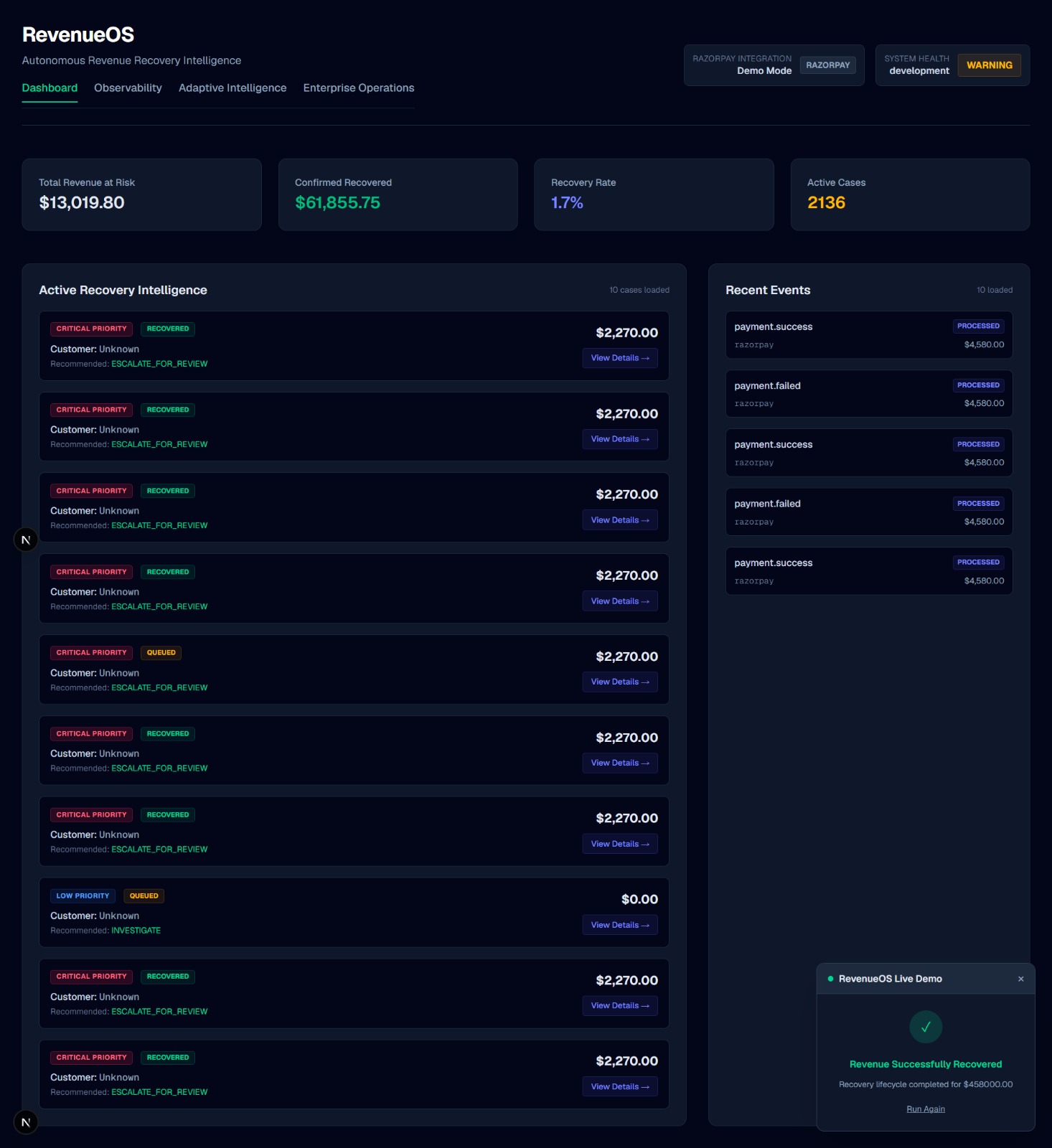
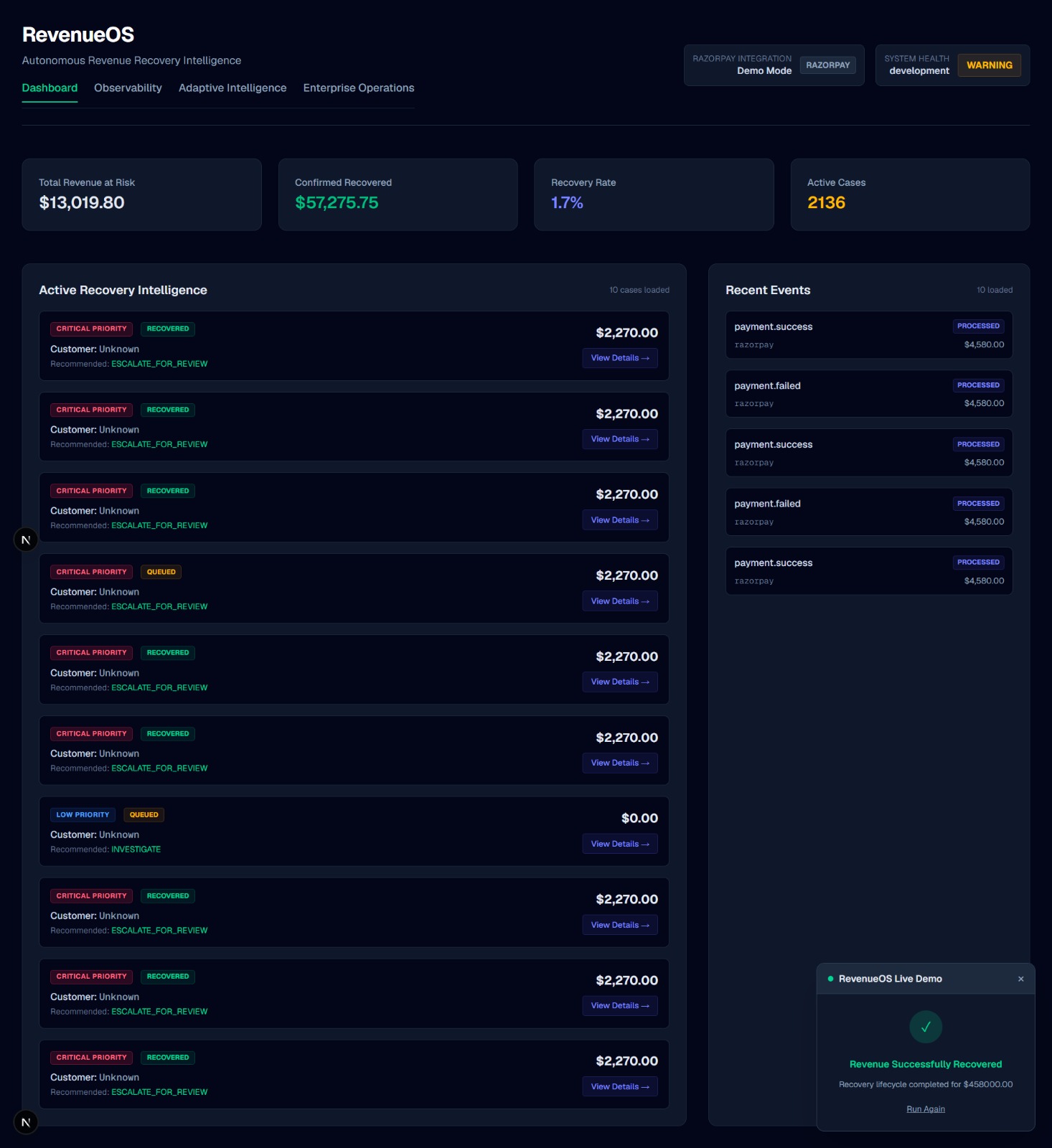
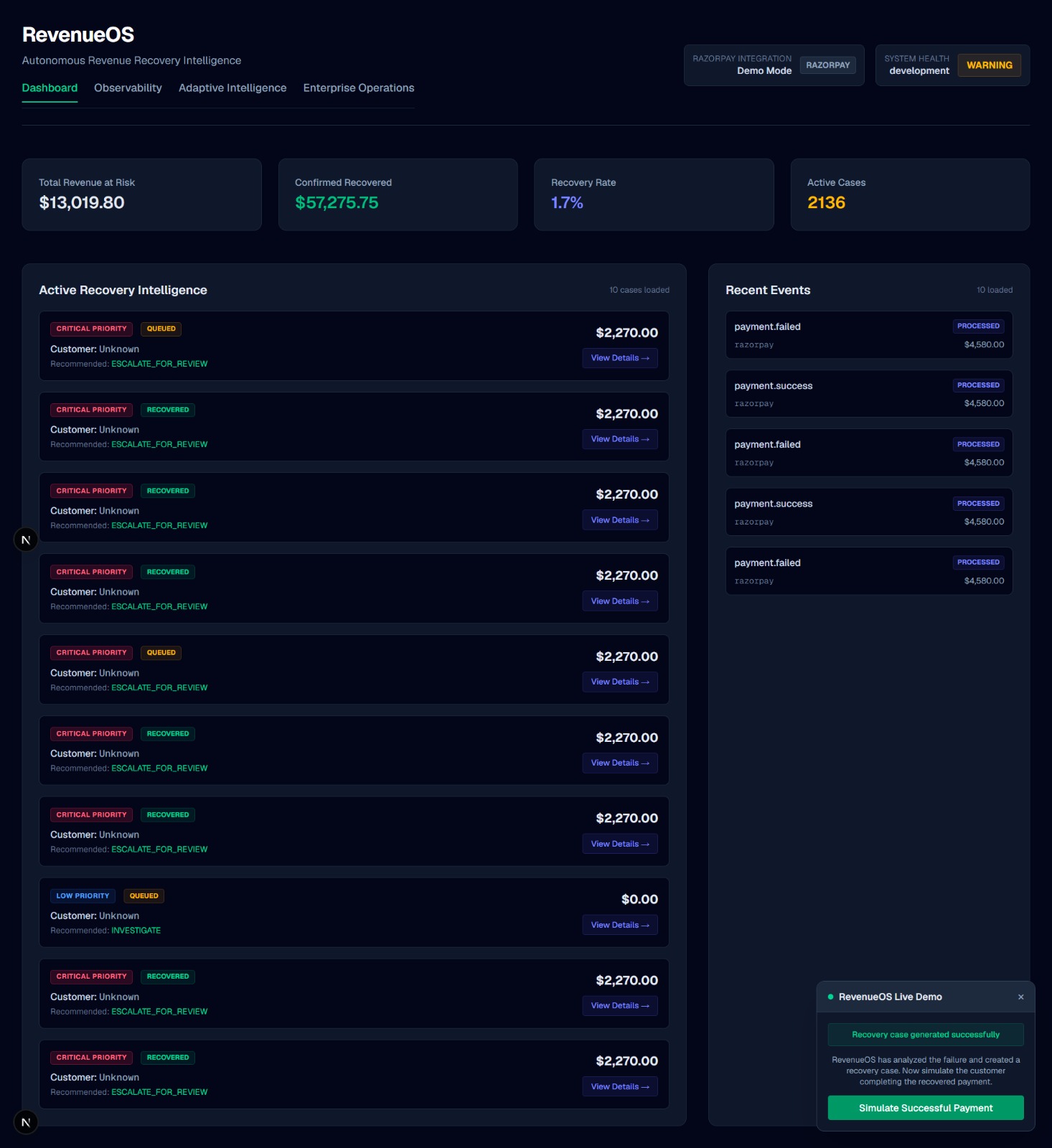
Dashboard
-
Dashboard
-
Dashboard
-
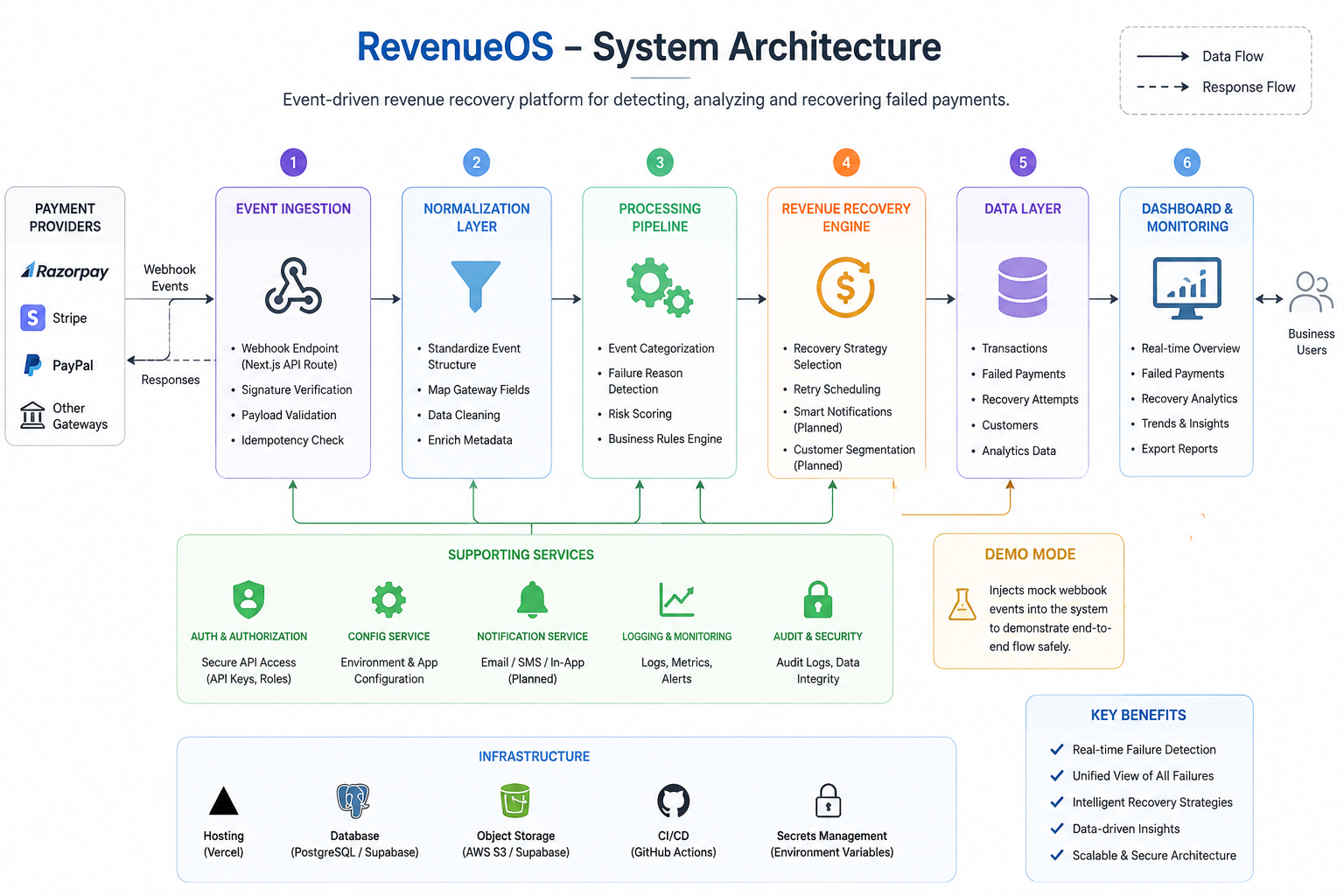
System Architecture
RevenueOS – An Intelligent Revenue Recovery System
Inspiration
Digital businesses often lose revenue not because customers do not want to pay, but because payments fail due to technical issues, expired cards, insufficient funds, network problems, or temporary gateway failures.
Most businesses detect these failures only after revenue has already been lost. We wanted to build a system that treats failed payments as an intelligent recovery problem rather than a simple transaction error.
That idea led to RevenueOS.
What it does
RevenueOS is an event-driven revenue recovery platform designed to help businesses detect, analyze, and respond to failed payment events.
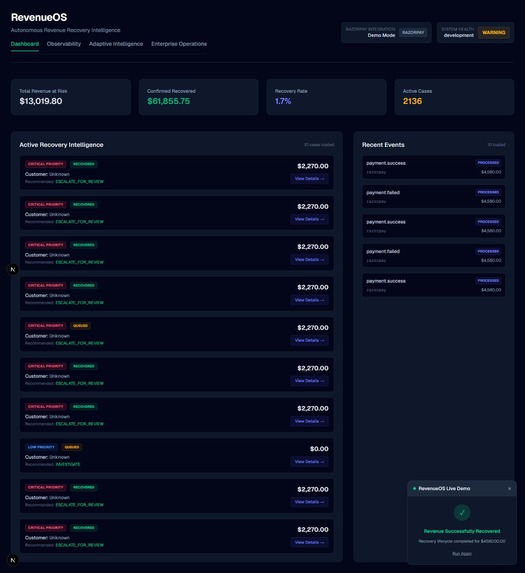
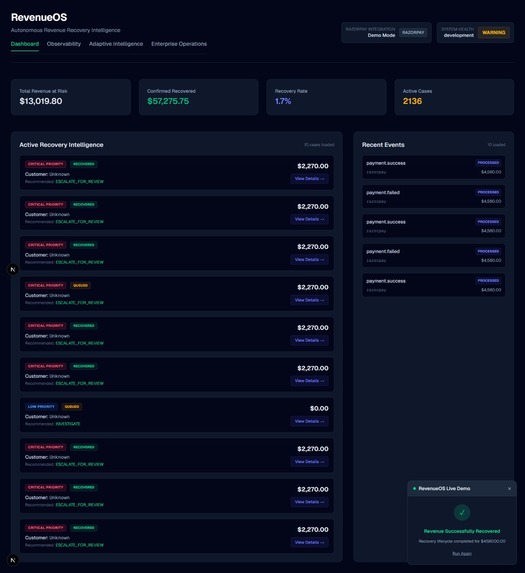
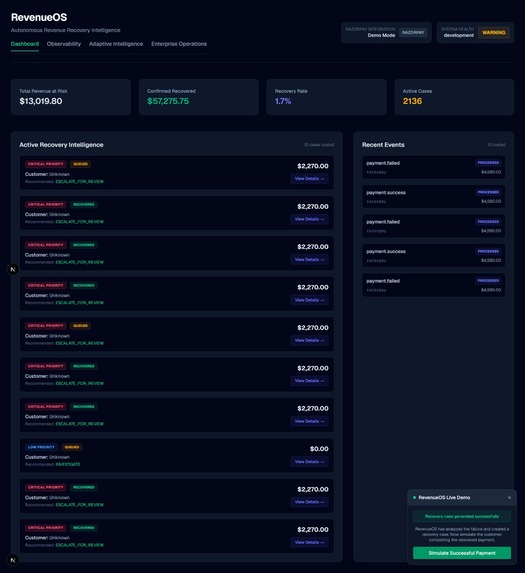
The system receives payment events through webhook-based ingestion, normalizes incoming data, processes the events through a structured backend pipeline, and presents useful information through an interactive dashboard.
Instead of simply storing payment failures, RevenueOS provides a foundation for intelligent revenue recovery workflows.
Key capabilities include:
- Real-time payment event ingestion
- Webhook-based payment processing
- Event normalization and validation
- Failed payment tracking
- Revenue recovery analysis
- Interactive dashboard and monitoring
- Secure backend communication
- Demonstration mode using realistic webhook event flows
How we built it
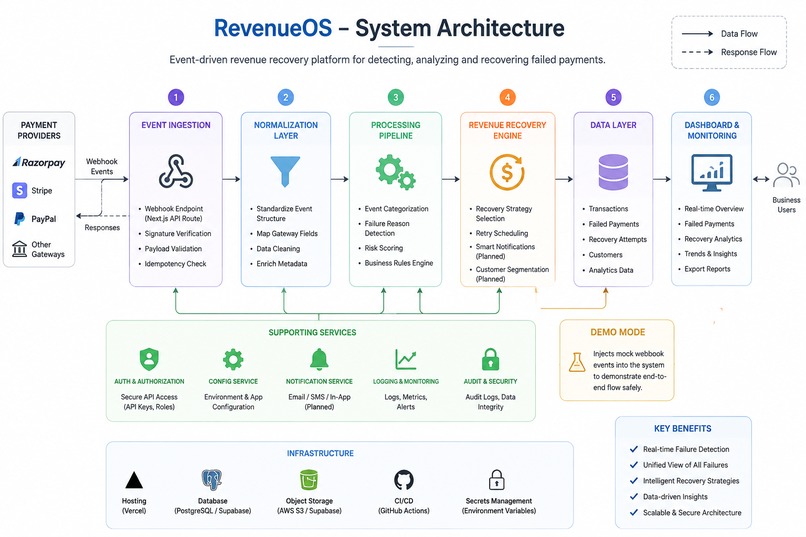
RevenueOS was designed using an event-driven architecture.
Payment events enter the system through a webhook ingestion layer. The incoming payload is validated and normalized before entering the application's processing pipeline.
The architecture separates the major responsibilities of the system:
- Event Ingestion – Payment providers send transaction events through webhooks.
- Normalization Layer – Different event structures are converted into a consistent internal format.
- Processing Pipeline – Events are analyzed and categorized.
- Revenue Recovery Logic – Failed payments can be evaluated for potential recovery actions.
- Data Layer – Important transaction and recovery information is securely managed.
- Dashboard – Users can monitor payment activity and recovery-related insights.
We also implemented a Demo Mode that injects realistic mock webhook payloads into the actual application pipeline. This allows the project to demonstrate the complete flow without exposing sensitive production credentials or fabricating database results.
Challenges we ran into
One of the biggest challenges was designing a system that could demonstrate realistic payment processing while remaining secure.
Handling webhook payloads required careful validation and normalization. Another important challenge was ensuring that API keys and sensitive configuration were never exposed to the frontend or committed to the public repository.
We also focused on making the demo realistic. Instead of creating fake dashboard data, the Demo Mode sends mock events through the same ingestion and processing pipeline used by the application.
This required careful separation between frontend and backend responsibilities.
Accomplishments that we're proud of
We are proud that RevenueOS is more than just a dashboard prototype.
The project demonstrates a complete architectural approach to revenue recovery, including:
- An event-driven processing architecture
- Secure webhook handling
- A structured payment event pipeline
- A functional dashboard
- Realistic end-to-end demonstration flows
- Separation of sensitive backend logic from the frontend
- A scalable foundation for future payment integrations
Most importantly, we focused on building an honest prototype that demonstrates real architectural concepts instead of only creating visually appealing screens.
What we learned
Through building RevenueOS, we learned the importance of event-driven system design, secure API integration, webhook processing, frontend-backend communication, and designing applications for future scalability.
We also learned that financial systems require special attention to security, reliability, and data consistency.
Building the Demo Mode taught us that a strong project demonstration should showcase the actual system architecture whenever possible.
What's next for RevenueOS
RevenueOS currently provides a foundation for intelligent revenue recovery, and there are several directions for future development.
Future improvements could include:
- AI-powered payment failure prediction
- Intelligent retry scheduling
- Customer-specific recovery strategies
- Support for multiple payment providers
- Advanced analytics and forecasting
- Automated recovery workflows
- Notification and communication systems
- Distributed event processing for higher scalability
- Enhanced monitoring and observability
- Enterprise-grade role-based access control
Our long-term vision is to develop RevenueOS into an intelligent operating system for detecting, understanding, and recovering potentially lost revenue.
Built With
- api
- fastapi
- github
- next.js
- node.js
- python
- razorpay
- react
- rest
- typescript
- webhooks


Log in or sign up for Devpost to join the conversation.